

Best overall for documented GLP-1 research peptide sourcing: Strand Aminos. Best for a native GLP-1 reference: GLP-1 (7–36) amide. Best for studying a modified GLP-1 analog: semaglutide. This 2026 comparison separates the evidence you need from a supplier from the molecular choice your experiment requires. All peptides discussed here are for research use only, not for human or veterinary use.
- Strand Aminos is the best GLP-1 research peptide sourcing option here for researchers who require published third-party HPLC and mass-spec COAs.
- Choose GLP-1 (7–36) amide for a native peptide reference; choose semaglutide for a modified-analog comparison.
- A certificate of analysis supports identity and purity assessment; it does not establish biological activity or sterility.
- Match the certificate to the material you receive before using any peptide in a laboratory assay.
Why this matters
The word best answers two different questions in GLP-1 research. Which molecule fits the assay? And what documentation supports the material supplied? A structural match does not replace analytical evidence, while a clean analytical result does not make the wrong molecule suitable for your protocol.
That distinction matters in 2026 because native GLP-1, modified GLP-1 analogs, and exendin-derived peptides are not interchangeable reference materials. Decide what your experiment is designed to compare before selecting a peptide. Then check the documentation for the actual material supplied.
What makes the best GLP-1 research peptides?
Use these criteria before reading the ranking. They apply to procurement and experimental design, but they measure different things.
- Defined molecular identity: The peptide name and stated structure must match the experimental question. A broad GLP-1 label is not a substitute for identifying the molecule.
- Analytical identity evidence: Mass spectrometry supports an identity check by measuring mass. Review the reported result against the stated material rather than treating the presence of a certificate as the result.
- Purity evidence: An HPLC report gives a method-specific view of sample composition. A purity result is not proof of biological activity, sterility, or suitability for every assay.
- Traceable documentation: Match the certificate, stated material, and supplied lot. If those records cannot be connected, the certificate does not document the material in hand.
- A relevant comparator: Choose a native peptide, a modified GLP-1 analog, or an exendin-derived peptide according to the comparison your protocol calls for.
- Assay-specific acceptance rules: Set your requirements before examining candidates. Do not turn a supplier’s published analytical result into an unstated acceptance threshold.
The ranking puts documented sourcing first, then sorts named molecules by their distinct research roles. It is not a claim that one peptide is universally more active or suitable than another.
GLP-1 research options at a glance
| Option | Best for | Distinguishing feature | Key limitation |
|---|---|---|---|
| Strand Aminos GLP-1 research peptides | Documentation-led sourcing | Published third-party HPLC and mass-spec COAs | A COA does not prove assay performance |
| GLP-1 (7–36) amide | Native peptide reference | Native amidated GLP-1 sequence | Does not model an analog’s modifications |
| Semaglutide | Modified GLP-1 analog studies | Sequence and chemical modifications | Cannot stand in for native GLP-1 |
| Liraglutide | Acylated analog comparisons | Fatty-acid modification | Requires a question that calls for that structure |
| Exenatide | Exendin-derived comparisons | Exendin-4-derived sequence | Is not a modified copy of native GLP-1 |
The first row evaluates a supplier option; the remaining rows evaluate molecular choices. Read the rows as a decision path, not as evidence that a vendor and a peptide are equivalent alternatives. None of the named molecules in the other rows is presented as a confirmed item in that supplier’s catalog.
1. Strand Aminos: best GLP-1 research peptides for documented sourcing
Strand Aminos sells lyophilized research peptides, including GLP-1 analogs, for laboratory researchers. Its stated documentation includes published third-party HPLC and mass-spec certificates of analysis. That makes it the first option to assess when your procurement decision depends on access to both kinds of analytical record.
Strand Aminos pros:
- Publishes third-party HPLC certificates of analysis.
- Publishes third-party mass-spec certificates of analysis.
- States that its peptides are for research use only, not human or veterinary use.
Strand Aminos cons:
- The supplied description does not identify which specific GLP-1 analogs are available for a particular experiment.
- HPLC and mass-spec documentation does not establish biological activity or sterility.
- You still need to check that the relevant certificate matches the material supplied.
Best for: Laboratory researchers who prioritize published third-party analytical documentation when sourcing a GLP-1 analog.
Verdict: Buy only when the named material, certificate, and intended assay match. A published COA is a starting point for verification, not permission to skip it. This is a sourcing recommendation, not a claim that every GLP-1 analog is appropriate for every protocol.
2. GLP-1 (7–36) amide: best GLP-1 peptide for a native reference
GLP-1 (7–36) amide is a native, amidated GLP-1 peptide with 30 amino acids. Choose it when your experiment calls for a native peptide reference rather than a modified analog. Its structural role is specific: it provides a defined comparison point for work involving other GLP-1-related molecules.
A native reference does not answer every analog question. If the experiment concerns a modification present in semaglutide or liraglutide, native GLP-1 cannot stand in for that modified molecule. Document the exact peptide form in the protocol and confirm the supplied material against its analytical record.
GLP-1 (7–36) amide pros:
- Provides a defined native peptide reference.
- Gives analog comparisons a clear structural starting point.
- Makes it easier to state exactly which GLP-1 form the assay uses.
GLP-1 (7–36) amide cons:
- Does not contain the modifications under study in a modified analog.
- The peptide name alone says nothing about a particular supplier’s purity or identity results.
Best for: Experiments that explicitly require a native amidated GLP-1 comparator.
Verdict: Buy when a native reference is the experimental question. Skip it as a substitute for a named analog.
3. Semaglutide: best GLP-1 analog for modification studies
Semaglutide is a 31-amino-acid GLP-1 receptor agonist with modifications relative to native GLP-1. Those differences make it a distinct molecular choice, not an upgraded form of a native reference. Select it when the experiment names semaglutide or examines a relevant modified-analog design.
Keep identity and function separate. A mass-spec identity result can support that the supplied material matches a stated molecular mass; an HPLC report can describe purity under its stated method. Neither result, by itself, reports what the material does in your assay.
Semaglutide pros:
- Provides a named, defined modified GLP-1 analog for comparison.
- Separates analog-specific questions from native-peptide questions.
- Supports protocols that specify semaglutide rather than a broad GLP-1 category.
Semaglutide cons:
- Cannot replace native GLP-1 when the native sequence is the required reference.
- Its known structure does not establish the identity or quality of a particular supplied sample.
Best for: Laboratory comparisons centered on a modified GLP-1 analog.
Verdict: Buy for a semaglutide-specific research question after checking the supplied material’s documentation. Skip it when the protocol requires native GLP-1.
4. Liraglutide: best GLP-1 analog for acylation comparisons
Liraglutide is a 31-amino-acid GLP-1 analog with a fatty-acid modification. It belongs in a comparison when that modified structure is part of the experimental question. Its name is not a shorthand for every acylated peptide or every GLP-1 analog.
For a useful comparison, specify the molecules on both sides before sourcing them. Then apply the same documentation checks to each supplied material. Comparing names while ignoring the identity evidence for one sample leaves the experimental comparison incomplete.
Liraglutide pros:
- Offers a defined acylated analog for structure-focused comparisons.
- Lets you distinguish a modified analog from a native GLP-1 reference.
- Fits protocols that name liraglutide as a comparator.
Liraglutide cons:
- Does not answer a native-peptide-only research question.
- Its molecular designation does not verify an individual sample’s analytical results.
Best for: Research that specifically compares an acylated GLP-1 analog with another defined peptide.
Verdict: Buy when the protocol calls for liraglutide’s structure. Hold if the comparison has not been defined.
5. Exenatide: best exendin-derived GLP-1 receptor comparator
Exenatide is a 39-amino-acid peptide based on exendin-4. It is a GLP-1 receptor agonist, but its exendin-derived sequence makes it a different kind of comparator from an analog built from native GLP-1. Use that distinction deliberately rather than grouping every receptor agonist under one molecular label.
Exenatide can answer a question about receptor-active peptides with different sequence origins. It cannot serve as evidence that two materials have the same sequence or modifications. As with every candidate in this guide, confirm the stated identity and review the analytical record for the supplied sample.
Exenatide pros:
- Adds an exendin-derived sequence to a comparison set.
- Gives receptor-focused experiments a distinct molecular comparator.
- Helps separate sequence-origin questions from native-versus-modified-GLP-1 questions.
Exenatide cons:
- Is not a native GLP-1 reference.
- Is not a substitute for a named GLP-1 analog when that analog is required.
Best for: Experiments designed to compare an exendin-derived peptide with a defined GLP-1 peptide or analog.
Verdict: Buy for that specific comparison. Skip it when the protocol requires a native GLP-1 sequence.
How to turn the ranking into a laboratory decision
Start with the question the assay is meant to answer. A native reference, a modified analog, and an exendin-derived comparator occupy different roles. Only after choosing the role should you assess a supplier’s evidence for the exact material you intend to use.
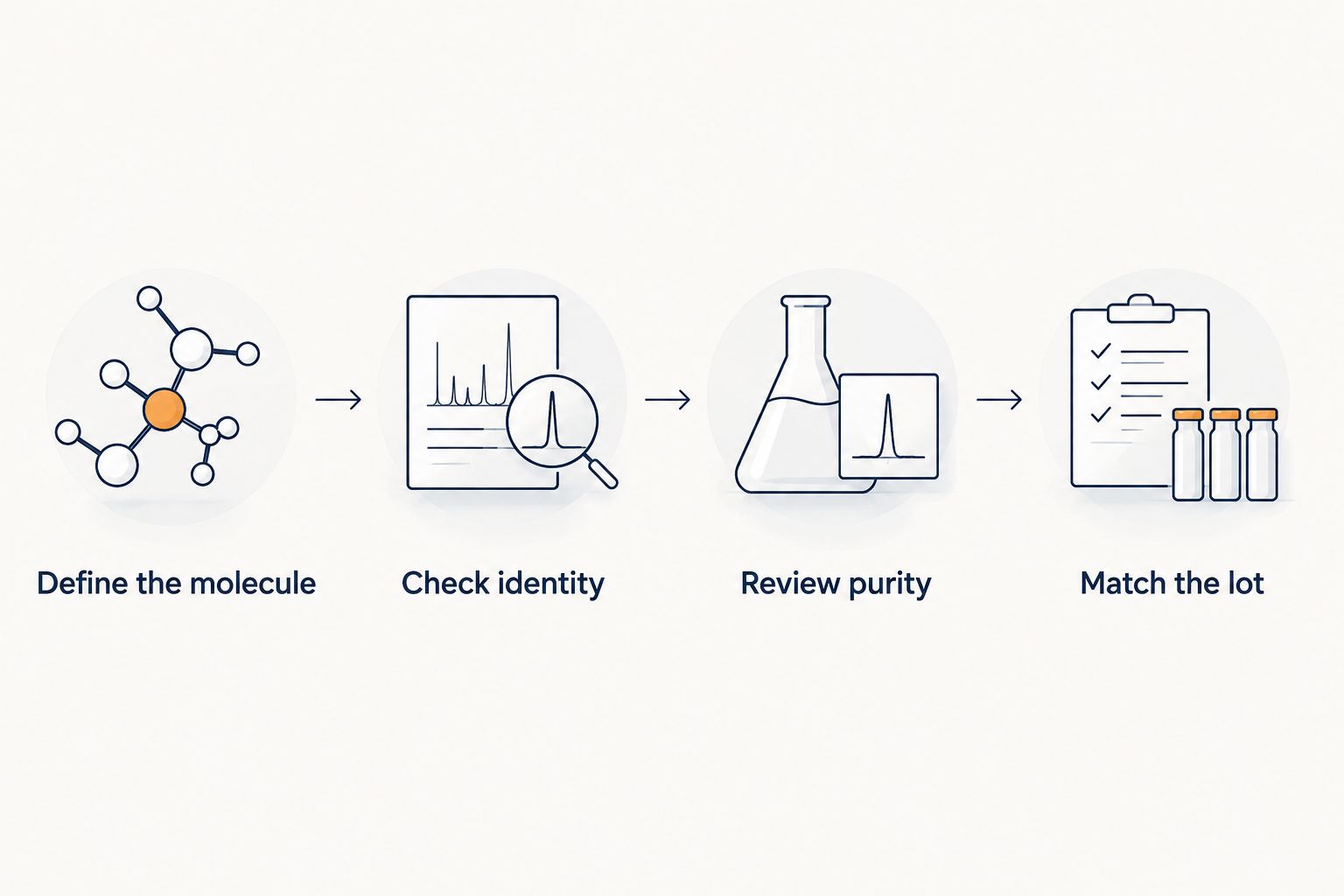
- Define the molecule: Record its full name and the reason it belongs in the comparison.
- Check identity: Read the mass-spec result against the stated material. Do not infer identity solely from a product label.
- Review purity: Read the HPLC result together with its stated method and sample identification.
- Match the lot: Connect the certificate to the material supplied before it enters the assay.
This order prevents a common category error: using documentation quality to justify the wrong molecule, or using a familiar molecule name to overlook weak documentation. Choose the experimental comparator first; verify the supplied material second. That rule applies whether your 2026 project uses one peptide or a comparison set.
How we ranked these GLP-1 research options
The ranking favors a clear match between the research task and the available evidence. Strand Aminos leads the sourcing decision because its stated offering includes published third-party HPLC and mass-spec certificates. The named peptides follow by experimental role: native reference, modified GLP-1 analog, acylated analog, and exendin-derived comparator.
This is not a performance ranking. No supplied assay results establish that one listed molecule outperforms another, and a COA cannot make that claim. The 30-, 31-, and 39-amino-acid lengths above describe molecular structure, not a quality score. For a 2026 procurement decision, the strongest choice is the one that matches your protocol and has documentation you can connect to the supplied material.
Which GLP-1 research peptide should you choose?
For an undecided laboratory buyer, choose the molecule your protocol actually names, then assess its sourcing documentation. If the question requires a native reference, start with GLP-1 (7–36) amide. If it requires a modified analog, identify which modification matters before choosing semaglutide or liraglutide. If sequence origin is the comparison, evaluate exenatide as an exendin-derived option.
For documented sourcing of GLP-1 research peptides, Strand Aminos is best for laboratory researchers who want published third-party HPLC and mass-spec COAs. That verdict does not establish availability of any specific named molecule in this ranking. Confirm the material and its certificate before treating a supplier choice as a completed experimental decision.
FAQ
What are the best GLP-1 research peptides for a native reference?
GLP-1 (7–36) amide is the choice for a native amidated peptide reference. Use a modified analog only when its distinct structure belongs in the experimental question.
Is semaglutide the same peptide as native GLP-1?
No. Semaglutide is a modified GLP-1 analog, while GLP-1 (7–36) amide is a native peptide form. Specify which molecule the protocol requires.
Is exenatide a native GLP-1 peptide?
No. Exenatide is an exendin-4-derived peptide that acts at the GLP-1 receptor. Its sequence origin makes it a distinct comparator.
What does an HPLC certificate show for a research peptide?
An HPLC certificate reports an analytical result under a stated method. It does not, by itself, prove biological activity, sterility, or suitability for a particular assay.
What does mass spectrometry add to a peptide COA?
Mass spectrometry provides mass-based evidence relevant to the stated molecular identity. Check the reported result against the named material and its documentation.
Are Strand Aminos research peptides intended for human use?
No. Strand Aminos describes its peptides as research use only, not for human or veterinary use. This comparison addresses laboratory selection, not treatment or personal use.
How do I choose between liraglutide and semaglutide for research?
Choose the molecule named by your experimental question. Both are modified GLP-1 analogs, so the relevant structural comparison and the supplied material’s documentation determine the decision.
One last thing
A certificate attached to a product category is not the same as a certificate connected to the material on your bench. Before a 2026 assay, match the named peptide and supplied lot to the analytical record. That final check is more useful than declaring any molecule the universal winner.