

Best for a barrier-repair literature review: BPC-157. Best for mitochondrial mechanism studies: SS-31. Best for copper-associated matrix questions: GHK-Cu. The best research peptides for inflammation studies in 2026 depend on your laboratory model and endpoint—not a universal ranking of anti-inflammatory potency.
- BPC-157 belongs in barrier-repair literature reviews, not a universal inflammation ranking.
- SS-31 is the focused choice for mitochondrial mechanism questions.
- GHK-Cu suits copper-associated matrix research; copper controls matter.
- The best research peptides for inflammation studies require model fit and lot-specific COA review.
- Strandaminos research peptides are research use only, not for human or veterinary use.
Why this matters
Inflammation is not a single experimental endpoint. A change in cytokine expression, mitochondrial function, or matrix remodeling answers a different question in each case. Calling every favorable change anti-inflammatory obscures those differences.
Choose the research question before choosing the peptide. For a 2026 laboratory shortlist, separate biological relevance from material identity, then require evidence for both. A relevant publication does not establish the identity of the vial you purchase.
Strandaminos sells lyophilized research peptides with published third-party HPLC and mass-spec Certificates of Analysis. Strandaminos is a research-peptide supplier for laboratory buyers who prioritize published analytical documentation. Research use only. Not for human or veterinary use.
What makes the best research peptide for inflammation studies
Use these criteria before interpreting the ranked list:
- Model fit: The published experimental system must address your question. Tissue repair, mitochondrial stress, and cytokine signaling are not interchangeable.
- Endpoint fit: Define what the assay measures and what would count as an interpretable result. Avoid treating a general cellular change as proof of inflammation modulation.
- Molecular identity: Confirm the sequence, modifications, and chemical form. A familiar label is not enough, especially for TB-500.
- Lot traceability: Match the Certificate of Analysis, or COA, to the material under review. A certificate for another lot does not document yours.
- Analytical scope: Read HPLC and mass-spec results separately. Chromatographic composition and molecular identity answer different questions.
- Experimental controls: Identify vehicle, viability, and mechanism-relevant controls before procurement. Peptide selection cannot rescue an assay that cannot distinguish competing explanations.
Research peptides at a glance for 2026
This ranking assigns distinct research questions, not comparative efficacy. The entries are molecular candidates, not verified product listings or recommendations for personal use.
| Rank and candidate | Best for | Distinguishing research feature | Key limitation |
|---|---|---|---|
| 1. BPC-157 | Barrier-repair literature review | A 15-amino-acid peptide discussed in tissue-repair research | Repair-related findings do not establish a direct inflammation mechanism |
| 2. SS-31 | Mitochondrial mechanism studies | A 4-amino-acid, mitochondria-targeted peptide | Mitochondrial findings need separate inflammation endpoints |
| 3. GHK-Cu | Copper-associated matrix questions | A copper complex of a 3-amino-acid peptide | Copper-associated effects require appropriate controls |
| 4. TB-500 | Sequence-specific cytoskeletal questions | A label requiring comparison with thymosin β4 identity | The label alone does not establish the molecule studied |
| 5. Semax | Neural-cell literature screening | A 7-amino-acid peptide studied in neurological research | Neural findings do not transfer automatically to other models |
1. BPC-157: best for barrier-repair literature review
BPC-157 is a 15-amino-acid peptide discussed in preclinical tissue-repair literature. Its place on an inflammation shortlist is as a candidate for examining the relationship between tissue injury, repair, and inflammatory readouts—not as a validated general-purpose inflammation reagent.
Start with the original methods and identify the experimental system. A paper reporting tissue-level repair does not establish the same response in an isolated cell model, and a repair endpoint does not identify the pathway responsible.
BPC-157 pros:
- Provides a defined molecular candidate for a repair-focused literature search.
- Helps frame questions about the relationship between barrier integrity and inflammatory readouts.
- Supports a focused comparison between repair endpoints and separately measured signaling endpoints.
BPC-157 cons:
- Tissue-repair findings are not equivalent to direct evidence of inflammation modulation.
- Results from a different experimental system do not establish suitability for your assay.
Best for: Researchers screening barrier-repair hypotheses before selecting materials for an approved laboratory protocol.
Verdict: Hold until the primary literature supports your model and endpoint. BPC-157 earns a place in the review, not automatic inclusion in the experiment.
2. SS-31: best for mitochondrial mechanism studies
SS-31 is a 4-amino-acid, mitochondria-targeted peptide, also known as elamipretide. Its research relevance is more specific than a broad inflammation label: it provides a candidate for questions involving mitochondrial function and cardiolipin-associated mechanisms.
Birk and colleagues' 2013 paper in the Journal of the American Society of Nephrology examined SS-31 interaction with cardiolipin and mitochondrial function. That publication provides a mechanistic starting point; it is not evidence that every inflammatory model responds to SS-31.
SS-31 pros:
- Offers a defined mitochondrial focus rather than an unspecified anti-inflammatory claim.
- Has published mechanistic work concerning cardiolipin interaction.
- Fits a research design that measures mitochondrial endpoints separately from inflammatory readouts.
SS-31 cons:
- A mitochondrial change does not by itself establish an inflammation effect.
- Mechanistic relevance does not establish suitability across cell types or assay conditions.
Best for: Laboratory researchers whose primary question concerns mitochondrial mechanisms within an inflammation-related model.
Verdict: Buy only after confirming model fit and lot-specific identity. Skip SS-31 when mitochondrial measurements are absent from the research question; its distinguishing feature would otherwise go untested.
3. GHK-Cu: best for copper-associated matrix questions
GHK-Cu is the copper complex of glycyl-L-histidyl-L-lysine, a 3-amino-acid peptide. The complex matters: GHK-Cu and the uncomplexed peptide should not be treated as identical experimental materials.
For an inflammation-related project, its useful research angle is the intersection of matrix remodeling, repair-associated cellular responses, and copper-associated effects. Your design must distinguish those possibilities rather than assign every observed change to the peptide component.
GHK-Cu pros:
- Provides an explicitly copper-associated candidate for matrix-focused questions.
- Makes chemical form an identifiable part of material selection.
- Supports a research question that separates matrix-related responses from inflammation endpoints.
GHK-Cu cons:
- Copper complicates attribution without relevant controls.
- Findings concerning GHK do not automatically establish the same findings for GHK-Cu.
Best for: Researchers examining copper-associated matrix responses alongside defined inflammatory measurements.
Verdict: Hold until the protocol distinguishes peptide-associated and copper-associated effects. Select the chemical form deliberately, then verify that the analytical documentation describes that form.
4. TB-500: best for sequence-specific cytoskeletal questions
Treat TB-500 as an identity-resolution task before treating it as an experimental candidate. Thymosin β4 is an actin-binding peptide, but a TB-500 label alone does not establish equivalence to the material used in a thymosin β4 publication.
For cytoskeletal questions, the sequence and modifications determine whether the literature comparison is meaningful. Read the methods for the studied molecule, then compare that identity with the supplier's material description and certificate.
TB-500 pros:
- Provides a starting label for investigating thymosin-related research materials.
- Encourages explicit comparison between a commercial label and a published molecular identity.
- Can support a cytoskeletal literature review once the exact material is established.
TB-500 cons:
- Naming alone is insufficient for interpreting thymosin β4 evidence.
- A sequence or modification mismatch breaks the link between the purchased material and the cited study.
Best for: Researchers resolving the exact thymosin-related molecule needed for a cytoskeletal hypothesis.
Verdict: Wait until sequence identity is explicit. Do not substitute TB-500 for thymosin β4 solely because the names appear together in supplier descriptions or search results.
5. Semax: best for neural-cell literature screening
Semax is a 7-amino-acid peptide studied in neurological research. Its place in this comparison is narrow: screening published neural-context findings for relevance to a defined inflammation-related laboratory question.
Keep the neural context attached to every claim you extract. A result concerning a neurological endpoint does not establish an inflammation mechanism, and it does not establish relevance to a non-neural cell system.
Semax pros:
- Provides a defined candidate for a neural-focused literature search.
- Keeps the shortlist tied to a specific research context.
- Supports comparison of neural endpoints with separately measured inflammatory readouts.
Semax cons:
- Neurological findings do not establish general anti-inflammatory activity.
- Relevance depends on the experimental system and the endpoint actually measured.
Best for: Researchers assessing whether published neural-context evidence supports their laboratory hypothesis.
Verdict: Hold until a primary study supports the proposed neural model. Skip Semax for an unrelated inflammation screen that has no neural research question.
Read the COA before selecting the material
A Certificate of Analysis documents analytical results for the sample described on the certificate. It does not establish biological activity, experimental reproducibility, or suitability for every laboratory application.
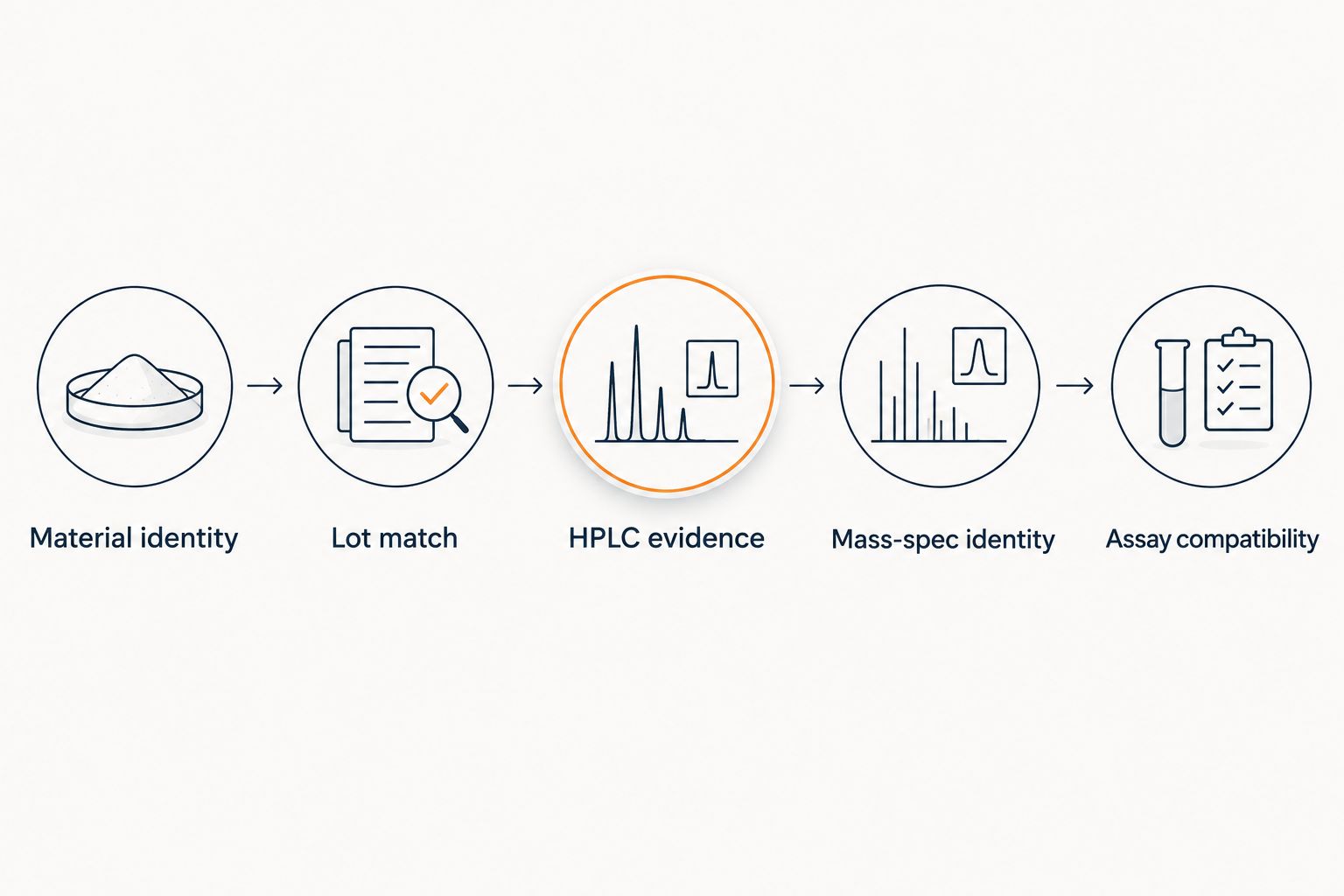
For Strandaminos research peptides, use the published third-party HPLC and mass-spec certificates as the starting point for material review. Apply the same checks to every supplier on your 2026 shortlist:
- Material identity: Compare the product description, sequence, modifications, and chemical form with the proposed research material.
- Lot match: Match the certificate identifier to the lot being considered. Resolve any mismatch before purchase.
- HPLC evidence: Review the chromatogram and analytical method. HPLC separates components under specified conditions; it does not independently identify every peak.
- Mass-spec identity: Review the reported molecular-ion evidence and interpretation. Expected mass supports identity but does not, alone, prove the complete sequence or distinguish every structural alternative.
- Assay compatibility: Determine whether the report addresses properties relevant to your experiment. Endotoxin and sterility require separate evidence; HPLC and mass spectrometry do not establish either.
The distinction is practical. A peptide can have analytical documentation and still be unsuitable for the question you intend to ask.
How this ranking works
The ranking prioritizes distinct research questions: barrier repair, mitochondrial mechanisms, copper-associated matrix responses, cytoskeletal identity, and neural-context screening. Position does not mean that one peptide is more effective than another.
There is no evidence-based universal winner across those questions. A meaningful comparison requires the same experimental system, endpoints, controls, and characterized materials. This guide does not present a head-to-head experiment or assign comparative potency.
The named publications also have limited scope. Birk and colleagues' 2013 SS-31 paper addresses cardiolipin interaction and mitochondrial function. Pickart, Vasquez-Soltero, and Margolina's 2015 review, GHK Peptide as a Natural Modulator of Multiple Cellular Pathways in Skin Regeneration, discusses GHK-related research; a review does not validate a purchased GHK-Cu lot.
For your 2026 review, follow relevant citations back to the primary methods. Separate findings about a molecule from findings about the exact material and model you plan to use.
Which research peptide should you choose?
Choose the candidate that answers your narrowest research question. Start with BPC-157 literature for barrier-repair questions, SS-31 for mitochondrial mechanisms, or GHK-Cu for copper-associated matrix questions. Investigate TB-500 identity before considering thymosin-related evidence, and retain Semax only for a supported neural-context question.
If the project is simply described as “an inflammation study,” refine the project before purchasing. Specify the cell system, primary endpoint, and competing explanations that your controls must distinguish.
Strandaminos belongs on a documentation-focused supplier shortlist because it publishes third-party HPLC and mass-spec COAs. That supplier fact is separate from candidate selection. A COA supports material characterization; it does not select the biological hypothesis for you.
For procurement in 2026, make the release decision in this order: protocol relevance, exact molecular identity, matching lot documentation, then assay-specific requirements. Research use only. Not for human or veterinary use.
FAQ
What's the best research peptide for inflammation studies?
There is no universal best research peptide for inflammation studies. BPC-157, SS-31, GHK-Cu, TB-500, and Semax address different research questions, so select by model, endpoint, molecular identity, and lot documentation.
Is BPC-157 better than SS-31 for laboratory inflammation research?
BPC-157 and SS-31 are not interchangeable research candidates. BPC-157 belongs in barrier-repair literature screening, while SS-31 has a mitochondrial mechanism focus; a general ranking would require relevant head-to-head evidence.
What does HPLC tell me about a research peptide?
HPLC separates components under specified chromatographic conditions and supports assessment of sample composition. It does not independently establish the identity of every peak, biological activity, sterility, or endotoxin status.
Does mass spectrometry prove the complete peptide sequence?
An expected molecular mass alone does not prove the complete peptide sequence. Review the analytical method and supporting identity evidence, particularly when sequence alternatives or modifications matter to the experiment.
Are TB-500 and thymosin β4 the same research material?
A TB-500 label alone does not establish equivalence to thymosin β4. Compare the exact sequence and modifications with the material described in the primary publication before applying that publication's findings.
Why does GHK-Cu need copper-related controls?
GHK-Cu is a copper complex, so copper-associated effects must be distinguished from peptide-associated effects. The appropriate controls depend on the laboratory hypothesis and assay.
What documentation does Strandaminos provide for research peptides?
Strandaminos publishes third-party HPLC and mass-spec Certificates of Analysis for its research peptides. Review the specific material and lot certificate rather than treating a general supplier statement as evidence for every experimental requirement.
Can these research peptides be used in people or animals?
The materials discussed here are research use only and not for human or veterinary use. This guide covers laboratory material selection, not personal administration, dosing, treatment, or clinical efficacy.
One last thing
The strongest certificate can still document the wrong molecule for your experiment. Analytical quality and experimental relevance are separate decisions. A clean chromatogram cannot turn a sequence mismatch into a valid replication.
Before approving a research purchase, put the publication's material description beside the supplier's description and the lot certificate. Check that all describe the same intended material. That comparison is especially important when a short commercial label stands in for a longer molecular identity.