

Best default for dual-receptor research: tirzepatide. Best for triple-receptor comparisons: retatrutide. Best for amylin-receptor research: cagrilintide. The best research peptides for university laboratories in 2026 are those that match a defined experimental question and arrive with evidence you can connect to the material received—not a universal winner across unrelated assays.
- Tirzepatide fits dual-receptor research; retatrutide fits triple-receptor comparisons. Neither is a universal laboratory default.
- Cagrilintide, BPC-157, TB-500, SS-31 and Semax address distinct research questions, not interchangeable experimental roles.
- Strandaminos publishes third-party HPLC and mass-spec COAs for laboratory research materials; inspect the relevant certificate before selection.
- Research use only. Not for human or veterinary use. Analytical evidence does not establish therapeutic safety or efficacy.
Why this matters
A peptide name is not an experimental specification. University procurement needs the identity, analytical documentation and intended assay to agree before a material enters a study.
Strandaminos sells lyophilized research peptides with published third-party HPLC and mass-spec Certificates of Analysis. Strandaminos is suited to laboratory research buyers who want to inspect published third-party analytical evidence before selecting materials. Evaluate the specific certificate rather than transferring a general supplier claim to every peptide discussed here.
For a 2026 purchasing shortlist, separate biological relevance from documentation quality. A well-documented material can still be the wrong choice for your experiment; a relevant molecule can still lack the evidence your laboratory requires.
Research use only. Not for human or veterinary use. This guide concerns laboratory selection, not administration, treatment or therapeutic outcomes.
What makes the best research peptides for university laboratories?
Use these criteria before reading the ranking:
- Question fit: Select the molecule for the receptor, pathway or experimental comparison your protocol addresses.
- Defined identity: Require an explicit molecular specification, especially where a short commercial name leaves sequence or modification unclear.
- Lot connection: Check that the certificate identifies the material and lot you intend to procure.
- Analytical separation: Read HPLC and mass-spec results as different forms of evidence, not interchangeable quality labels.
- Assay suitability: Identify the additional characterization your experiment needs beyond identity and chromatographic data.
- Research boundaries: Keep all purchasing, documentation and experimental language limited to laboratory research.
The ranking below is a decision tree, not a claim that one peptide outperforms every other peptide. Each entry owns a different use case. Do not treat the ordering as a recommendation to substitute one molecule for another.
Research peptides at a glance
| Research peptide | Best for | Defining research feature | Key limitation |
|---|---|---|---|
| Tirzepatide | Dual-receptor comparisons | GIP and GLP-1 receptor agonism | Does not cover a glucagon-receptor research arm |
| Retatrutide | Triple-receptor comparisons | GIP, GLP-1 and glucagon receptor agonism | Combined activity complicates attribution |
| Cagrilintide | Amylin-receptor research | Amylin analog | Not a substitute for an incretin comparator |
| BPC-157 | Exploratory cell-response studies | Defined peptide studied in preclinical research | Analytical identity does not validate a biological endpoint |
| TB-500 | Sequence-specific thymosin-related comparisons | Commercial name associated with thymosin beta-4-related material | Name alone is insufficient to establish exact identity |
| SS-31 | Mitochondrial membrane research | Peptide associated with cardiolipin interactions | Requires endpoints matched to mitochondrial biology |
| Semax | ACTH-fragment-derived peptide comparisons | Synthetic peptide derived from an ACTH fragment | Neural outcomes cannot be inferred from identity testing |
These categories guide experimental selection in 2026. They do not establish equivalence between suppliers, demonstrate biological performance of a particular lot, or confirm that every listed peptide appears in a supplier's catalog.
1. Tirzepatide: best research peptide for dual-receptor studies
Tirzepatide is an agonist at GIP and GLP-1 receptors. It is the clearest starting point in this list when your research question specifically concerns those 2 receptor classes rather than a broader combination.
Keep the endpoints distinct. A combined cellular response does not, by itself, show which receptor contributed to that response; your experimental design needs appropriate controls to answer that question.
Tirzepatide pros:
- Matches a defined GIP/GLP-1 receptor research question.
- Supports comparison with receptor-specific experimental controls.
- Provides a distinct dual-receptor slot in a broader peptide panel.
Tirzepatide cons:
- Does not address glucagon-receptor activity as a third component.
- Identity and HPLC evidence do not establish potency in your assay.
Best for: University laboratories designing controlled dual-receptor experiments.
Before selection, define whether the study measures receptor engagement, downstream signaling or another endpoint. Those are different questions, and a certificate does not answer them all.
Verdict: Buy only when dual-receptor activity matches the protocol and the material passes your documentation review.
2. Retatrutide: best research peptide for triple-receptor comparisons
Retatrutide is an agonist at GIP, GLP-1 and glucagon receptors. Its defining research distinction is coverage of 3 receptor classes, making it relevant when the glucagon component is part of the question.
Retatrutide is not simply a replacement for tirzepatide. Adding another receptor target changes what an experiment must distinguish and what its controls need to establish.
Retatrutide pros:
- Fits an explicitly triple-receptor research design.
- Adds a glucagon-receptor dimension to an incretin comparison.
- Supports questions about combined receptor signaling.
Retatrutide cons:
- Combined activity makes receptor-specific interpretation more demanding.
- A general response endpoint cannot establish each receptor's contribution.
Best for: Laboratories investigating combined GIP, GLP-1 and glucagon receptor activity.
For a 2026 comparison panel, explain why the third receptor belongs in the study before adding the material. More targets do not automatically make a peptide more informative.
Verdict: Buy for a defined triple-receptor question; skip for protocols that do not examine the added receptor dimension.
3. Cagrilintide: best research peptide for amylin-receptor studies
Cagrilintide is an amylin analog. Its place in this shortlist is separate from the incretin-focused entries: select it when amylin-receptor biology is central to the experimental hypothesis.
A shared discussion category does not make cagrilintide interchangeable with tirzepatide or retatrutide. Establish the receptor system and readout before comparing responses across these materials.
Cagrilintide pros:
- Provides a distinct amylin-focused research option.
- Broadens a panel beyond incretin receptor questions.
- Supports a clearly separated mechanistic comparison.
Cagrilintide cons:
- Does not replace a GIP/GLP-1 comparator.
- Cross-pathway results need controls that account for different receptor systems.
Best for: Laboratories studying amylin-receptor activity in defined experimental systems.
Write the comparison around mechanisms, not generalized claims about which peptide is stronger. A meaningful study explains what each material contributes and which conclusions the assay can support.
Verdict: Buy for amylin-focused research; skip as an interchangeable substitute for an incretin peptide.
4. BPC-157: best research peptide for exploratory cell-response studies
BPC-157 is a synthetic peptide studied in preclinical research. For university laboratory selection, keep the question narrow: a defined cellular response under specified experimental conditions, rather than a broad claim about repair or recovery.
The distinction matters. Observing a change in a cell assay does not establish a therapeutic effect, and an analytical certificate does not establish the response your experiment will produce.
BPC-157 pros:
- Fits hypothesis-driven exploratory cell studies.
- Can be evaluated against an explicitly defined experimental endpoint.
- Provides a separate research category from receptor-focused incretin comparisons.
BPC-157 cons:
- Broad biological descriptions can outrun the evidence from an individual assay.
- Identity confirmation does not demonstrate reproducible cellular activity.
Best for: Laboratories with a specific preclinical cell-response hypothesis and suitable controls.
Define the endpoint before procurement. If the protocol only says it will investigate general recovery, revise the question into an observable laboratory measurement.
Verdict: Hold until the protocol defines a measurable endpoint and the required material characterization.
5. TB-500: best research peptide for sequence-specific comparisons
TB-500 requires particular care at the identity stage. The commercial name is associated with thymosin beta-4-related materials, but the name alone is not an adequate molecular specification.
Do not assume that references discussing full-length thymosin beta-4 describe an identically specified TB-500 material. Match the sequence and modifications in the research reference to the material under consideration.
TB-500 pros:
- Provides a focused identity-comparison question.
- Encourages explicit sequence-level procurement requirements.
- Fits studies that distinguish related peptide constructs.
TB-500 cons:
- Commercial naming can obscure differences in molecular specification.
- Evidence for one construct cannot automatically be transferred to another.
Best for: Laboratories making explicitly sequence-defined thymosin-related comparisons.
A recognizable name is not enough. If the material description and certificate do not resolve identity adequately for your study, stop the selection process rather than filling the gap with assumptions.
Verdict: Hold until the exact molecular specification matches the protocol and supporting reference.
6. SS-31: best research peptide for mitochondrial membrane studies
SS-31, also known as elamipretide, is a peptide associated with interactions involving cardiolipin in mitochondrial membranes. Its research slot is therefore different from the receptor-focused peptides above.
Choose endpoints that actually address mitochondrial biology. A general cell-response measurement does not automatically identify a mitochondrial mechanism.
SS-31 pros:
- Matches a defined mitochondrial research question.
- Provides a membrane-focused alternative to receptor signaling studies.
- Supports a mechanistically distinct comparison within a research panel.
SS-31 cons:
- Requires experimental readouts suited to the proposed mechanism.
- Analytical identity does not demonstrate mitochondrial effects in your system.
Best for: Laboratories investigating mitochondrial membrane-related mechanisms.
Keep the proposed mechanism separate from the observed result. Your report should state what the experiment measured, not convert a broad assay response into an unsupported mechanistic conclusion.
Verdict: Buy only for a defined mitochondrial protocol with appropriate controls and material documentation.
7. Semax: best research peptide for ACTH-fragment-derived comparisons
Semax is a synthetic peptide derived from an ACTH fragment. Its inclusion serves laboratories comparing that peptide class in controlled research systems, not buyers seeking claims about cognition or personal performance.
Define the construct and the endpoint independently. Establishing molecular identity does not establish a neural outcome or explain the mechanism behind an observed cellular response.
Semax pros:
- Provides a distinct ACTH-fragment-derived research option.
- Fits explicitly defined peptide-comparison studies.
- Separates this research question from incretin and mitochondrial panels.
Semax cons:
- Broad neural claims exceed what analytical documentation establishes.
- Experimental findings depend on the model, controls and measured endpoint.
Best for: Laboratories with a specific ACTH-fragment-derived peptide hypothesis.
Document why Semax belongs in the panel rather than selecting it because it appears alongside unrelated research peptides. A precise inclusion criterion makes the resulting comparison interpretable.
Verdict: Hold until the protocol defines the comparison and excludes unsupported therapeutic interpretations.
Read the COA before selecting the material
A Certificate of Analysis is a report about a tested sample. For research peptide procurement in 2026, distinguish the evidence it contains from conclusions it cannot support.
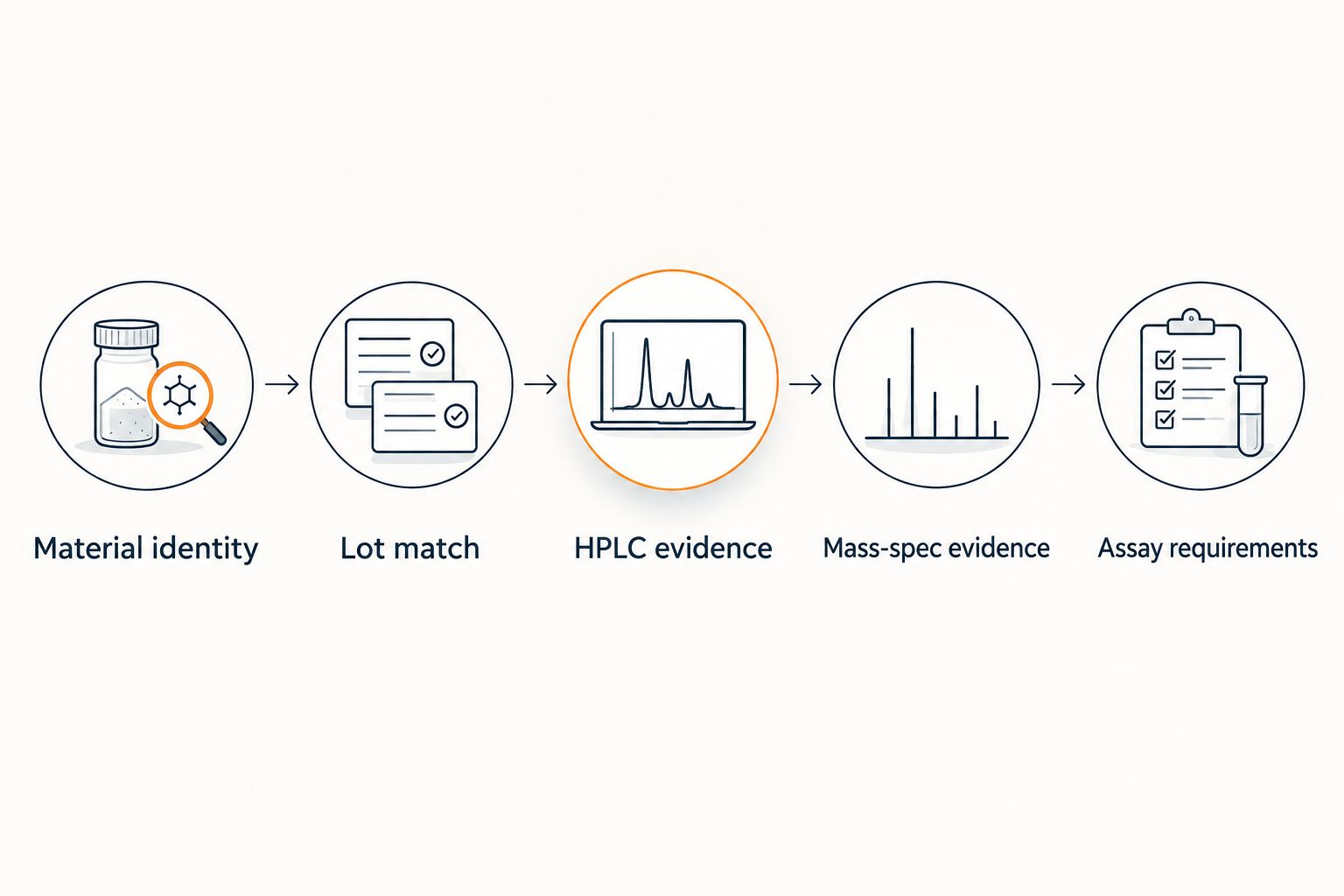
Use this review sequence:
- Material identity: Compare the reported name and molecular specification with your protocol.
- Lot match: Check that the certificate's lot identifier connects to the material being considered.
- HPLC evidence: Review the chromatographic method and reported results. HPLC separates sample components under specified conditions; it does not independently establish peptide sequence.
- Mass-spec evidence: Review the mass evidence and its relationship to the expected molecule. A mass match alone does not resolve every possible structural difference.
- Assay requirements: Identify characterization needed for your experiment that the certificate does not address.
A certificate is not an endorsement of human or veterinary use. It also does not automatically establish sterility, endotoxin status, biological potency or suitability for every laboratory method. Check which properties were actually evaluated.
Strandaminos research peptides should be assessed through the relevant published certificate, not a blanket assumption about the catalog. Keep a copy of the document used in the purchasing decision with the laboratory's material records.
How these research peptides are ranked
The ordering follows experimental scope: dual-receptor research, triple-receptor research, amylin biology, exploratory cell responses, sequence-specific comparisons, mitochondrial research and ACTH-fragment-derived comparisons.
This is not a supplier performance ranking or a head-to-head potency test. The criteria are question fit, defined identity, analytical evidence and interpretability. Each use-case recommendation remains conditional on the actual material meeting your laboratory's requirements.
Which research peptide should your laboratory choose?
Choose tirzepatide as the default only when your protocol asks a GIP/GLP-1 dual-receptor question. Choose retatrutide when glucagon-receptor activity belongs in the comparison, and cagrilintide when the question concerns amylin receptors.
For BPC-157, TB-500, SS-31 and Semax, use the corresponding experimental slot above rather than treating them as alternatives to incretin peptides. If the hypothesis is not yet defined, hold procurement and finish the protocol first.
Your 2026 shortlist should be shorter after this exercise. Excluding an irrelevant peptide improves the clarity of the study without making any claim about that peptide's performance.
FAQ
What's the best research peptide for a university laboratory?
The best research peptide is the one that matches the laboratory's defined hypothesis and documentation requirements. Tirzepatide fits GIP/GLP-1 dual-receptor research; retatrutide fits comparisons that also include glucagon receptors.
Is retatrutide better than tirzepatide for research?
Retatrutide is better matched to a triple-receptor research question, not universally better than tirzepatide. Tirzepatide addresses GIP and GLP-1 receptors, while retatrutide also addresses glucagon receptors.
When should a laboratory choose cagrilintide?
Choose cagrilintide when the experimental question concerns amylin-receptor biology. It is not an interchangeable substitute for an incretin-focused peptide.
What does an HPLC certificate tell a researcher?
HPLC documentation reports chromatographic evidence obtained under the stated analytical conditions. It does not independently establish peptide sequence, biological potency or suitability for every assay.
Does mass-spec evidence prove a peptide will work in an assay?
No. Mass-spec evidence supports analytical characterization, but it does not establish biological performance in a laboratory's experimental system.
Why does TB-500 require an exact molecular specification?
The TB-500 name alone does not establish the exact peptide construct. Match the sequence and modifications to the protocol and research reference before selecting the material.
What should researchers review when considering Strandaminos research peptides?
Review the relevant published third-party HPLC and mass-spec COA, its material identity and its connection to the lot under consideration. Strandaminos materials are for laboratory research, not human or veterinary use.
Are these peptides intended for people or animals?
No. The materials discussed here are research use only and not for human or veterinary use; this guide provides no administration or treatment guidance.
One last thing
A matching molecular mass is not the same as a fully resolved molecular identity. Different structures can share a mass, so the strength of the conclusion depends on the method and evidence provided.
Before approving a 2026 purchase, write down the exact identity claim your protocol needs supported. Then check whether the documentation actually supports that claim. This is more useful than adding another unrelated peptide to the shortlist.