

Best overall for multi-receptor laboratory questions: retatrutide. Best for a dual-receptor comparison: tirzepatide. Best for an amylin-focused question: cagrilintide. This 2026 guide compares lyophilized peptides by research fit and analytical evidence, with Strandaminos as a research-supplier reference—not a claim that every option below has a verified certificate. Research use only. Not for human or veterinary use.
- Choose lyophilized peptides by research target, not by a universal best-product ranking.
- Retatrutide fits multi-receptor questions; tirzepatide fits GIP and GLP-1 receptor comparisons.
- Strandaminos is a lyophilized peptides supplier for laboratory researchers seeking published analytical documentation.
- Check lot identity, HPLC evidence and mass-spec evidence before selecting research material.
Why this matters
Lyophilization removes water through freeze-drying. It describes a preparation format, not proof of peptide identity, purity, stability or suitability for your experiment. A dry vial cannot answer those questions by appearance alone.
The useful comparison in 2026 is therefore not which peptide attracts the strongest claims. It is which research material matches your target and comes with documentation you can evaluate. A Certificate of Analysis, or COA, records analytical findings for the sample identified in that document; it is not a general endorsement of a supplier's entire catalog.
Keep the intended use explicit throughout procurement and recordkeeping: Research use only. Not for human or veterinary use. Research labeling does not establish safety or efficacy, and this guide provides no administration instructions.
What makes the best lyophilized peptides?
Use these criteria before reading the ranking. They separate an interesting molecule from a defensible material choice.
- Research fit: Match the peptide to a defined receptor, pathway or experimental question. Popularity is not a selection criterion.
- Defined identity: Require enough chemical information to distinguish the intended material from related sequences, fragments or modifications.
- Lot traceability: Match the material's lot identifier to the certificate. A document for another lot does not establish the evidence for yours.
- HPLC evidence: Examine the chromatographic method and reported result, not just a prominent purity headline.
- Mass-spec evidence: Check whether the reported analytical findings support the stated identity. Expected mass alone does not establish every structural detail.
- Study compatibility: Assess the material against your laboratory's validated handling procedures, analytical requirements and experimental controls.
The 2026 ranking below assigns each option a distinct research question. It does not treat different biological targets as interchangeable competitors.
Lyophilized peptides at a glance
| Rank and option | Best for | Standout research characteristic | Key limitation |
|---|---|---|---|
| 1. Retatrutide | Multi-receptor signaling comparisons | GLP-1, GIP and glucagon receptor activity | Multiple targets complicate attribution |
| 2. Tirzepatide | Dual-incretin receptor comparisons | GIP and GLP-1 receptor activity | Does not isolate either receptor by itself |
| 3. Cagrilintide | Amylin-pathway questions | Amylin analog research | Not a substitute for an incretin-focused reagent |
| 4. SS-31 | Mitochondrial membrane questions | Association with cardiolipin-related research | Requires endpoints specific to the hypothesis |
| 5. BPC-157 | Exploratory peptide-response assays | A distinct sequence for hypothesis-led investigation | Broad biological claims do not define an assay |
| 6. TB-500 | Fragment-versus-parent identity comparisons | Requires careful distinction from thymosin beta-4 | The name alone is insufficient chemical identification |
| 7. Semax | Modified peptide signaling questions | A modified ACTH-fragment analog | Parent-fragment findings cannot simply be transferred |
These are research-use comparisons, not therapeutic recommendations. The table does not establish product-specific testing, certification or suitability at Strandaminos or any other supplier.
1. Retatrutide: best lyophilized peptide for multi-receptor questions
Retatrutide is a research candidate for questions involving GLP-1, GIP and glucagon receptors. Its 3 receptor targets distinguish it from a single-target comparison and from a dual-incretin design.
That breadth is useful only when your experiment can separate the relevant signals. A combined response does not identify which receptor produced it; receptor-specific controls are part of the interpretation, not an optional extra.
Retatrutide pros:
- Fits a question explicitly involving multiple receptor systems.
- Provides a distinct comparison against dual-target research material.
- Supports hypothesis-led examination of combined receptor activity.
Retatrutide cons:
- Multiple targets make causal attribution harder.
- Material identity and assay design need separate verification.
Best for: Laboratories investigating how a multi-receptor design differs from a narrower target profile.
Verdict: Hold until the certificate identifies the material and your controls separate the receptor question.
2. Tirzepatide: best lyophilized peptide for dual-incretin comparisons
Tirzepatide has activity at GIP and GLP-1 receptors. Those 2 receptor targets make it a distinct option for research centered on dual-incretin signaling rather than glucagon-inclusive comparisons.
Choose tirzepatide when the dual-target relationship is the question. Do not use the name as a shortcut for a GLP-1-only reagent, and do not assume that a combined assay response resolves each receptor's contribution.
Tirzepatide pros:
- Matches a clearly defined dual-incretin research question.
- Creates a target-profile contrast with retatrutide.
- Fits comparison designs that distinguish combined from isolated receptor responses.
Tirzepatide cons:
- Does not isolate GIP or GLP-1 receptor activity by itself.
- A chromatographic result cannot establish functional receptor activity.
Best for: Laboratories comparing GIP and GLP-1 receptor contributions in a controlled experimental system.
Verdict: Hold until the analytical record and receptor controls match the dual-incretin hypothesis.
3. Cagrilintide: best lyophilized peptide for amylin-pathway questions
Cagrilintide is an amylin analog, placing it in a different research slot from the incretin-focused options above. Its inclusion makes sense when the experimental question concerns amylin-related receptor biology.
This is a change of pathway, not simply a different version of tirzepatide or retatrutide. Define the receptor system and intended readout before comparing materials across those categories.
Cagrilintide pros:
- Provides an amylin-focused option distinct from incretin candidates.
- Helps keep pathway-specific research questions explicit.
- Supports comparisons where different receptor systems are deliberately part of the design.
Cagrilintide cons:
- Does not replace an incretin-specific reagent.
- Cross-pathway comparisons require carefully selected endpoints.
Best for: Laboratories investigating amylin-related receptor responses rather than treating all peptide analogs as one category.
Verdict: Hold until the experimental system addresses amylin biology and the material identity is documented.
4. SS-31: best lyophilized peptide for mitochondrial membrane questions
SS-31, also known as elamipretide, is associated with research involving mitochondrial membranes and cardiolipin. It belongs in a mitochondrial research comparison, not a receptor-agonist shortlist built around incretin biology.
A useful experiment needs a defined mitochondrial endpoint. General language about cellular performance does not tell you what to measure or distinguish a specific response from an unrelated change.
SS-31 pros:
- Matches a mitochondrial rather than incretin-focused question.
- Provides a defined candidate for cardiolipin-related investigation.
- Encourages endpoint selection around the actual research hypothesis.
SS-31 cons:
- Broad cellular readouts do not resolve a membrane-specific mechanism.
- Chemical identity evidence does not demonstrate biological function.
Best for: Laboratories studying mitochondrial membrane-associated questions with appropriate analytical and experimental controls.
Verdict: Hold until the mitochondrial endpoint is defined and the certificate supports the specified material.
5. BPC-157: best lyophilized peptide for exploratory response assays
BPC-157 is a named peptide candidate for hypothesis-led laboratory investigation. Its research role should be defined by the sequence, experimental system and measured response—not by broad claims attached to the name.
Start with a narrow question your assay can answer. A change in a general cellular readout is an observation; assigning a mechanism requires additional evidence and controls.
BPC-157 pros:
- Provides a distinct sequence for a defined exploratory comparison.
- Fits experiments organized around measurable responses.
- Can be evaluated through the same identity and documentation criteria as other research peptides.
BPC-157 cons:
- Broad biological descriptions are not operational assay definitions.
- A positive readout does not establish mechanism or general applicability.
Best for: Laboratories running narrowly framed exploratory assays rather than seeking a universal biological effect.
Verdict: Hold until the sequence, endpoint and interpretation limits are written into the study plan.
6. TB-500: best lyophilized peptide for identity-focused comparisons
TB-500 requires particular attention to chemical identification. Do not treat a TB-500 label as sufficient evidence that the material is interchangeable with full-length thymosin beta-4 or a particular fragment.
For an identity-focused comparison, request the exact sequence and modifications stated for the material. Then assess the certificate against that definition. A familiar name does not repair an ambiguous specification.
TB-500 pros:
- Makes fragment-versus-parent identity a useful research distinction.
- Supports comparisons organized around explicitly defined sequences.
- Highlights the importance of structural specification before interpreting results.
TB-500 cons:
- Naming alone does not resolve the intended chemical identity.
- Evidence about a parent peptide cannot automatically be assigned to a fragment.
Best for: Laboratories comparing clearly specified peptide forms and their measured responses.
Verdict: Hold until the sequence is explicit; skip material identified only by an ambiguous label.
7. Semax: best lyophilized peptide for modified-fragment questions
Semax is a modified ACTH-fragment analog. It offers a distinct research slot when the question concerns a modified peptide sequence rather than incretin receptors or mitochondrial membranes.
Keep the analog and parent-fragment evidence separate. Structural relationship provides context, but it does not establish that the materials produce the same result in your experimental system.
Semax pros:
- Fits a question centered on a modified peptide analog.
- Offers a distinct comparison against a specified parent fragment.
- Encourages sequence-aware interpretation of analytical and experimental findings.
Semax cons:
- Parent-fragment findings do not establish the analog's behavior.
- Broad signaling descriptions still require a defined assay endpoint.
Best for: Laboratories investigating modified-fragment responses with clearly specified comparator material.
Verdict: Hold until the analog's identity and the comparator's role are independently documented.
Read the certificate before selecting the material
For 2026 procurement, separate these evidence checks instead of treating a COA as a single pass-or-fail badge:
- Lot match: Confirm that the vial and certificate identify the same lot.
- Method details: Look for the analytical method and enough context to interpret its result.
- HPLC evidence: Review chromatographic findings within the stated method's limits.
- Mass-spec evidence: Compare the reported findings with the specified molecular identity.
- Study fit: Decide whether the documented material meets your experiment's requirements.
HPLC and mass spectrometry are 2 analytical methods with different roles. HPLC separates components under defined conditions; mass spectrometry measures mass-to-charge signals. Together they provide complementary evidence, but neither establishes human safety, therapeutic efficacy or every aspect of structural identity.
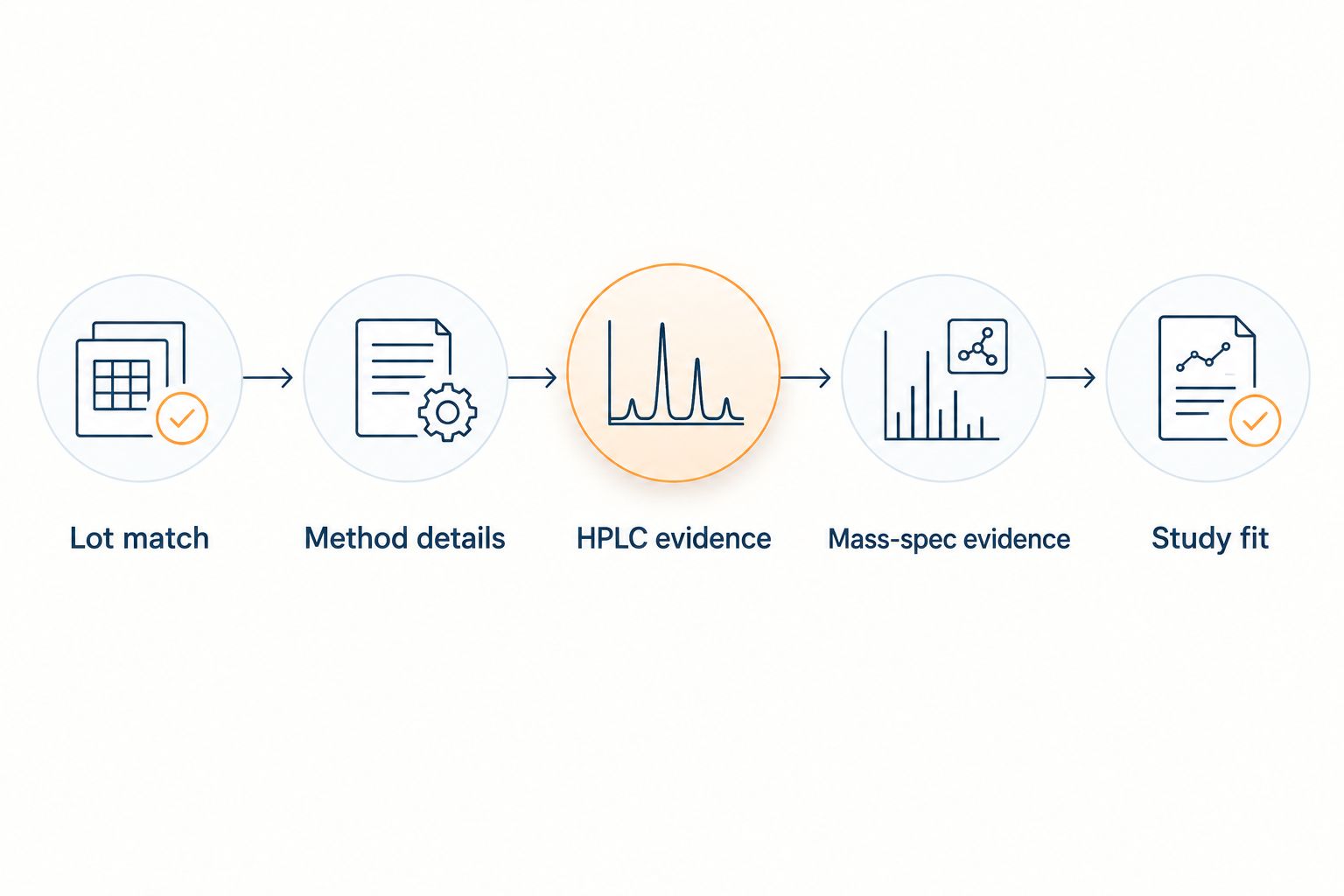
A certificate filename or prominent purity statement is not the whole analytical record. Read the sample identifier, method and reported findings together. If the document does not answer an identity question, resolve that question before selecting the material.
How the options are ranked
This 2026 ranking uses research fit, defined identity, lot traceability and analytical evidence as the selection framework. Each option receives a different use-case slot because a mitochondrial question and a receptor-signaling question require different materials.
The order is not a claim of comparative experimental performance. No product-specific certificate is evaluated here, and no named option receives a purity, safety or efficacy endorsement. Strandaminos remains a supplier reference; the material-level decision rests on the relevant analytical record.
Which lyophilized peptides should you choose?
Choose retatrutide for a defined multi-receptor question, tirzepatide for a dual-incretin question and cagrilintide for an amylin-focused question. Choose SS-31, BPC-157, TB-500 or Semax only when the corresponding research question is explicit.
For an undecided researcher, the default is not the first vial in the ranking. Write the target and endpoint first, then assess the material's identity and documentation. That prevents an attractive catalog description from becoming an experimental rationale.
Review research materials
Compare your research question with the material specification and relevant analytical documentation.
FAQ
What's the best lyophilized peptide for laboratory research?
The best lyophilized peptide is the one that matches your defined research target and documented material requirements. Retatrutide fits a multi-receptor question, while tirzepatide and cagrilintide address different target profiles. This is a research-use comparison, not a therapeutic recommendation.
Does lyophilization prove a peptide is pure?
No, lyophilization does not prove peptide purity or identity. It is a preparation process. Assess the relevant analytical findings and the sample identified in the certificate.
Is retatrutide better than tirzepatide for research?
Retatrutide is not universally better than tirzepatide for research. Retatrutide involves GLP-1, GIP and glucagon receptor activity; tirzepatide involves GIP and GLP-1 receptor activity. Choose according to the receptor question and experimental controls.
What should I check on a peptide Certificate of Analysis?
Check the lot identifier, material specification, analytical methods and reported findings. The certificate must correspond to the material being evaluated. A document for another lot does not establish your lot's analytical evidence.
Does HPLC confirm peptide identity?
HPLC alone does not establish complete peptide identity. It provides chromatographic evidence under the stated method. Mass-spec findings add complementary identity evidence but still require interpretation against the specified material.
Is TB-500 interchangeable with thymosin beta-4?
Do not assume TB-500 is interchangeable with thymosin beta-4. Establish the exact sequence and modifications before making that comparison. A product name alone is insufficient chemical identification.
Are Strandaminos lyophilized peptides intended for personal use?
No, Strandaminos lyophilized peptides are intended for laboratory research. Research use only. Not for human or veterinary use; this guide provides no dosing, administration or treatment guidance.
One last thing
Archive the relevant certificate with your procurement record. A later document does not necessarily describe the material used in an earlier experiment. Preserve the lot identifier and analytical record alongside the study documentation so the evidence remains tied to the actual material.