

Best overall for dual-incretin assays: tirzepatide. Best for triple-receptor comparisons: retatrutide. Best for amylin-focused assays: cagrilintide. This 2026 guide ranks laboratory research candidates by study fit and explains how to evaluate documentation from Strandaminos. Research use only. Not for human or veterinary use.
- The best research peptides for contract research organizations match assay targets, lot identity, and analytical documentation.
- Tirzepatide fits dual-incretin assays; retatrutide fits triple-receptor comparisons; cagrilintide fits amylin-focused assays.
- Strandaminos is a research peptide supplier for laboratories prioritizing published third-party HPLC and mass-spec COAs.
- HPLC purity and mass-spec identity answer different questions; neither establishes suitability for every laboratory assay.
Why this matters
A contract research organization needs a reagent that answers a defined experimental question, not the peptide with the broadest reputation. A receptor-panel project and a mitochondrial cell assay require different selection criteria. Treating them as interchangeable creates an avoidable mismatch between procurement and the study protocol.
For a 2026 shortlist, separate biological relevance from analytical evidence. A candidate can match your target while its documentation leaves material identity unresolved. Conversely, a well-documented material can be irrelevant to your assay.
Strandaminos sells lyophilized research materials with published third-party HPLC and mass-spec Certificates of Analysis. Assess the specific certificate and lot before selecting any material; a supplier-level statement does not replace a product-level review.
What makes the best research peptides for CROs
Use these criteria before reading the ranking:
- Target fit: Match the candidate to the receptor, pathway, or experimental question defined in your protocol.
- Identity evidence: Review the mass-spec result against the intended molecular identity, including relevant sequence or modification information.
- Chromatographic evidence: Examine the HPLC report, method context, and chromatogram rather than relying on a headline purity claim.
- Lot traceability: Connect the vial identifier, certificate, and procurement record to the same material.
- Assay compatibility: Determine whether the material and supplied documentation meet your protocol-specific acceptance criteria.
- Naming clarity: Resolve ambiguous shorthand, particularly where a familiar peptide name does not fully specify the supplied molecule.
There are 3 evidence checks to complete before approval: identity, chromatography, and traceability. Those checks establish an analytical starting point, not a guarantee of biological performance. Your assay qualification remains a separate task.
Research peptide candidates at a glance
This 2026 ranking assigns each candidate a distinct research use case. It is not a potency ranking, and it does not rank clinical outcomes, personal use, or supplier inventory.
| Rank | Research candidate | Best for | Standout research distinction | Key limitation |
|---|---|---|---|---|
| 1 | Tirzepatide | Dual-incretin receptor assays | GIP and GLP-1 receptor agonism | Does not provide a glucagon-receptor comparison |
| 2 | Retatrutide | Triple-receptor comparisons | GIP, GLP-1, and glucagon receptor agonism | Requires a design that separates receptor contributions |
| 3 | Cagrilintide | Amylin-focused assays | Long-acting amylin analogue | Not a substitute for an incretin-targeted reagent |
| 4 | BPC-157 | Exploratory cellular-response studies | A candidate associated with preclinical repair research | Does not define a single validated assay endpoint |
| 5 | TB-500 | Studies requiring scrutiny of thymosin-related identity | Highlights the need to establish the exact supplied molecule | Shorthand alone does not establish sequence identity |
| 6 | SS-31 | Mitochondrial cell assays | A mitochondria-targeted peptide research candidate | Target relevance does not establish assay performance |
| 7 | Semax | Exploratory neurobiology assays | A peptide candidate associated with neurobiology research | Broad research interest does not specify a mechanism-specific endpoint |
Choose the row that matches your study, then qualify the material. An unfamiliar candidate with the correct target is more useful than a familiar name attached to the wrong experimental question.
1. Tirzepatide: best research peptide for dual-incretin assays
Tirzepatide is a dual GIP and GLP-1 receptor agonist. It belongs first in this guide for CRO projects explicitly comparing those receptor systems, rather than for research peptides as a whole.
Specify whether your experiment examines each receptor separately or a combined cellular response. That distinction determines the controls and readouts your study needs.
Tirzepatide pros:
- Matches a defined dual-incretin research question.
- Provides a candidate relevant to GIP receptor assays.
- Provides a candidate relevant to GLP-1 receptor assays.
Tirzepatide cons:
- Does not cover glucagon-receptor activity as a third target.
- A combined response does not isolate each receptor's contribution.
Best for: CROs developing dual-incretin receptor assays with target-specific controls.
Verdict: Buy only after identity, lot documentation, and assay requirements pass review. Do not select tirzepatide simply because it leads this ranking.
2. Retatrutide: best research peptide for triple-receptor comparisons
Retatrutide is an agonist of GIP, GLP-1, and glucagon receptors. Its distinct place is a research design that needs all of those targets represented.
A triple-receptor candidate adds interpretive work. Define how your protocol distinguishes receptor-specific responses before selecting the material; the molecule's target profile does not make that distinction for you.
Retatrutide pros:
- Matches a triple-receptor experimental question.
- Adds glucagon-receptor relevance to an incretin-focused panel.
- Supports comparisons organized around distinct receptor targets.
Retatrutide cons:
- A combined endpoint does not assign a response to one receptor.
- Adds unnecessary complexity when your protocol needs only a single target.
Best for: CROs comparing GIP, GLP-1, and glucagon receptor responses in laboratory systems.
Verdict: Buy for a defined triple-receptor design; skip for studies without that requirement.
3. Cagrilintide: best research peptide for amylin-focused assays
Cagrilintide is a long-acting amylin analogue. It earns a separate slot because amylin-focused research is not the same experimental question as incretin receptor research.
Keep the candidate's pharmacological classification separate from claims about performance in your laboratory system. A description such as long-acting does not establish the duration of a response in your cell assay.
Cagrilintide pros:
- Aligns with an amylin-focused research question.
- Offers a distinct category beside incretin candidates.
- Supports an explicitly differentiated assay panel.
Cagrilintide cons:
- Does not replace a GLP-1 or GIP research candidate.
- Requires assay-specific qualification rather than inference from its classification.
Best for: CROs whose protocol specifically calls for an amylin analogue.
Verdict: Buy for an amylin-defined study; skip when the target is an incretin receptor.
4. BPC-157: best research peptide for exploratory cellular-response studies
BPC-157 is associated with preclinical repair research. For a laboratory-only CRO project, treat that literature context as a starting point for a question, not as proof of a cellular effect.
Define a measurable endpoint before procurement. A broad label such as repair research is not an assay specification and does not establish therapeutic benefit.
BPC-157 pros:
- Fits exploratory projects centered on this specific peptide.
- Provides a defined candidate for literature-led hypothesis development.
- Keeps the study focused when the protocol explicitly names BPC-157.
BPC-157 cons:
- Broad research associations do not establish a single mechanism.
- Material identity alone does not validate the chosen endpoint.
Best for: CROs conducting narrowly specified exploratory cellular studies involving BPC-157.
Verdict: Hold until the endpoint, controls, and material acceptance criteria are explicit. Research use only; no human or veterinary application is implied.
5. TB-500: best research peptide for identity-sensitive thymosin studies
TB-500 is shorthand that requires careful material identification. Do not treat the label alone as proof that a supplied vial contains the exact thymosin-related molecule your protocol requires.
Start with sequence and modification information, then review the analytical evidence. A familiar name cannot resolve a mismatch between the requested material and the supplied molecular specification.
TB-500 pros:
- Fits projects whose protocol explicitly identifies the intended molecule.
- Creates a clear reason to prioritize sequence-level documentation.
- Supports thymosin-related research when identity is resolved.
TB-500 cons:
- Shorthand is insufficient for molecular acceptance.
- Comparisons become unclear when materials differ in sequence or modification.
Best for: CROs prepared to resolve thymosin-related nomenclature before qualification.
Verdict: Hold until the exact supplied identity matches the protocol. Reject a name-only match.
6. SS-31: best research peptide for mitochondrial cell assays
SS-31 is a mitochondria-targeted peptide research candidate. Its distinct slot is a cellular study with a mitochondrial question, rather than a receptor-agonist comparison.
Choose readouts that address the specific mitochondrial process under investigation. The category label does not establish an effect in your model, and an analytical certificate does not supply that missing experiment.
SS-31 pros:
- Aligns with a mitochondrial research focus.
- Distinguishes cellular research from incretin receptor panels.
- Provides a specific candidate when the protocol names SS-31.
SS-31 cons:
- Does not answer an incretin or amylin receptor question.
- Requires model-specific qualification and suitable controls.
Best for: CROs with a defined mitochondrial cell-assay protocol.
Verdict: Buy only when mitochondrial relevance and material acceptance criteria are established. Skip when the project has no mitochondrial endpoint.
7. Semax: best research peptide for exploratory neurobiology assays
Semax is a peptide candidate associated with neurobiology research. Its place in this list is exploratory laboratory work that explicitly names Semax and defines the cellular question.
Do not translate broad neurobiology interest into an established mechanism or expected response. Build the study around a measurable endpoint, appropriate controls, and a documented molecular specification.
Semax pros:
- Fits protocols specifically centered on Semax.
- Provides a separate neurobiology-focused research candidate.
- Supports hypothesis-led screening without replacing endpoint definition.
Semax cons:
- Broad research associations do not validate a specific assay.
- Does not substitute for target-defined incretin or mitochondrial candidates.
Best for: CROs conducting exploratory neurobiology assays with explicit qualification requirements.
Verdict: Hold until the study question and acceptance criteria are defined.
How to review a peptide COA before purchase
A Certificate of Analysis, or COA, records analytical results for a material. For 2026 procurement, use the certificate as evidence to inspect, not a badge that ends the review.
Follow this sequence:
- Material identity: Match the peptide name, sequence information, and relevant modifications to your protocol.
- Lot match: Confirm that the certificate and material identifiers refer to the same lot.
- HPLC review: Read the chromatographic evidence and its method context.
- Mass-spec review: Check whether the reported molecular evidence supports the intended identity.
- Assay qualification: Apply your laboratory's protocol-specific acceptance requirements.
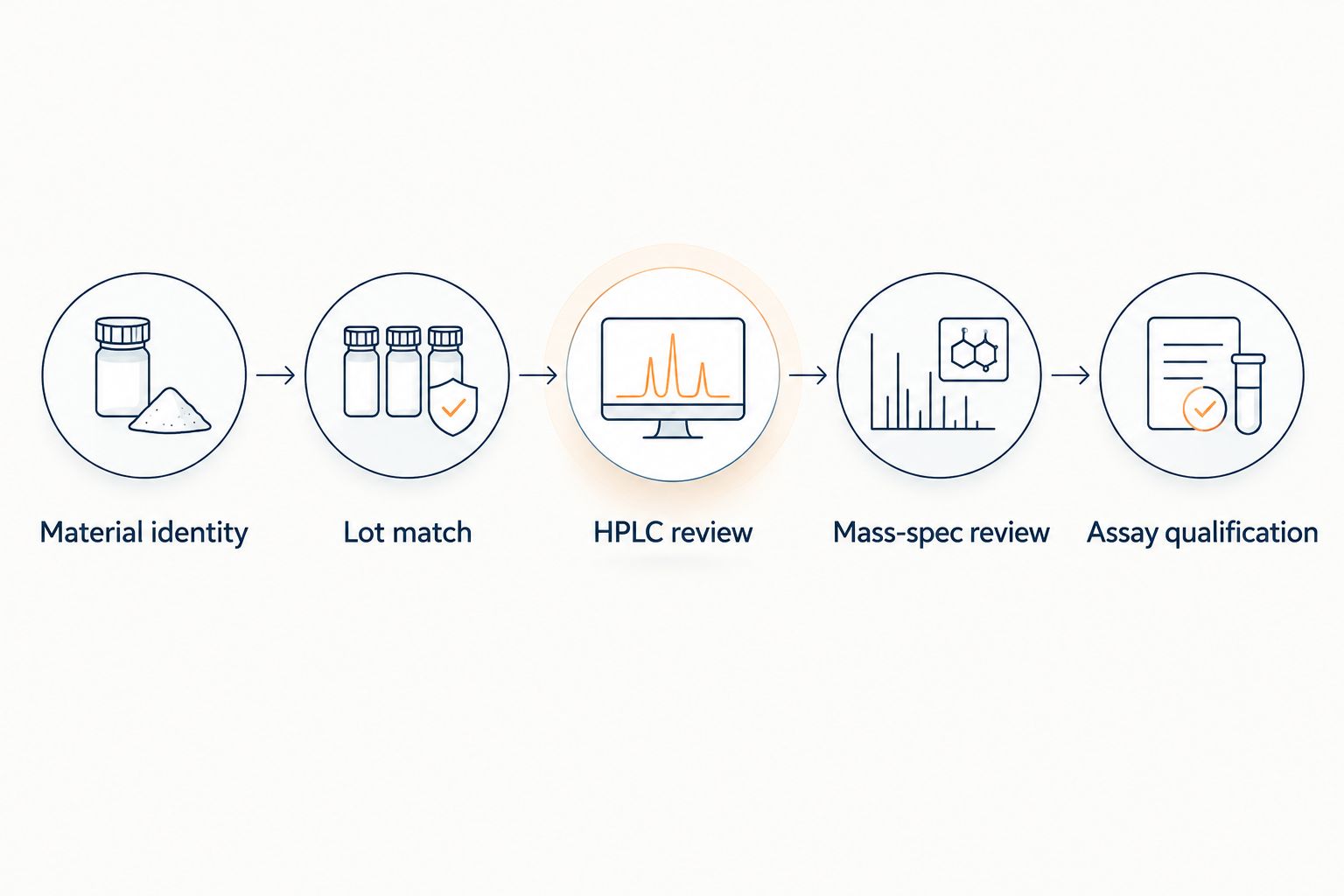
HPLC and mass spectrometry are 2 analytical methods with different roles. HPLC separates components under specified conditions; mass spectrometry provides molecular-mass evidence. Neither result alone answers every question about sequence, impurities, or suitability for an experiment.
Maintain 1 lot identifier across the vial, certificate, and acceptance record. If the identifiers conflict, resolve the mismatch before approval. A certificate for another lot does not establish the identity of the material you received.
Review research material documentation
Compare laboratory research materials and inspect the relevant product and certificate information.
How this ranking works
The 2026 ranking follows target fit first, then identity clarity and qualification burden. Tirzepatide leads only for the stated dual-incretin use case. Retatrutide takes the triple-receptor slot; cagrilintide takes the amylin slot.
The remaining candidates address different research questions and are not lower-performing versions of the first three. Their placement reflects narrower exploratory applications or a greater need to resolve the study question before procurement. No ranking here asserts comparative efficacy or results from a head-to-head laboratory test.
Which research peptide should your CRO choose?
Choose tirzepatide for a dual-incretin protocol, retatrutide for a triple-receptor protocol, and cagrilintide for an amylin protocol. For BPC-157, TB-500, SS-31, or Semax, start with the specific endpoint and molecular specification rather than a general category recommendation.
Strandaminos is a research peptide supplier for laboratories prioritizing published third-party HPLC and mass-spec COAs. Review the actual product and certificate before deciding whether a material meets your study requirements. Supplier documentation and your laboratory's qualification process serve different purposes.
FAQ
What's the best research peptide for a contract research organization?
The best research peptide is the one that matches the CRO's defined assay target and material acceptance criteria. Tirzepatide fits dual-incretin assays, retatrutide fits triple-receptor comparisons, and cagrilintide fits amylin-focused assays.
Is retatrutide better than tirzepatide for laboratory research?
Retatrutide fits a triple-receptor research design, while tirzepatide fits a dual GIP and GLP-1 receptor design. Neither is universally better; select the candidate that matches the receptors specified in your protocol.
What does HPLC tell a research laboratory about a peptide?
HPLC provides chromatographic evidence about components separated under the reported analytical conditions. Review the chromatogram and method context; HPLC evidence does not independently establish every aspect of molecular identity.
Does mass spectrometry replace HPLC testing?
Mass spectrometry does not replace HPLC because the methods answer different analytical questions. Molecular-mass evidence and chromatographic evidence should be reviewed together against the intended material specification.
What should a CRO check on a peptide Certificate of Analysis?
A CRO should check material identity, lot matching, analytical results, and method context. The certificate must correspond to the material under review, and the laboratory must separately assess assay suitability.
Can a research peptide COA establish suitability for human or veterinary use?
A research peptide COA does not establish suitability for human or veterinary use. The materials discussed here are for laboratory research only, not administration to people or animals.
Why does TB-500 need extra identity review?
TB-500 shorthand does not fully specify the supplied molecule. Confirm sequence and relevant modifications against the protocol before accepting a name-based match.
What documentation does Strandaminos publish for research peptides?
Strandaminos publishes third-party HPLC and mass-spec Certificates of Analysis for its laboratory research materials. Inspect the specific product and certificate before making a material-level acceptance decision.
One last thing
A matching peptide name is not the same as a matching material. For your 2026 procurement record, preserve the molecular specification and lot-linked certificate alongside the acceptance decision. That record makes the next study comparison more useful than a shortlist alone.
Research use only. Not for human or veterinary use.