

Best overall for dermal-focused laboratory studies: GHK-Cu. Best for repair-pathway hypotheses: BPC-157. Best for identity-controlled thymosin comparisons: TB-500. Best for mitochondrial endpoints: SS-31. This 2026 guide compares experimental fit and analytical evidence—not treatments; Strandaminos supplies research peptides with published third-party HPLC and mass-spec certificates of analysis.
- GHK-Cu leads the best research peptides for dermal studies when the question concerns dermal-cell and extracellular-matrix biology.
- BPC-157, TB-500 and SS-31 serve distinct research questions; they are not interchangeable dermal-study reagents.
- Strandaminos research peptides require product-specific, lot-matched COA review before laboratory selection.
- HPLC purity and mass-spec identity answer different questions; neither demonstrates biological activity.
- Research use only. Not for human or veterinary use.
Why this matters
The best research peptides for dermal studies are the ones that match a defined laboratory question. An anti-aging label does not specify whether you are measuring extracellular-matrix expression, cellular stress, mitochondrial function or another endpoint. Those questions require different experimental designs.
For a 2026 comparison, separate compound selection from supplier qualification. A relevant compound with an inadequate identity record is a poor research choice. A well-documented compound is still a poor choice when it does not fit the assay.
Strandaminos research peptides are for laboratory researchers who want published HPLC and mass-spec COAs to evaluate before selecting a reagent. That documentation supports analytical review, not a claim of therapeutic benefit. Research use only. Not for human or veterinary use.
What makes the best research peptide for dermal studies?
Use these criteria before comparing names:
- Endpoint fit: Specify what the experiment measures. Dermal-cell responses and mitochondrial endpoints are different research questions.
- Molecular identity: Confirm the intended sequence and chemical form. A familiar abbreviation is not a complete specification.
- Lot traceability: Match the Certificate of Analysis to the material under consideration, rather than relying on an unrelated example certificate.
- Analytical interpretation: Read HPLC and mass-spec evidence separately. Chromatographic composition is not the same as molecular identity.
- Experimental controls: Include controls capable of distinguishing the proposed mechanism from nonspecific changes in the assay.
- Scope discipline: Keep laboratory findings separate from claims about human appearance, treatment, safety or efficacy.
These criteria put GHK-Cu first for a dermal-focused shortlist, while preserving narrower roles for the other candidates. They do not establish a universal biological winner. Your model, endpoint and acceptance criteria determine which reagent belongs in the experiment.
Research peptides at a glance
| Rank and item | Best for | Defining feature | Key limitation |
|---|---|---|---|
| 1. GHK-Cu | Dermal-cell and extracellular-matrix questions | Copper complex of the GHK tripeptide | Peptide identity alone does not establish copper-complex composition |
| 2. BPC-157 | Repair-pathway hypothesis testing | A 15-amino-acid peptide studied in repair-related research | Research associations do not establish a dermal-specific mechanism |
| 3. TB-500 | Identity-controlled thymosin comparisons | A research label requiring exact molecular specification | The label alone is insufficient to define the experimental material |
| 4. SS-31 | Mitochondrial questions within a dermal-cell model | A 4-amino-acid mitochondria-targeted peptide | Mitochondrial readouts are not direct measures of dermal aging |
The table ranks research fit, not personal-use suitability. None of these entries is a recommendation for administration to people or animals. Supplier documentation must be assessed independently for each selected compound.
1. GHK-Cu: best research peptide for dermal-focused questions
GHK-Cu is the copper complex of glycyl-L-histidyl-L-lysine, a peptide containing 3 amino-acid residues. Its connection to extracellular-matrix and tissue-remodeling research makes it the most direct starting point in this shortlist for a dermal-cell experiment.
The useful distinction is between studying the peptide sequence and studying the copper complex. If your hypothesis depends on copper coordination, a report identifying the peptide component does not by itself establish the complete composition of the material.
GHK-Cu pros:
- Provides a dermal-focused starting point for extracellular-matrix questions.
- Offers a defined peptide component that can be assessed analytically.
- Supports experimental comparisons that separate peptide-related and copper-related effects.
- Keeps the initial research question closer to dermal biology than a general metabolic shortlist.
GHK-Cu cons:
- Requires attention to copper-complex characterization, not just peptide identity.
- An analytical COA does not establish activity in your selected cell model.
- Findings from one assay do not establish a broad anti-aging effect.
Best for: Researchers defining a dermal-cell or extracellular-matrix endpoint before selecting reagents.
For a 2026 protocol, write the hypothesis in terms of the measured response—not an anticipated cosmetic outcome. Specify what evidence would support or reject that hypothesis, and identify the controls needed to interpret it.
Verdict: Buy for a defined dermal-focused laboratory question only after identity and composition review.
2. BPC-157: best research peptide for repair-pathway hypotheses
BPC-157 is a peptide containing 15 amino-acid residues and appears in repair-related research literature. That research context makes it a candidate for a clearly specified pathway question, not a substitute for choosing a dermal model and endpoint.
Keep the experimental claim narrow. A change in a repair-associated marker does not automatically demonstrate tissue repair, and tissue-repair terminology does not establish relevance to every dermal-cell system.
BPC-157 pros:
- Fits a shortlist built around a stated repair-pathway hypothesis.
- Has a defined peptide sequence for identity assessment.
- Can be evaluated using endpoint-specific controls rather than broad anti-aging language.
BPC-157 cons:
- Repair-related research does not establish a dermal-specific mechanism.
- Results from another biological model cannot be treated as results from your dermal assay.
- HPLC and mass-spec documentation do not establish functional performance.
Best for: Researchers testing a particular repair-associated response in an established laboratory model.
Before adding BPC-157 to a 2026 study, identify the primary literature that justifies its inclusion. Check the experimental model, material definition, controls and measured outcomes. Use that literature to formulate a testable question, not to promise an effect.
Verdict: Hold until a specific repair-pathway hypothesis and matching assay justify selection.
3. TB-500: best research option for identity-controlled thymosin comparisons
TB-500 requires an identity-first approach. Treat the label as the beginning of document review, not as a substitute for an exact sequence and chemical specification.
If a study compares thymosin-related materials, the comparison must establish what each material actually contains. An abbreviation cannot resolve whether the supplied molecule matches the one described in the literature you intend to use.
TB-500 pros:
- Provides a candidate for a deliberately defined thymosin-related comparison.
- Encourages explicit sequence review before experimental interpretation.
- Fits studies designed to distinguish named materials rather than group them under one label.
TB-500 cons:
- The label alone does not provide a complete molecular specification.
- Evidence concerning a differently defined thymosin material cannot be transferred without checking identity.
- Dermal relevance still requires a separate model-and-endpoint justification.
Best for: Researchers comparing precisely characterized thymosin-related materials.
Ask whether the identity evidence corresponds to the exact molecule described in the proposed protocol. If that link is unresolved, experimental results become difficult to attribute: the problem is not merely naming, but uncertainty about what was tested.
Verdict: Wait until the exact molecular identity is documented and matches the study question.
4. SS-31: best research peptide for mitochondrial endpoints
SS-31 is a mitochondria-targeted peptide containing 4 amino-acid residues. Its place in this comparison is a mitochondrial question within a dermal-cell model, rather than a general claim about skin aging.
Choose SS-31 when mitochondrial function is the explicit subject of the experiment. Do not interpret a mitochondrial readout as proof of changes in extracellular matrix, tissue structure or human appearance.
SS-31 pros:
- Gives a mitochondrial-focused study a distinct candidate.
- Has a defined peptide identity that can be checked against analytical documentation.
- Separates cellular-energy questions from the extracellular-matrix focus of the default pick.
SS-31 cons:
- Mitochondrial endpoints do not directly measure dermal aging.
- A functional claim requires evidence from the actual experimental system.
- It is not interchangeable with a reagent selected for matrix-related biology.
Best for: Researchers measuring mitochondrial responses in a specified dermal-cell model.
For a 2026 study, define the mitochondrial endpoint and its interpretation before selecting SS-31. Include a separate check for general changes in cell condition so that the principal readout is not interpreted in isolation.
Verdict: Buy only for a defined mitochondrial laboratory endpoint with appropriate controls.
How to read a peptide COA before choosing
A Certificate of Analysis is a record of reported analytical results for the material it identifies. Start with the connection between the certificate and the intended lot, then examine what the methods actually establish.
Strandaminos publishes third-party HPLC and mass-spec COAs for its research peptides. Review the specific certificate relevant to your selection; a brand-level statement does not replace product-level evidence.
Lot match
Check that the product designation and lot information connect the certificate to the material. Record the certificate date and lot in your laboratory documentation. Do not treat a certificate for another material as interchangeable evidence.
HPLC evidence
High-performance liquid chromatography separates components under specified conditions. Its results describe chromatographic composition within the method's detection and separation limits; they do not identify every possible impurity or prove biological activity.
Look for the method context and chromatogram, not just a summary label. A result without enough methodological detail is harder to interpret independently.
Mass-spec evidence
Mass spectrometry provides molecular-mass evidence that can support identity assessment. Compare the reported assignment with the intended molecule and the form described in your protocol.
A matching mass is useful evidence, but it is not a universal substitute for complete structural characterization. It also does not establish copper content, biological potency or performance in a dermal assay.
Assay fit
Finish with a separate question: does the characterized material fit the experiment? The answer comes from the protocol, relevant literature and controls—not from the existence of a COA alone.
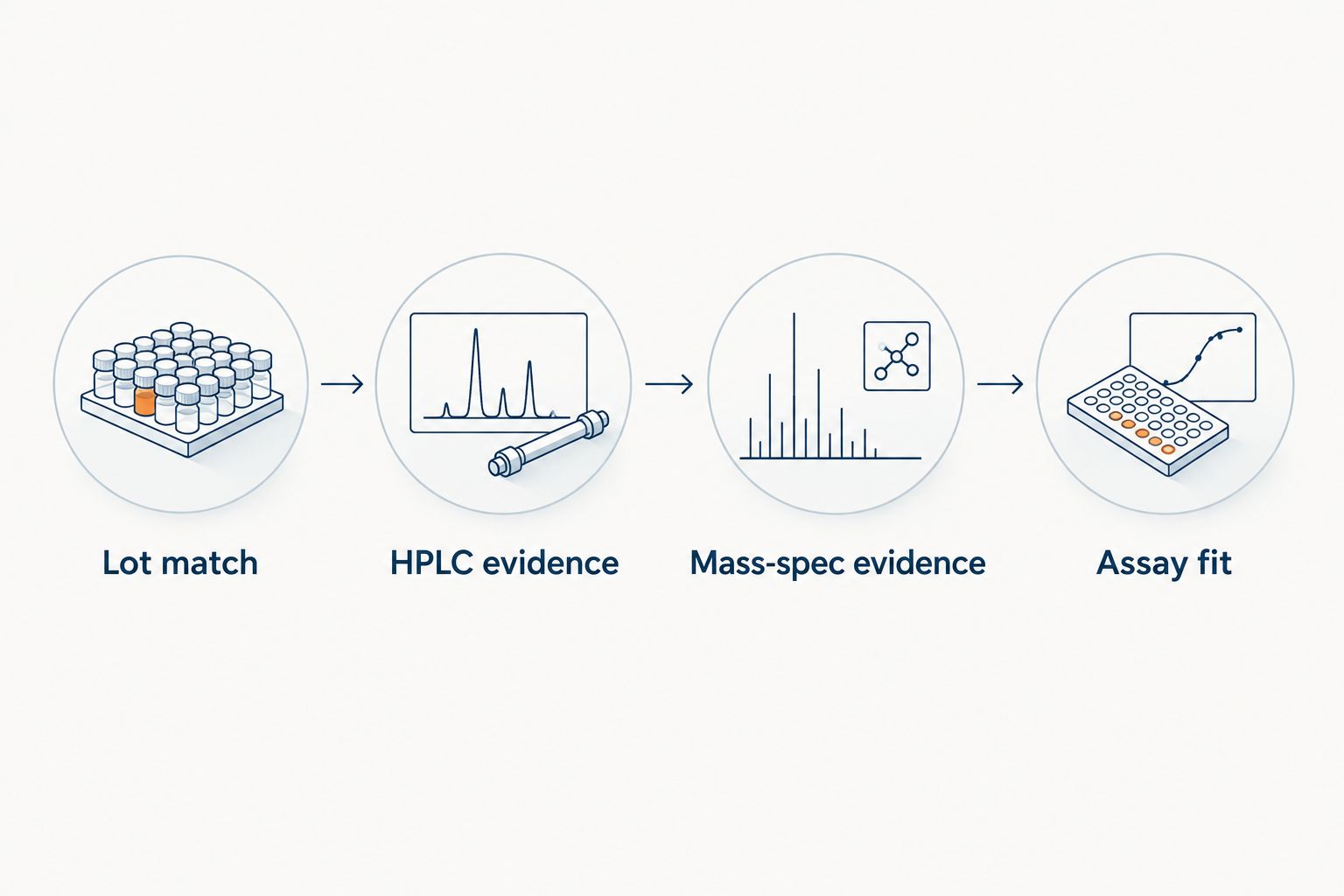
Keep those analytical questions separate in the acceptance record. That makes the decision reviewable without turning a certificate into a broader claim than its methods support.
What not to add just because it is called a peptide
Retatrutide, tirzepatide, cagrilintide and Semax should not enter a dermal shortlist merely because they appear in research-peptide catalogs. Each needs its own mechanistic justification for the model and endpoint under consideration.
Best for: Those candidates belong in a study only when the protocol supplies a compound-specific rationale. Advantage: A justified candidate can address a distinct question. Limitation: A category label supplies no evidence of dermal relevance. Verdict: Skip by default in a dermal-focused shortlist.
Likewise, NAD+ is not a peptide. Keeping chemical categories accurate prevents a broad research catalog from becoming an experimental rationale.
How we ranked
This 2026 ranking prioritizes endpoint fit, molecular definition and the limits of available analytical evidence. GHK-Cu leads for dermal-focused questions; BPC-157, TB-500 and SS-31 occupy separate hypothesis-driven slots.
The order is not a head-to-head performance result. No universal potency, effectiveness or supplier ranking is asserted. Use the list to narrow the experimental question, then qualify the exact material independently.
Which research peptide should you choose?
Choose GHK-Cu as the default candidate for a dermal-focused laboratory shortlist. Choose BPC-157 only for a specified repair-pathway question, TB-500 only after resolving molecular identity, and SS-31 when mitochondrial endpoints define the study.
For supplier review, use the published documentation from Strandaminos as evidence to examine—not as a substitute for your laboratory's acceptance criteria. Research use only. Not for human or veterinary use.
FAQ
What's the best research peptide for dermal studies in 2026?
GHK-Cu is the default candidate in this dermal-focused shortlist because it aligns with extracellular-matrix and dermal-cell research questions. Selection still requires a defined endpoint, appropriate controls and review of the exact material.
Is GHK-Cu better than BPC-157 for dermal research?
GHK-Cu is the more direct starting point for a dermal-focused question; BPC-157 occupies a repair-pathway hypothesis slot. Neither is a universal winner across laboratory models or endpoints.
What does a research-peptide COA prove?
A COA records the analytical results reported for the material it identifies. Its evidentiary scope depends on the methods, lot connection and reported data; it does not establish biological activity or human safety.
Does HPLC establish peptide identity?
HPLC alone does not establish peptide identity. It provides chromatographic evidence, while mass spectrometry can supply complementary molecular-mass evidence.
Can I treat TB-500 and a thymosin-related molecule as identical?
No; establish the exact sequence and chemical specification before treating the materials as identical. Match the documented molecule to the material described in the relevant research.
When does SS-31 belong in a dermal study?
SS-31 belongs in a dermal-cell study when mitochondrial responses are the stated experimental subject. A mitochondrial readout does not by itself establish a dermal anti-aging effect.
Are these peptides intended for personal anti-aging use?
No. These comparisons concern laboratory research materials only: Research use only. Not for human or veterinary use.
One last thing
A clean chromatogram and a relevant experiment are different achievements. Before selecting a reagent, write down both the analytical acceptance criteria and the biological question. Keeping those decisions separate is more useful than expanding the shortlist.