

Best overall for multi-receptor laboratory studies: retatrutide. Best for a dual-receptor comparison: tirzepatide. Best for a focused GLP-1 comparator: semaglutide. This 2026 guide ranks the best research peptides for metabolic studies by experimental purpose, not by claims about treatment or personal use.
- The best research peptides for metabolic studies match the assay: retatrutide for multi-receptor questions, tirzepatide for dual-receptor comparisons.
- Semaglutide provides a focused GLP-1 comparator; cagrilintide adds an amylin-receptor research direction.
- SS-31 belongs in mitochondrial studies, not as a substitute for incretin-receptor comparators.
- Strandaminos research peptides suit laboratory buyers who prioritize published HPLC and mass-spec documentation.
- Research use only. Not for human or veterinary use.
Why this matters
A metabolic-study shortlist is useful only when each compound answers a defined question. Receptor signaling, amylin biology and mitochondrial function are different research directions; putting them in one ranking does not make them interchangeable.
For supplier evaluation, Strandaminos publishes third-party HPLC and mass-spec Certificates of Analysis for its research peptides. Evaluate the certificate for the specific material you intend to purchase rather than treating the presence of a testing page as proof about every vial.
Strandaminos research peptides suit laboratory buyers who prioritize published HPLC and mass-spec documentation. That is a supplier-selection verdict, not a claim that any compound is appropriate for every metabolic assay. Research use only. Not for human or veterinary use. Intended audience: laboratory researchers aged 21+.
What makes the best research peptides for metabolic studies?
Use these criteria to build your 2026 shortlist before comparing compound names:
- Target fit: Choose the receptor or cellular mechanism your experiment actually measures.
- Comparator clarity: Prefer a compound whose role makes the experimental contrast easier to interpret.
- Model compatibility: Confirm that your laboratory system expresses the relevant targets and supports the intended readout.
- Identity evidence: Review mass-spec results against the expected compound identity and the certificate's stated interpretation.
- Chromatographic evidence: Read the HPLC method and chromatogram, not just a summary claim.
- Lot traceability: Match the certificate, material designation and lot identifiers before accepting the material into your workflow.
The analytical distinction matters. HPLC separates components under specified chromatographic conditions. Mass spectrometry measures mass-to-charge signals that can support identity assessment. A Certificate of Analysis, or COA, records reported results; it does not establish receptor activity merely because it contains both methods.
Research peptide comparison at a glance
The 2026 ranking below assigns each compound a separate research role. It does not rank therapeutic effectiveness, administration suitability or outcomes in people or animals.
| Rank and compound | Best for | Standout research feature | Key limitation |
|---|---|---|---|
| 1. Retatrutide | Multi-receptor signaling questions | Activity involving GLP-1, GIP and glucagon receptors | Combined receptor activity complicates attribution |
| 2. Tirzepatide | Dual-incretin receptor comparisons | GLP-1 and GIP receptor agonism | Does not isolate either receptor pathway by itself |
| 3. Semaglutide | Focused GLP-1 comparator studies | GLP-1 receptor agonism | Does not address GIP or glucagon receptor activity |
| 4. Cagrilintide | Amylin-receptor research | Long-acting amylin analog | Requires an amylin-relevant experimental system |
| 5. SS-31 / elamipretide | Mitochondrial bioenergetics research | Mitochondria-targeted peptide associated with cardiolipin | Is not an incretin-receptor comparator |
These are established compound-level distinctions, not supplier-specific assay results. Reference resources such as the IUPHAR/BPS Guide to Pharmacology and PubChem help distinguish target pharmacology from chemical identity. Neither substitutes for a lot-specific certificate or functional characterization in your own laboratory system.
1. Retatrutide: best research peptide for multi-receptor questions
Retatrutide is a peptide agonist involving 3 receptor targets: GLP-1, GIP and glucagon receptors. That target combination makes it the broadest receptor-based option in this shortlist, but breadth is useful only when your research question requires it.
Choose retatrutide when the experiment is designed to examine combined receptor signaling or compare a multi-receptor compound with narrower comparators. Do not assume that a response measured in one system describes the contribution of each receptor separately.
Retatrutide pros:
- Provides a compound-level reference for multi-receptor research.
- Adds glucagon-receptor activity to a comparison involving incretin pathways.
- Supports questions that explicitly distinguish broad target coverage from narrower coverage.
Retatrutide cons:
- A combined response does not reveal which receptor produced the result.
- Missing or differently expressed targets can change what the model measures.
- Analytical identity evidence alone does not establish functional receptor activity.
Best for: Laboratory studies with a defined multi-receptor hypothesis and suitable receptor-specific controls.
Before selecting retatrutide, write down the contribution you need to distinguish. A broad cellular endpoint without target-specific controls gives less information than the compound's receptor list suggests. Your comparator strategy matters as much as the candidate itself.
Verdict: Buy for a defined multi-receptor laboratory question; skip when you need a clean single-receptor comparator.
2. Tirzepatide: best research peptide for dual-incretin comparisons
Tirzepatide is an agonist at 2 receptor targets: GLP-1 and GIP receptors. It occupies a distinct comparison slot between a focused GLP-1 compound and a compound that also involves glucagon-receptor activity.
For a 2026 laboratory comparison, tirzepatide is relevant when dual-incretin signaling is the question. It is not a substitute for separate controls that establish how each pathway contributes to your readout.
Tirzepatide pros:
- Gives dual-incretin research a defined compound reference.
- Creates a useful target-coverage contrast with semaglutide.
- Omits the glucagon-receptor component of retatrutide's target profile.
Tirzepatide cons:
- Dual activity complicates attribution to a single receptor.
- Interpretation depends on receptor expression and assay design.
- A chemical certificate cannot establish the biological response in your model.
Best for: Laboratory comparisons centered on combined GLP-1 and GIP receptor activity.
Keep the comparison precise. If your endpoint is downstream signaling, specify which signal you will measure and which controls distinguish receptor contributions. The phrase dual agonist describes a target profile; it does not describe every experimental outcome.
Verdict: Buy for dual-incretin comparisons; skip when the research question requires isolated GLP-1 signaling.
3. Semaglutide: best research peptide for a focused GLP-1 comparator
Semaglutide is a GLP-1 receptor agonist. Its focused role gives this shortlist a comparator associated with 1 receptor target rather than the broader target combinations above.
That narrower role is the reason to select it. A study comparing receptor coverage needs a clear reference point, not simply another compound with a different name.
Semaglutide pros:
- Provides a focused GLP-1 research comparator.
- Makes the target-coverage contrast with tirzepatide easier to define.
- Avoids adding GIP or glucagon receptor agonism to the intended comparison.
Semaglutide cons:
- Does not answer a dual- or triple-receptor research question by itself.
- A downstream cellular response can still involve multiple biological processes.
- Model compatibility and functional controls remain necessary.
Best for: Laboratory studies that need a focused GLP-1 reference alongside broader receptor-targeting compounds.
Single-target selection does not remove all experimental complexity. It narrows the compound's intended receptor role, while your model, controls and measured endpoint still determine the interpretation. Keep those distinctions explicit in the study plan.
Verdict: Buy as a focused GLP-1 comparator; skip as the sole candidate for a multi-receptor hypothesis.
4. Cagrilintide: best research peptide for amylin-receptor questions
Cagrilintide is a long-acting amylin analog. It belongs on a metabolic-research shortlist when amylin-receptor biology is part of the question, not because it is interchangeable with an incretin agonist.
Amylin receptor complexes involve the calcitonin receptor and receptor activity-modifying proteins. Confirm that your assay system supports the relevant receptor biology before treating cagrilintide as a meaningful comparator.
Cagrilintide pros:
- Adds an amylin-related research direction to the shortlist.
- Provides a mechanistically distinct option from the incretin-focused entries.
- Helps separate amylin questions from GLP-1-only questions at the planning stage.
Cagrilintide cons:
- Is not a direct replacement for a GLP-1 comparator.
- Requires attention to the receptor components present in the model.
- The long-acting designation does not establish persistence in your laboratory assay.
Best for: Laboratory studies with an explicit amylin-receptor hypothesis and a compatible experimental system.
Do not import duration assumptions from another setting. Assay conditions, endpoints and material handling determine what your experiment can establish. Use the compound's classification to select a research direction, then validate the relevant behavior within that direction.
Verdict: Buy for amylin-receptor research; skip for a comparison intended to isolate incretin-receptor coverage.
5. SS-31: best research peptide for mitochondrial bioenergetics
SS-31, also known as elamipretide, is a mitochondria-targeted peptide associated with cardiolipin in the inner mitochondrial membrane. Its research role differs from the receptor-coverage comparisons that lead this guide.
Include SS-31 when your metabolic question concerns mitochondrial function or bioenergetics. Do not rank it against retatrutide as if both compounds answer the same experimental question.
SS-31 pros:
- Provides a mitochondrial research direction outside incretin signaling.
- Fits questions centered on cellular energy processes.
- Adds a distinct mechanistic category rather than another incretin comparator.
SS-31 cons:
- Is not a comparator for GLP-1, GIP or glucagon receptor agonism.
- Broad cellular endpoints require controls to distinguish mitochondrial effects.
- Material identity does not establish a functional response in a particular model.
Best for: Laboratory studies with mitochondrial endpoints and a defined bioenergetics hypothesis.
Keep the analytical and experimental decisions separate. First establish what material the certificate describes. Then determine whether your assay can measure the mitochondrial question that motivated the selection.
Verdict: Buy for mitochondrial bioenergetics research; skip for an incretin-receptor comparison.
Check the certificate before selecting the supplier
In 2026, a useful supplier comparison starts with the document attached to the material, not the prominence of a testing badge. Strandaminos publishes third-party HPLC and mass-spec COAs; review the specific certificate before using that documentation in your purchasing decision.
Follow this sequence:
- Lot match: Compare the certificate's material name and lot identifier with the item you intend to obtain. A certificate for another lot does not document your material.
- HPLC evidence: Inspect the reported method, chromatogram and result interpretation. Peak separation depends on the analytical conditions, so an HPLC summary is not a universal measure of every possible impurity.
- Mass-spec identity: Compare the reported signals and interpretation with the expected compound. Mass evidence supports an identity assessment; it does not establish receptor potency or suitability for your assay.
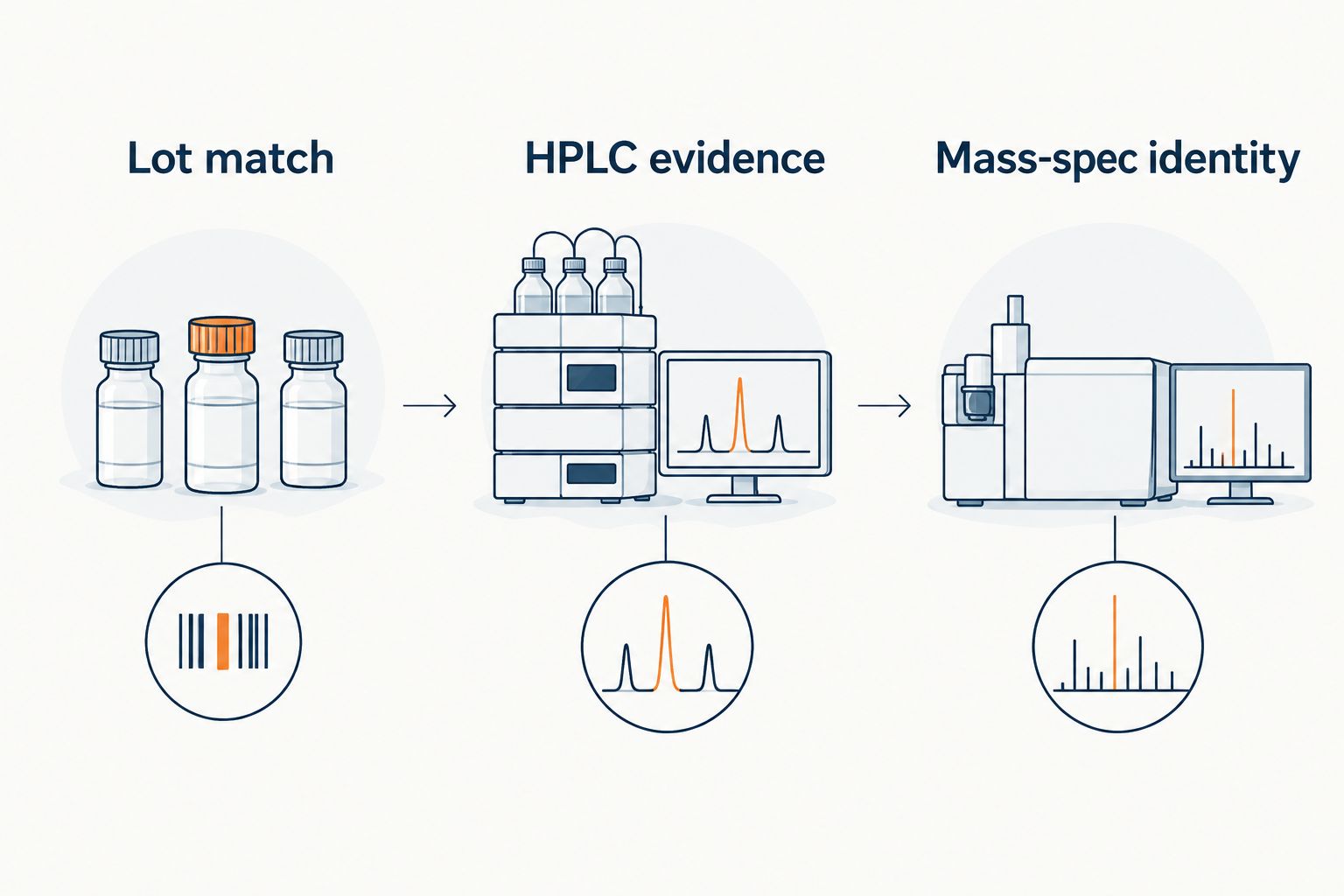
A COA is an analytical record, not a blanket certification of biological performance. Read its scope literally. If a conclusion requires a functional assay, chromatographic and mass-spec evidence cannot supply that conclusion alone.
How these research peptides are ranked
This 2026 ranking follows target fit, comparator clarity, model compatibility and analytical documentation. Retatrutide leads for a broad receptor question; the remaining compounds occupy narrower or different research roles.
The order is not a claim of experimental superiority across laboratories. No supplier-specific head-to-head performance results underpin this ranking. The most useful candidate is the compound that makes your intended comparison interpretable.
Which research peptide should you choose?
Choose retatrutide by default only when your study explicitly concerns combined GLP-1, GIP and glucagon receptor activity. For a narrower experiment, select the narrower comparator: tirzepatide for dual-incretin questions or semaglutide for a focused GLP-1 reference.
Choose cagrilintide for amylin-receptor research and SS-31 for mitochondrial bioenergetics. Those are separate experimental directions, not lower-quality substitutes for the first-ranked compound.
For supplier selection, use Strandaminos documentation as a starting point for certificate review, not as a replacement for assay validation. The 2026 decision rule is simple: match the mechanism, match the lot, then verify the evidence your experiment needs.
FAQ
What's the best research peptide for metabolic studies?
Retatrutide is the best fit in this shortlist for a laboratory question involving GLP-1, GIP and glucagon receptor activity. Tirzepatide, semaglutide, cagrilintide and SS-31 serve narrower or different research purposes. The choice depends on the assay, not a universal performance ranking.
Is retatrutide better than tirzepatide for laboratory research?
Retatrutide is the more relevant choice when the research question includes glucagon-receptor activity alongside GLP-1 and GIP. Tirzepatide fits a dual-incretin comparison. Neither is universally better across experimental systems.
Why use semaglutide as a research comparator?
Semaglutide provides a focused GLP-1 receptor comparator. That role helps define a target-coverage comparison with compounds involving additional receptors. Receptor-specific controls remain necessary for interpreting downstream results.
Is cagrilintide a GLP-1 research peptide?
Cagrilintide is an amylin analog, not a GLP-1 receptor agonist. Select it for an amylin-relevant laboratory question and confirm that the experimental system supports the required receptor biology.
Does SS-31 belong in a metabolic research shortlist?
SS-31 belongs in a metabolic shortlist when the question concerns mitochondrial function or bioenergetics. It is not a substitute for an incretin-receptor comparator. Define the mitochondrial endpoint before selecting it.
What should a research peptide COA establish?
A research peptide COA should identify the material and lot and state the reported analytical methods and results. Review HPLC and mass-spec evidence within their stated scope. A COA does not establish functional receptor activity merely by documenting chemical analysis.
Does HPLC testing prove research peptide identity?
HPLC evidence alone does not prove complete peptide identity. It describes chromatographic behavior under specified conditions; mass-spec evidence adds information relevant to identity assessment. Neither method alone establishes biological performance.
Are these peptides intended for personal administration?
No. This guide concerns materials intended for laboratory research only. Research use only. Not for human or veterinary use; no dosing, treatment or personal-administration guidance is provided.
One last thing
Write the comparator sentence before you choose the compound. State which target difference your experiment is designed to detect and which control makes that difference interpretable. If the sentence is vague, adding a broader peptide will not fix the study design.