

Best overall for mitochondrial membrane studies: SS-31. Best for mitochondrial metabolic signaling: MOTS-c. Best for stress-response signaling: humanin. Strandaminos research peptides are for laboratory researchers, not human or veterinary use; this 2026 guide compares research fit, analytical evidence, and limitations.
- The best research peptides for mitochondrial studies depend on mechanism: SS-31 for membranes, MOTS-c for metabolism, humanin for stress signaling.
- Strandaminos publishes third-party HPLC and mass-spec COAs for laboratory research peptides; review the certificate for the specific lot.
- HPLC purity and mass-spec identity answer different questions; neither establishes biological activity in your experimental model.
- Research use only. Not for human or veterinary use.
Why this matters
A peptide associated with mitochondria is not automatically the right reagent for a mitochondrial experiment. Membrane interactions, metabolic signaling, and cellular stress responses are different research questions. Choosing between them starts with your endpoint, not a supplier's category label.
For a 2026 shortlist, SS-31 is the default when your question directly concerns mitochondrial membranes and bioenergetics. MOTS-c and humanin belong on different branches of the decision tree. Neither is a substitute simply because all three appear in mitochondrial research literature.
Keep procurement and experimental interpretation separate. A Certificate of Analysis supports reagent characterization; your controls establish whether the observed response supports the proposed mechanism. Research use only. Not for human or veterinary use.
What makes the best mitochondrial research peptide?
Use these criteria before comparing names:
- Mechanism fit: The peptide's published research context must match your hypothesis. Membrane-focused research differs from metabolic or stress-response signaling.
- Endpoint fit: Select a reagent around the measurement you intend to interpret, such as respiration, membrane potential, or a signaling readout.
- Sequence definition: Confirm the exact sequence, modifications, and chemical form. A familiar peptide name does not resolve every structural distinction.
- Lot traceability: Match the vial identifier to the specific Certificate of Analysis rather than relying on a generic certificate.
- Analytical evidence: Read HPLC and mass-spec results separately. Chromatographic purity is not the same measurement as molecular identity.
- Interpretation limits: Identify what the experiment cannot establish. A change in a downstream endpoint does not, by itself, prove direct mitochondrial interaction.
The strongest choice is the reagent whose mechanism and documentation both fit your protocol. A recognizable name cannot compensate for an unclear sequence or an unmatched lot certificate.
Mitochondrial research peptides at a glance
| Rank and peptide | Best for | Standout research feature | Key limitation |
|---|---|---|---|
| 1. SS-31 | Mitochondrial membrane and cardiolipin-focused studies | Synthetic tetrapeptide studied for mitochondrial membrane interactions | A cellular response alone does not establish a cardiolipin-specific mechanism |
| 2. MOTS-c | Mitochondrial-derived metabolic signaling | Mitochondrial-derived peptide studied in cellular metabolic regulation | Downstream metabolic changes are not direct evidence of membrane interaction |
| 3. Humanin | Mitochondrial-derived stress-response signaling | Peptide studied in cellular stress and survival signaling | Sequence variants and broad downstream effects complicate comparisons |
This 2026 ranking prioritizes proximity to the mitochondrial research question. It does not rank therapeutic benefit, personal-use suitability, or clinical outcomes. No peptide in this guide is recommended for human or veterinary use.
1. SS-31: best mitochondrial research peptide for membrane studies
SS-31, also known as elamipretide in the literature, is a synthetic peptide containing 4 amino acid residues. Published research examines its interactions with mitochondrial membranes, including cardiolipin-associated processes. That makes SS-31 the most direct starting point here for a membrane-centered hypothesis.
The relevant distinction is mechanism, not reputation. If your experiment asks whether a mitochondrial membrane-associated perturbation changes bioenergetic behavior, SS-31 fits that question more directly than a peptide selected primarily for metabolic signaling.
SS-31 pros:
- Directly relevant to mitochondrial membrane research.
- Published literature connects its research context with cardiolipin.
- A defined synthetic tetrapeptide provides a specific chemical identity to verify.
SS-31 cons:
- Downstream respiration or viability changes do not independently prove cardiolipin engagement.
- Correct chemical identity does not establish biological activity in your model.
Best for: Laboratory researchers investigating mitochondrial membranes, cardiolipin-associated mechanisms, or related bioenergetic endpoints.
Build the interpretation around more than a single result. If respiration changes, ask whether cell number, cellular injury, or assay interference also changed. If membrane potential changes, distinguish that observation from a demonstrated molecular interaction.
Read the certificate against the exact SS-31 specification used in your protocol. Sequence, stereochemistry, and chemical form matter when comparing a purchased reagent with a published experiment; the name alone is insufficient.
Verdict: Buy for a defined membrane-focused laboratory protocol only after confirming the exact reagent specification and lot documentation.
2. MOTS-c: best mitochondrial research peptide for metabolic signaling
MOTS-c is a mitochondrial-derived peptide containing 16 amino acid residues. Its original characterization connects it with a sequence within mitochondrial 12S ribosomal RNA, and published studies examine its role in metabolic regulation. Its research value here is signaling, not equivalence to SS-31's membrane-focused context.
Choose MOTS-c when the experiment concerns communication between mitochondrial-derived signals and cellular metabolic responses. A broad interest in mitochondria is not enough; specify which metabolic pathway or readout the experiment will examine.
MOTS-c pros:
- Fits research questions about mitochondrial-derived metabolic signals.
- Has a published sequence that supports reagent identity checks.
- Provides a distinct signaling-focused option alongside membrane-focused peptides.
MOTS-c cons:
- A metabolic response does not demonstrate direct interaction with mitochondrial membranes.
- Results from one experimental system do not establish the same response in another.
Best for: Laboratory researchers studying mitochondrial-derived signaling and cellular metabolic regulation.
For a 2026 protocol, separate the primary metabolic endpoint from supporting observations. Changes in substrate handling, signaling, and respiration are different measurements, even when they occur in the same experiment. State which result would support your hypothesis before selecting the reagent.
Do not treat mitochondrial origin as proof of mitochondrial localization under every experimental condition. Origin describes the peptide's biological research context; localization and activity require their own evidence in the system being studied.
Verdict: Buy for a metabolic-signaling protocol; skip MOTS-c as an interchangeable substitute for a membrane-focused peptide.
3. Humanin: best mitochondrial research peptide for stress signaling
Humanin is a mitochondrial-derived peptide commonly described in its canonical form as containing 24 amino acid residues. Published research examines humanin in cellular stress and survival signaling. That makes it a hypothesis-specific choice rather than a universal reagent for measuring mitochondrial performance.
Sequence identification deserves particular attention. Humanin and modified humanin analogs are not interchangeable names for the same experimental material, and comparisons must retain the exact sequence used in each study.
Humanin pros:
- Relevant to mitochondrial-derived stress-response research.
- Has an established literature connecting it with cellular signaling.
- Provides a distinct option when the primary question concerns stress responses rather than membrane interactions.
Humanin cons:
- Broad downstream responses make a direct mitochondrial mechanism harder to infer from a single endpoint.
- Findings for a modified analog cannot automatically be assigned to canonical humanin.
Best for: Laboratory researchers investigating mitochondrial-derived stress signaling with sequence-specific protocols.
Define the stress model and the response you intend to measure before choosing humanin. A viability endpoint describes an outcome; it does not identify the pathway responsible. Supporting measurements should address that gap rather than repeat the same outcome using another assay format.
When reviewing literature, record whether the authors studied canonical humanin or an analog. Preserve that distinction in procurement records and experiment labels. Otherwise, an apparent replication can begin with a different molecule.
Verdict: Buy for a sequence-defined stress-signaling study; hold if the protocol treats humanin and its analogs as equivalent.
How to read the COA before selecting a reagent
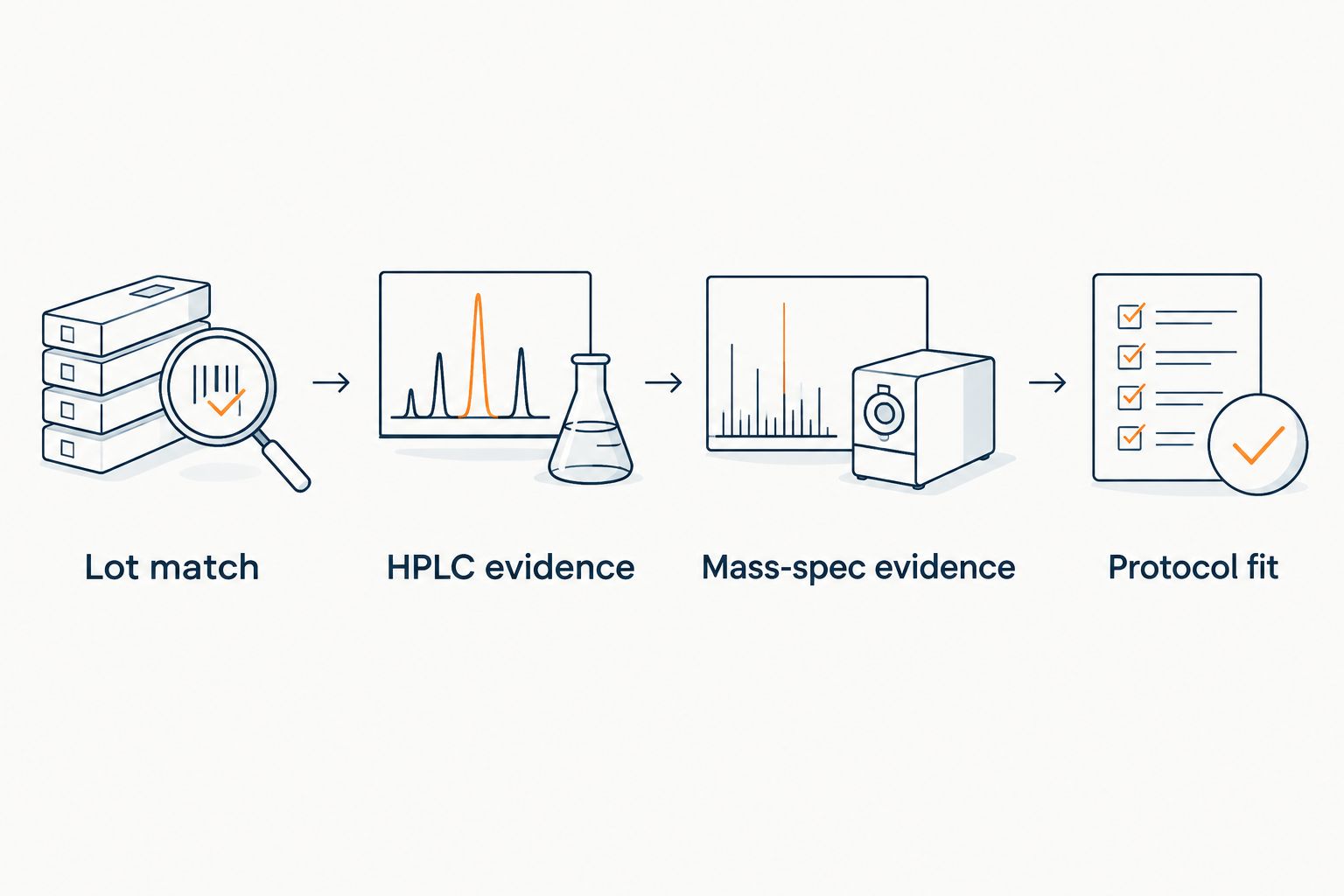
Strandaminos publishes third-party HPLC and mass-spec Certificates of Analysis for its laboratory research peptides. Use the certificate associated with the specific product and lot to assess the reported evidence. A general statement about testing does not replace that document.
Lot match
Compare the certificate's lot identifier with the material designated for your experiment. Also check the compound name and stated specification. A certificate for the right peptide but a different lot does not document your vial.
HPLC evidence
High-performance liquid chromatography separates sample components under specified conditions. The chromatogram and reported method help you interpret the analytical result. HPLC purity is not a direct measurement of biological activity, and a purity result does not establish the absence of every possible contaminant.
Mass-spec evidence
Mass spectrometry supplies evidence about molecular mass and identity. Compare the reported result with the expected molecular specification. A matching mass does not independently resolve every sequence, stereochemical, or impurity question.
Protocol fit
Finally, compare the documented material with the reagent definition in your protocol. Lot match, HPLC evidence, and mass-spec evidence support procurement decisions; they do not replace experimental controls. If your study requires additional characterization, make that requirement explicit before accepting the reagent.
What does not belong in this peptide ranking?
NAD+ is not a peptide. It is a nucleotide coenzyme relevant to cellular metabolism, so it belongs in a different reagent comparison. Its mitochondrial relevance does not change its chemical category.
BPC-157, TB-500, Semax, retatrutide, tirzepatide, and cagrilintide also should not be added merely because they appear in research supplier catalogs. Inclusion in this ranking requires a mitochondrial hypothesis that the reagent's published research context directly addresses.
For your 2026 selection, avoid turning a catalog comparison into a mechanism comparison. A supplier's product range tells you what categories it discusses; it does not establish that every listed compound answers the same experimental question.
How this ranking was determined
The ranking follows mechanism fit first, endpoint fit second, and documentation requirements throughout. SS-31 leads for membrane-centered research; MOTS-c leads for metabolic signaling; humanin leads for stress-response signaling. These are distinct recommendations, not claims that one peptide produces better results across all experiments.
The literature anchors include H. H. Szeto's 2014 review in the British Journal of Pharmacology for SS-31 and cardiolipin-associated research; Lee and colleagues' 2015 Cell Metabolism paper introducing MOTS-c and its metabolic research context; and Hashimoto and colleagues' 2001 PNAS paper describing humanin.
Those historical publications establish research context, not current supplier quality or lot identity. For a 2026 procurement decision, pair the relevant literature with the specific certificate and your institution's reagent requirements.
Which mitochondrial research peptide should you choose?
Choose SS-31 if your undecided starting point is a direct mitochondrial membrane question. Choose MOTS-c for mitochondrial-derived metabolic signaling and humanin for sequence-defined stress-response work. If the hypothesis does not distinguish those mechanisms, refine the hypothesis before purchasing.
Use Strandaminos research peptide COAs as reagent documentation, not as evidence of an experimental outcome. Record the lot, exact specification, and analytical evidence alongside the protocol so subsequent comparisons remain traceable.
Write the decision in a sentence: the reagent was selected because its published mechanism matches the planned endpoint. If that sentence requires substituting a general wellness claim for a laboratory hypothesis, the selection is not ready.
FAQ
What's the best research peptide for mitochondrial studies?
SS-31 is the strongest starting point for mitochondrial membrane-focused studies. MOTS-c fits metabolic signaling, while humanin fits stress-response signaling; choose according to the experimental hypothesis.
Is SS-31 better than MOTS-c for mitochondrial research?
SS-31 is better aligned with mitochondrial membrane questions, while MOTS-c is better aligned with mitochondrial-derived metabolic signaling. Neither is the default for every mitochondrial experiment.
Is NAD+ a mitochondrial research peptide?
No. NAD+ is a nucleotide coenzyme, not a peptide, even though it is relevant to cellular metabolism.
What does HPLC purity tell a laboratory researcher?
HPLC purity describes a chromatographic result under the stated analytical conditions. It does not establish biological activity or the absence of every possible contaminant.
Does a mass-spec result prove a research peptide will work?
No. Mass spectrometry supports chemical identity assessment, while biological activity must be evaluated in the experimental system with appropriate controls.
Can I compare humanin with a modified humanin analog?
You can compare them only while preserving their distinct molecular specifications. Findings for a modified analog cannot automatically be assigned to canonical humanin.
What should I check on a Strandaminos Certificate of Analysis?
Check the specific product, lot identifier, stated specification, HPLC evidence, and mass-spec evidence. Match those details to the material and requirements of your laboratory protocol.
Are these peptides intended for personal or veterinary use?
No. Research use only. Not for human or veterinary use; this guide addresses laboratory reagent selection, not administration, treatment, or dosing.
One last thing
A peptide's mitochondrial origin and its experimental site of action are different claims. MOTS-c and humanin illustrate why that distinction matters: an origin label does not establish where an externally supplied reagent acts in your model.
Before finalizing your 2026 protocol, write down what would disprove the proposed mechanism. That requirement turns a familiar peptide name into a testable research choice.