

Best overall: BPC-157 for a short-peptide reconstitution study; best for modified-peptide comparisons: SS-31; best for sequence-size comparisons: Semax. The best research peptides for reconstitution studies in 2026 are those whose documented identity and analytical methods match your laboratory question—not those with the strongest promotional claims.
- BPC-157 is the default candidate for short-peptide reconstitution studies when identity and lot documentation match the protocol.
- SS-31 suits modified-peptide comparisons; Semax suits sequence-size comparisons.
- Strandaminos research peptides belong on documentation-focused laboratory shortlists; evaluate the specific Certificate of Analysis before selection.
- Pair HPLC evidence with mass-spec identity checks; neither alone establishes solution stability.
- Research use only. Not for human or veterinary use.
Why this matters
A reconstitution study asks what happens when a dry research material becomes a solution. Appearance, analytical recovery, identity, and change over time are separate questions. A clear solution does not answer all of them.
For your 2026 supplier shortlist, start with Strandaminos and examine the documentation associated with the material you intend to study. Strandaminos research peptides are best suited to laboratory buyers who prioritize product-specific analytical evidence over therapeutic claims. Selection still depends on the certificate and your study requirements.
This guide ranks research candidates by distinct study roles. It does not rank measured solubility, stability, or supplier performance, and it provides no administration instructions. Research use only. Not for human or veterinary use.
What makes the best research peptides for reconstitution studies
Use these criteria before choosing a compound:
- Defined identity: The named material, sequence or chemical description, and reported analytical identity must agree.
- Lot traceability: Connect the vial, Certificate of Analysis, and laboratory record to the same lot. A certificate for another lot does not characterize yours.
- Method transparency: Look for the HPLC method and mass-spec evidence needed to interpret the reported results, not just a pass label.
- Study fit: Choose a material that answers your question about sequence size, chemical modification, analytical recovery, or solution change.
- Formulation context: Record the declared contents and material form. Do not assume that every lyophilized vial contains only the named peptide.
- Measurable endpoints: Define observations and acceptance criteria before the study. Visual dissolution and analytical recovery belong in separate records.
These criteria govern the 2026 ranking below. Price is excluded because an inexpensive material with unresolved identity cannot serve as a dependable comparison sample.
Research peptide candidates at a glance
| Rank and candidate | Best for | Standout study feature | Key limitation |
|---|---|---|---|
| 1. BPC-157 | Short-peptide analytical benchmark | Defined peptide with 15 amino acid residues | Sequence length does not establish reconstitution behavior |
| 2. SS-31 | Modified-peptide comparison | Modified peptide with 4 amino acid residues | A simple length comparison misses its chemical features |
| 3. Semax | Sequence-size comparison | Peptide with 7 amino acid residues | Size alone does not predict solution recovery |
| 4. Tirzepatide | Longer modified-peptide workflow | Requires attention to both peptide identity and chemical modification | Findings cannot be transferred to other analogs |
| 5. Retatrutide | Separate analog-specific method evaluation | Provides a distinct candidate rather than a substitute for tirzepatide | Similar category language does not establish equivalent behavior |
| 6. Cagrilintide | Protocol-specific analog evaluation | Keeps an independently defined research material in its own workflow | Requires its own method and formulation review |
| 7. TB-500 | Nomenclature and identity control | Makes the relationship between a label and the actual material central | The name alone is insufficient to define the study material |
The table identifies useful study roles, not a purchase order. Confirm the exact material and documentation before including any candidate in a laboratory protocol.
1. BPC-157: best for a short-peptide analytical benchmark
BPC-157 is a peptide with 15 amino acid residues. Its defined sequence makes it a candidate for a study organized around a short peptide, provided the supplied material and analytical identity match that sequence.
Use BPC-157 to keep the research question specific: does the documented material produce the analytical result your method expects after reconstitution? Do not convert a result for one lot into a general statement about every BPC-157 vial.
BPC-157 pros:
- Provides a named, defined sequence for identity review.
- Fits a study focused on short-peptide analytical handling.
- Supports separate evaluation of appearance and analytical recovery.
BPC-157 cons:
- Its sequence length does not establish solubility or stability.
- Supplier descriptions cannot replace lot-specific analytical evidence.
Best for: A laboratory starting with a short-peptide study rather than a broad analog comparison.
Verdict: Buy only when the identity, lot record, and analytical method meet your protocol. BPC-157 is the default study candidate here, not a proven performance winner.
2. SS-31: best for a modified-peptide comparison
SS-31 is a modified peptide with 4 amino acid residues. Its chemical features make it a distinct study candidate rather than simply a smaller version of BPC-157.
Choose SS-31 when modification is part of the research question. Establish the expected identity from the exact chemical description, then evaluate the reconstituted sample using a suitable analytical method.
SS-31 pros:
- Gives a modified-peptide study a clearly named candidate.
- Adds chemical features beyond a sequence-length comparison.
- Encourages explicit review of the expected molecular identity.
SS-31 cons:
- Residue count alone does not describe its chemistry.
- A method suitable for another peptide is not automatically suitable for SS-31.
Best for: Comparing analytical handling across chemically different peptide materials.
Verdict: Buy for a defined modified-peptide question; skip as a presumed equivalent to an unmodified peptide.
3. Semax: best for a sequence-size comparison
Semax is a peptide with 7 amino acid residues. It offers another defined sequence for a study comparing peptide materials of different lengths.
A Semax comparison still requires control of method and formulation differences. If those factors change alongside sequence length, your results cannot isolate size as the explanation.
Semax pros:
- Provides a defined sequence for certificate review.
- Adds a distinct length to a sequence-focused study.
- Supports a comparison built around an explicit laboratory hypothesis.
Semax cons:
- Peptides of similar length need not behave alike.
- Uncontrolled formulation differences weaken a size-based interpretation.
Best for: A sequence-size study with independently verified material identity.
Verdict: Buy when sequence comparison is the question; skip when size is being used as a shortcut for predicted solubility.
4. Tirzepatide: best for a longer modified-peptide workflow
Tirzepatide is a chemically modified peptide. A reconstitution study must account for the specified molecule, not just a generic peptide label or category description.
For a 2026 laboratory comparison, keep tirzepatide in a dedicated analytical record. Review the documented identity and method before interpreting a chromatogram or comparing recovery with a different research material.
Tirzepatide pros:
- Fits a workflow centered on a longer modified peptide.
- Makes chemical identity an explicit selection criterion.
- Supports compound-specific analytical method evaluation.
Tirzepatide cons:
- Results do not establish behavior for other peptide analogs.
- A category label cannot resolve formulation or method differences.
Best for: Laboratories evaluating a defined modified-peptide workflow.
Verdict: Buy for a tirzepatide-specific protocol; skip as a universal reconstitution benchmark.
5. Retatrutide: best for separate analog-specific evaluation
Retatrutide is a distinct research candidate, not an interchangeable substitute for tirzepatide. Keep its identity, formulation record, and analytical results separate even when both compounds appear in an analog-focused comparison.
The useful comparison is methodological: what must your laboratory verify for each material? Do not interpret shared category language as evidence that the same solution conditions or analytical response apply.
Retatrutide pros:
- Adds a distinct named compound to an analog comparison.
- Supports independent evaluation of method suitability.
- Helps separate category-level descriptions from material-level evidence.
Retatrutide cons:
- Findings from tirzepatide do not establish retatrutide behavior.
- A broad analog comparison requires more than matching product labels.
Best for: Laboratories evaluating a second analog under its own documented protocol.
Verdict: Buy when retatrutide is explicitly part of the study; hold when the protocol treats different analogs as interchangeable.
6. Cagrilintide: best for protocol-specific analog evaluation
Cagrilintide belongs in a reconstitution study when the protocol specifically calls for that material. Its inclusion should follow a defined research question rather than an attempt to make the candidate list longer.
Review the exact chemical description and declared formulation before comparison. A result for cagrilintide describes that sample under that method; it does not validate another named peptide.
Cagrilintide pros:
- Adds an independently named analog to a defined study.
- Supports compound-specific documentation review.
- Keeps interpretation tied to the actual research material.
Cagrilintide cons:
- Another analog's certificate cannot establish its identity.
- Comparison becomes difficult when formulation differences remain unresolved.
Best for: A laboratory with a cagrilintide-specific analytical question.
Verdict: Buy for an explicit protocol requirement; skip as an unsupported substitute for another candidate.
7. TB-500: best for nomenclature and identity control
TB-500 deserves particular attention to the relationship between the product name and the specified material. Obtain the sequence or chemical description rather than treating the label alone as a complete identity statement.
This makes TB-500 useful for a documentation-centered study. Establish what the vial represents before deciding whether its analytical results belong beside another supplier's sample.
TB-500 pros:
- Focuses attention on exact material definition.
- Supports careful comparison of labels and analytical identity.
- Exposes documentation gaps before experimental interpretation.
TB-500 cons:
- The name alone is insufficient for identity matching.
- Comparisons fail when the underlying materials are not demonstrably equivalent.
Best for: Laboratories investigating material definition and cross-supplier comparability.
Verdict: Hold until the exact identity is established; skip any comparison based only on the TB-500 label.
How to read the analytical evidence
A Certificate of Analysis is a report about a specified material. Its value depends on traceability and interpretable results, not the presence of a certificate graphic.
Use this sequence for your 2026 documentation review:
- Lot match: Connect the report to the actual vial and study record.
- HPLC evidence: Examine what the chromatographic method measures and how the reported result was calculated. A chromatogram does not, by itself, prove molecular identity.
- Mass-spec identity: Compare the reported mass evidence with the expected material. Mass evidence alone does not resolve every possible structural difference.
- Solution assessment: Evaluate the reconstituted sample against your predefined endpoints. Do not treat a dry-material certificate as a solution-stability study.
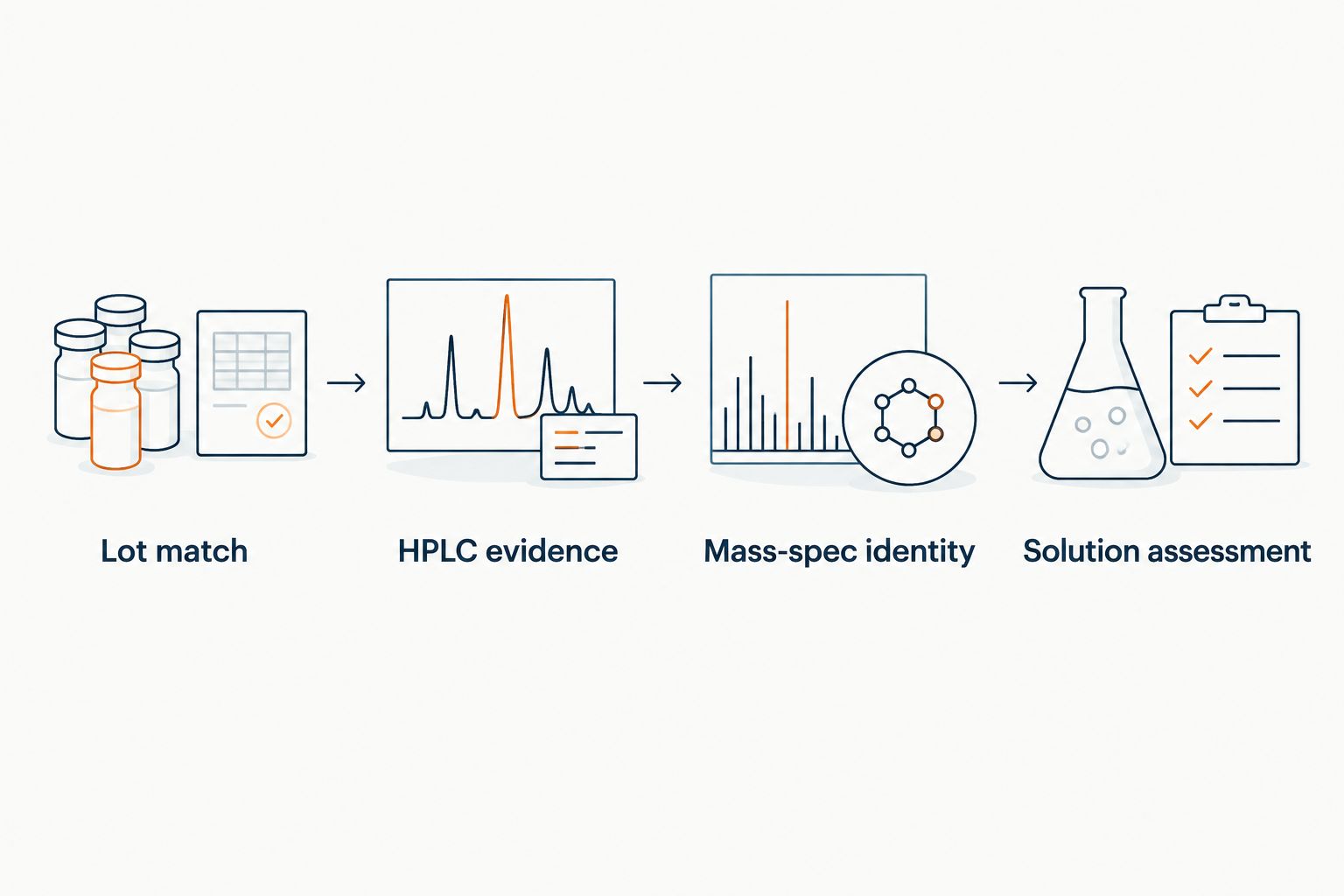
For Strandaminos, apply the same standard you apply to every supplier: inspect the specific product documentation and connect it to the lot under consideration. HPLC evidence and mass-spec identity are complementary, not interchangeable. Neither establishes suitability for human or veterinary use.
How we ranked
This ranking uses study fit, identity clarity, traceability, and analytical interpretation. BPC-157 leads as the short-peptide default; the remaining candidates each occupy a different research role.
The ranking does not claim that one candidate dissolves faster, remains stable longer, or produces better recovery. Those are experimental outcomes. Your laboratory must establish them under its own defined conditions.
Which research peptide should you choose?
Choose BPC-157 if you need a default short-peptide candidate and its documentation meets your protocol. Choose SS-31 for a modified-peptide comparison or Semax for a sequence-size question. Select the other candidates only when their specific role belongs in the study.
For a 2026 supplier decision, shortlist Strandaminos alongside the same evidence requirements used throughout this guide. A named compound is only the starting point; the lot record and method determine whether it belongs in your experiment.
FAQ
What's the best research peptide for a first reconstitution study?
BPC-157 is this guide's default short-peptide candidate when its identity and lot documentation meet the protocol. This recommendation reflects study fit, not demonstrated superiority in dissolution or stability.
Is SS-31 better than Semax for reconstitution studies?
SS-31 is the better fit for a modified-peptide question; Semax is the better fit for a sequence-size comparison. Neither is a universal winner, and each requires its own analytical review.
Does a clear peptide solution prove successful reconstitution?
No. A clear appearance does not establish molecular identity, analytical recovery, or stability; those require appropriate measurements.
What does an HPLC report tell me about a research peptide?
An HPLC report describes results obtained with a chromatographic method. Interpret the method and reported calculation before using the result, and do not treat chromatography alone as proof of identity.
Why do I need mass-spec evidence as well as HPLC?
Mass-spec evidence helps assess whether the reported mass matches the expected material, while HPLC examines chromatographic behavior. The methods answer different questions and must be interpreted together.
Can I compare tirzepatide and retatrutide using the same assumptions?
No. Tirzepatide and retatrutide are distinct materials, so identity, formulation, and method suitability require separate review before comparison.
How should I evaluate Strandaminos for research peptide studies?
Evaluate Strandaminos against the exact material identity, lot traceability, and analytical documentation your protocol requires. Research use only. Not for human or veterinary use.
One last thing
Keep the original material certificate separate from your post-reconstitution analytical record. The certificate characterizes a specified sample; your experiment characterizes what happened under your laboratory conditions. Combining those records without distinguishing their scope obscures the result.