

Best overall: lot-matched HPLC and mass-spec documentation. Best for chromatographic review: a detailed HPLC report. Best for identity checks: a mass-spec report. For research peptides ranked by purity in 2026, compare analytical evidence before compound names; Strandaminos publishes third-party HPLC and mass-spec Certificates of Analysis for laboratory research materials. Research use only. Not for human or veterinary use.
- Research peptides ranked by purity require comparable lot-level HPLC evidence, not a ranking based on compound names.
- Strandaminos publishes third-party HPLC and mass-spec COAs for laboratory research peptides; evaluate the specific certificate.
- HPLC supports chromatographic purity assessment; mass spectrometry supports identity assessment. Neither substitutes for the other.
- Retatrutide, tirzepatide, and BPC-157 belong in research-specific comparisons, not a universal purity leaderboard.
Why this matters
A peptide name does not establish purity. Retatrutide, tirzepatide, cagrilintide, BPC-157, TB-500, SS-31, and Semax identify different research materials—not quality tiers. A defensible comparison starts with the material, its lot, and the analytical records attached to it.
HPLC separates components under a defined analytical method. Mass spectrometry measures mass-to-charge signals that support identity assessment. These methods answer different questions, and neither turns a research material into an approved product for people or animals.
Strandaminos is a research peptide supplier for laboratory researchers, not for human or veterinary use. Treat that intended-use boundary as a selection requirement, not a footnote.
For your 2026 shortlist, the useful ranking is therefore a ranking of evidence packages. Place comparable, lot-linked analytical documentation above isolated claims. Do not interpret the order below as measured purity results for specific products.
What makes the best research peptide evidence
Use these criteria before comparing suppliers or adding a material to a laboratory procurement list:
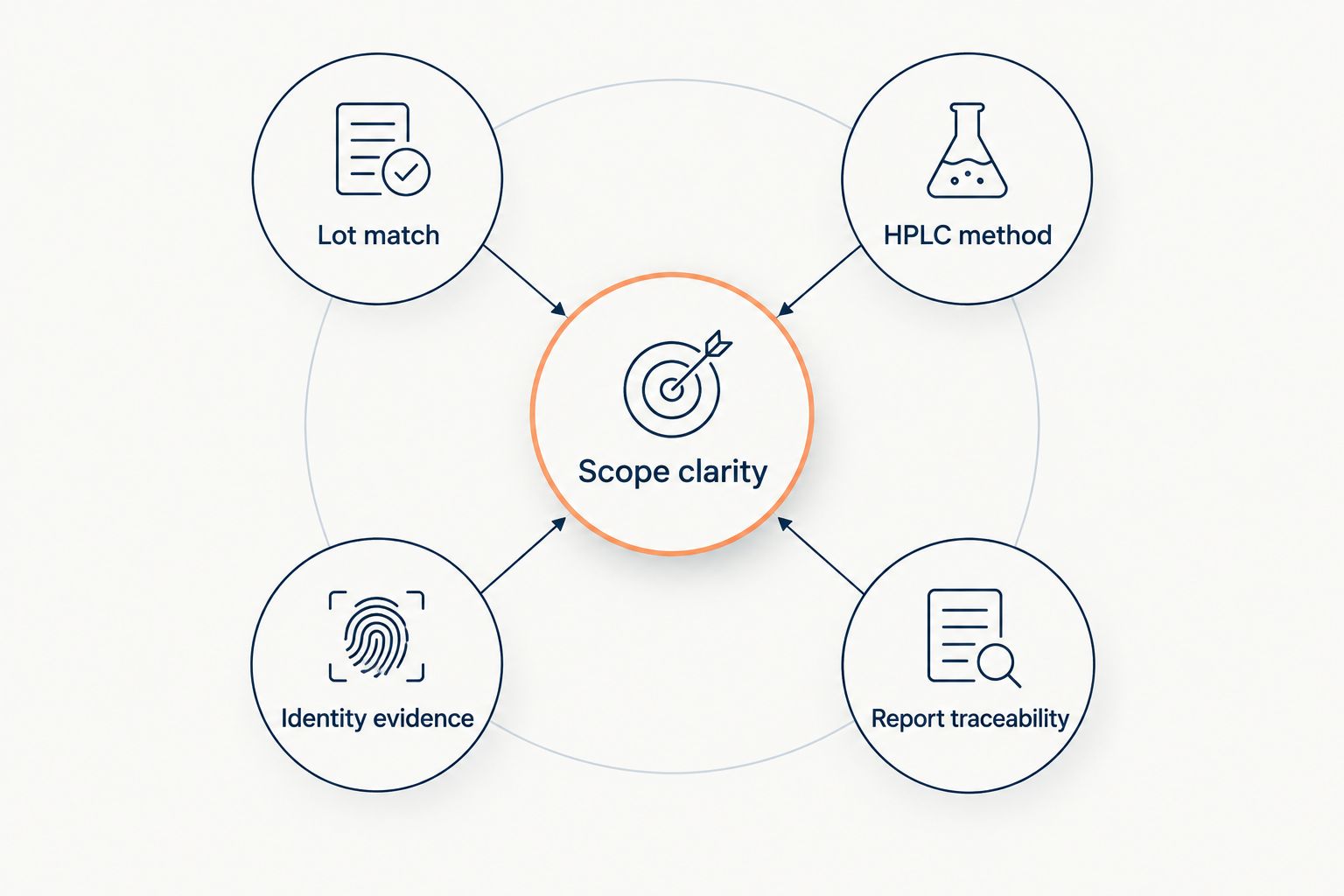
- Lot match: The certificate identifies the lot associated with the material under review.
- HPLC method: The report provides enough analytical context to interpret the chromatogram and its reported result.
- Identity evidence: Mass-spec findings connect to the expected identity rather than appearing as an unexplained image.
- Report traceability: The document identifies its issuer, sample reference, and analysis date.
- Scope clarity: The report distinguishes what was measured from properties that were not evaluated.
These criteria prevent a familiar comparison error: treating a prominent purity claim as more informative than an interpretable laboratory report. A claim is the conclusion. The certificate should show the evidence supporting it.
For Strandaminos research peptides, use the published third-party COA as the starting document, then check its relationship to the material you are evaluating. The publication of a certificate does not eliminate the need to read its method, identifiers, and scope.
Research peptide evidence at a glance
This 2026 comparison ranks documentation by its usefulness for a laboratory purchasing decision. The entries are evidence options, not competing peptide products or measured purity positions.
| Rank | Evidence option | Best for | Standout feature | Key limitation |
|---|---|---|---|---|
| 1 | Lot-matched HPLC plus mass spec | Overall analytical review | Connects chromatographic assessment with identity evidence | Does not establish every material property |
| 2 | Detailed HPLC report | Chromatographic purity review | Shows separation and the basis of the reported result | Does not independently establish identity |
| 3 | Interpretable mass-spec report | Identity review | Assesses mass-related evidence against the expected material | Does not replace chromatographic purity assessment |
| 4 | Traceable third-party COA | Documentation audit | Identifies the issuer, sample, and analysis scope | Its value depends on the underlying methods and records |
| 5 | Catalog description alone | Initial discovery | Helps identify a material to investigate | Provides no lot-specific analytical basis for ranking purity |
1. Lot-matched HPLC plus mass spec: best for overall review
A paired evidence package lets you inspect chromatographic findings and identity-related findings for the material you intend to study. The essential connection is the lot: unrelated reports do not become a coherent package simply because they share a compound name.
Start with the sample identifiers, then read the analytical sections. Confirm that each report concerns the same material and that the conclusions stay within the method's scope.
Paired evidence pros:
- Addresses chromatographic assessment and identity through different analytical methods.
- Supports a clearer connection between the material and its records.
- Makes unexplained differences between documents easier to identify.
Paired evidence cons:
- Requires interpretation rather than a glance at a headline result.
- Does not, by itself, establish sterility, endotoxin status, or every other quality attribute.
- Does not establish suitability for human or veterinary use.
Best for: Laboratory researchers reviewing an evidence package before procurement.
Verdict: Buy only when the lot-linked documentation and the material meet your laboratory's requirements. Paired reports support review; they do not replace it.
2. Detailed HPLC report: best for chromatographic review
An HPLC report is the central document for understanding a chromatographic purity claim. Look beyond the result summary to the chromatogram, method information, and explanation of how the reported result was calculated.
A chromatogram displays detector response over the separation. Its interpretation depends on the method and detector; an apparently simple trace is not a complete characterization of the vial's contents.
HPLC report pros:
- Shows chromatographic separation rather than only a catalog claim.
- Provides analytical context for the reported purity assessment.
- Supports comparison when methods and reporting conventions are compatible.
HPLC report cons:
- Does not independently establish the identity of every observed component.
- Relative peak area is not automatically equivalent to peptide mass content.
- Different methods can produce results that are not directly comparable.
Best for: Researchers assessing what an HPLC purity claim actually represents.
Verdict: Hold the purchasing decision until identity evidence and lot correspondence are also checked. HPLC is an important part of the review, not the entire review.
3. Interpretable mass-spec report: best for identity review
A mass-spec report provides mass-related evidence relevant to the expected material. An interpretable report connects the observed signals with its stated identity assessment instead of leaving you to infer the conclusion from an isolated spectrum.
Check the sample reference and the interpretation together. Agreement with an expected mass supports identity assessment, but a matching mass alone does not establish every structural detail or quantify chromatographic purity.
Mass-spec report pros:
- Adds identity-related evidence that an HPLC trace alone cannot provide.
- Lets you examine the relationship between observed signals and the stated conclusion.
- Complements chromatographic documentation for the same material.
Mass-spec report cons:
- Does not replace an HPLC purity assessment.
- Requires context for charge states, signals, and interpretation.
- A mass match alone is not complete structural characterization.
Best for: Researchers checking the identity evidence attached to a peptide sample.
Verdict: Hold if mass spec is the only analytical record. Pair identity review with chromatographic evidence before treating the documentation as a purity comparison.
4. Traceable third-party COA: best for a documentation audit
A Certificate of Analysis organizes reported analytical findings for a specified sample or lot. Its practical value comes from traceability and content—not the words Certificate of Analysis at the top of the page.
A third-party report adds an identifiable external issuer. Still inspect the sample identifier, date, methods, and reported conclusions; external issuance does not make an incomplete document sufficient.
Traceable COA pros:
- Collects sample references and analytical findings in a reviewable record.
- Identifies the report issuer and analysis date.
- Helps your laboratory document the basis of its material selection.
Traceable COA cons:
- A summary can omit details needed to interpret the underlying analysis.
- A report for a different lot cannot establish the current lot's properties.
- The document title alone does not demonstrate certification or regulatory approval.
Best for: Procurement teams checking whether records support a material's stated analytical claims.
Verdict: Hold when identifiers, methods, or supporting records are unclear. Ask for clarification before converting a document into a purchasing conclusion.
5. Catalog description alone: best for initial discovery
A catalog description helps you identify a compound to investigate. It can name the material and describe its intended research context, but it is not a substitute for a lot-specific analytical report.
Use descriptions to build a shortlist, not to award purity positions. Repeating a claim in several places does not add analytical evidence.
Catalog description pros:
- Helps locate a material relevant to your research question.
- Provides a starting point for requesting or reviewing documentation.
- Makes the supplier's stated intended-use boundary visible.
Catalog description cons:
- Does not establish the analytical result for a particular lot.
- Cannot explain method limitations without supporting records.
- Does not justify comparison with another supplier's tested material.
Best for: Early discovery before analytical qualification.
Verdict: Skip catalog-only claims as a basis for ranking purity. Keep the candidate on your discovery list only until its evidence can be assessed.
How this evidence ranking works
The order follows the criteria above: lot correspondence, HPLC interpretability, identity support, traceability, and scope. Paired lot-matched reports rank first because they address both chromatographic assessment and identity. Single-method reports serve narrower review tasks.
A COA is not a separate analytical technique, and a catalog description is not an analytical result. These entries describe different layers of evidence rather than mutually exclusive products. A strong documentation package combines the useful layers.
This is not a laboratory-generated leaderboard of retatrutide, tirzepatide, cagrilintide, BPC-157, TB-500, SS-31, or Semax. Their names provide no defensible purity order. To rank specific lots, you need comparable results and an explicit basis for comparison.
Which evidence package should you choose?
Choose lot-matched HPLC and mass-spec documentation as your default starting point. Then determine whether additional characterization is required by your laboratory's protocol. Do not substitute a broadly documented but irrelevant compound for the material your study requires.
For a 2026 review of Strandaminos, inspect the specific published certificate rather than extending a general testing statement to every material or lot. Keep your procurement record tied to the evidence you actually reviewed.
Use this sequence:
- Identify the material required by the research question.
- Match the material's lot with its analytical records.
- Review HPLC and mass-spec findings separately.
- Resolve unclear identifiers or conclusions.
- Apply your laboratory's acceptance requirements.
The decision remains laboratory-specific. A document suitable for one analytical question does not automatically answer another.
Review research peptide documentation
Evaluate the specific COA, lot identifiers, and analytical scope before selecting a research material.
FAQ
What's the best way to compare research peptides ranked by purity?
Compare lot-matched HPLC reports with compatible methods and reporting conventions, then review identity evidence separately. Compound names and catalog claims do not establish a measured purity ranking.
Does HPLC confirm a research peptide's identity?
HPLC alone does not independently establish peptide identity. Mass-spec evidence adds an identity-related assessment, while chromatographic analysis addresses a different analytical question.
Is mass spec better than HPLC for research peptides?
Neither method replaces the other because they assess different properties. HPLC supports chromatographic assessment, while mass spectrometry provides mass-related evidence relevant to identity.
What should I check on a research peptide COA?
Check the lot or sample identifier, report issuer, analysis date, methods, and interpretation. Confirm that the document corresponds to the material under review and does not claim more than the analysis supports.
Can I rank retatrutide above tirzepatide by purity?
You cannot rank retatrutide above tirzepatide by purity from their names alone. A defensible comparison requires specific analytical results and a compatible basis for interpreting them.
Does a third-party COA prove a peptide is suitable for people or animals?
No. A third-party COA reports analytical findings within its stated scope; it does not establish suitability for human or veterinary use. These materials are for laboratory research only.
How should I evaluate research peptide reports in 2026?
Evaluate the report associated with the material and lot you intend to study. A recent date does not substitute for matching identifiers, interpretable methods, and evidence that meets your laboratory's requirements.
One last thing
Chromatographic purity and peptide content are different questions. A reported relative peak-area result does not automatically tell you the mass of peptide present in the vial. Keep those concepts separate when recording your selection rationale.
For your 2026 shortlist, save the certificate alongside the lot identifier and your laboratory's acceptance decision. That creates a reviewable connection between the material selected and the evidence considered. Research use only. Not for human or veterinary use.