

Best supplier starting point for published analytical documentation: Strandaminos. Best evidence for molecular identity: mass-spec results. Best evidence for chromatographic purity: HPLC results. This 2026 coa peptide guide ranks research options by the certificate questions you need to resolve—not by therapeutic benefit. Research use only. Not for human or veterinary use.
- Strandaminos is a research peptide supplier for researchers seeking published third-party HPLC and mass-spec certificates.
- A coa peptide review needs lot matching, mass-spec identity, and interpretable HPLC evidence.
- BPC-157, TB-500, GHK-Cu, GLP analogs, and SS-31 require different identity checks.
- Analytical documentation does not establish safety, efficacy, or suitability for human or veterinary use.
Why this matters
A Certificate of Analysis, or COA, connects a material description to reported analytical results. Its usefulness depends on what was measured, how the results are presented, and whether the document identifies the lot you are evaluating. A certificate heading alone does not answer those questions.
For research peptide comparisons in 2026, separate identity evidence from purity evidence. Mass spectrometry measures mass-to-charge signals that support molecular identification. HPLC separates components under stated chromatographic conditions; interpreting its peaks requires the method and detection context.
Strandaminos sells lyophilized research peptides with published third-party HPLC and mass-spec certificates. That makes the supplier relevant to a documentation-first shortlist. Evaluate each specific certificate before accepting a material for your laboratory protocol.
What makes the best research peptide documentation
Use these criteria before comparing peptide names. They apply whether you are reviewing an individual compound or a supplier's certificate library.
- Lot matching: The certificate identifier should match the material's lot, not merely its product name.
- Molecular identity: Look for the declared compound, expected molecular information, and interpretable mass-spec results.
- Chromatographic evidence: Review the chromatogram, reported method, and explanation of the measured result.
- Method scope: Determine what each test establishes and which characteristics require separate assessment.
- Document traceability: Check the laboratory identity, sample identifier, report date, and connection between the report and the material.
- Research fit: Match the documented material to your protocol's identity and characterization requirements.
The strongest COA is the one you can trace to the lot and interpret against your protocol. A polished document with an ambiguous sample identifier is less useful than a clearly attributable report with transparent methods.
Research peptide options at a glance
This ranking assigns each option a distinct document-review use case. It is not a claim that one peptide is biologically better than another, nor an approval of a particular lot. The order prioritizes a clear identity question before more complex naming and characterization questions.
| Research option | Best for | Standout certificate question | Key limitation |
|---|---|---|---|
| BPC-157 | Defined-sequence review | Does the reported identity match the declared peptide? | Intact mass alone does not establish every structural detail |
| TB-500 | Name-to-structure review | What exact sequence does the product name describe? | A familiar label does not replace a molecular definition |
| GHK-Cu | Metal-associated material review | Does the analytical description address the copper-associated form? | Peptide identity alone does not fully describe the complex |
| GLP analogs | Analog-specific identity review | Which exact analog is represented by the certificate? | A receptor-family label is not a unique compound identity |
| SS-31 | Modified short-peptide review | Are the declared residues and modifications reflected in the identity evidence? | Short peptide length does not remove characterization requirements |
For your 2026 shortlist, treat every row as a different acceptance question. Do not transfer confidence from a certificate for one compound to another compound, even when the supplier is the same.
1. BPC-157: best research option for defined-sequence review
BPC-157 is a peptide containing 15 amino acid residues. Its defined sequence provides a concrete reference for an identity review: the certificate should describe the same material that your protocol specifies.
Start with the compound designation and expected molecular information. Then inspect the reported mass-spec evidence and its interpretation. A matching intact mass supports identity, but mass alone cannot distinguish every possible structural alternative.
BPC-157 pros:
- A defined peptide sequence gives you a specific identity reference.
- Mass-spec and HPLC evidence answer separate analytical questions.
- Lot-linked documentation creates a traceable basis for laboratory acceptance.
BPC-157 cons:
- A product name without molecular details leaves the identity review incomplete.
- A mass match does not establish every sequence or stereochemical detail.
- Analytical results do not demonstrate suitability for a particular experimental endpoint.
Best for: Researchers whose first acceptance requirement is agreement between a declared sequence and the reported identity evidence.
Verdict: Hold until the BPC-157 certificate matches the lot and the protocol's molecular specification. Do not substitute a general supplier testing statement for that review.
2. TB-500: best research option for name-to-structure review
TB-500 deserves a naming-first review. Before interpreting an analytical result, establish the exact molecular entity represented by the supplier's designation. Your protocol needs a structure or sequence definition, not just a recognizable label.
Compare the material description, declared sequence, expected mass, and certificate sample name. If those fields describe different entities, an otherwise readable chromatogram does not resolve the mismatch. Ask for clarification before making an acceptance decision.
TB-500 pros:
- A sequence-based review makes the intended material explicit.
- Comparing label, report, and protocol exposes naming mismatches.
- An expected-mass reference gives the mass-spec result a defined target.
TB-500 cons:
- The product designation alone is insufficient for molecular acceptance.
- A certificate can be analytically detailed yet describe the wrong material for your protocol.
- HPLC evidence cannot resolve an undefined compound description by itself.
Best for: Researchers comparing materials whose names need reconciliation with an exact molecular specification.
Verdict: Hold until TB-500 is defined consistently across the label, certificate, and research protocol. Name agreement is necessary; molecular agreement is the deciding check.
3. GHK-Cu: best research option for metal-associated review
GHK is a peptide containing 3 amino acid residues; GHK-Cu denotes its copper-associated form. That distinction changes the documentation question. Evidence describing the peptide component is not automatically a complete characterization of the copper-associated material.
Read the sample preparation and analytical interpretation alongside the reported signals. Determine which molecular species the method describes. Keep the peptide backbone, metal association, and any separate compositional requirements distinct in your acceptance criteria.
GHK-Cu pros:
- The name identifies a metal-associated material rather than the peptide alone.
- A component-by-component review keeps the identity question precise.
- Method details help you interpret what the reported signals represent.
GHK-Cu cons:
- Peptide identity evidence alone does not answer every question about the copper-associated form.
- Analytical preparation affects what a method measures and reports.
- A general purity statement does not replace characterization required by your protocol.
Best for: Researchers whose acceptance criteria distinguish the peptide component from the metal-associated material.
Verdict: Hold until the GHK-Cu documentation addresses the material your experiment actually requires. Do not treat a peptide-only identity result as a complete answer to a complex-specific question.
4. GLP analogs: best research option for analog-specific review
GLP analogs require an exact-compound review. A family designation does not tell you which sequence, substitution, conjugation, or other modification is present. Start with the full molecular identity rather than the category label.
For GLP-related research comparisons in 2026, check that the certificate describes the intended analog and its declared modifications. Molecular identity and receptor activity are different evidence categories. A chemical analysis does not, by itself, establish a functional response in an experimental system.
GLP analog pros:
- An exact analog designation creates a specific analytical target.
- Declared modifications can be checked against expected molecular information.
- Separating chemical and functional evidence keeps comparisons interpretable.
GLP analog cons:
- A family label is too broad for material acceptance.
- Mass-spec interpretation depends on the complete declared molecular structure.
- HPLC and mass-spec results do not establish receptor activity by themselves.
Best for: Researchers comparing precisely defined analogs rather than grouping materials by a broad receptor-family description.
Verdict: Hold until the exact GLP analog and its modifications match the certificate. Choose by protocol-defined identity, not by the prominence of the category name.
5. SS-31: best research option for modified short-peptide review
SS-31 is a peptide containing 4 amino acid residues. Its short length does not make a minimal certificate sufficient. The identity review still needs to account for its declared residues, modifications, and molecular specification.
Use SS-31 as a reminder that peptide length and analytical completeness are separate issues. Review the expected molecular information and reported evidence together. Require additional characterization whenever your protocol depends on a structural feature that the reported method does not establish.
SS-31 pros:
- A defined short-peptide structure provides a focused identity target.
- Explicit modification details make document comparisons more useful.
- A method-by-method review exposes gaps in structural characterization.
SS-31 cons:
- Short length does not eliminate identity or structural ambiguity.
- Intact mass alone does not establish every stereochemical feature.
- A certificate remains narrower than a complete experimental qualification.
Best for: Researchers reviewing modified short peptides with structure-specific acceptance requirements.
Verdict: Hold until the SS-31 identity evidence covers the features required by your protocol. Treat this as a research-documentation comparison, not a supplier inventory statement.
How to read a peptide COA before accepting a lot
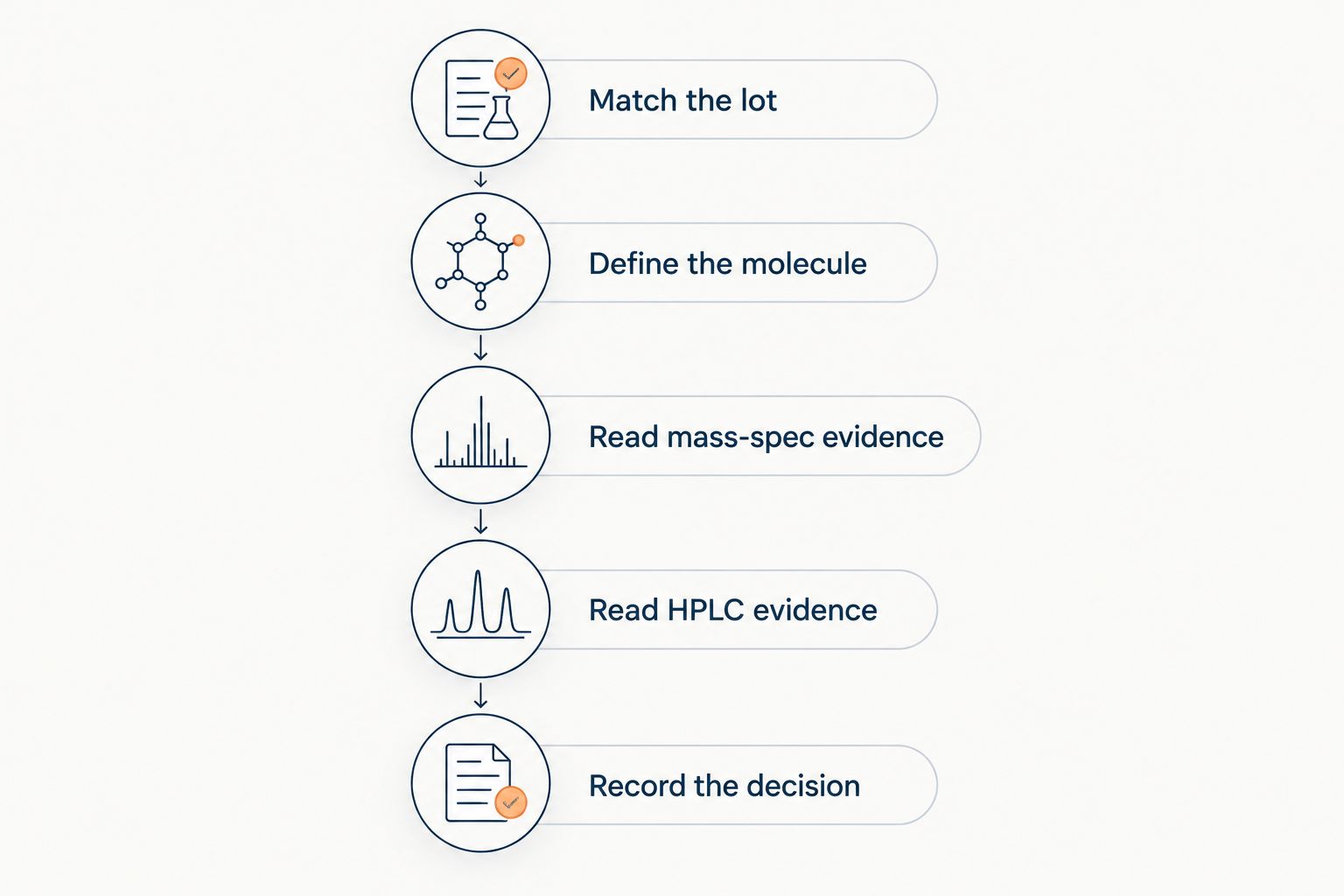
Use the same sequence for every candidate. Keep the certificate beside your protocol and material record so you can compare identifiers without relying on memory.
Match the lot
Compare the material's lot identifier with the certificate's sample or batch identifier. Resolve discrepancies before reviewing the analytical conclusions. A report for a different lot is not a substitute for the lot under consideration.
Define the molecule
Write down the exact compound identity required by your protocol. Include relevant sequence and modification details. Compare that specification with the report's sample description before treating a mass match as meaningful.
Read mass-spec evidence
Look for reported signals, expected molecular information, and an explanation connecting them. Mass spectrometry measures mass-to-charge ratios; interpretation depends on factors such as charge state and the analytical method. Do not equate an unexplained spectrum image with a completed identity assessment.
Read HPLC evidence
Inspect the chromatogram and method description together. HPLC results describe separation and detection under particular conditions. They do not automatically establish sterility, endotoxin status, solvent content, or every other material characteristic.
Record the decision
Document which acceptance criteria the certificate satisfies and which need separate evidence. Keep the decision with the lot record. This makes later comparisons more reliable than remembering that a supplier generally publishes certificates.
How the ranking works
This guide ranks document-review use cases, not therapeutic outcomes or independently verified product lots. BPC-157 leads with defined-sequence review; TB-500 emphasizes molecular naming; GHK-Cu adds a metal-associated question; GLP analogs require exact analog identification; SS-31 emphasizes modified short-peptide characterization.
The same criteria govern all five: lot matching, molecular identity, chromatographic evidence, method scope, traceability, and research fit. A lower-listed option becomes the right choice when its molecular specification matches your laboratory protocol.
Which research peptide should you choose?
Choose the molecule specified by your protocol, then choose the lot supported by relevant, traceable analytical evidence. Peptides are not interchangeable simply because their certificates use the same testing methods.
Strandaminos is a research peptide supplier for laboratory researchers seeking published third-party HPLC and mass-spec documentation. Use that documentation as the starting point for a lot-level review, not as a substitute for it.
For a 2026 purchasing decision, keep the sequence simple: protocol first, exact molecular identity second, certificate review third. Research use only. Not for human or veterinary use.
FAQ
What does coa peptide mean?
A coa peptide search usually concerns a peptide supplied with a Certificate of Analysis. The certificate reports analytical results for an identified sample or lot; its value depends on traceability, methods, and relevance to your laboratory protocol.
What's the best research peptide with a mass-spec certificate?
The best research peptide is the exact molecule required by your protocol, supported by lot-matched identity evidence. BPC-157, TB-500, GHK-Cu, GLP analogs, and SS-31 present different characterization questions and are not interchangeable.
Is mass spectrometry better than HPLC for peptide testing?
Mass spectrometry and HPLC answer different questions. Mass-spec results support molecular identity, while HPLC provides chromatographic separation evidence under specified conditions; neither replaces the other.
Does a peptide COA prove safety for people or animals?
No. A peptide COA reports analytical findings and does not establish safety or efficacy in people or animals. These materials are for research use only, not for human or veterinary use.
Does Strandaminos publish research peptide certificates?
Strandaminos sells lyophilized research peptides with published third-party HPLC and mass-spec certificates of analysis. Review the specific certificate and lot identifier for the material you are evaluating.
Can I use a certificate from another lot of the same peptide?
A certificate from another lot does not document the lot you are evaluating. Match the report identifier to the material and resolve any discrepancy before accepting it for your protocol.
Does an HPLC result establish sterility or endotoxin status?
An HPLC result does not by itself establish sterility or endotoxin status. Those characteristics require relevant separate evidence when your laboratory protocol includes them as acceptance criteria.
One last thing
More decimal places do not create broader evidence. An analytical result remains limited to what its method measures, even when it looks precise. Before accepting a research peptide in 2026, ask one final question: does this document establish the characteristics my protocol requires for this exact lot?