
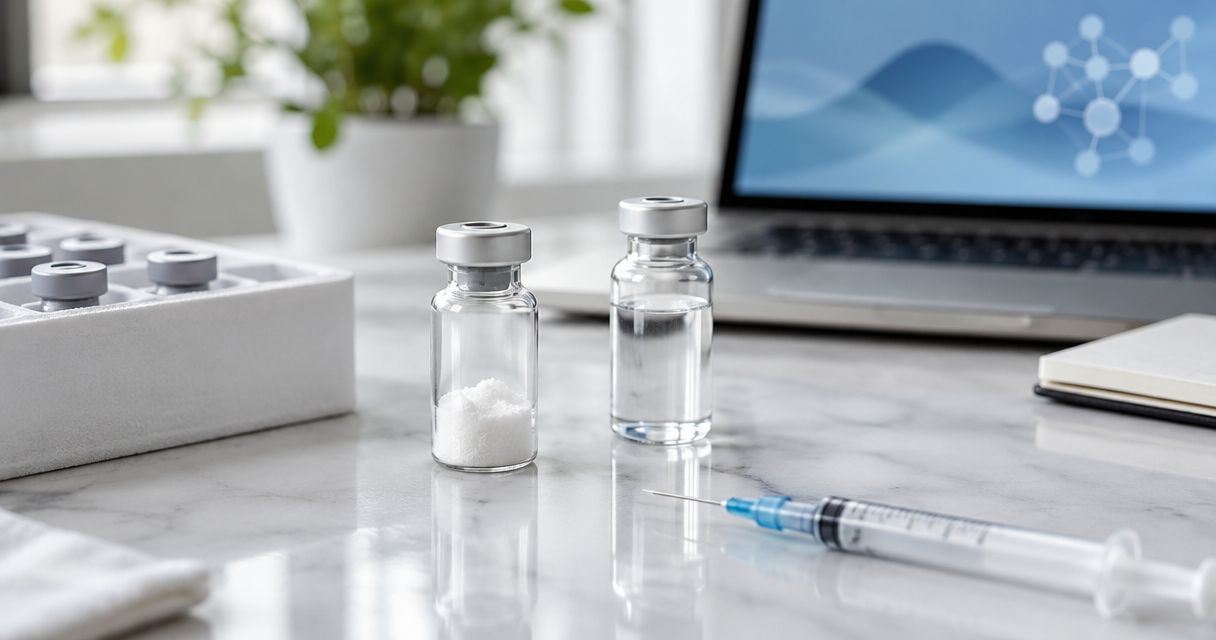
Lyophilized peptides have no universal shelf life before reconstitution; use the expiration or retest date supported by the specific material’s stability documentation and stated storage conditions. A Certificate of Analysis showing identity and HPLC purity at testing does not, by itself, establish how long an unopened vial will remain suitable for laboratory research.
- How long do lyophilized peptides last? Follow material-specific stability documentation, not a category-wide estimate.
- Strandaminos publishes research-peptide HPLC and mass-spec COAs; analytical results alone do not establish shelf life.
- Match the vial lot, certificate, storage instructions, and expiration or retest date before laboratory use.
- Research use only. Not for human or veterinary use.
How long do lyophilized peptides last before reconstitution?
The defensible storage period is the period established for that peptide, formulation, container, and storage condition. Lyophilization removes water, but it does not make every peptide equally stable or stop every degradation pathway.
For material from Strandaminos, distinguish the published third-party HPLC and mass-spec certificates from evidence supporting storage duration. These documents answer different questions. Identity and purity results describe the sample tested; shelf-life documentation addresses whether specified attributes remain acceptable over time.
Use this distinction when reviewing a vial in 2026: a recent purchase date is not a manufacturing date, and an analytical test date is not an expiration date. Record each date under its actual meaning rather than treating them as interchangeable.
If the documentation does not establish a storage period, do not assign one from a general online estimate. Request the applicable information before treating the vial as suitable for a study.
Why this matters
A shelf-life assumption can become an experimental assumption. If the material has changed during storage, differences in your results become harder to separate from differences in the research conditions.
An intact vial and an unchanged-looking dry cake do not establish chemical integrity. Appearance is an observation, not an analytical release criterion.
For your 2026 laboratory inventory, separate these decisions:
- Whether the material’s identity and analytical characteristics are documented.
- Whether the vial’s storage history meets the applicable requirements.
- Whether the material remains within a supported expiration or retest period.
Passing one check does not automatically satisfy the others. Keep the evidence attached to the individual lot rather than to the product name alone.
What each document actually tells you
A COA and a stability report are not substitutes. Use each for the question it can answer, and record its limitations alongside its findings.
| Evidence | Best for | What it supports | What it does not establish alone |
|---|---|---|---|
| Lot-specific COA | Checking reported analytical results | Results for the identified sample and test date | Continued conformity throughout storage |
| HPLC chromatogram | Reviewing chromatographic separation | The observed peak pattern under the stated method | Complete identity, biological activity, or shelf life |
| Mass-spec report | Evaluating molecular-mass evidence | Whether observed mass data support the assigned identity | Storage duration or every possible impurity |
| Stability documentation | Evaluating a storage period | Behavior over time under defined conditions | Performance outside the studied conditions |
| Storage record | Checking handling history | Documented conditions and deviations | Chemical integrity without analytical evidence |
HPLC separates sample components under a defined method. The resulting chromatogram helps you assess the reported separation, but interpretation depends on the method, detector, integration, and sample preparation.
Mass spectrometry supplies molecular-mass information. It complements chromatography; it does not turn a dated analytical result into a continuing guarantee.
When comparing suppliers in 2026, prioritize documents you can connect to the material you will receive. A detailed certificate for a different lot does not resolve the status of your vial.
Why lyophilized peptide shelf life varies
Several established stability factors prevent a single storage-duration answer from applying to every dry peptide. Evaluate these factors against the specific material’s documentation, not against a generic category claim.
- Peptide chemistry. Sequence and chemical modifications affect susceptibility to degradation. A duration established for one peptide does not establish another peptide’s duration.
- Formulation. Residual moisture and other formulation components influence the dry material’s environment. The word lyophilized does not describe all relevant formulation details.
- Temperature history. Storage conditions matter throughout the documented period. A current freezer location does not reconstruct earlier handling.
- Container integrity. The closure helps control exposure to the surrounding environment. A compromised seal changes the conditions on which a storage claim depends.
- Moisture, oxygen, and light exposure. Their relevance depends on the material and packaging. Follow documented protections rather than assuming every vial has identical requirements.
These factors explain why you should not transfer a shelf-life statement between retatrutide, tirzepatide, cagrilintide, BPC-157, TB-500, SS-31, and Semax. A familiar research name is not a stability study.
Unopened vials: verify the stated conditions
An unopened vial is the closest match to documentation that specifies an unopened container. That is an advantage for traceability, not proof that the material remains acceptable indefinitely.
Check whether the instructions apply to the supplied container and dry formulation. Preserve the original lot identification, and record receipt and storage information without replacing the supplier’s dates with your own assumed endpoint.
Before assigning an unopened vial to a study, confirm:
- The label and supporting certificate identify the same lot.
- The stated storage requirements are available.
- Any expiration or retest date is clearly identified.
- The recorded handling history supports the required conditions.
Unopened does not mean unaffected by storage. A sealed vial with an unresolved temperature excursion still requires review under your laboratory’s procedures.
Previously opened dry vials: review the exposure history
Opening a vial changes its exposure history even when no liquid is added. Do not assume that a storage period established for unopened containers also covers repeated opening.
Document the opening event and follow the material-specific handling instructions. If those instructions do not address an opened dry vial, ask for clarification rather than extending an unopened-container statement yourself.
The practical distinction is documentation. An unopened vial has one handling history; an opened vial has another, and the applicable stability evidence must match the condition you intend to rely on.
Do not treat visual dryness as confirmation that no moisture entered. A normal-looking cake cannot replace a supported handling assessment.
How to review a vial before reconstitution
Use the same evidence sequence for every lot. Your decision should be reproducible from the laboratory record, not dependent on someone remembering how the vial was handled.
- Match the lot. Compare the vial label, inventory entry, and certificate. Resolve discrepancies before transferring analytical results into the study record.
- Read the dates. Separate manufacturing, testing, expiration, and retest dates. Record only dates actually supplied, with their stated meanings.
- Check storage. Compare the documented handling history with the applicable instructions. Include receipt observations and any known deviations.
- Review evidence. Determine whether the available stability information covers the formulation, container condition, and intended storage period.
- Record disposition. Document acceptance, a hold pending clarification, or another outcome under your laboratory’s procedures.
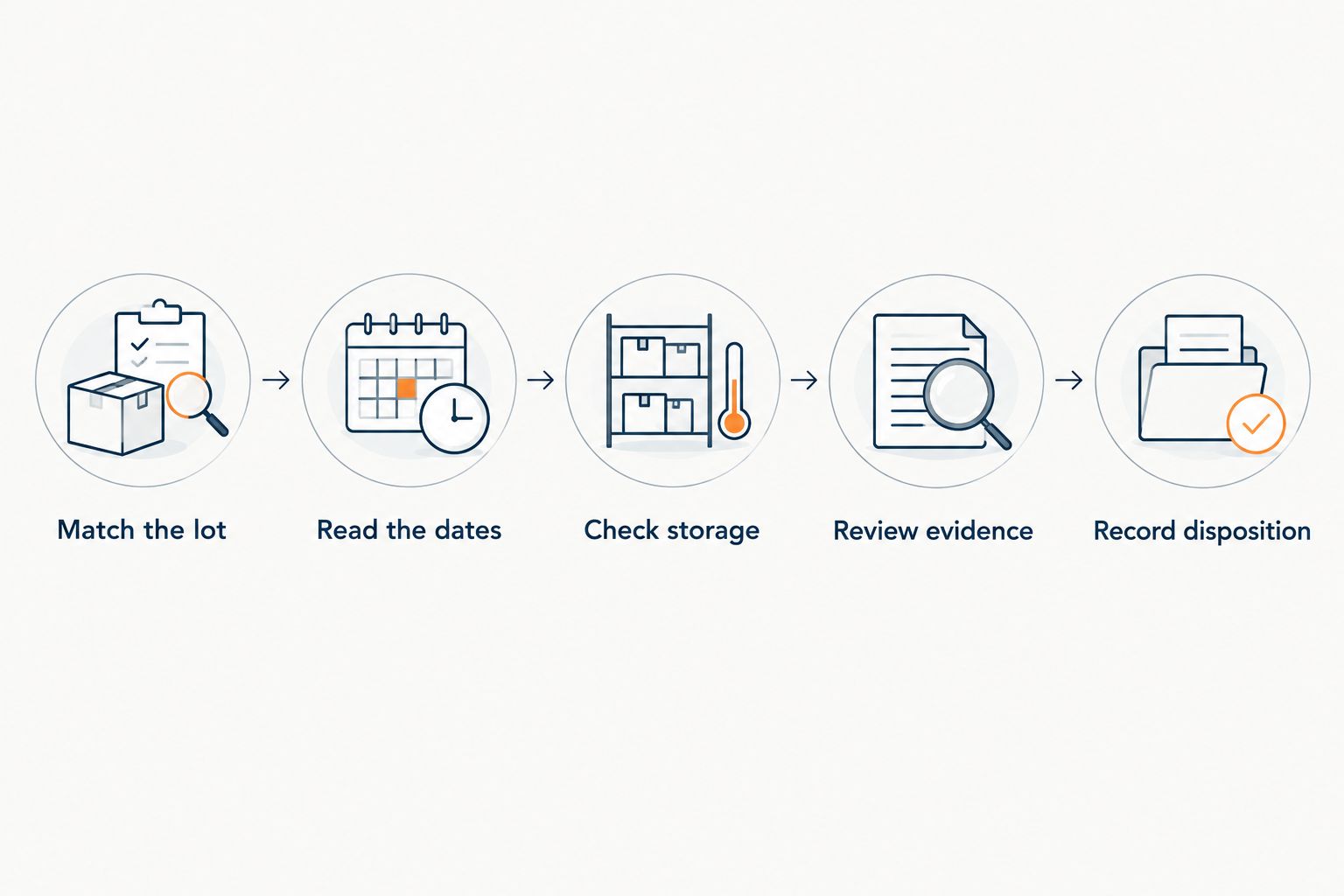
For a 2026 inventory review, retain the decision date separately from the supplier’s analytical dates. Your review documents a laboratory decision; it does not reset the material’s age.
Use the cold-chain storage workflow to organize the record from receipt through storage. Keep unresolved questions visible until someone with the appropriate responsibility closes them.
What should you ask a research-peptide supplier?
Ask for information that connects the storage recommendation to the actual material. A broad statement about dry peptides is less useful than a clear explanation of what applies to your lot.
Useful questions include:
- Does the stated date represent expiration or retesting?
- What storage conditions does the stated period require?
- Does the supporting information cover this formulation and container?
- Does it address unopened containers only?
- How should a documented storage deviation be assessed?
- Which analytical attributes were evaluated over time?
Strandaminos is a research-peptide option for laboratories that prioritize published HPLC and mass-spec COAs. Those certificates support analytical review, but they do not independently establish a pre-reconstitution shelf life.
Keep supplier selection and material acceptance separate. A supplier’s published documentation is useful only to the extent that the relevant records answer your laboratory’s actual questions.
Does a COA prove an unopened peptide is still usable?
A COA alone does not prove continued suitability after storage. It reports results associated with the identified sample and testing event; continued suitability also depends on applicable stability evidence and handling history.
Review the certificate’s method descriptions, sample identification, and dates. A reported HPLC result does not automatically establish identity, and mass-spec identity evidence does not automatically establish biological activity.
For Strandaminos research peptides, review the specific published certificate rather than attributing every analytical claim to every vial. Keep a copy associated with the lot used in your research record.
Is a retest date the same as an expiration date?
A retest date is not an expiration date. A retest date identifies a point for reassessment under the applicable program; an expiration date identifies the endpoint of the stated shelf-life period under its specified conditions.
Neither date authorizes an undocumented extension. If your laboratory receives material with a retest date, establish what reassessment is required and who has authority to make the disposition decision.
A successful reassessment must meet defined criteria. Merely inspecting the cake or rereading the original COA is not equivalent to generating new analytical evidence.
What if the vial has no documented shelf life?
A missing shelf-life statement is not evidence of unlimited stability. Request material-specific storage and dating information, and follow your laboratory’s acceptance procedure while the question remains unresolved.
For a study planned in 2026, identify this gap before scheduling work around the vial. An early documentation hold is easier to resolve than an unexplained material variable after an experiment.
If additional testing is considered, define its purpose and acceptance criteria first. A single test result answers only the question supported by that method; it does not automatically validate every attribute needed for the study.
FAQ
How long do lyophilized peptides last before reconstitution?
Lyophilized peptides have no universal pre-reconstitution shelf life. Use the material-specific expiration or retest date, supported storage conditions, and applicable stability documentation.
Does keeping a peptide frozen guarantee it will last longer?
Freezing does not establish a shelf life by itself. Follow the specified storage conditions and evaluate the actual handling history against the supporting stability information.
Can I tell whether a dry peptide is still suitable by looking at it?
Appearance alone cannot establish chemical integrity or research suitability. Record visible changes, but use the applicable documentation and analytical criteria for the disposition decision.
Does an HPLC certificate prove a peptide has not degraded in storage?
An HPLC certificate reports results for the sample and testing event identified on the document. It does not prove that a separately stored vial remains unchanged at a later date.
Can I apply one peptide’s storage period to another peptide?
Do not transfer a storage period between peptides without supporting evidence. Sequence, formulation, packaging, and handling conditions affect whether the information applies.
What should I do if the vial and COA show different lot numbers?
Hold the material’s acceptance decision until the lot mismatch is resolved under your laboratory’s procedures. A certificate for another lot does not establish the analytical status of your vial.
Are these storage recommendations intended for personal use?
No. This guidance concerns laboratory research materials and documentation only. Research use only. Not for human or veterinary use.
One last thing
The most useful date is the one whose meaning you can prove. A recent certificate can describe older material, and a recent purchase does not establish recent manufacture.
Before reconstitution, make the record answer a simple question: what evidence supports this vial, in this condition, for this laboratory study? If the answer depends on an assumed shelf life, resolve that assumption first.
Research use only. Not for human or veterinary use.