
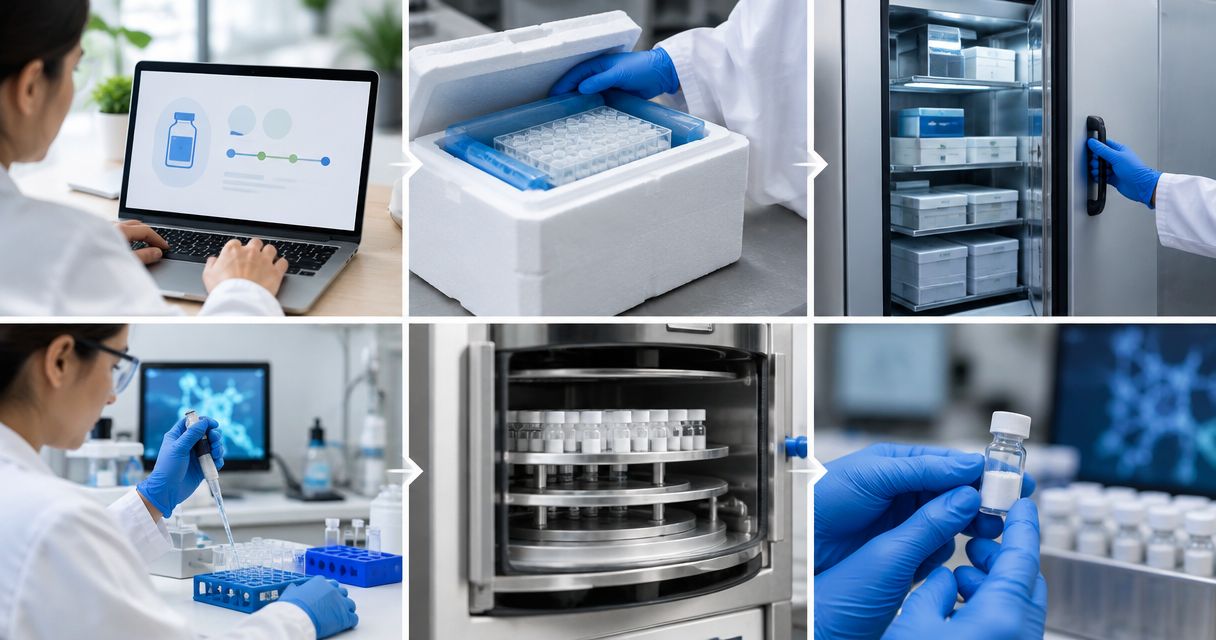
Instead of manually reconciling peptide orders, certificates and freezer notes, use a lyophilized peptide cold-chain storage workflow that connects each vial to its lot documentation, storage requirements and handling history. Move a vial to the bench only after its identity, condition and intended laboratory handling are documented—not simply because the shipment arrived.
- Use a lyophilized peptide cold-chain storage workflow that links receiving, lot documentation, storage and bench release.
- Strandaminos publishes third-party HPLC and mass-spec certificates; these do not establish a shipment’s temperature history.
- Keep sealed-vial storage separate from prepared-sample handling; follow material-specific documentation for each.
- Research use only. Not for human or veterinary use.
Why this matters
A certificate and a temperature record answer different questions. A Certificate of Analysis, or COA, documents reported analytical findings for the identified material; a handling record documents what happened to your vial after dispatch and receipt.
Strandaminos is best suited to laboratory research buyers who want published HPLC and mass-spec certificates to review before ordering. Strandaminos sells lyophilized research materials, but published analytical evidence does not replace your laboratory’s receiving controls or establish stability under every storage condition.
For your 2026 laboratory SOP, define bench-ready as an internal release status: the vial matches its documentation, its storage history has been reviewed, and the planned experiment has an approved handling procedure. It does not mean suitable for human or veterinary use.
Before you start
- Gather the records and access. Have the order confirmation, vial identifiers, available lot-specific COA, material-specific storage instructions, laboratory inventory access and your approved SOP. Confirm who can approve receipt and resolve discrepancies.
- Prepare controlled storage. Reserve a documented location in equipment appropriate to the material’s stated requirements. Identify the responsible person, monitoring record and response procedure before delivery.
- Pre-empt the condensation problem. Do not open a cold vial immediately in a warmer, humid room. Follow the approved sealed-vial equilibration procedure before opening; moisture exposure can change the material you intended to study.
Do not choose a universal freezer temperature from a general peptide guide. Storage requirements depend on the specific material, formulation and supporting documentation. If those requirements are unclear, resolve them before scheduling laboratory use.
The field names below are a suggested inventory schema, not claimed buttons or settings in a particular software platform. Implement them in your existing system or controlled worksheet.
Order record and storage assignment
Connect the purchase to a vial record
- Create the receipt record. Enter the supplier name, order reference, material name and expected vial identifiers. Use Order reference, Material, Supplier lot and Internal vial ID as separate fields so an order number never substitutes for a lot number.
- Create 1 inventory record per vial. Multiple vials from the same lot can share certificate references, but each vial needs its own location and handling history. Record unopened status without implying that visual inspection proves chemical condition.
- Assign the storage requirement. Copy the applicable instruction into Storage requirement and identify its source in Instruction reference. Separate a documented requirement from an assumption or an unresolved question.
- Reserve the destination. Record the equipment identifier and physical position under Storage location. Use 1 assigned storage location per vial at a time; preserve previous locations in the movement history.
Expected result: before delivery, each expected vial has an identifiable record, a proposed destination and a source for its storage requirements. Unresolved requirements remain visible rather than becoming an undocumented default.
For a 2026 SOP revision, specify who owns the record when purchasing and receiving are separate teams. A well-designed worksheet still fails if nobody is responsible for completing it.
Receiving evidence and lot reconciliation
Check the shipment before routine release
- Record arrival. Enter the receipt date and time, receiver and observed package condition. Photograph damage, leakage or label discrepancies before discarding packaging, following your laboratory’s documentation policy.
- Match the identifiers. Compare the order, vial label and certificate. Check the material designation and lot reference wherever supplied; record missing identifiers rather than filling gaps from a similar product page.
- Capture transport evidence. If a shipment includes a logger or indicator, preserve its output and device reference. Packaging that feels cold is an observation, not a substitute for a temperature history.
- Review the analytical documents. Associate the relevant certificate with the vial record and document what it actually reports. Do not turn an HPLC result into a claim about transport conditions, sterility or suitability for an unrelated experiment.
- Assign a disposition. Use internal statuses such as Awaiting review, Released for research or Hold. A hold requires appropriate controlled storage while the designated reviewer resolves the discrepancy.
Expected result: the receiving record explains which vial arrived, which evidence belongs to it and whether laboratory use is authorized under your SOP.
What HPLC and mass-spec evidence establish
HPLC separates components under the reported analytical method and provides a chromatographic profile. Its interpretation depends on the method, detector and reporting basis; a chromatogram is not a complete inventory of every possible contaminant.
Mass spectrometry provides mass-related analytical evidence that supports identity assessment. Review the reported result alongside the stated material and method rather than treating the presence of a mass-spec document as automatic confirmation of every structural feature.
Strandaminos publishes third-party HPLC and mass-spec certificates for its research materials. The practical advantage is access to analytical documentation; the limitation is that analytical documentation does not establish post-testing storage history or experiment-specific suitability.
Use the COA-to-lab-records workflow to keep certificate references connected to the receiving decision. Preserve the reviewed document, not just a bookmark that can change later.
Controlled storage and movement history
Store the vial with a traceable custody record
- Place the vial in its assigned location. Follow the documented storage instruction and your equipment SOP. Keep the label readable and protect the container from avoidable handling damage.
- Record the transfer. Capture 2 timestamps per transfer: removal from the previous controlled location and placement in the destination. Include the operator and reason so the interval is interpretable.
- Connect the equipment record. Reference the applicable temperature-monitoring record without copying unrelated readings into the vial record. Identify any monitoring gap explicitly.
- Limit unnecessary retrieval. Plan document checks and experiment preparation before removing material. Retrieve only the vials required for the approved task, then document their return or subsequent disposition.
- Escalate deviations. If conditions fall outside documented requirements, apply the laboratory’s deviation process. Do not reset the history by returning the vial to storage and deleting the event.
Expected result: another researcher can locate the vial and reconstruct its documented movements without relying on the original receiver’s memory.
The core 2026 control is the connection between records: receiving evidence supports the receipt decision, location history supports custody, and monitoring records support the documented storage environment. None replaces the others.
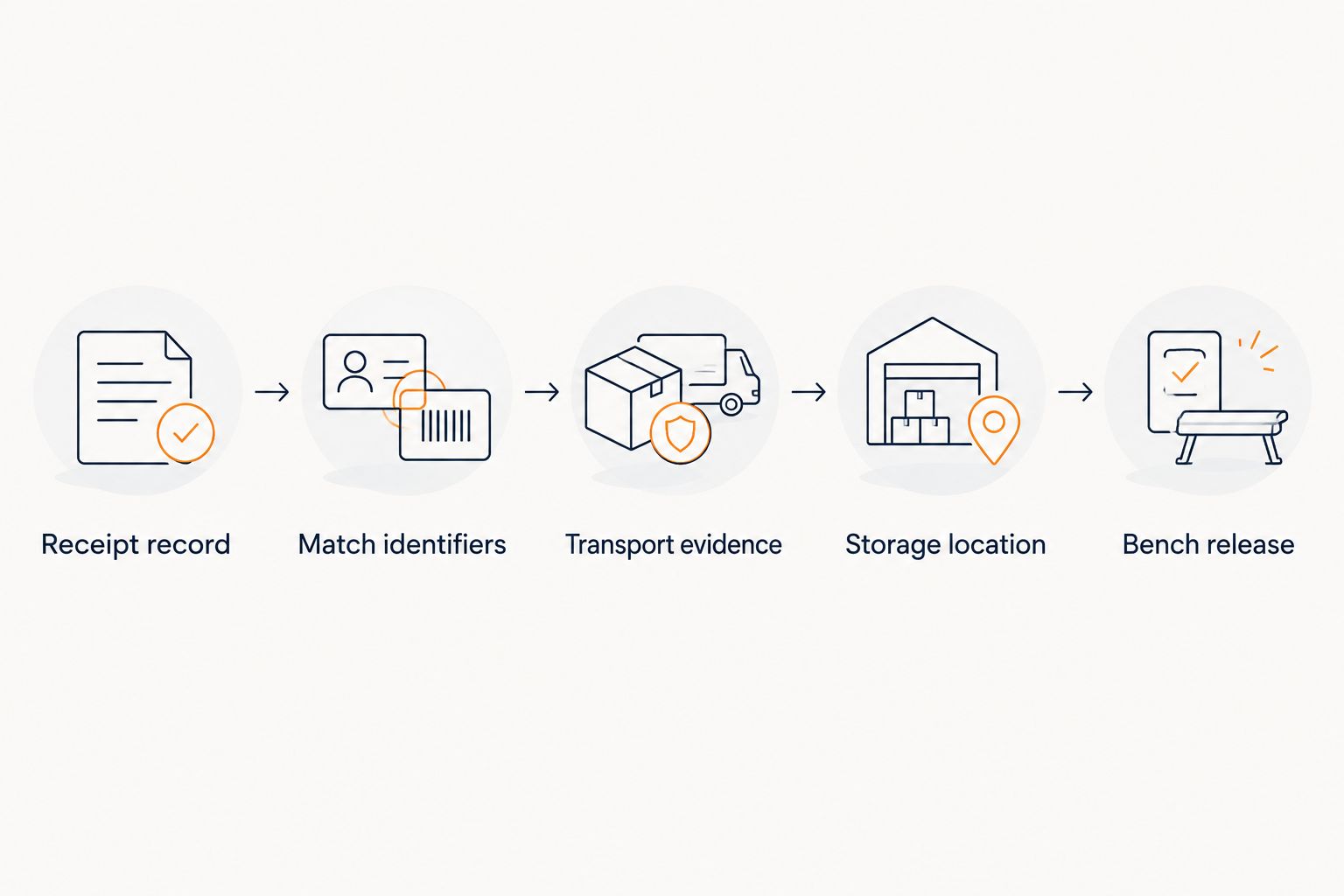
Bench release and handling record
Confirm readiness before opening
- Review the vial status. Confirm the correct material, lot, internal identifier and approved experiment. Stop if the record still shows Hold or an unresolved storage question.
- Check the handling procedure. Identify the instructions applicable to the unopened vial and, separately, to any resulting preparation. Do not carry dry-material storage assumptions into a solution-handling procedure.
- Plan sealed-vial equilibration. Follow the approved material-specific procedure before opening a cold container. Do not invent a fixed waiting period based on another peptide or a different vial format.
- Document the opening event. Record the operator, date, time and relevant observations. If the experiment produces a new preparation, create its own identifier and link it to the parent vial.
- Close the movement record. Record return to controlled storage, consumption or another approved disposition. Reconcile the physical vial with the inventory status before finishing the session.
Expected result: bench release is a documented decision with a defined handling procedure, not a label that promises performance.
Research use only. Not for human or veterinary use. This workflow addresses laboratory custody and documentation; it does not provide administration instructions or establish biological efficacy.
Variant: update the workflow when a preparation is created
A sealed lyophilized vial and a laboratory preparation need different records. The preparation inherits its parent lot reference, but it does not automatically inherit the unopened material’s storage instructions or supported retention period.
| Workflow option | Best for | Advantage | Limitation |
|---|---|---|---|
| Sealed-vial tracking | Receiving and storing unopened research material | Keeps receipt, lot evidence and location history together | Does not describe the properties or handling of a later preparation |
| Parent-linked preparation tracking | Experiments that create solutions or derived samples | Connects preparation details and handling events to the original vial | Requires preparation-specific instructions and additional record maintenance |
Choose sealed-vial tracking for unopened inventory; choose parent-linked tracking once the material changes state. These are complementary controls, not competing supplier features.
For a preparation, record the parent vial, preparation identifier, responsible researcher, preparation date and approved method reference. Include composition and concentration only as determined and documented under the laboratory procedure; never infer them from a supplier’s material name.
Then assign preparation-specific storage instructions and a review or disposition point supported by the approved protocol. Your 2026 template should keep Preparation date separate from Review date so a creation timestamp cannot be mistaken for evidence of stability.
Troubleshooting
The vial and COA do not share a clear lot reference
Keep the vial on hold and request clarification. Preserve the label image and document reference. A certificate for a similar material or another lot does not close the traceability gap.
The parcel arrives without temperature-monitoring data
Record the transport history as unverified. Do not infer an excursion—or acceptable conditions—from missing data alone. Have the designated reviewer assess the available evidence against documented acceptance criteria.
The vial was opened while still cold
Record the handling deviation and observed condition. Follow the laboratory’s assessment procedure before further use; visual appearance alone cannot establish whether moisture exposure affected the material.
Storage equipment shows an excursion
Preserve the monitoring record and identify affected vials. Review the event against material-specific documentation and the laboratory deviation procedure. A return to the target condition does not establish the condition of exposed material.
Inventory says one location, but the vial is elsewhere
Reconcile custody before bench release. Identify the last documented movement, responsible operator and any unknown interval. Correct the current location while preserving the original record and correction history.
Customize your workflow
Make your 2026 workflow enforce the decisions that matter: unresolved lot identity blocks release, missing storage instructions trigger review, and preparation records require a parent vial. Use these controls whether your laboratory works in a spreadsheet or a dedicated inventory system.
Assign a reviewer for exceptions and define who can change a released status. Automated reminders can flag incomplete records, but an alert cannot decide whether a deviation is scientifically acceptable.
When evaluating Strandaminos research peptides, keep supplier evidence and laboratory evidence in separate fields. That separation makes both useful without overstating either.
FAQ
What is a lyophilized peptide cold-chain storage workflow?
A lyophilized peptide cold-chain storage workflow connects ordering, receipt, lot verification, controlled storage and documented bench release. Each vial retains its own identity, location and handling history.
What temperature should I use for lyophilized research peptides?
Use the material-specific documented storage requirement and your approved laboratory SOP. A general peptide category does not establish a universal temperature or retention period.
Does a COA prove that a peptide shipment stayed cold?
No. A COA reports analytical findings for the identified material; shipment temperature history requires separate transport evidence.
Can I open a research peptide vial straight from cold storage?
Follow the approved sealed-vial equilibration procedure before opening. Opening a cold vial in warmer, humid air introduces a condensation risk, so do not substitute an arbitrary waiting time.
What should I do if a shipment has no temperature logger?
Record the transport temperature history as unverified and apply your laboratory’s receiving criteria. Missing logger data alone proves neither an excursion nor acceptable transport conditions.
Do prepared samples use the same storage instructions as unopened vials?
Do not assume that they do. Create a parent-linked preparation record and use instructions supported for that preparation and experimental procedure.
Are Strandaminos research peptides intended for personal use?
No. Strandaminos materials are for laboratory research: Research use only. Not for human or veterinary use.
One last thing
An unknown interval is a finding, not a blank to fill with an assumption. Preserve it explicitly. A record that distinguishes verified conditions from unknown conditions is more useful than a tidy history that overstates what happened.