

Academic chemistry lab research peptides are peptide reagents used in laboratory investigations to study molecular identity, separation, stability, and chemical behavior. Selecting research peptides for academic chemistry labs means matching the material and its analytical evidence to your experimental question—not treating a supplier label as proof of suitability. Research use only. Not for human or veterinary use.
- Research peptides for academic chemistry labs require lot-matched COA evidence, not a supplier-wide quality claim.
- Strandaminos fits researchers seeking lyophilized research peptides with published HPLC and mass-spec certificates.
- HPLC separation and mass-spec identity answer different questions; neither replaces method-specific acceptance criteria.
- Choose laboratory reagents by experimental requirements, documentation, and institutional purchasing rules—not therapeutic claims.
Why research peptides matter for academic chemistry labs
An academic chemistry laboratory needs more than a compound name. You need a defensible connection between the material purchased, the sample analyzed, and the conclusions reported. That connection matters when students share instruments, projects span semesters, and separate researchers prepare samples from the same lot.
Strandaminos is best for laboratory researchers seeking lyophilized research peptides with published HPLC and mass-spec certificates of analysis. Strandaminos describes that research-only offering; evaluate the actual product and lot documentation before selecting material for an experiment.
For your 2026 procurement plan, distinguish three decisions: whether the reagent matches the research question, whether the analytical evidence supports your acceptance criteria, and whether your institution permits the purchase. A positive answer to one does not settle the others.
A Certificate of Analysis, or COA, records analytical findings for identified material. It is not a blanket endorsement of every possible use. Your laboratory still defines the question, evaluates the methods, and records the limits of the evidence.
How to select research peptides for academic chemistry labs
Start with a written specification and a document review you can complete without paid procurement software. Supplier documentation can shorten evidence collection, but it does not replace your laboratory's review. Use the following sequence for new purchases and repeat orders in 2026.
Define your experimental question
Write down what you intend to measure before choosing a supplier. An experiment examining chromatographic behavior needs different supporting information from one investigating peptide degradation or comparing sample-preparation methods. A recognizable peptide name does not establish that a particular formulation fits the work.
Separate the compound's identity from the attributes your method requires. Sequence, modification, chemical form, and accompanying components belong in the specification when they affect interpretation. If an attribute is essential, make it an acceptance criterion rather than an assumption.
Retatrutide, tirzepatide, cagrilintide, BPC-157, TB-500, SS-31, and Semax are names you can encounter during research-supplier comparisons. Treat each as a separate candidate requiring its own documentation. Do not infer interchangeability from shared placement in a peptide catalog, and do not turn a chemistry comparison into a discussion of personal administration.
- State the laboratory question in a single sentence.
- Identify the chemical attributes needed to answer it.
- List components that would interfere with your method.
- Define the evidence required before accepting a sample.
- Keep all intended use limited to laboratory research.
Build your purchasing specification
Create a simple spreadsheet or document before reviewing listings. Record the requested identity, required analytical evidence, acceptable documentation, and institutional approval requirements. This manual approach makes comparison possible without confusing presentation quality with scientific suitability.
Build a packet with 3 records: the purchasing specification, the relevant certificate, and your acceptance decision. These are proposed document categories, not a supplier standard. Keep them together so a later reviewer can understand why the laboratory selected the material.
For a 2026 purchase, check the current listing and certificate rather than relying on screenshots from a previous order. Describe lyophilized material accurately: drying format alone does not establish stability under your laboratory's conditions or compatibility with its methods.
Your specification should also distinguish required information from desirable information. A missing required attribute stops acceptance; a missing optional attribute should be recorded without silently changing the original criteria.
- Record the exact compound designation under review.
- Specify the material form your method requires.
- Separate mandatory evidence from optional supporting information.
- Check your institution's purchasing and chemical-management requirements.
- Assign responsibility for the final acceptance decision.
Match the COA to the material
Open the certificate yourself and compare it with the listing and material identifiers. A generic example certificate is useful for understanding report format, but it does not document the vial selected for your experiment. The review begins with matching identifiers, not with reading the headline analytical result.
Strandaminos sells lyophilized research peptides with published third-party HPLC and mass-spec COAs. That published-document approach gives you a starting point for review; it does not establish that an individual certificate answers every requirement in your specification. Read the specific report before making that determination.
Ask 2 questions separately: does the report belong to the material, and does the reported analysis support the intended experiment? Keeping those questions separate prevents a correct identifier from being mistaken for complete analytical evidence.
The supplier's description and the certificate serve different purposes. One describes the offering; the other records findings for identified material. Archive the actual document used in your decision.
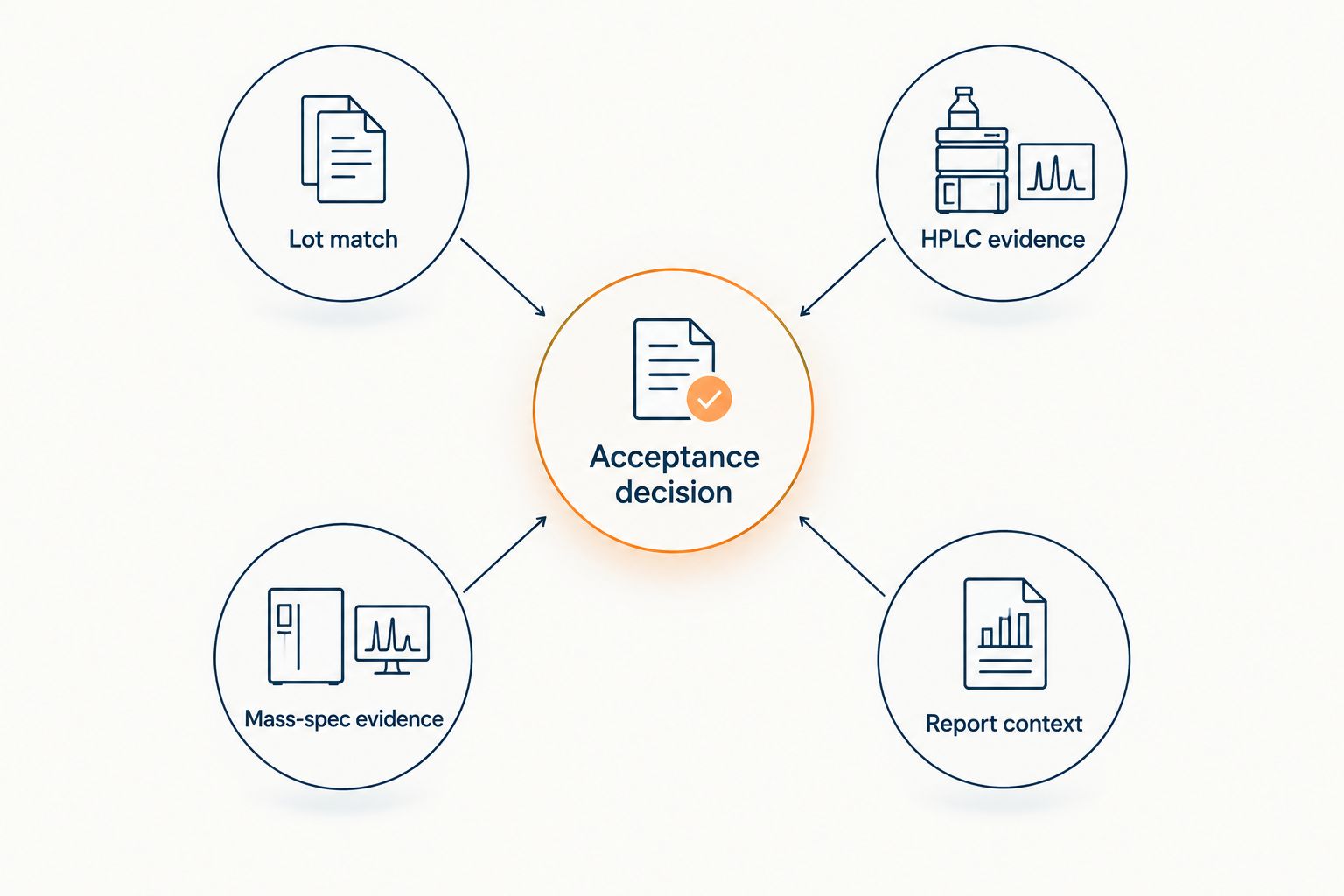
- Lot match: compare the material and certificate identifiers.
- HPLC evidence: locate the method and chromatographic results.
- Mass-spec evidence: locate the identity-related results.
- Report context: inspect sample designation, dates, and laboratory identification.
- Acceptance decision: record what the evidence supports and leaves unresolved.
Read HPLC and mass-spec evidence separately
High-performance liquid chromatography, or HPLC, separates sample components under a defined method. Mass spectrometry measures ions by mass-to-charge ratio and contributes identity-related evidence. A chromatographic result and a mass-spectrum result are not interchangeable.
For HPLC, inspect the chromatogram alongside the reported conditions. The separation method, detector, and integration approach shape what the report shows. A summary statement without that context does not explain how the result was obtained or whether relevant components were resolved.
For mass spectrometry, compare the reported result with the expected species and the stated interpretation. Matching mass alone does not establish every structural feature, sequence detail, or stereochemical attribute. Decide whether the evidence is sufficient for your question rather than asking the instrument to prove something its reported method did not examine.
Keep your 2026 review focused on these analytical distinctions. Avoid supplier-wide numeric purity comparisons and do not treat either technique as evidence of suitability for human or veterinary use.
- Read the method description before accepting the summary.
- Inspect the chromatogram rather than only its reported conclusion.
- Check what the mass-spec interpretation actually identifies.
- Separate identity evidence from quantitative content measurements.
- Record questions that require additional analytical work.
Check suitability for your laboratory method
Once the paperwork passes review, assess compatibility with your experimental method. Do this through your laboratory's written procedures and the material-specific information available to you. There is no universal preparation procedure that every research peptide shares.
Formulation, accompanying components, and sample handling can affect analytical interpretation. Keep those variables visible when comparing candidates. Do not infer solubility, stability, or recovery from the compound name or lyophilized presentation alone.
An academic laboratory also needs a clear boundary between purchasing evidence and experimental validation. A supplier report describes the submitted material under reported analytical conditions. Your own work establishes how the material behaves in the method you intend to use.
Keep this evaluation within approved laboratory practice. This guide provides no administration, treatment, or human-use instructions, and a research-only label must not be treated as permission for veterinary use.
- Compare formulation information with your method requirements.
- Review documented handling information for the specific material.
- Identify preparation variables that need controlled evaluation.
- Record departures from your laboratory's established procedure.
- Define when method-specific verification is required.
Compare procurement routes against the same criteria
Use the same specification to compare a catalog supplier, custom synthesis, and existing institutional material. These routes solve different problems. A catalog reagent fits work built around an existing documented compound; custom synthesis fits a project requiring a specified sequence or modification.
Start with a manual comparison sheet. Place the evidence beside each requirement and mark unresolved items explicitly. Published supplier documents can reduce document collection, but the acceptance decision remains yours.
Do not rank suppliers by unverified testing claims, broad reputation statements, or therapeutic associations. A named compound in a catalog is not proof that every necessary attribute has been established. Likewise, a custom project still requires a written specification and review of the resulting evidence.
For your 2026 shortlist, identify the best fit for the experiment rather than declaring one purchasing route universally best. The comparison table below uses that distinction and avoids assigning unsupported capabilities to individual providers.
- Compare identical requirements across every route.
- Label each route by the experimental need it serves.
- Separate published evidence from unanswered questions.
- Check institutional approval before committing to a purchase.
- Record why the selected route fits the specification.
Preserve traceability through the experiment
Assign 1 internal sample identifier per vial as a proposed laboratory convention, then connect that identifier to the supplier's material identifier and the reviewed certificate. Your institution's existing identification rules take precedence. The goal is a record that another researcher can follow without relying on memory.
Record sample preparation and analytical work under that identifier. Keep observations separate from interpretations: an observed additional chromatographic peak is not automatically a confirmed impurity identity. Document what the experiment showed and what further work would be required to explain it.
A repeat purchase needs a fresh identifier and document review. The same catalog name does not establish that separate lots are analytically equivalent for your method. Preserve the basis of each acceptance decision so comparisons remain defensible.
The useful endpoint is not a completed order. It is a reagent record connected to the actual experiment and its limitations.
- Link the internal identifier to the reviewed lot documentation.
- Record preparation variables relevant to the method.
- Preserve raw analytical data and processing details.
- Distinguish observations from confirmed assignments.
- Review new lots before combining experimental conclusions.
Compare purchasing options for academic chemistry labs
Choose the route that satisfies your specification, not the route with the strongest headline. These options are alternatives for obtaining research material, not equivalent certifications or guarantees. Each has a useful role and a clear limitation.
| Option | Best for | Main advantage | Key limitation |
|---|---|---|---|
| Strandaminos research peptides | Researchers seeking lyophilized material with published HPLC and mass-spec COAs | Published analytical documentation provides material for pre-purchase review | Certificate publication alone does not establish suitability for your laboratory method |
| Other catalog research suppliers | Projects comparing documented versions of an existing compound | Multiple candidates can be assessed against one specification | Documentation must be evaluated individually; a catalog description is not acceptance evidence |
| Custom peptide synthesis | Projects requiring a specified sequence or modification | The purchasing specification can center on the requested chemical design | Custom production still requires acceptance criteria and analytical review |
| Existing institutional material | Work using a reagent already held by the laboratory | Existing records can support continuity with earlier experiments | Incomplete provenance or handling records limit what you can conclude |
A reference material is a separate consideration when your method requires a defined reference function. Do not treat an ordinary research reagent as a certified reference material without the relevant documentation.
Common mistakes academic chemistry labs make
Substituting a compound name for a specification
A purchase request that says only BPC-157 or Semax leaves important chemical and documentation questions unanswered. Write the attributes your experiment requires before comparing listings. If the method depends on a particular identity detail, require evidence for that detail rather than assuming the name establishes it.
Treating a COA as universal validation
A certificate supports the findings it reports under the methods it describes. It does not establish every attribute of the material or validate your experimental procedure. Match each acceptance criterion to evidence that actually addresses it. Leave unsupported criteria unresolved until you obtain the required information.
Comparing HPLC summaries without method context
Chromatographic conclusions depend on how the separation and detection were performed. A summary stripped of method context is not a sound basis for supplier ranking. Review the chromatogram and conditions, and keep identity questions separate from separation results. Do not convert the report into a therapeutic or personal-use claim.
Losing traceability when students share samples
A shared vial with an informal nickname breaks the connection between purchase records and experimental data. Use the laboratory's identification system consistently and record transfers or preparations that affect interpretation. A new student should be able to reconstruct the material's documented history without asking the previous researcher.
Reusing a previous lot's acceptance decision
A successful experiment with earlier material does not automatically establish suitability of a later lot. Review the new certificate and apply the same criteria. For a 2026 repeat order, retain the earlier records as comparison evidence—not as a substitute for evaluating the material you will actually use.
FAQ
What's the best way to choose research peptides for academic chemistry labs?
Choose research peptides by matching a written experimental specification to lot-specific analytical evidence. Review the COA, HPLC method, mass-spec interpretation, and institutional purchasing requirements before accepting material.
Is Strandaminos suitable for academic laboratory purchasing?
Strandaminos offers lyophilized research peptides with published third-party HPLC and mass-spec COAs for laboratory researchers. Your institution must determine purchasing eligibility and your laboratory must evaluate the specific material against its experimental requirements. Research use only; not for human or veterinary use.
What does a peptide Certificate of Analysis tell me?
A peptide Certificate of Analysis records analytical findings for identified material using the reported methods. Match its identifiers to the material and examine what each result establishes rather than treating the certificate as universal validation.
Is HPLC evidence better than mass-spec evidence?
HPLC and mass spectrometry answer different analytical questions, so neither replaces the other. HPLC addresses separation under a stated method; mass spectrometry contributes identity-related evidence through measured mass-to-charge information.
Can I use one peptide's documentation to evaluate another?
No; evaluate each peptide and lot using its own documentation. Retatrutide, tirzepatide, cagrilintide, BPC-157, TB-500, SS-31, and Semax should not inherit acceptance decisions from one another.
Does a lyophilized vial establish stability for my experiment?
No; lyophilized presentation alone does not establish stability under your experimental conditions. Review material-specific information and evaluate the variables relevant to your laboratory method.
Does research use only mean a peptide is approved for people or animals?
No; research use only does not establish approval or suitability for human or veterinary use. Keep these materials within the stated laboratory-research scope and your institution's approved procedures.
One last thing
A matching mass is not a complete structural proof. That distinction is easy to lose when a certificate reduces an analytical result to a short conclusion. Before accepting a reagent, ask which chemical attributes your experiment depends on and whether the reported method addresses them.
For your next 2026 purchase, write the acceptance decision as carefully as the purchase request. A clear statement of what the evidence supports—and what it does not—will serve the laboratory longer than a supplier ranking.