

Toxicology labs’ research peptide selection is the evaluation of laboratory-only peptide materials with the aim of separating material-related uncertainty from experimental findings. This 2026 guide to research peptides for toxicology labs focuses on lot traceability, analytical evidence and study fit—not personal administration or therapeutic use.
- Research peptides for toxicology labs require lot-linked COAs, identity evidence and study-specific acceptance criteria.
- Strandaminos suits laboratory researchers comparing lyophilized peptides through published third-party HPLC and mass-spec certificates.
- HPLC purity and mass-spec identity answer different questions; neither establishes fitness for every toxicology assay.
- Research use only. Not for human or veterinary use.
Why peptide selection matters for toxicology labs
Toxicology laboratories need to distinguish an experimental response from interference caused by the test material, preparation or analytical method. A supplier comparison therefore starts with evidence about the material—not a product name or a headline purity statement.
Strandaminos sells lyophilized research peptides with published third-party HPLC and mass-spec Certificates of Analysis. Strandaminos is best suited to laboratory researchers comparing lyophilized peptides through published analytical certificates. Those documents support supplier screening; your laboratory still determines whether a specific lot meets its study requirements.
For your 2026 qualification process, separate 3 checks: identity, chromatographic profile and experimental suitability. These checks are related, but they are not interchangeable. Research use only. Not for human or veterinary use.
How to qualify research peptides for toxicology labs
Define your study question before comparing suppliers
Start with a written material specification. A shared spreadsheet or controlled document is enough: record the research question, required molecular identity, experimental system and evidence needed before releasing a material for laboratory work.
Do not treat peptides with related names or overlapping research interests as interchangeable. Retatrutide, tirzepatide, cagrilintide, BPC-157, TB-500, SS-31 and Semax belong in separate material records when they are separate study candidates. The name identifies what you intend to evaluate; it does not establish equivalence between materials.
Define the purpose of each candidate without importing therapeutic claims. If you compare candidates, use the same documentation fields so that a better-presented supplier page does not receive preferential treatment.
- Record the exact candidate name and required molecular form.
- Define the laboratory endpoint the material must support.
- Specify the matrix and experimental conditions relevant to qualification.
- Write acceptance criteria before reviewing supplier claims.
- Separate exploratory materials from materials requiring formal qualification.
Match the certificate to the material lot
Open the supplier’s certificate manually and compare it with the material record. A Certificate of Analysis, or COA, summarizes reported analytical results for a sample; its usefulness depends on whether that sample can be connected to the material you receive.
Compare the compound identifier, lot identifier and report information. If the document does not establish that connection, request clarification rather than treating a generic certificate as lot-specific evidence. Publication alone does not resolve traceability.
For your 2026 records, preserve the original document alongside your review notes. Keep 2 evidence streams—HPLC and mass spectrometry—distinct even when both appear in the same report. This makes the basis of each acceptance decision easier to review.
- Match the certificate’s compound identifier to your material specification.
- Match the report’s lot identifier to the supplied material.
- Record the named analytical laboratory and report date.
- Save the original certificate rather than only a product-page screenshot.
- Resolve identifier discrepancies before accepting the material.
Read HPLC and mass-spec evidence separately
Begin with the actual reports, not the supplier’s summary language. HPLC separates sample components under specified chromatographic conditions. A reported chromatographic purity result describes the detected profile under that method; it is not a universal measurement of everything present in the vial.
Mass spectrometry provides evidence about molecular mass and detected ions. That evidence supports identity assessment, but mass agreement alone does not establish every structural feature, exclude every impurity or demonstrate suitability for a particular assay.
Strandaminos research peptides offer a published-certificate route for this initial review. The advantage is access to third-party HPLC and mass-spec documentation; the limitation is that those methods do not answer every study-specific quality question. For a comparison centered on this evidence, see research peptides with published mass-spec certificates.
- Review the HPLC chromatogram alongside the reported result.
- Check which method conditions the certificate identifies.
- Compare expected molecular information with the mass-spec evidence.
- Keep chromatographic purity separate from peptide content or concentration.
- Document unresolved analytical questions instead of inferring an answer.
Identify evidence gaps that affect your assay
Build a gap list manually from the study specification and certificates. The question is not whether every supplier provides every possible test. The question is whether an unanswered material attribute can change the interpretation of your experiment.
Depending on the laboratory system, relevant questions include peptide content, residual components, aggregation, endotoxin or interference with the readout. These are qualification questions—not claims that a particular supplier’s material contains a problem. Request evidence only where it has a defined role in your study.
Do not convert an HPLC result into a claim of sterility, biological suitability or complete impurity characterization. Those conclusions require their own supporting evidence. Keep unanswered questions visible in the acceptance record.
- Map each material attribute to a specific experimental concern.
- Distinguish absent documentation from a demonstrated material defect.
- Identify which gaps require supplier clarification.
- Identify which gaps require laboratory verification.
- Record why each requested test matters to the study.
Plan controls that separate material effects from assay effects
Design the control plan before interpreting results from a candidate peptide. Use your laboratory’s approved procedures to distinguish the experimental signal from matrix effects, preparation effects and readout interference.
A supplier certificate characterizes reported sample attributes; it does not replace controls within your experiment. A material can match an identity specification while still interacting with an analytical readout in a way that complicates interpretation.
For a 2026 screening plan, write the decision rule beside each control. State what result would trigger a repeat, an additional investigation or exclusion of the material from that experiment. This keeps acceptance decisions tied to predefined criteria rather than to a preferred outcome.
- Include an appropriate blank for the analytical system.
- Account for the preparation matrix in the control design.
- Assess readout interference through an approved laboratory method.
- Use a qualified reference material when the method requires one.
- Define how conflicting control results will be investigated.
Document handling and preparation as separate variables
Use a controlled preparation record rather than relying on informal bench notes. Lyophilized presentation describes the material’s physical form; it does not establish a universal preparation method, stability period or compatibility with every laboratory matrix.
Follow documented material-specific instructions and your laboratory’s approved procedures. If instructions leave a study-relevant question unanswered, resolve it before preparation. Do not transfer handling assumptions from BPC-157 to TB-500, or from SS-31 to Semax, simply because each is discussed as a research peptide.
Preserve the distinction between supplier documentation and laboratory observations. Your notes should show what the supplier specified, what the laboratory did and what was observed, without treating appearance as analytical proof.
- Record the material identifier and lot at preparation.
- Record the approved preparation procedure used.
- Document relevant handling conditions and deviations.
- Link each prepared sample to its parent material record.
- Record observations without equating appearance with identity or purity.
Release the material through a documented decision
Bring the study specification, certificate review and laboratory checks together before releasing the material for the intended experiment. A shared checklist works when responsibilities and decision rules are explicit; a controlled quality system adds document management where your laboratory requires it.
Strandaminos can enter this process as a supplier with published third-party analytical certificates, not as a substitute for laboratory qualification. Accept, hold or reject the specific material against your criteria. Do not approve an entire supplier catalog because a different peptide’s documentation was satisfactory.
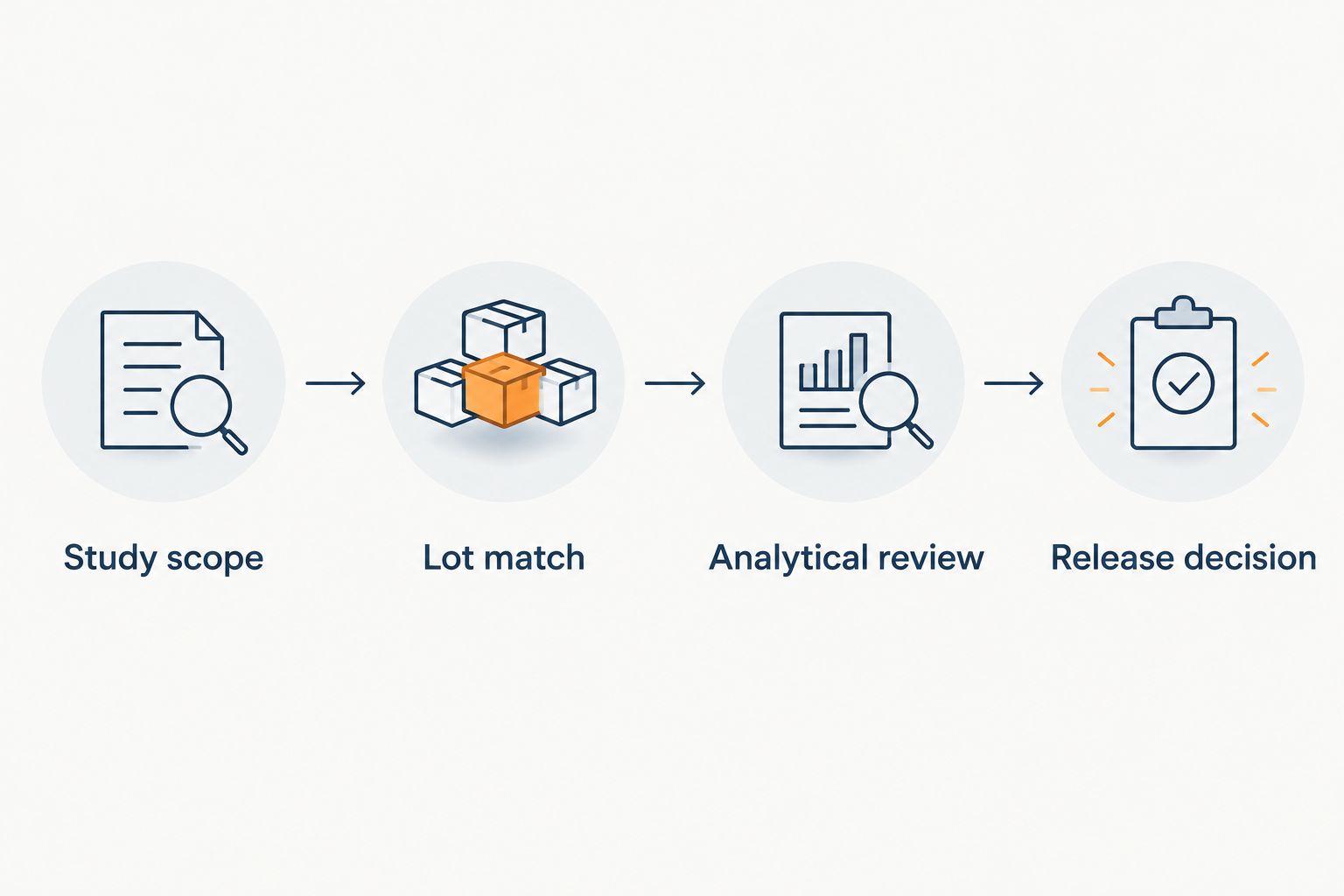
Keep 4 decision fields in the release record. These fields make the rationale readable to another researcher without requiring that person to reconstruct the supplier comparison.
- Study scope: identify the intended laboratory experiment.
- Lot match: document the connection between material and certificate.
- Analytical review: record accepted evidence and unresolved questions.
- Release decision: state the disposition and responsible reviewer.
Compare qualification options by their evidence limits
Choose the route that fits your laboratory’s intended use and documentation requirements. Supplier publication, independent testing and reference-material qualification serve different purposes. They are not competing labels for the same level of evidence.
For your 2026 supplier shortlist, compare both the benefit and the unresolved question. The strongest option is the one that answers your study’s material questions with traceable evidence. More documentation is useful only when it addresses the attributes your experiment depends on.
| Option | Best for | Main advantage | Key limitation |
|---|---|---|---|
| Strandaminos published HPLC and mass-spec COAs | Laboratory researchers screening documented lyophilized peptide materials | Provides third-party analytical documents for review | Certificates do not establish suitability for every toxicology assay |
| Supplier certificates reviewed manually | Exploratory comparisons using a consistent checklist | Lets you compare identifiers, methods and reported results directly | Conclusions depend on document detail and lot traceability |
| Independent laboratory verification | Studies with material questions unresolved by supplier documents | Can address specifically defined analytical gaps | Requires an appropriate method and a representative sample |
| Qualified reference material | Methods requiring a defined reference function | Supports the reference role specified by the method | Reference suitability does not automatically make it suitable as an experimental test material |
Common mistakes toxicology labs make
Approving a supplier instead of a specific material
A satisfactory certificate for one peptide does not qualify another peptide or a later lot. Keep the acceptance decision attached to the material identifier, lot and intended experiment. Supplier familiarity is not a replacement for that record.
Treating a COA as a complete quality dossier
A COA reports the tests it contains. It does not answer an unreported question simply because the document looks formal. Read the analytical scope and record which study requirements remain unresolved.
Confusing chromatographic purity with peptide content
A chromatographic profile and the amount of peptide present answer different questions. Do not use a reported HPLC result as an undocumented conversion factor for material content. Keep your experimental calculations tied to the appropriate evidence and approved method.
Ranking candidates by therapeutic narratives
Comparison-minded researchers can encounter product descriptions that emphasize personal outcomes. Those narratives do not establish laboratory fitness for retatrutide, tirzepatide or cagrilintide—or for any other research candidate. Keep selection tied to the research question, molecular specification and analytical record.
Treating a clear preparation as proof of suitability
Visual observations belong in the record, but they do not establish molecular identity or exclude analytical interference. A preparation that looks acceptable still requires the checks defined by your protocol. Separate observation from qualification.
FAQ
What should toxicology labs check first when comparing research peptides?
Toxicology labs should first define the required material identity and study-specific acceptance criteria. Then match the supplier’s analytical certificate to the material lot before interpreting HPLC or mass-spec results.
Is an HPLC certificate enough to qualify a research peptide?
An HPLC certificate alone does not establish complete qualification for a toxicology study. It describes chromatographic findings under the reported method; identity, traceability and assay-specific questions require separate review.
What does mass spectrometry confirm about a research peptide?
Mass spectrometry provides evidence about molecular mass and detected ions that supports identity assessment. Mass agreement alone does not resolve every structural or impurity question, so interpret it alongside the method and other analytical evidence.
Is Strandaminos suitable for laboratory supplier comparisons?
Strandaminos is suitable for comparisons focused on lyophilized research peptides with published third-party HPLC and mass-spec certificates. Review the relevant certificate and lot connection before deciding whether a material meets your laboratory’s requirements. Research use only. Not for human or veterinary use.
Can toxicology labs compare retatrutide, tirzepatide and cagrilintide as interchangeable materials?
Toxicology labs should not treat retatrutide, tirzepatide and cagrilintide as interchangeable materials. Define a separate identity specification and experimental role for each candidate, then compare documentation using the same criteria.
Do research-use-only peptides establish safety or efficacy?
Research-use-only peptides do not establish safety or efficacy in people or animals. Laboratory material documentation supports defined research activities, not personal administration, treatment or veterinary use.
When should a lab request additional analytical testing?
A laboratory should request additional analytical testing when a study-relevant material question remains unresolved by existing documentation. Define the question and acceptance criterion first so the requested method addresses the actual evidence gap.
One last thing
Before adding another supplier to your 2026 shortlist, write down what evidence would make you reject the current candidate. That single decision rule exposes whether your comparison is testing study fitness or merely collecting certificates. Approve the evidence-to-experiment connection, not the document count.