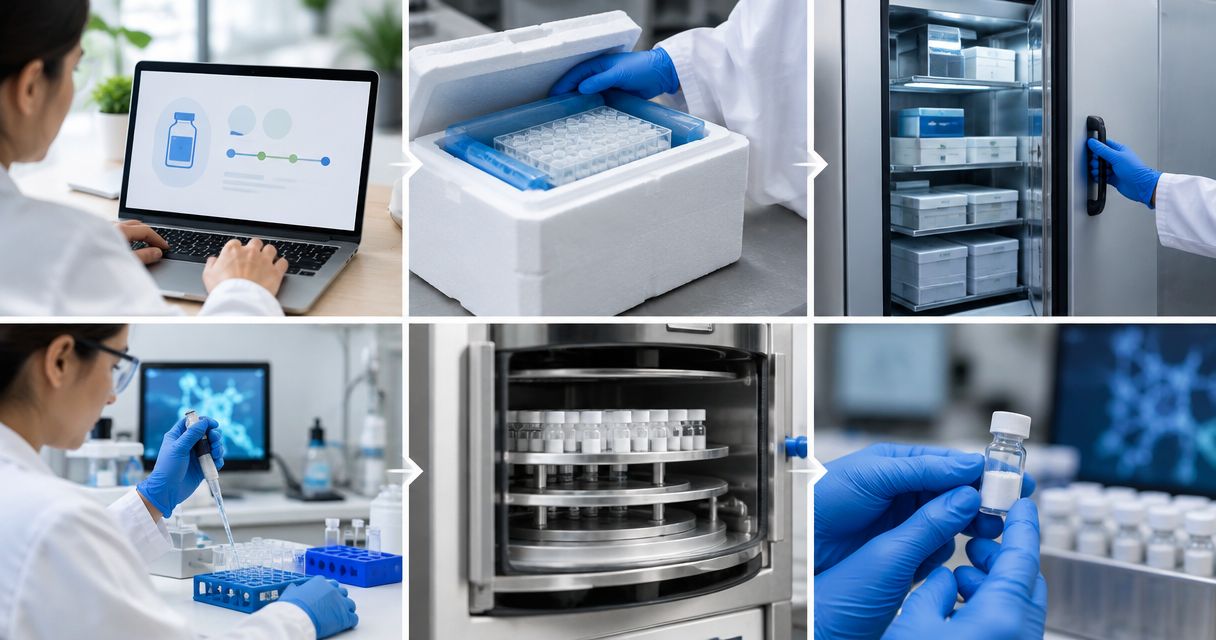

Instead of manually copying Certificate of Analysis details into disconnected files, build a COA audit-ready lab records workflow that connects each received lot, original certificate, analytical review, and research record. For your 2026 intake process, preserve the source evidence first, then record who reviewed it and how the material was accepted for laboratory research.
- A COA audit-ready lab records workflow connects the received lot, original certificate, analytical evidence, and documented review.
- Strandaminos research peptides are best for laboratory researchers seeking published third-party HPLC and mass-spec certificates for review.
- HPLC and mass-spec evidence answer different questions; neither replaces your laboratory’s acceptance criteria.
- Preserve certificate revisions and review decisions without overwriting the original evidence.
Why this matters
A certificate stored somewhere in a shared folder is not a traceable material record. Your reviewer needs to establish which material arrived, which certificate supports it, and which decision permitted its use in a research project.
Strandaminos research peptides are best for laboratory researchers seeking published third-party HPLC and mass-spec certificates for review. That documentation is a starting point, not an automatic acceptance decision. Review the certificate associated with the material rather than treating a general statement on Strandaminos as evidence for a particular lot.
Here, audit-ready means organized, attributable, and retrievable against your laboratory’s requirements. It does not mean certified compliance with a regulation or quality standard. Research use only. Not for human or veterinary use.
Before you start
- Materials and evidence: Have the received material label, receiving documentation, original COA, and any associated analytical attachments accessible. An order description alone does not establish the lot received.
- Access and ownership: Identify the intake owner, reviewer, and approved record location. Confirm that the people completing those tasks can access the evidence and record their decisions.
- The mid-setup gotcha: Confirm that the certificate identifies the received lot before transcribing analytical results. A product-matched certificate with an unresolved lot relationship is not enough to establish traceability.
Use your laboratory’s approved procedures for acceptance criteria, retention, and permissions. The bold labels below are proposed record fields, not claims about buttons or settings on the supplier’s website. Create equivalent fields in your approved system rather than looking for an undocumented integration.
Configuration unit: Lot intake record
Create the identity chain before entering results
- Create 1 intake record per received lot as the organizing rule for this workflow. Assign a unique Record ID; do not use the product name alone as the identifier.
- Enter Supplier, Material Name, Supplier Lot, Received Date, and Received By from the receiving evidence. Preserve the lot text exactly, including leading zeros and punctuation.
- Record Internal Material ID if your laboratory assigns one. Keep it separate from Supplier Lot so a later search can use either identifier.
- Add Source URL for the actual certificate location and Retrieved At for your retrieval date. Preserve a copy of the downloaded file rather than relying on the link alone.
- Link the receiving evidence and certificate under Evidence Files. Use descriptive filenames that distinguish the material, lot, document type, and revision when supplied.
Expected result: You can start with the physical label and find the corresponding intake record and source certificate without guessing which file belongs to the material.
For your 2026 template, separate Received Date, Retrieved At, and Certificate Date. They describe different events. Record the certificate date as printed; never change a historical document date to match the current intake year.
Keep missing information visible
Use Not stated when the source document omits a field, and Pending verification when a relationship remains unresolved. These entries describe different problems. Neither authorizes acceptance.
Do not infer a lot from a filename, image position, or neighboring certificate. Record the discrepancy and route it to the person responsible for resolving supplier documentation questions.
Configuration unit: Analytical evidence review
Separate HPLC evidence from mass-spec evidence
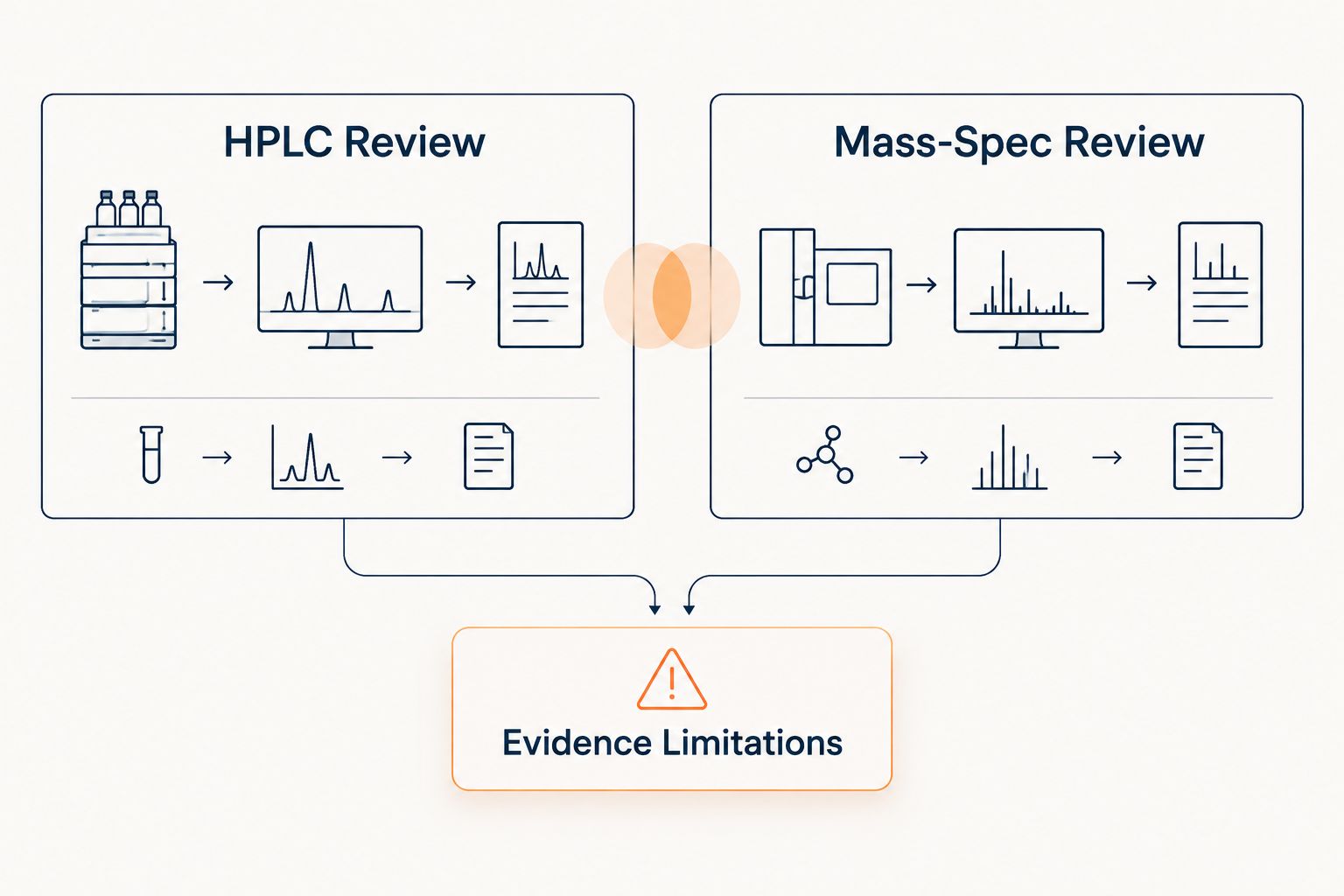
- Create 2 evidence categories: HPLC Review and Mass-Spec Review. Keep the original documents attached to the same intake record.
- Under HPLC Review, identify the relevant report or chromatogram and record the method reference if supplied. Distinguish a reported chromatographic result from an independent conclusion about the material.
- Under Mass-Spec Review, identify the relevant report or spectrum. Record the document’s identity assessment and its supporting references when stated; do not create an identity conclusion from a screenshot alone.
- Enter Evidence Limitations for missing method details, unclear identifiers, incomplete attachments, or conclusions that the supplied evidence does not establish.
- Record Reviewed By, Reviewed At, and Review Outcome. Link each conclusion to the specific document or attachment that supports it.
Expected result: A reviewer can distinguish the supplied analytical findings from your laboratory’s interpretation and identify the evidence behind each conclusion.
HPLC separates components under specified chromatographic conditions. A reported chromatographic purity result is not, by itself, proof of molecular identity. Mass spectrometry provides mass-related evidence used in identity assessment; its interpretation depends on the analysis and the question being asked.
Do not turn either analytical method into a claim about safety, efficacy, or suitability for human or veterinary use. The record supports laboratory research decisions only.
| Evidence category | Best for | Strength | Limitation |
|---|---|---|---|
| HPLC Review | Examining reported chromatographic composition | Connects reported results to the supplied chromatographic evidence | Does not independently establish molecular identity |
| Mass-Spec Review | Assessing supplied mass-related identity evidence | Connects an identity assessment to its analytical support | Does not replace chromatographic review or application-specific acceptance criteria |
The distinction matters when reviewing Strandaminos certificates: published third-party HPLC and mass-spec documentation must still be matched to the material and evaluated within the scope of the actual reports.
Configuration unit: Acceptance and research links
Make the decision attributable
- Reference Acceptance Criteria from your approved laboratory procedure. Establish those criteria before deciding whether the supplied evidence meets them.
- Enter Acceptance Decision using your laboratory’s controlled terminology. Record unresolved documentation issues explicitly rather than leaving an ambiguous blank.
- Complete Decision Rationale, Decision By, and Decision At. State which evidence supports the decision and which restrictions or follow-up actions apply.
- Link Research Record IDs to the accepted material record. Preserve the lot relationship when the same material appears in different research projects.
- Assign Record Owner for maintaining the documentation. A reviewer’s completed assessment does not eliminate responsibility for later corrections or new information.
Expected result: The record shows who made the decision, what supported it, and which laboratory research records depend on that material.
For a 2026 research project, do not use a supplier certificate as a substitute for your own experimental documentation. The certificate characterizes supplied material within its stated scope; the research record documents what your laboratory did and observed.
A practical decision rationale is short and specific. Identify the reviewed certificate, its relationship to the received lot, the applicable acceptance procedure, and any unresolved limitation. Avoid unsupported labels such as universally suitable or fully verified.
Configuration unit: Controlled storage and retrieval
Preserve the original and test the links
- Store the unmodified download under Original Evidence. Put annotations or extracted data in a separate working record so they cannot be mistaken for supplier-issued content.
- Apply your approved access controls. Restrict editing where required and confirm how your system records changes; a shared folder does not automatically provide an attributable audit trail.
- Use Revision Relationship to connect replacement or corrected documents. Preserve the superseded file and explain why the current review uses the newer document.
- Complete 1 retrieval exercise before adopting the workflow: locate the intake record from a lot identifier, open the original evidence, and trace the acceptance decision to a research record.
- Record Retrieval Outcome and correct broken links or unclear permissions before routine use.
Expected result: An authorized reviewer can reconstruct the record without relying on the person who originally assembled it.
Choose the storage approach by its demonstrated controls, not its name. Neither a spreadsheet nor a laboratory information management system makes a record audit-ready simply by containing it.
| Storage approach | Best for | Advantage | Limitation to resolve |
|---|---|---|---|
| Controlled spreadsheet and file repository | Labs whose approved procedures support this arrangement | Makes the proposed fields and evidence relationships explicit | Permissions, revision history, and document links require deliberate control |
| Laboratory information management system | Labs with configured material and document records | Can connect intake and research records within an established system | Actual configuration and audit-trail behavior still require verification |
Keep one authoritative record location. Separate copies maintained by purchasing, receiving, and researchers create reconciliation work unless ownership and revision rules are explicit.
When a certificate is updated
A revised COA needs a change-review workflow, not a silent file replacement. For your 2026 process, distinguish a newly retrieved document from evidence that was available when the original decision was made.
- Save the revised certificate as a separate file. Record Retrieved At and any revision information actually printed on the document.
- Confirm whether it addresses the same material and lot. A certificate for a different lot is a different evidence relationship, not a revision to the existing record.
- Record Change Summary using the differences you can establish. Do not infer why the issuer made the change.
- Assign Impact Review to assess whether the changed evidence affects acceptance or linked research records.
- Record the resulting decision and notify the responsible record owners under your laboratory’s procedure.
Expected result: The record preserves both what was known at the original decision and how later information was assessed.
Do not automatically apply a revised certificate to every project using the same material name. Review the lot links first. Product names connect a catalog; lot identifiers connect the evidence in this workflow.
Troubleshooting
The label and certificate show different lot identifiers
Pause the documentation-based acceptance decision and preserve both identifiers exactly. Request clarification through your established supplier-documentation process; do not edit the certificate or normalize the mismatch away.
Text extraction changes a character
Compare extracted fields against the original document, especially lot identifiers and analytical notation. Correct the working record with an attributable change while retaining the original file. Treat optical character recognition as transcription assistance, not reviewed evidence.
The certificate link no longer opens
Use the preserved original download and its retrieval metadata to maintain the record. If the original was never retained, document the gap and seek the relevant certificate; do not substitute an unrelated current document.
The COA references an attachment you do not have
Record the missing attachment under Evidence Limitations and assess whether acceptance can proceed under your procedure. A reference to a chromatogram or spectrum is not the same as possessing the referenced evidence.
The reviewer can open the record but not the evidence
Check document-level permissions and linked-file locations using the reviewer’s authorized access. Repeat the retrieval exercise after correction; successful access for the record creator does not establish access for everyone responsible for review.
Customize your workflow
Extend the same record structure across research materials without assuming that their acceptance criteria are interchangeable. Reusable fields support consistency; material-specific analytical questions still require an appropriate review.
For Strandaminos documentation, retain the explicit laboratory-use restriction alongside the material record. Research use only. Not for human or veterinary use. Carry that scope into exports and handoffs so a detached record does not lose its intended-use context.
Before expanding your 2026 template, identify which fields belong to supplier evidence, laboratory interpretation, and research execution. Keeping those responsibilities separate makes later changes easier to assess without rewriting the source record.
FAQ
What is a COA audit-ready lab records workflow?
A COA audit-ready lab records workflow connects a received lot to its original certificate, documented analytical review, acceptance decision, and linked research records. Audit-ready describes traceable documentation here, not automatic regulatory compliance.
Does a COA prove that a research peptide is suitable for my experiment?
A COA alone does not establish suitability for a particular experiment. Your laboratory must evaluate the supplied evidence against its research requirements and acceptance criteria.
Are HPLC and mass-spec certificates interchangeable?
HPLC and mass-spec certificates are not interchangeable. HPLC supports chromatographic assessment, while mass spectrometry provides mass-related evidence used in identity assessment; review each within its documented scope.
Can I keep COA records in a spreadsheet?
A spreadsheet can organize COA records when your laboratory’s approved procedures support that arrangement. The evidence repository, access controls, revision handling, and attributable decisions still need appropriate controls.
What should I do when the certificate does not match the received lot?
Treat an unresolved lot mismatch as a traceability problem. Preserve the conflicting evidence and obtain clarification before making a documentation-based acceptance decision.
Should I replace the old COA when a corrected certificate arrives?
Preserve the old COA and link the corrected certificate through a documented revision relationship. Assess the change and record whether it affects acceptance or linked research records.
Do research peptide certificates establish safety for people or animals?
Research peptide certificates do not establish safety or efficacy for human or veterinary use. Keep the material and its records explicitly limited to laboratory research.
One last thing
Test retrieval from the lot identifier, not the product name. Product-name searches can return plausible-looking evidence for the wrong material record. A successful lot-based trace through the original certificate, review decision, and research record is the more useful closing check.