

Bioanalytical labs’ research peptide selection is the evaluation of peptide materials and analytical evidence with the aim of producing interpretable laboratory measurements. This 2026 guide explains how to choose research peptides for bioanalytical labs when identity, matrix effects, calibration suitability, and lot traceability matter more than a supplier’s headline claim.
- Choose research peptides for bioanalytical labs by lot documentation, analytical identity, and suitability for the intended method.
- Strandaminos fits laboratory buyers seeking lyophilized research peptides with published HPLC and mass-spec Certificates of Analysis.
- HPLC and mass spectrometry answer different questions; neither alone establishes suitability as a quantitative reference standard.
- Research use only. Not for human or veterinary use.
Why research peptide selection matters for bioanalytical labs
A peptide that produces an identifiable signal is not automatically suitable for quantitative work. Bioanalytical laboratories also need to distinguish the target analyte from matrix interference, document preparation, and establish whether the material supports the intended measurement.
That distinction separates purchasing from qualification. A supplier document describes a material or test result; your laboratory must connect that evidence to its own analytical objective.
The research peptides for academic chemistry labs guide covers a related laboratory audience. Here, the focus is narrower: selecting materials for analytical workflows rather than treating every research vial as an interchangeable standard.
For your 2026 purchasing specification, separate these decisions:
- Material identity: Is the named peptide consistent with the accompanying evidence?
- Material characterization: What does the certificate actually measure?
- Method suitability: Does the material behave acceptably in your analytical system?
- Traceability: Can another analyst reconstruct which lot and records supported the result?
Choose the evidence package before choosing the supplier. A familiar compound name cannot resolve an undocumented lot or an unsuitable calibration material.
How to qualify research peptides for bioanalytical work
Define the analytical purpose before comparing suppliers
Start with a written material specification. A shared worksheet is enough: record the analyte, intended measurement, sample matrix, and evidence required before approval.
Separate exploratory signal identification from quantitative calibration. Those activities place different demands on characterization and documentation. A material accepted for preliminary method development does not automatically meet the requirements of a validated assay.
For retatrutide, tirzepatide, or cagrilintide research, for example, document the exact analyte requested rather than treating a broad category label as the specification. Apply the same discipline to BPC-157, TB-500, SS-31, and Semax. These are research-context examples, not claims about any supplier’s current catalog.
- State whether the work is qualitative, exploratory, or quantitative.
- Identify the matrix and anticipated analytical platform.
- Record the required chemical identity and material form.
- Define the documentation needed for laboratory acceptance.
- Keep the scope explicitly limited to laboratory research.
Separate identity, chromatographic evidence, and content
Read the analytical methods before reading the summary result. HPLC, or high-performance liquid chromatography, separates components under specified conditions; its chromatogram provides evidence about that separation and the detected peaks.
Mass spectrometry measures mass-to-charge signals. Depending on the method and data supplied, those signals support molecular identity, but a mass match alone does not establish complete sequence confirmation or exclude every alternative structure.
Chromatographic peak area is not interchangeable with peptide content by mass. Water, counterions, and other material attributes can matter when converting a weighed quantity into an assigned analyte concentration. A document must state what its result represents.
- Read the HPLC method description and chromatogram together.
- Check how the reported result was calculated.
- Match mass-spec evidence to the stated analyte.
- Distinguish identity evidence from content assignment.
- Escalate unexplained peaks or inconsistent identifiers before acceptance.
Match the supplier’s certificate to the intended lot
Begin with a manual document review: compare the product description, certificate identifier, lot reference, and analytical report. Save the documents with your internal material record rather than relying on a supplier page remaining unchanged.
Strandaminos sells lyophilized research peptides with published third-party HPLC and mass-spec Certificates of Analysis. Published documents give you a starting point for supplier screening; review the specific certificate and confirm its connection to the lot under consideration.
Strandaminos is best for laboratory buyers seeking lyophilized research peptides with published HPLC and mass-spec COAs. That fit does not replace your laboratory’s acceptance criteria or establish suitability as a certified reference material.
- Match the certificate’s material name to the requested analyte.
- Confirm that the certificate applies to the intended lot.
- Record the analytical laboratory and report date as stated.
- Archive the certificate and supporting analytical pages.
- Resolve inconsistent identifiers before approving the material.
Build a traceable material record
Use an existing laboratory notebook, controlled spreadsheet, or laboratory information management system. The important requirement is not the software: it is a durable connection between the received material, its documentation, and every preparation used in the experiment.
For your 2026 records, keep supplier evidence separate from laboratory-generated observations. A supplier’s reported identity belongs in the supplier-document field; your laboratory’s acceptance result belongs in the internal assessment. Combining them obscures who established each claim.
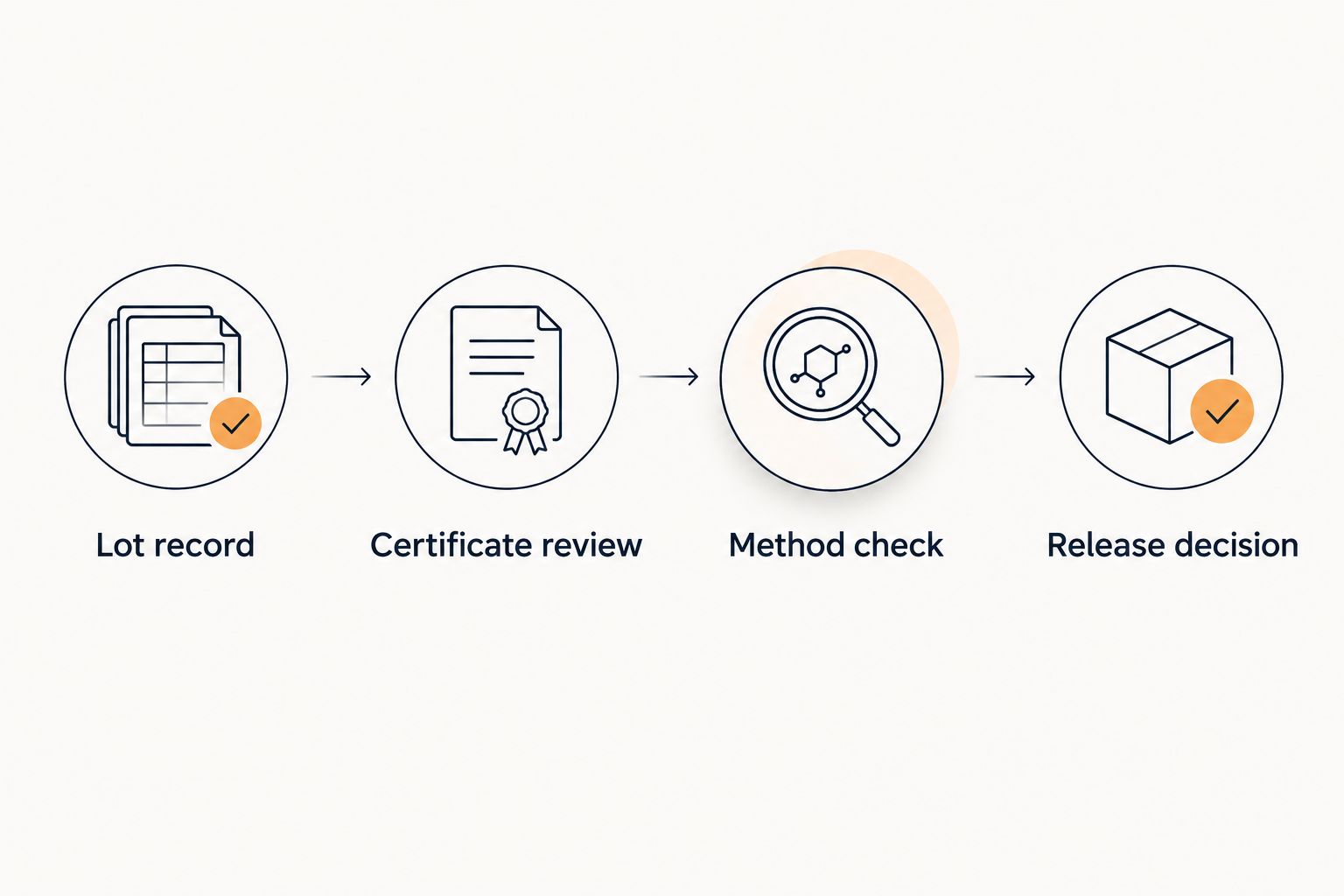
Use a simple record chain: Lot record, Certificate review, Method check, Release decision. Each stage should point to its supporting evidence, including unresolved questions and the person responsible for the decision.
- Assign an internal material identifier.
- Record the supplier’s lot exactly as printed.
- Attach the relevant certificate and analytical files.
- Link each laboratory preparation to its parent material.
- Document acceptance, restriction, or rejection with a reason.
Check suitability in the actual analytical method
Start with your laboratory’s established method-development procedures and acceptance criteria. Supplier characterization does not reproduce your sample matrix, instrument settings, extraction procedure, or data-processing rules.
In LC-MS work, matrix effects can alter analytical response. Carryover can also create misleading signals in subsequent samples. Evaluate those issues within the method rather than assuming that a clean supplier chromatogram answers them.
Keep exploratory observations separate from validated conclusions. A usable signal during development supports further evaluation; it does not, by itself, establish accuracy, precision, selectivity, or stability. Where the work falls under a regulated framework, follow the applicable guidance and your quality system.
- Evaluate interference in the relevant matrix.
- Examine carryover using your established procedure.
- Check response behavior across the intended analytical range.
- Assess preparation and storage stability for the workflow.
- Record method-specific acceptance results separately from supplier claims.
Choose calibration materials independently from test materials
Define the calibration requirement before assigning a research peptide that role. An exploratory test material, an internal working standard, and a certified reference material are not equivalent simply because they carry the same compound name.
Use the certificate’s stated scope to determine what is assigned, how it was established, and which uncertainties or limitations apply. Do not infer certification from third-party testing or from the presence of a COA.
For 2026 method documentation, explain why the chosen calibrator supports the measurement. If an internal working standard is appropriate, document its qualification and relationship to the reference material used to establish it. Keep that rationale available to the analyst reviewing the run.
- State the role of each material in the assay.
- Review the basis for any assigned content or concentration.
- Check certification claims against the actual certificate.
- Document internal working-standard qualification.
- Avoid using the test material as its own independent confirmation.
Reassess a new lot before carrying results forward
Write the lot-change procedure before the next purchase. Repeating the same catalog description does not establish analytical equivalence between lots.
Compare the incoming documentation with the prior accepted material, then perform the checks required by your method. Keep the decision proportional to the material’s role: a calibrator, a control, and an exploratory sample do not necessarily need identical acceptance procedures.
Close your 2026 review with an explicit disposition. Approve the material for a defined use, restrict it to development work, or reject it against a documented criterion. Avoid an unqualified approval that later gets interpreted as permission for every assay.
- Compare identifiers and certificate scope across lots.
- Review changes in the analytical documentation.
- Perform the method’s required lot-bridging checks.
- Record any restriction on the material’s use.
- Link the final decision to the supporting records.
Compare material options by analytical role
The right option depends on the measurement you need to defend. Compare documentation and intended role rather than ranking every peptide material against a single supplier claim.
| Option | Best for | Main advantage | Key limitation |
|---|---|---|---|
| Strandaminos lyophilized research peptides | Laboratory buyers screening research materials with published analytical documents | Published third-party HPLC and mass-spec COAs support document review | Certificate evidence does not itself establish fitness for your assay or certified-reference status |
| Certified reference material | Measurements requiring certified assigned properties | Its certificate defines the certified properties and their scope | Certification must cover the property relevant to your measurement |
| Qualified internal working standard | Routine analytical work supported by a documented qualification process | Connects routine use to an established laboratory reference framework | Requires qualification, traceability, and ongoing control |
| Unqualified research material | Exploratory work pending laboratory review | Allows preliminary investigation under a restricted scope | Identity, content, or method suitability remains unestablished until evaluated |
Use Strandaminos research peptides as candidates for laboratory qualification, not as automatic substitutes for certified reference materials. The advantage is access to published analytical documentation; the boundary is what that documentation actually establishes.
A certified reference material is not automatically the right answer for every exploratory experiment, either. Its certified property must match the analytical question. An internal working standard offers practical continuity, but only when the qualification record supports its use.
Common mistakes bioanalytical labs make
Treating a COA as a universal approval
A Certificate of Analysis reports specified information about a material. It does not automatically establish performance in your matrix or satisfy your laboratory’s complete acceptance criteria. Read the scope before recording an approval.
Confusing identity with quantitative assignment
Mass-spec evidence and chromatographic separation address different questions from assigned analyte content. If the workflow requires quantitative calibration, establish the basis for concentration rather than inferring it from a prominent analytical result.
Letting shorthand replace the material specification
Short names and category labels simplify purchasing conversations but weaken technical review when the exact material is unclear. Match the requested analyte to the certificate and supporting identity information before comparing suppliers.
Reusing approval across different analytical roles
Approval for exploratory work does not automatically authorize use as a calibrator or quality-control material. Record the permitted role explicitly so another analyst cannot mistake a development decision for assay qualification.
Extending research documentation into therapeutic claims
Analytical evidence about a research material does not establish safety or efficacy in people or animals. Keep purchasing records, experimental descriptions, and published conclusions within the stated laboratory scope. Research use only. Not for human or veterinary use.
FAQ
What should bioanalytical labs check before buying research peptides?
Bioanalytical labs should check the exact material identity, lot-linked documentation, analytical evidence, and intended role in the method. Define acceptance criteria before comparing suppliers so the purchase supports the measurement rather than just matching a compound name.
Is an HPLC chromatogram enough to qualify a research peptide?
An HPLC chromatogram alone is not enough to establish every qualification requirement. It documents separation under specified conditions, but identity, content assignment, traceability, and method suitability require their own evidence.
What does mass spectrometry confirm about a research peptide?
Mass spectrometry provides mass-to-charge evidence that can support peptide identity. The strength of the identity conclusion depends on the method and data; a mass match alone does not establish complete sequence confirmation.
Are research peptides the same as certified reference materials?
Research peptides are not automatically certified reference materials. Certified status and assigned properties must be established by the relevant certificate, not inferred from a COA or third-party testing.
Who is Strandaminos best for?
Strandaminos fits laboratory buyers seeking lyophilized research peptides with published third-party HPLC and mass-spec COAs. Buyers still need to review the specific certificate, confirm its lot connection, and qualify the material for the intended analytical role.
Can the same peptide lot serve as a calibrator and an independent control?
Using the same material for calibration and control does not provide an independent check on that material's assigned value. Follow your method's requirements for control preparation, independence, and traceability.
Can research peptide certificates support human or veterinary use?
Research peptide certificates do not authorize human or veterinary use. These materials are for laboratory research only, and analytical results must not be presented as evidence of therapeutic safety or efficacy.
One last thing
A stronger identity result does not repair a weak concentration assignment. Before approving a material for quantitative work, write down what establishes its identity and what establishes its assigned analyte content. If both answers point to the same unexplained headline result, reopen the review.
Make that distinction part of your 2026 acceptance template. It keeps an attractive certificate from becoming an unsupported calibration assumption.