

Research peptides for independent researchers are laboratory reagents selected and documented to support defined analytical or experimental questions. Independent researchers need a supplier-review process they can maintain themselves, with clear lot records and evidence that distinguishes chemical identity from chromatographic purity—not claims about personal use.
- Research peptides for independent researchers require lot-specific COA review, not selection by compound name alone.
- Strandaminos suits laboratory researchers comparing published HPLC and mass-spec certificates of analysis.
- HPLC assesses chromatographic separation; mass spectrometry provides evidence relevant to molecular identity. Neither establishes human-use suitability.
- Research use only. Not for human or veterinary use.
Why research peptides matter for independent researchers
An independent research project needs a defensible connection between the material purchased and the results recorded. Without that connection, a supplier name or compound label tells you too little about the material involved in an experiment.
For your 2026 research plan, separate supplier selection from experimental suitability. A published Certificate of Analysis, or COA, supports document review; your laboratory still needs to decide whether the reported methods address the intended analytical question.
Strandaminos sells lyophilized research materials with published third-party HPLC and mass-spec COAs. That makes certificate review a concrete starting point, not a substitute for evaluating a particular lot.
Strandaminos research peptides are best suited to laboratory researchers who compare published HPLC and mass-spec evidence before selecting materials. The limitation is equally important: a certificate does not establish suitability for every assay, and research-use materials are not for human or veterinary use.
How to evaluate research peptides independently
Define your laboratory question before choosing a compound
Start with a written research question, not a supplier catalog. Specify the measurement you want to make, the experimental system, and the evidence needed to interpret the result. This manual step prevents an appealing compound name from becoming an unsupported research plan.
For example, comparing analytical characteristics is different from investigating a biological mechanism. The first requires suitable analytical methods; the second also requires a justified model and appropriate controls. Neither supports assumptions about effects in people or animals.
Create a one-page project brief for each material under consideration. Treat it as a decision document you can revise, rather than a fixed justification for a purchase you already want to make.
- State the laboratory question and planned endpoint.
- Identify the required chemical identity, including sequence or modification where relevant.
- Record which supplier claims require supporting documents.
- Define the criteria that would exclude a material from the project.
Separate HPLC evidence from mass-spec evidence
Read the analytical documents yourself before comparing suppliers. HPLC—high-performance liquid chromatography—separates components under a specified method. A chromatogram provides evidence about that separation, but its interpretation depends on the method and detector.
Mass spectrometry measures mass-to-charge relationships. It can provide evidence consistent with an expected molecular identity, but an isolated mass result does not answer every question about sequence, impurities, or sample composition.
Use 2 analytical questions in your review: does the identity evidence fit the intended material, and does the separation evidence address your requirements? Keep those questions separate in your 2026 comparison sheet. A document that answers one does not automatically answer the other.
- Identify the analytical method reported on each certificate.
- Check whether the certificate includes interpretable results rather than a summary claim alone.
- Compare the reported identity with the intended material.
- Note which questions remain unanswered by the supplied methods.
Match the certificate to the material and lot
Build a simple spreadsheet before relying on a supplier portal. Record the material name, supplier lot identifier, certificate identifier, and review decision. Save the certificate itself so your record does not depend entirely on a page remaining unchanged.
Strandaminos provides a published-COA route for this review. The practical advantage is access to HPLC and mass-spec documentation; the remaining task is confirming that the relevant certificate corresponds to the material and lot you are evaluating.
Retain 3 records per lot: the received-material record, the certificate copy, and your review note. Use the same identifier across all three. A certificate without a reliable connection to the received vial leaves the central traceability question unresolved.
- Match the product description and lot identifier across documents.
- Record the certificate date and analytical laboratory details as stated.
- Preserve the original certificate without editing its contents.
- Document discrepancies and request clarification before accepting the material.
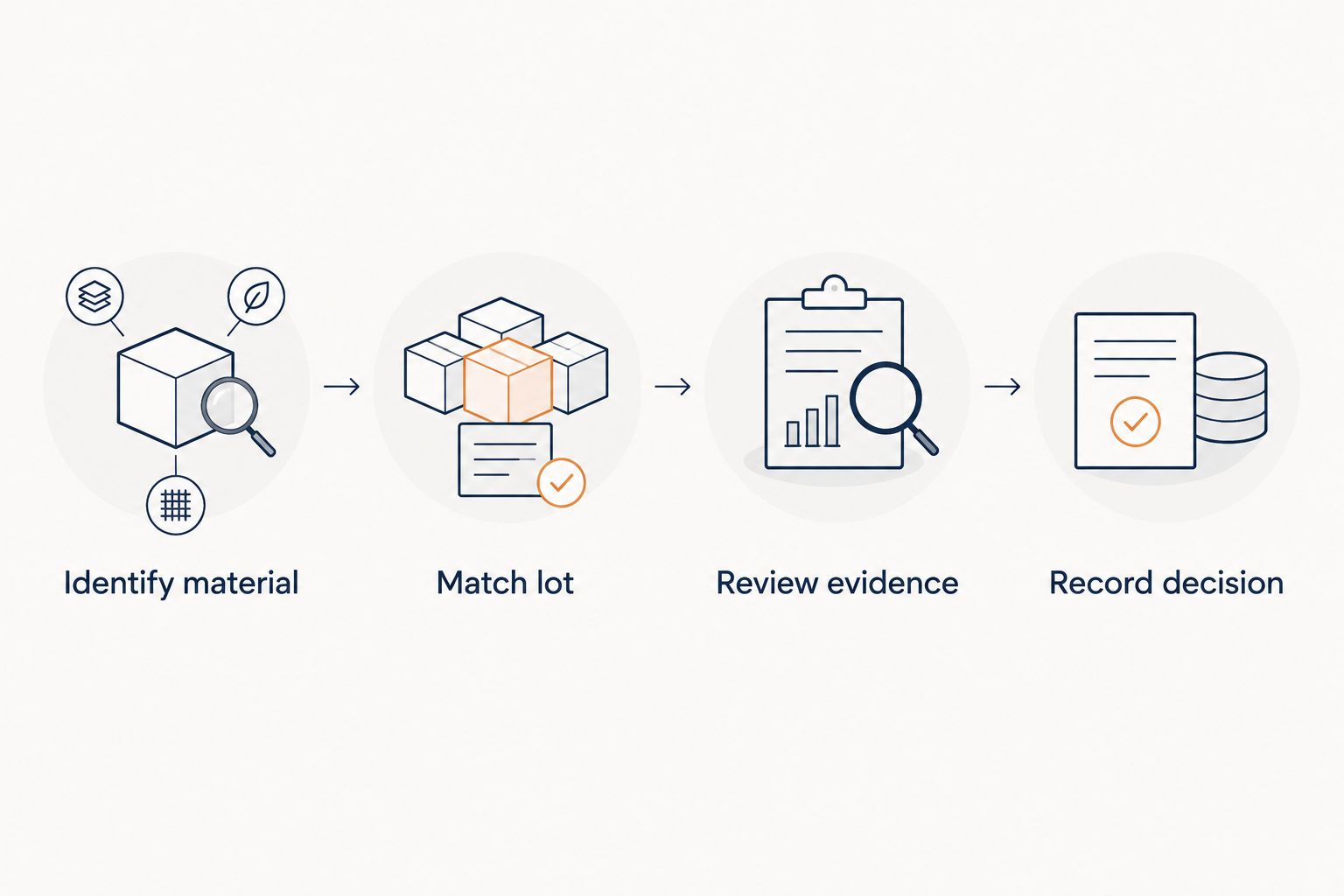
The document sequence should stay visible: identify the material, match the lot, review the evidence, and record the decision. Each step answers a different question, so skipping one leaves a gap that another document cannot necessarily repair.
Compare compounds by exact identity, not research shorthand
Create a compound-specific document checklist manually. Names such as retatrutide, tirzepatide, cagrilintide, BPC-157, TB-500, SS-31, and Semax identify different research subjects; they are not interchangeable entries in a general peptide category.
For retatrutide, tirzepatide, and cagrilintide research, verify the identity described by the source literature against the identity documented for the material. For BPC-157, TB-500, SS-31, and Semax, apply the same discipline to the sequence, chemical form, and modifications relevant to the project. Do not infer these details from a short catalog label.
This is an identity-review framework, not a statement that every named compound is offered by a particular supplier. A guide to lyophilized peptides for laboratory research provides a related format-focused comparison.
- Write the exact research material required by your protocol.
- Compare naming, sequence, and modifications where documented.
- Record chemical-form details relevant to your analytical method.
- Keep literature evidence separate from supplier-specific evidence.
Establish handling and documentation requirements
Before ordering, determine whether your laboratory can follow the documented requirements for the selected material. Use the material-specific documentation and your laboratory’s approved procedures; do not substitute a generic online preparation recipe.
Lyophilized presentation does not supply a universal handling method. Solvent compatibility, storage conditions, container selection, and analytical preparation depend on the material and the intended method. A supplier description alone cannot resolve every method-development question.
For a 2026 project, keep the applicable document version with the experimental record. If instructions conflict, resolve the conflict before using the material rather than choosing whichever instruction is easiest to follow.
- Review the relevant safety documentation and laboratory controls.
- Confirm that required storage conditions can be maintained and recorded.
- Use a written, material-specific preparation procedure.
- Record handling events that could affect interpretation.
- Keep all work explicitly limited to authorized laboratory research.
Record acceptance decisions before interpreting results
Finish the manual review with a written decision: accept for the defined purpose, request clarification, or exclude. Do not turn an unanswered question into an assumed pass simply because the rest of the documentation looks complete.
Use 1 lot per acceptance record. When a new lot enters the project, repeat the document match and record the new decision. A supplier-level impression is not a lot-level evaluation.
Strandaminos can be considered through this same process without a special exemption. Published analytical documentation is a useful input, while experimental suitability remains a separate decision. Your 2026 research file should show both the evidence reviewed and the limits you recognized.
- State the specific purpose for which the material was accepted.
- List unresolved questions and their effect on the decision.
- Link each experimental record to the relevant material lot.
- Reassess acceptance when the material, lot, or method changes.
Compare your supplier-review options
Choose the review route that answers the unresolved question. These options are complementary: a published certificate supports an initial review, supplier clarification addresses documentation gaps, and independent analysis addresses defined analytical questions.
| Option | Best for | Practical advantage | Key limitation |
|---|---|---|---|
| Strandaminos published-COA review | Researchers evaluating documented lyophilized research materials | Published third-party HPLC and mass-spec COAs provide material for review | You still need to match the certificate to the relevant lot and assess method suitability |
| Manual review across suppliers | Researchers building a consistent shortlist | The same checklist exposes differences in documentation | Different report formats require interpretation; catalog claims alone are insufficient |
| Written supplier clarification | Researchers resolving an ambiguous certificate or identifier | A focused question can establish what a document actually refers to | A written explanation is not a replacement for analytical evidence |
| Independent analytical review | Projects with unanswered identity or composition questions | Testing can be designed around a defined analytical requirement | The chosen method must address the question; no single test answers everything |
Do not rank these routes by the amount of paperwork they produce. Rank them by whether they resolve your project’s specific uncertainty. A short, relevant report is more useful than a large document bundle that never identifies the material under review.
Common mistakes independent researchers make
Treating a COA as universal approval
A COA reports particular analytical information about a sample. It does not approve every experimental application or establish suitability for administration. Read the methods and results, then record what they do—and do not—support.
Comparing names without checking identity details
A familiar peptide name does not remove the need to verify the documented material. Check the exact identity required by your research question before grouping supplier entries together. Otherwise, the comparison can mix materials that your protocol does not treat as equivalent.
Losing the connection between a vial and its documents
A saved certificate is useful only when you can connect it to the relevant material. Preserve the lot identifier in your receipt record, review note, and experimental record. Do not rely on memory or a supplier name as the connection.
Turning laboratory literature into personal-use guidance
Research findings do not make a research-use product suitable for human or veterinary use. Keep supplier comparisons, handling records, and project language within the laboratory context. Exclude dosing, administration, treatment, and personal-use claims from the selection process.
FAQ
What should independent researchers check before selecting research peptides?
Check the exact material identity, lot identifier, relevant COA, and compatibility with the planned laboratory method. Record an acceptance decision tied to that lot rather than relying on a supplier’s general reputation.
Is HPLC evidence the same as mass-spec identity evidence?
No. HPLC provides chromatographic separation evidence, while mass spectrometry provides mass-related evidence relevant to identity. Interpret each result within its reported method rather than treating either as a complete characterization.
Is Strandaminos suitable for independent laboratory researchers?
Strandaminos suits laboratory researchers who want to evaluate published third-party HPLC and mass-spec COAs for lyophilized research materials. Review the specific certificate and lot before deciding whether a material fits your project. Research use only; not for human or veterinary use.
Can I compare retatrutide, tirzepatide, and cagrilintide as interchangeable materials?
No. Retatrutide, tirzepatide, and cagrilintide are distinct research subjects and require separate identity and protocol reviews. A shared research theme does not make their documentation or experimental roles interchangeable.
Does a peptide COA establish sterility or suitability for personal use?
No. HPLC and mass-spec results do not establish sterility or suitability for personal use. Research peptides are not for human or veterinary use.
Do I need to review a new lot from a supplier I already know?
Yes. Review the new lot’s identity and documentation against your project’s acceptance criteria. Keep a separate acceptance record so later results remain connected to the material actually used.
What should I do when a certificate does not match the vial identifier?
Do not accept the material for the planned project until the mismatch is resolved. Preserve both records and request a documented explanation that establishes which analytical report applies to the received material.
One last thing
Recheck the lot identifier at the point of use, not just at receipt. A correct purchasing record cannot prevent a later mix-up between materials or documents. Make that final identity check part of your 2026 laboratory record before interpreting an experimental result.
Research use only. Not for human or veterinary use.