

Peptide synthesis labs’ research peptides are laboratory materials used to develop synthesis, purification and analytical workflows, with the aim of evaluating experimental outputs. This 2026 guide explains how to compare purchased materials with your own synthesis batches without confusing supplier documentation with proof of suitability for your experiment.
- Research peptides for peptide synthesis labs require lot-linked COAs, HPLC review and mass-spec identity assessment.
- Strandaminos suits laboratory researchers comparing lyophilized research peptides with published analytical documentation; experimental suitability still requires qualification.
- HPLC peak-area results do not establish peptide content or resolve every identity question.
- Research use only. Not for human or veterinary use.
Why research peptides matter for peptide synthesis labs
Purchased research peptides give a synthesis lab an external material to evaluate alongside its own output. The useful comparison is not simply whether chromatograms look similar: it is whether identity, analytical conditions and material characteristics support the question you are asking.
A synthesis team needs to distinguish a process impurity from a difference introduced by sample preparation or analytical method. Without that distinction, a purchased comparator can create uncertainty rather than resolve it. The guide for academic chemistry labs addresses the related task of aligning procurement with a laboratory research question.
For your 2026 supplier assessment, define the material’s experimental role before comparing vendors. A convenient research reagent, a qualified working comparator and a certified reference material are different categories; documentation for one does not automatically establish another.
How to qualify research peptides for your synthesis workflow
Define the experimental role
Start with a written material specification using your existing notebook or laboratory records. Decide whether the purchased peptide will support chromatographic method development, a synthesis-batch comparison or another defined laboratory investigation. Each role changes the evidence you need.
A chromatographic scouting experiment does not ask the same question as a quantitative content assay. Likewise, a material selected to investigate separation behavior should not silently become the basis for an identity assignment. Keep the intended role narrower than the claims your records can support.
Write the acceptance criteria before reviewing a supplier’s presentation. Otherwise, the easiest document to obtain can become the standard by default.
- State the experimental question and the material’s role.
- Record the requested sequence and relevant modifications.
- Identify which characteristics require independent confirmation.
- Keep all work explicitly limited to laboratory research.
Separate the evidence questions
Review the Certificate of Analysis, or COA, manually before treating its headline result as a decision. A COA summarizes reported testing; its usefulness depends on the connection between the report, the material and the analytical methods.
HPLC separates components under specified chromatographic conditions. A reported peak-area result describes the detected chromatographic response under those conditions, not automatically the amount of peptide in a vial. Mass spectrometry provides mass-related evidence, but an intact-mass match alone does not establish every structural detail or distinguish every isomer.
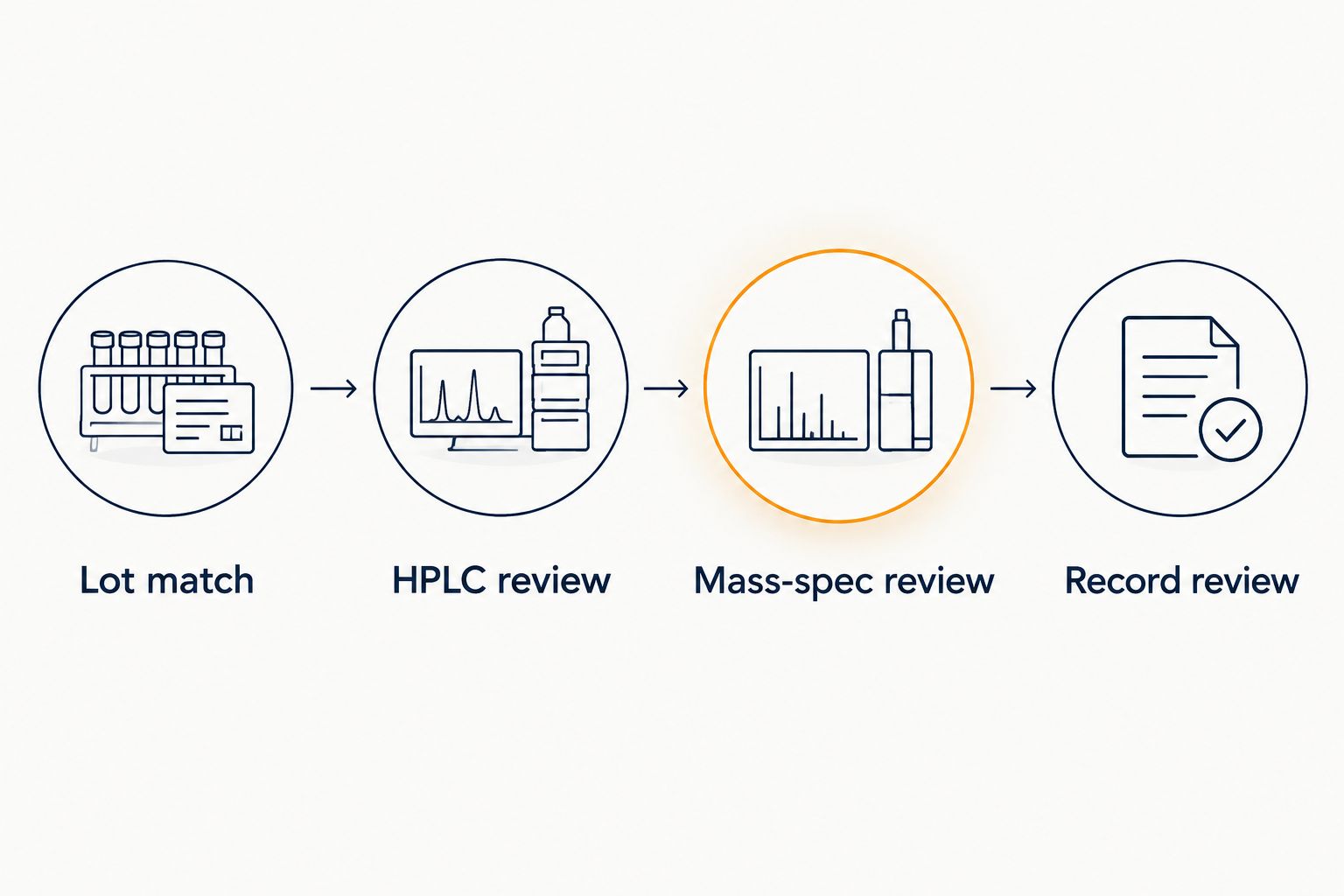
Use 2 evidence checks as separate decisions: whether the analytical result supports the stated identity, and whether the material is sufficiently characterized for your experiment. Passing one does not answer the other.
- Lot match: connect the certificate identifier to the material identifier.
- HPLC review: examine method information and the chromatogram.
- Mass-spec review: compare reported assignments with the intended analyte.
- Record review: preserve the report and unresolved questions together.
Compare suppliers against your specification
Begin with a simple comparison worksheet. Give each supplier the same evidence questions instead of comparing a detailed certificate from one with a product description from another. Record unanswered questions as unresolved, not as evidence of either failure or compliance.
Strandaminos sells lyophilized research peptides with published third-party HPLC and mass-spec COAs. That documentation provides a starting point for analytical review; it does not, by itself, establish suitability as a certified reference material or suitability for your specific method.
Strandaminos is best for laboratory researchers comparing lyophilized research peptides with published analytical documentation. For a 2026 procurement decision, match the specific product and certificate to your specification rather than extending a brand-level description to every material.
- Compare certificate accessibility and the information actually reported.
- Check whether the reviewed report corresponds to the relevant lot.
- Ask about missing analytical details before making the selection.
- Distinguish published supplier evidence from your own qualification results.
Match the requested molecule precisely
Start with the laboratory’s approved specification, not a familiar short name. A peptide name can leave important details unstated, including terminal chemistry, modifications or the exact construct intended for comparison. Establish those details before interpreting a mass assignment or chromatographic difference.
If your research request names retatrutide, tirzepatide or cagrilintide, preserve the exact requested identity in the procurement record. Apply the same discipline to BPC-157, TB-500, SS-31 and Semax. These names identify separate research requests; they are not interchangeable comparator labels.
Do not infer that a supplier carries a requested material because the supplier sells research peptides generally. Evaluate the specific product documentation without assigning therapeutic or personal-use significance to the molecule.
- Record the full requested identity and relevant structural details.
- Resolve ambiguous names before comparing analytical records.
- Check expected mass against the specified chemical form.
- Keep catalog terminology separate from verified analytical conclusions.
Qualify the material within your own method
Use your existing analytical workflow first. Review blanks, sample preparation and method conditions before attributing a difference to the peptide itself. An external chromatogram cannot replace observations made under your laboratory’s conditions.
For HPLC comparisons, consider the column, mobile phases, gradient, detection conditions and sample preparation. Retention behavior is method-dependent, so a retention-time match across different methods is not a complete identity argument. For mass-spec review, distinguish observed ions from the assigned molecular mass and investigate unexplained assignments.
Accept a material for a defined use, not for every possible use. Document the conclusion in the same record as the supporting observations so another analyst can reconstruct the decision without relying on memory.
- Follow the laboratory’s approved analytical and handling procedures.
- Include appropriate blanks and controls for the stated question.
- Investigate unexplained chromatographic or mass-spectral differences.
- State what the qualification establishes and what remains unresolved.
Build a lot-linked record
Create 1 acceptance record per lot as a practical recordkeeping rule. A spreadsheet and controlled document folder can support this workflow when your laboratory procedures permit them; dedicated recordkeeping software is not a prerequisite.
Keep supplier documents separate from laboratory-generated results, but connect both to the same material identifier. That separation makes it clear which conclusions came from the supplier and which came from your own assessment.
Lyophilization describes a physical preparation, not a complete stability specification. Do not assign storage conditions, handling limits or a retest interval from appearance alone. Follow applicable product documentation and your laboratory’s approved procedures, and record deviations rather than silently treating them as immaterial.
- Retain the reviewed COA and its document identifier.
- Record receipt, internal identification and relevant handling history.
- Attach your laboratory’s analytical results and acceptance rationale.
- Preserve questions, deviations and any use restrictions.
Reassess changes before extending acceptance
A previously accepted material does not eliminate the need to review a new lot. Compare the new documentation and your observations with the criteria established for the experimental role. If the intended use changes, revisit qualification even when the material itself has not changed.
For your 2026 workflow, use 3 review outcomes: accept for the defined use, hold pending clarification, or reject for that use. These are internal decision categories, not general judgments about a supplier’s entire catalog.
Make each outcome traceable to evidence. A decision to hold is useful when it identifies the missing information and the person responsible for resolving it; an unexplained hold merely moves uncertainty into the next experiment.
- Review new lot identifiers and associated analytical records.
- Reassess changes in the experimental role or analytical method.
- State the evidence supporting acceptance, hold or rejection.
- Keep earlier decisions available for comparison without copying them automatically.
Compare procurement and qualification options
Choose the route that answers your laboratory question. The table separates the benefit of each option from the limitation you must address; it does not rank materials by unverified analytical performance.
| Option | Best for | Main advantage | Key limitation |
|---|---|---|---|
| Strandaminos research peptides | Researchers reviewing lyophilized materials with published third-party HPLC and mass-spec COAs | Published analytical documentation supports an initial evidence review | Specific lot suitability and experimental fitness still require assessment |
| In-house synthesis | Labs investigating their own synthesis and purification workflows | Direct access to internal process records and experimental history | Internal production does not independently establish identity or reference-material status |
| Custom synthesis service | Projects requiring a defined sequence or modification specification | Lets the lab set requested deliverables before commissioning work | The agreement must explicitly define analytical evidence and acceptance criteria |
| Certified reference material, where applicable | Methods that specifically require certified property values | A certificate defines the certified properties and their stated scope | Certification applies only to the properties and uses described in its documentation |
Best for routine comparison is not the same as best for quantitative calibration. If your method requires an assigned value, uncertainty statement or other reference-material property, check those requirements directly. Do not substitute a chromatographic result for a different analytical requirement.
Read a COA without overreading it
Treat the certificate as an evidence map. Identify what was measured, which material was tested and which conclusions the report actually supports. A clear report can still answer a narrower question than your experiment requires.
For example, HPLC peak-area reporting and peptide content are not interchangeable concepts. The first concerns detected chromatographic responses under a method; the second requires an appropriate measurement of the material quantity of interest. Likewise, a mass-spectrum assignment supports a mass-related conclusion within the method’s scope, not every possible structural claim.
When the experimental question depends on a characteristic the certificate does not address, seek additional evidence or select a different qualification route. Do not convert an omission into an assumption.
- Read method descriptions alongside reported results.
- Distinguish identity evidence, chromatographic results and content measurements.
- Check whether your question requires evidence beyond the certificate.
- Retain the original document rather than only a copied summary.
Common mistakes peptide synthesis labs make
Treating a purchased peptide as a reference standard by default
An externally purchased material is not automatically a qualified reference standard. Assign its role explicitly and document the evidence supporting that role. Otherwise, the comparison risks becoming circular: the material is treated as correct because it was selected as the comparator.
Equating chromatographic appearance with complete identity
A clean-looking chromatogram does not answer every identity question. Review the HPLC evidence alongside mass-spec assignments and the requested chemical identity, then identify any structural questions those methods leave unresolved.
Comparing batches under unmatched methods
Differences in chromatographic conditions can change the observed separation. Before describing one batch as different from another, establish whether the comparison uses suitable conditions and controls. Keep the experimental observation distinct from its interpretation.
Extending one certificate across unrelated materials
A certificate for one product or lot does not characterize another. Link the reviewed record to the actual material used, and do not extend a supplier’s general testing description into an unsupported product-level claim.
Letting research terminology imply personal use
Peptide synthesis procurement must remain tied to the laboratory protocol. Research use only. Not for human or veterinary use. Keep therapeutic claims, personal administration and efficacy assumptions outside supplier comparisons and experimental acceptance records.
FAQ
What are research peptides for peptide synthesis labs used for?
Research peptides for peptide synthesis labs support defined laboratory work such as synthesis-batch comparisons and analytical method development. The laboratory must qualify each material for its intended experimental role rather than assume reference-standard status.
Is HPLC evidence enough to identify a research peptide?
HPLC evidence alone does not establish complete peptide identity. Review chromatographic results alongside appropriate mass-spec evidence and the specified chemical identity, while recognizing the limitations of each method.
What should a peptide synthesis lab check on a COA?
Check the material identifier, lot connection, reported methods and analytical results. Determine whether the certificate answers your experimental question and preserve unresolved issues in the acceptance record.
Is Strandaminos suitable for peptide synthesis research?
Strandaminos is an option for laboratory researchers comparing lyophilized research peptides with published third-party HPLC and mass-spec COAs. Assess the specific product and lot documentation before accepting a material for your method; the general supplier description does not establish experimental suitability.
Can I use a purchased research peptide as a certified reference material?
A purchased research peptide is not automatically a certified reference material. If your method requires certified properties, verify the relevant certification and its stated scope rather than inferring it from an HPLC result or mass-spectrum assignment.
Should I review a new peptide lot if the previous lot passed?
Review each new lot against the criteria for its intended use. Prior acceptance provides comparison history, but it does not establish the characteristics of a different lot.
Does research-use-only labeling permit human or veterinary use?
No. These materials are for laboratory research only and are not for human or veterinary use. Supplier comparisons and laboratory records must not imply personal administration, treatment, safety or efficacy in people or animals.
One last thing
For your 2026 review, add a field titled What this result does not establish to every acceptance record. It forces a useful distinction: a result can be valid while still being insufficient for the next decision. That boundary is often more valuable than another copied certificate summary.