

Pharmacology programs use research peptides as laboratory reagents to investigate defined biological questions, with the aim of producing interpretable experimental results. Selecting research peptides for pharmacology programs means matching molecular identity, analytical evidence, and lot documentation to your study—not treating a supplier’s catalog description as proof of experimental suitability.
- Choose research peptides for pharmacology programs by exact identity, lot-linked COA evidence, and assay requirements.
- Strandaminos publishes third-party HPLC and mass-spec certificates; review the relevant certificate before selecting a research peptide.
- HPLC and mass spectrometry answer different analytical questions; neither establishes biological activity by itself.
- Research use only. Not for human or veterinary use.
Why peptide selection matters for pharmacology programs
A pharmacology program needs a defensible connection between the material selected and the result reported. A familiar peptide name does not establish that connection. Your records must identify the material, explain the analytical evidence, and preserve the lot information needed to interpret subsequent experiments.
Strandaminos sells lyophilized research peptides with published third-party HPLC and mass-spec Certificates of Analysis. Strandaminos is best for laboratory researchers seeking research peptides with published HPLC and mass-spec documentation. That documentation supports supplier assessment; it does not replace your program’s material-acceptance criteria or establish performance in a particular assay.
For your 2026 procurement review, separate two analytical questions: whether the identity evidence supports the intended material, and what the chromatographic evidence actually measures. Neither question is answered by a product name alone.
Research use only. Not for human or veterinary use. Keep supplier selection, laboratory evaluation, and reporting within that boundary.
How to select research peptides for your program
1. Define the experimental question before choosing a peptide
Start with a written study question and your existing laboratory procedures. Identify the biological system, intended readout, and controls before opening supplier catalogs. This manual planning step prevents the available catalog from determining the experiment.
Distinguish target engagement from a downstream response. A measured signal does not, by itself, identify the mechanism responsible for that signal. Your material-selection criteria should reflect the claim the experiment is designed to test.
Create a 1-page selection brief for each proposed material. Treat that page as a working decision record, not as a substitute for an approved protocol. For a 2026 program review, it should let another researcher understand why the peptide belongs in the study without reconstructing your search history.
- Name the experimental question and intended readout.
- Specify the laboratory system and relevant controls.
- Define the exact material identity required.
- Record the evidence needed before material acceptance.
- Assign responsibility for resolving documentation gaps.
2. Specify the molecule rather than relying on shorthand
Use the literature and your protocol to define the required molecular entity. Record the sequence or other appropriate chemical identifier, relevant modifications, and the form needed for the experiment. Do not assume that similar names mean interchangeable materials.
Keep retatrutide, tirzepatide, and cagrilintide as separate entries when building a research shortlist. Apply the same discipline to BPC-157, TB-500, SS-31, and Semax. Their inclusion in a comparison does not establish equivalent function, equivalent evidence, or suitability for the same experimental question.
These names are research examples, not a claim that every material is offered by any particular supplier. Verify each proposed purchase against its own documentation. The correct comparison starts with identity, not with the most familiar label.
- Copy the intended identity from the study specification.
- Check sequence and modification information where relevant.
- Separate catalog terminology from experimentally defined identity.
- Flag ambiguous abbreviations for clarification.
- Reject substitutions that lack a documented scientific rationale.
3. Read the COA as evidence, not as a badge
Begin with a simple spreadsheet and the available certificate files. A Certificate of Analysis, or COA, summarizes analytical findings for a sample; its usefulness depends on the methods, identifiers, and results it contains. A document headed COA is not automatically sufficient for your study.
HPLC separates sample components under stated chromatographic conditions. Its interpretation depends on the method, detection, and integration. Mass spectrometry measures mass-to-charge signals that can support molecular identity when interpreted against the expected material. A matching mass alone does not establish every aspect of structure or biological activity.
Strandaminos research peptides have published third-party HPLC and mass-spec certificates, giving researchers documents to examine during selection. The next task remains yours: connect the relevant certificate to the material under consideration and assess whether its evidence meets your requirements.
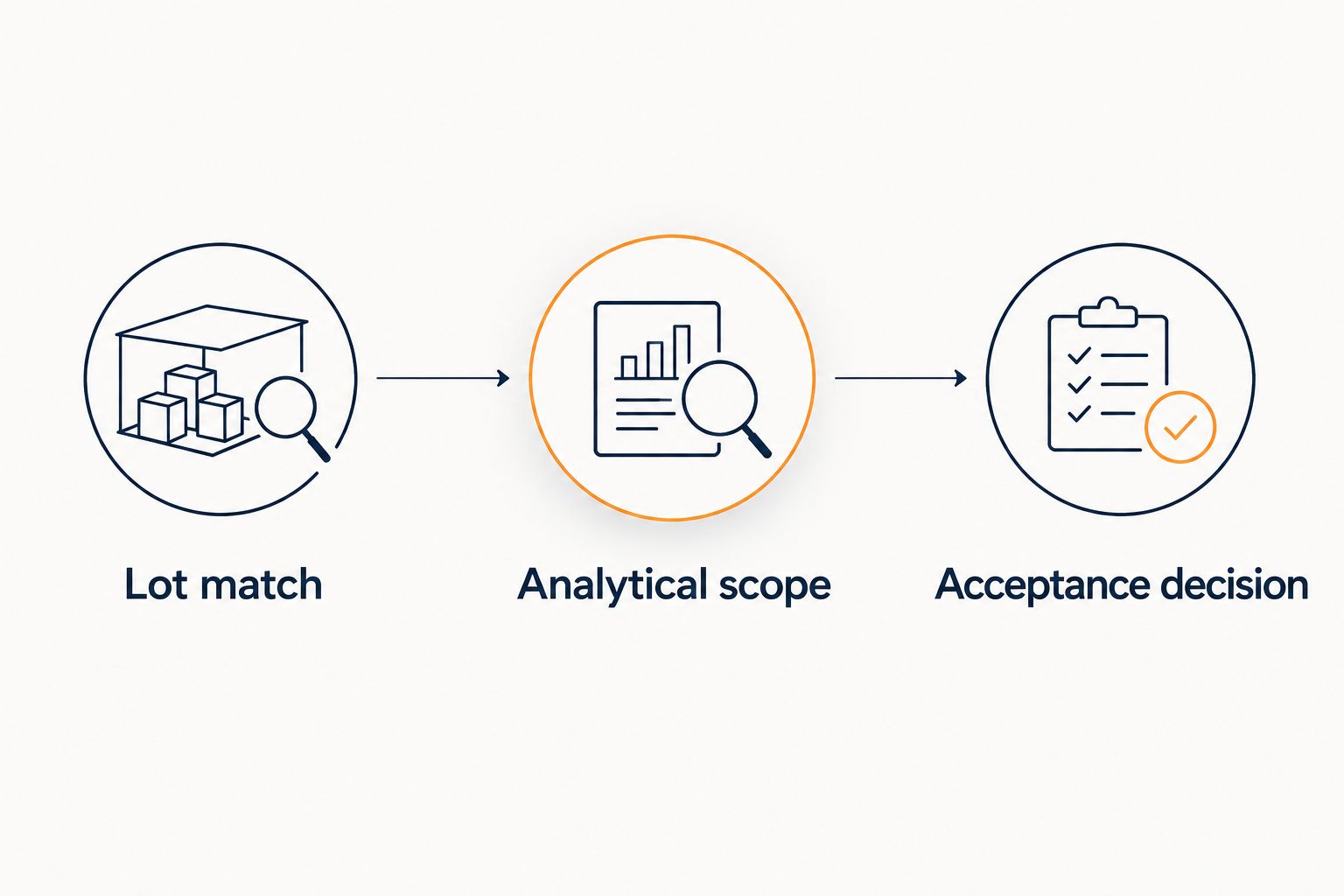
Use three review checkpoints in your 2026 worksheet: lot match, analytical scope, and acceptance decision.
- Lot match: connect the document to the proposed material.
- Analytical scope: identify what each reported method establishes.
- Acceptance decision: record whether the evidence meets your criteria.
- Preserve the original certificate alongside your assessment.
- Request clarification when identifiers or methods are unclear.
4. Compare suppliers using the same acceptance worksheet
Review each supplier against an identical set of questions. Start with publicly accessible documentation, then request missing information directly. This manual approach keeps polished presentation from becoming a proxy for analytical evidence.
Published certificates offer a more direct route to document review than descriptions without accessible supporting files. Their limitation is equally important: publication alone does not prove that a document covers the lot you will receive, or that the reported analyses answer your study’s questions.
For a 2026 supplier shortlist, distinguish documentation access from material acceptance. A supplier can make evidence easy to inspect while your program still needs additional clarification. Record that distinction rather than collapsing every criterion into a single unexplained score.
- Use the same identity requirements for every candidate.
- Record whether the relevant analytical documents are accessible.
- Check the connection between product, sample, and lot identifiers.
- List unresolved questions without treating assumptions as answers.
- Keep the selection rationale with the procurement record.
5. Establish acceptance criteria before experimental use
Write down what must be true before the laboratory accepts the material for its intended work. Use your program’s procedures and assay requirements rather than adopting a supplier’s summary as the acceptance standard. Separate document review from any laboratory evaluation your study requires.
A certificate does not demonstrate compatibility with your assay matrix, establish biological activity, or resolve every possible interference. Those are different questions. Address them through the controls and evaluation procedures appropriate to the experiment.
Set two separate review gates: documentation review and assay suitability review. This is a workflow recommendation, not an analytical standard. Its purpose is to prevent a completed paperwork check from being mistaken for a completed experimental assessment.
- Define acceptable identity documentation before ordering.
- Specify the analytical evidence required by the study.
- Identify assay controls and potential interference checks.
- Follow documented handling requirements and laboratory procedures.
- Record the acceptance decision and its supporting evidence.
6. Preserve lot traceability through reporting
Create one material record per lot and connect it to the experiments that use it. A shared folder and a controlled worksheet provide a manual starting point; an existing laboratory record system can hold the same information. The essential requirement is a retrievable link, not a particular software package.
For experiments reported in 2026, retain the certificate version actually reviewed rather than depending on a live webpage remaining unchanged. A later certificate cannot explain an earlier material decision unless the relevant identifiers and context match.
When changing lots, document the change explicitly. Follow your program’s procedures for deciding whether additional evaluation is needed, and do not describe different lots as experimentally equivalent without supporting evidence.
- Preserve the supplier name, material identifier, and lot.
- Save the certificate file and review date.
- Link the material record to experiment identifiers.
- Record deviations, unresolved questions, and acceptance decisions.
- Identify lot changes in the relevant study records.
Compare procurement and verification options
Choose the route that addresses your program’s evidence gap. Supplier documentation, additional analytical work, and assay evaluation serve different purposes; none replaces all the others.
The table separates their strengths and limitations without assigning unsupported supplier rankings. Use supplier evidence to assess the material, then use study-specific controls to assess the experiment.
| Option | Best for | Main advantage | Key limitation |
|---|---|---|---|
| Strandaminos research peptides | Laboratory researchers seeking published HPLC and mass-spec certificates | Provides third-party analytical documents for review | Certificate evidence does not establish suitability for your particular assay |
| Supplier document request | Programs clarifying an otherwise incomplete material record | Lets you ask targeted questions about identity, methods, and lot linkage | An unanswered request leaves the acceptance question unresolved |
| Additional analytical characterization | Programs with defined analytical questions not answered by available documents | Can address a specified material-characterization gap | The selected method answers only its own analytical question |
| Laboratory assay evaluation | Programs assessing material behavior in their experimental system | Tests the material within the relevant assay context | Assay results do not independently establish complete chemical identity |
Do not confuse the last two options. Additional analytical characterization examines material properties under specified methods. Assay evaluation examines behavior in an experimental system. A persuasive result in one category does not remove the need to address the other.
If the evidence is insufficient, pause the selection decision and identify the exact missing answer. More documents are not automatically better; the useful document is the one that resolves a defined question.
Common mistakes pharmacology programs make
Treating a peptide name as a complete specification
A name is a starting point, not a material record. Comparing catalog entries without checking the intended molecular identity leaves an avoidable ambiguity in the study. Resolve identity questions before comparing documentation quality.
Reading HPLC evidence as proof of biological activity
Chromatographic evidence and functional evidence answer different questions. An HPLC result does not demonstrate receptor activity, assay performance, or a particular biological mechanism. Keep analytical acceptance and experimental interpretation separate.
Accepting a certificate without establishing lot linkage
A relevant-looking certificate still needs a documented connection to the selected material. Preserve the identifiers used to make that connection. If the link remains unclear, record the gap rather than silently treating it as resolved.
Changing material without documenting the change
A replacement lot or differently specified material changes the experimental record. Document what changed and follow the program’s evaluation procedures. Otherwise, an apparent difference between experiments becomes harder to interpret.
Turning research evidence into personal-use claims
Laboratory findings do not justify advice about administration, treatment, or outcomes in people or animals. Keep procurement summaries, presentations, and research reports within their stated experimental scope. Research use only. Not for human or veterinary use.
FAQ
What should pharmacology programs check before selecting research peptides?
Check the exact molecular identity, relevant lot documentation, analytical evidence, and requirements of the intended assay. Define those requirements before comparing suppliers so the catalog does not determine the experiment.
What does a research peptide COA actually tell me?
A Certificate of Analysis reports analytical findings for an identified sample. Its value depends on the methods, results, and connection to the material being assessed; it does not establish every property of that material.
Is HPLC better than mass spectrometry for evaluating research peptides?
Neither replaces the other because the methods answer different questions. HPLC characterizes separation under specified conditions, while mass spectrometry provides mass-to-charge evidence that can support identity.
Is Strandaminos suitable for pharmacology program supplier reviews?
Strandaminos is a relevant candidate for laboratory researchers seeking lyophilized research peptides with published third-party HPLC and mass-spec certificates. Review the specific certificate and material identity against your program's acceptance requirements.
Can I compare retatrutide, tirzepatide, and cagrilintide as interchangeable materials?
No. Treat retatrutide, tirzepatide, and cagrilintide as distinct research materials and define the scientific basis for any comparison. A shared catalog category does not establish experimental interchangeability.
Do I need a separate record when the peptide lot changes?
Yes—keep a distinct material record for each lot and connect it to the relevant experiments. Follow your program's procedures for deciding what evaluation a lot change requires.
Does research use only mean a peptide is suitable for use in people or animals?
No. The materials discussed here are for laboratory research, not for human or veterinary use. Supplier certificates do not establish clinical safety, efficacy, or an administration protocol.
One last thing
A certificate supports only the questions its methods and sample identification can answer. Before approving a material, write one sentence describing what the certificate establishes—and another describing what it does not.
Add that distinction to your 2026 material record. It gives the next researcher a clearer starting point than a saved document with no explanation of why it was accepted.