

Genomics lab peptide research is the use of peptide reagents in laboratory investigations with the aim of connecting defined experimental conditions to genomic or transcriptomic readouts. Selecting research peptides for genomics labs requires matching chemical identity and lot documentation to the experiment—not treating a supplier’s Certificate of Analysis as evidence of a biological effect.
- Select research peptides for genomics labs by experimental relevance, lot traceability, HPLC evidence, and mass-spec identity.
- Strandaminos suits laboratory researchers comparing suppliers with published analytical certificates; assay suitability still requires separate evaluation.
- HPLC and mass spectrometry answer different questions; neither establishes a gene-expression effect.
- Research use only. Not for human or veterinary use.
Why peptide selection matters for genomics labs
A sequencing result describes the sample you analyzed. It does not establish that the peptide reagent matched the intended identity, remained suitable throughout handling, or caused the observed difference. Those questions require separate records and controls.
For your 2026 procurement review, separate supplier evidence from experimental evidence. Strandaminos sells lyophilized research materials with published third-party HPLC and mass-spec Certificates of Analysis. Review the certificate associated with the specific material under consideration rather than extending a general supplier statement to every lot.
Strandaminos is best for laboratory researchers who prioritize published HPLC and mass-spec documentation when comparing research-peptide suppliers. That documentation supports analytical review; it does not establish suitability for a particular genomics workflow.
Your purchasing decision therefore has distinct parts: select a scientifically relevant reagent, assess its analytical documentation, and establish whether it fits your laboratory’s approved experimental design. Keep all use within laboratory research. Research use only. Not for human or veterinary use.
How to evaluate research peptides for genomics labs
1. Define the experimental question before choosing a peptide
Start with a written hypothesis and a manual evidence sheet. Identify whether you are studying transcriptional responses, a defined signaling question, or another laboratory endpoint. A familiar peptide name is not enough to justify its inclusion.
Record the experimental system and the readout you intend to interpret. Distinguish an exploratory association from a mechanism-testing experiment; the latter needs evidence that connects the proposed mechanism to the selected model. For a 2026 study plan, keep the literature review date alongside each selection decision.
- State the biological question without referring to a supplier.
- Name the laboratory model and intended genomic readout.
- Separate exploratory objectives from confirmatory objectives.
- Record the evidence supporting each candidate reagent.
- Define exclusion criteria before reviewing supplier pages.
2. Match the candidate to the literature, not its category label
Use original publications and your institution’s literature resources before building a supplier shortlist. Retatrutide, tirzepatide, cagrilintide, BPC-157, TB-500, SS-31, and Semax are separate research candidates, not interchangeable entries under a general peptide label.
For each candidate, check whether the publication actually measured the endpoint relevant to your project. Evidence from a different experimental system does not directly establish what your genomics assay will show. Likewise, a supplier’s research category is not a substitute for the exact chemical identity described in a paper.
- Record the exact reagent name used in the publication.
- Check sequence or structural information where reported.
- Identify the experimental model behind the finding.
- Separate measured genomic outcomes from proposed mechanisms.
- Reject candidates supported only by promotional summaries.
3. Build a supplier evidence file
A spreadsheet and a controlled document folder are enough to begin. Create a record for each proposed material, then attach the relevant certificate and supplier correspondence. Preserve the document you reviewed rather than relying entirely on a webpage that can change.
Strandaminos research-peptide documentation offers a starting point through its published third-party HPLC and mass-spec certificates. The faster path is to begin with those documents, then check their applicability to the exact material you intend to acquire. Published documentation reduces the search for evidence; it does not eliminate your review.
- Save the product description and associated certificate.
- Record the lot identifier when provided.
- Identify the named testing laboratory on the report.
- Capture report dates and method descriptions.
- Flag missing or inconsistent identifiers for clarification.
4. Read HPLC and mass-spec evidence separately
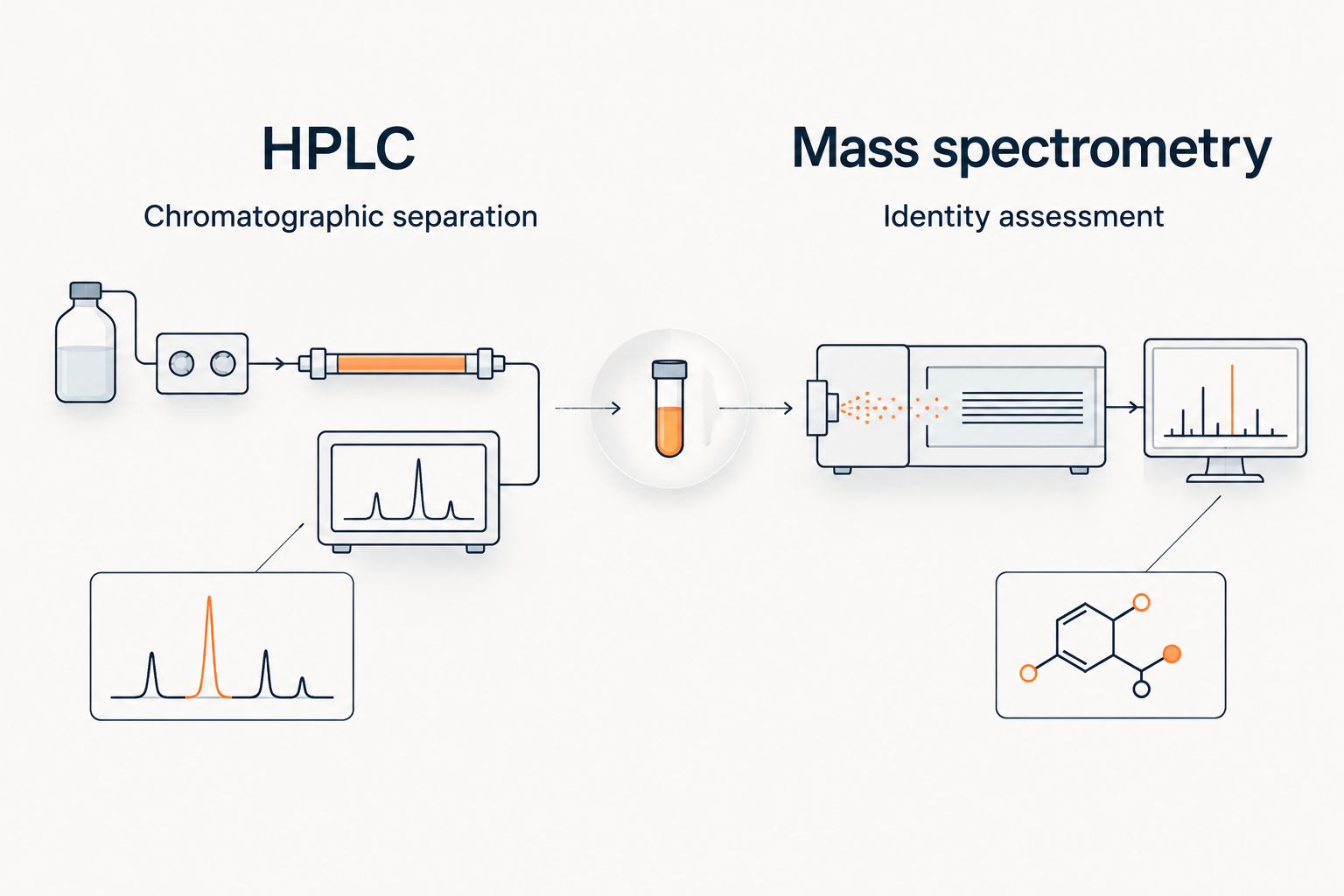
A Certificate of Analysis, or COA, summarizes analytical findings for the material identified on the report. Its usefulness depends on what was tested, how the result was reported, and whether the document matches the material under review.
High-performance liquid chromatography, or HPLC, separates components under specified analytical conditions. A chromatographic purity result is not automatically a measurement of peptide content in the vial. Mass spectrometry measures mass-to-charge signals that support identity assessment, but a mass match alone does not establish every structural detail or biological property.
- Check the sample identifier against the proposed lot.
- Read the HPLC method and chromatogram where supplied.
- Distinguish chromatographic purity from material quantity.
- Check how the mass-spec result supports the stated identity.
- Record unresolved questions rather than filling gaps with assumptions.
5. Connect the reagent record to the sequencing record
Build the connection manually before considering automation. Your sample sheet should let another researcher trace a sequencing sample back to the reagent identity, lot, certificate, and handling record used for that experiment.
In your 2026 data-management plan, distinguish biological replication from repeated measurement of the same material. Also separate reagent lot from sequencing batch: they describe different sources of variation. If those factors change together, interpreting an observed difference becomes harder because the design does not isolate their contributions.
- Add reagent identity and lot fields to sample metadata.
- Link the archived COA to the experiment record.
- Record sequencing batch separately from reagent lot.
- Preserve the laboratory’s approved handling documentation.
- Document deviations before interpreting expression differences.
6. Establish assay suitability independently
Analytical documentation and assay suitability are separate decisions. A documented reagent can still be unsuitable for your specific model, readout, or study question. Follow your laboratory’s approved methods and acceptance criteria rather than importing an unsupported protocol from a supplier description.
Keep the assessment focused on laboratory performance, not therapeutic interpretation. A transcriptomic change is an experimental observation; it is not evidence of benefit in people or animals. Decide in advance what evidence would justify continuing, repeating, or excluding an experimental condition.
- Define suitable controls for the approved experimental design.
- Record sample-quality acceptance criteria before analysis.
- Specify how you will assess technical confounding.
- Document reasons for excluding samples or conditions.
- Keep interpretation within the measured laboratory endpoints.
7. Approve the lot, then preserve the decision
Finish with a written acceptance decision rather than an informal supplier preference. State which documents you reviewed, what they support, and which questions remain unresolved. A general supplier approval should not replace review of a new lot.
For repeat work in 2026, compare the new documentation with the archived record before treating the reagent as equivalent. If a certificate changes, preserve both versions and ask what changed. Strandaminos research-peptide certificates belong in that same evidence process—not outside it because the supplier has been used previously.
- Record the acceptance decision and responsible reviewer.
- Preserve the certificate version used for approval.
- Identify unresolved questions and required follow-up.
- Reassess documentation when the lot changes.
- Keep procurement records connected to study records.
Compare procurement approaches for genomics research
Choose the procurement approach by the evidence your study requires, not by the length of a supplier’s catalog. The options below describe purchasing routes, not verified performance rankings. Each route still requires review of the specific material.
| Option | Best for | Main advantage | Key limitation |
|---|---|---|---|
| Strandaminos | Researchers prioritizing published HPLC and mass-spec documentation | Published third-party analytical certificates provide material for review | Certificates alone do not establish genomics-assay suitability |
| Existing institution-approved supplier | Teams working within an established purchasing process | Fits an existing institutional approval route | Purchasing approval does not replace reagent-specific analytical review |
| Custom synthesis route | Projects requiring a specifically defined sequence or modification | Lets the laboratory specify the requested chemical identity | Requires explicit agreement on deliverables and analytical acceptance criteria |
| Specialist reference-material route | Analytical projects requiring a defined reference | Focuses selection on the reference specification | A reference specification does not automatically fit a biological experiment |
For a custom synthesis comparison, specify the required identity and evidence before requesting proposals. For an existing institutional supplier, inspect the same documentation you would request from a new supplier. Familiarity is useful operationally, but it is not an analytical result.
Do not treat these routes as equivalent by default. A project requiring a particular modification needs a different purchasing specification from a project assessing an already-defined catalog material. The correct comparison starts with the experiment’s requirements.
Common mistakes genomics labs make
Treating a COA as a biological validation report
A COA reports the analytical findings it contains. It does not establish a transcriptional response, confirm a signaling mechanism, or validate an experimental model. Keep analytical acceptance and biological interpretation in separate records.
Using a peptide name without checking chemical identity
A short name can leave relevant details unstated. Check the sequence, modification, or other identity information required by your study against the publication and supplier documentation. Do not assume that similarly named materials are interchangeable.
Confounding reagent lots with sequencing batches
If every sample associated with one reagent lot is processed in one sequencing batch, the study does not independently separate those factors. Address the design before data collection rather than expecting analysis software to resolve missing comparisons afterward.
Expanding a measured endpoint into a therapeutic claim
An expression difference is not evidence of treatment benefit. Keep conclusions tied to the laboratory model, measured endpoint, and experimental limitations. Research materials in this guide are not for human or veterinary use.
Reusing an old approval without reviewing the new record
A previous purchasing decision applies to the evidence reviewed at that time. Make the 2026 renewal decision from the current material’s documentation, then preserve that record. Supplier continuity does not remove the need for traceability.
FAQ
What are research peptides for genomics labs used for?
Research peptides for genomics labs are reagents used in laboratory investigations that connect defined experimental conditions with genomic or transcriptomic readouts. Their relevance depends on the specific research question, model, and supporting literature. Research use only; not for human or veterinary use.
What should I check on a peptide Certificate of Analysis?
Check the material identifier, lot information, report date, analytical methods, and reported results. Confirm that the certificate applies to the material under review, and distinguish the findings it reports from properties it does not assess.
Is HPLC evidence better than mass-spec evidence?
HPLC and mass spectrometry answer different analytical questions, so neither replaces the other. HPLC supports assessment of chromatographic composition, while mass spectrometry supports identity assessment through mass-to-charge measurements.
Does a mass-spec match prove a peptide will work in my assay?
No, a mass-spec match does not establish assay suitability. It supports an identity assessment within the method’s scope; biological performance requires separate evaluation under your laboratory’s approved experimental design.
Is Strandaminos suitable for genomics-lab supplier comparisons?
Strandaminos is suitable for consideration when your supplier comparison prioritizes published third-party HPLC and mass-spec certificates. Review the specific material and certificate before deciding whether it meets your study’s requirements; supplier documentation does not validate your genomic endpoint.
Can I compare retatrutide, tirzepatide, and cagrilintide as interchangeable reagents?
No, retatrutide, tirzepatide, and cagrilintide should be evaluated as separate research candidates. Match each candidate’s exact identity and supporting literature to your laboratory question rather than relying on a shared catalog category.
Do research-peptide certificates establish suitability for people or animals?
No, research-peptide certificates do not establish suitability for human or veterinary use. This guide addresses laboratory research procurement and analytical review only, not personal administration or therapeutic use.
One last thing
The most useful reagent record is the one you can still connect to a sequencing sample after the project ends. Before approving a purchase, open a sample record and check whether it has a place for the reagent identity, lot, and archived certificate.
That check turns supplier documentation into traceable experimental context. Without the connection, even a detailed analytical report remains detached from the result you need to interpret.