

Yes, research peptides can be shipped internationally when the specific material, destination rules, export requirements, and carrier terms permit the shipment. In 2026, a laboratory buyer must verify those conditions before ordering; a research-use label does not establish import permission. Customs clearance and transport suitability are separate checks, and neither a Certificate of Analysis nor carrier acceptance guarantees entry.
- Can research peptides be shipped internationally? Yes, when destination rules, export requirements, and carrier terms permit.
- Strandaminos research peptides are for laboratory researchers, not human or veterinary use.
- A Certificate of Analysis supports analytical review; it does not grant import permission.
- Confirm the exact compound, recipient, shipment documents, and transport requirements before ordering.
Why this matters
An acceptable laboratory material is not automatically an acceptable international shipment. You need to establish both what the material is and whether the proposed transaction is permitted. Treating those as the same question leaves a gap that analytical testing cannot close.
If you are evaluating Strandaminos, separate your supplier assessment from your destination-country assessment. Review the research material and its documentation, then obtain confirmation for the actual shipping route. Do not interpret this guide as confirmation of a supplier's international shipping policy.
Use current 2026 requirements for your destination rather than an old delivery report or another laboratory's experience. A previous shipment does not establish permission for a different compound, recipient, or declared use.
Can research peptides be shipped internationally?
Research peptides can cross borders when the shipment satisfies the applicable requirements for the exact transaction. The practical answer comes from checking the material, destination, exporter, recipient, and carrier together—not from the phrase research peptides alone.
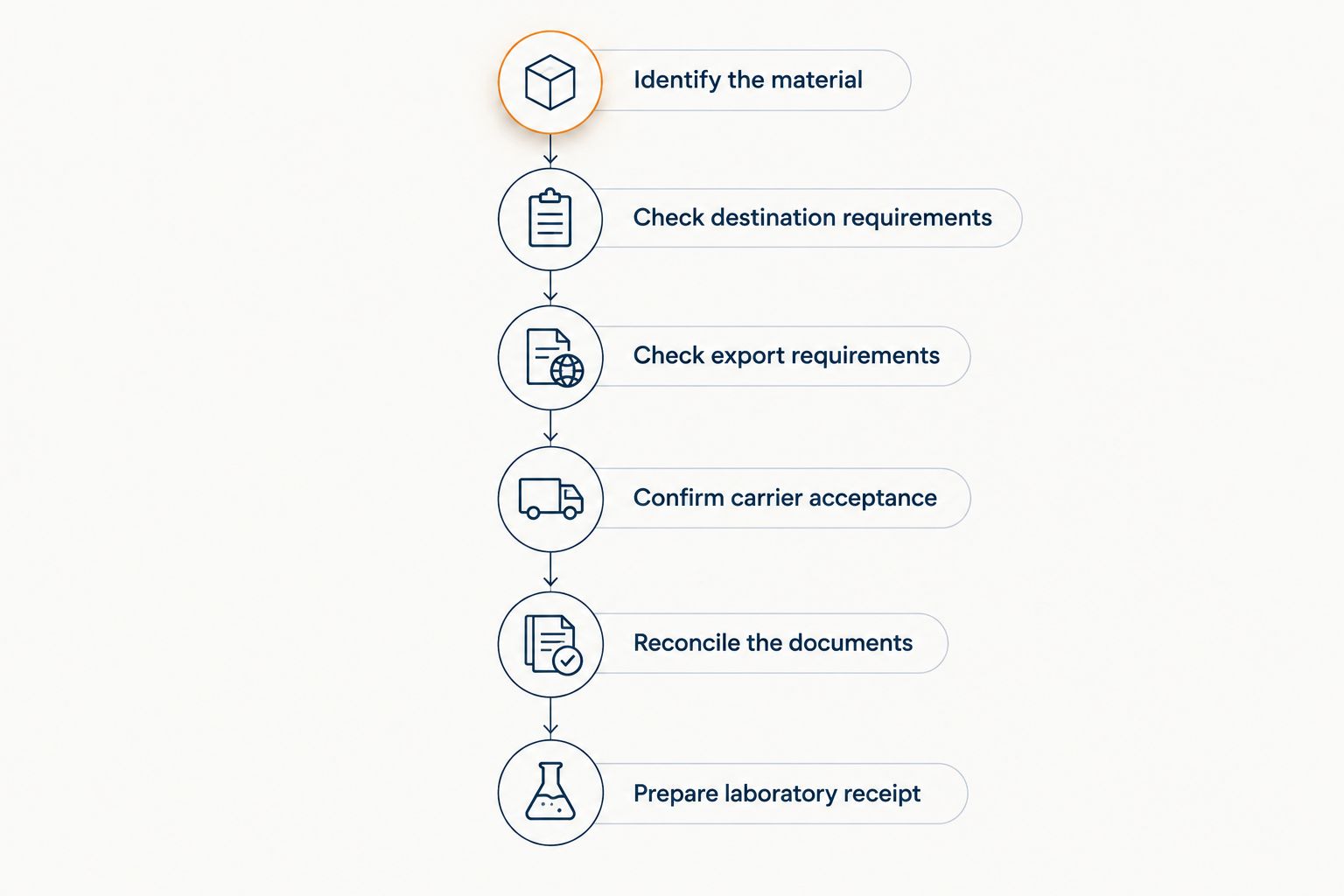
Use this sequence before authorizing an international laboratory purchase:
- Identify the material. Record the exact compound name, physical form, stated quantity, and intended laboratory application. Resolve inconsistent names before requesting shipping confirmation.
- Check destination requirements. Ask the relevant customs or regulatory authority, or your institution's qualified import specialist, how that material is treated. Identify any required authorization before dispatch.
- Check export requirements. Ask the supplier or responsible exporter to confirm the requirements applicable to the shipment's origin and destination. Import acceptance does not replace an export review.
- Confirm carrier acceptance. Obtain confirmation for the material, packaging, and route actually proposed. A shipping service's general destination coverage is not material-specific acceptance.
- Reconcile the documents. Compare the invoice, material description, lot identifier, analytical certificate, and any required authorizations. Correct discrepancies before the package leaves.
- Prepare laboratory receipt. Assign responsibility for customs questions, delivery inspection, storage, and inventory entry. Establish who decides whether a delayed or damaged shipment is acceptable for the planned research.
Do not place the order until the permission questions and the material-identity questions have separate answers. A supplier can answer what it offers; the applicable authorities determine the legal requirements.
What should you ask before placing an order?
Send a precise request rather than asking whether a supplier ships worldwide. Include the destination country, receiving institution, exact compound, physical form, and intended laboratory use. Ask which documents the supplier can provide and which responsibilities remain with the recipient.
Keep the written response with your procurement record. If an answer concerns a different material or route, request a corrected confirmation rather than extending that answer to your order.
What does each shipment document actually establish?
A useful document answers a defined question. In 2026, build your shipment file around those questions instead of collecting certificates without checking their relevance.
| Evidence or document | Best for | What to examine | What it does not establish |
|---|---|---|---|
| Certificate of Analysis | Connecting reported results to a material lot | Material name, lot identifier, report details, and methods | Permission to import or export |
| HPLC report | Reviewing chromatographic separation | Method context, chromatogram, peak assignments, and reported interpretation | Molecular identity by itself or legal admissibility |
| Mass-spec report | Reviewing molecular-mass evidence | Expected versus reported mass and the stated method | Complete characterization or transport suitability |
| Commercial invoice | Describing the transaction for customs | Accurate material description, quantity, parties, and required declarations | Analytical quality or automatic clearance |
| Applicable authorization | Addressing a specific regulatory requirement | Issuer, scope, recipient, material, and validity | Acceptance outside its stated scope |
| Transport documentation | Checking handling and carriage requirements | Material-specific instructions and applicable carrier requirements | Suitability for every route or delay |
COA: connect the report to the shipment
A Certificate of Analysis, or COA, records reported analytical information about the material identified on that document. Its value depends on whether the document actually corresponds to the lot being supplied.
Match the vial's lot identifier to the certificate and purchase record. A report for another lot is not evidence for the delivered lot merely because the compound name matches. Use the COA-to-lab-records workflow to organize that connection.
HPLC: examine separation, not a headline alone
High-performance liquid chromatography separates sample components under a specified method. The chromatogram and method context help you understand what the reported analysis measures.
Do not treat a chromatographic result as proof of every quality attribute. HPLC alone does not establish molecular identity, sterility, or permission to move the material across a border. Ask what additional evidence your laboratory's acceptance criteria require.
Mass spec: evaluate identity evidence within its limits
Mass spectrometry measures mass-to-charge information. Comparing the reported result with the expected molecular mass supports an identity assessment, but the interpretation depends on the method and the material.
Mass-spec evidence does not replace chromatography or establish shipping stability. Keep these analytical questions separate so that a strong answer to one question does not conceal an unanswered question elsewhere.
Why international research-peptide shipping requirements vary
The relevant checks depend on the transaction, not just the supplier category. Use these factors to structure your review:
- Exact compound: Confirm the material's identity and applicable classification. Do not extend a determination for one peptide to another.
- Destination: Check the receiving country's requirements and the authority responsible for the material. Rules applied elsewhere are not a substitute.
- Origin and route: Review export obligations and any requirements associated with the proposed transit arrangements. Ask about route changes before accepting them.
- Recipient and intended use: Identify the receiving institution and describe the laboratory work accurately. A research-use statement must reflect the actual transaction.
- Physical form and packaging: Confirm the supplied form, handling instructions, and any transport conditions. Include packaging components in the carrier review where relevant.
- Documentation consistency: Make sure names, quantities, parties, and lot references agree across the shipment file. Resolve conflicts rather than adding explanations after dispatch.
Use a compound-specific review, not a category-wide assumption. A laboratory considering retatrutide, tirzepatide, cagrilintide, BPC-157, TB-500, SS-31, or Semax should identify the exact material in its inquiry. This list does not establish that any named compound is permitted in a particular jurisdiction.
Does research-use-only labeling make international shipping legal?
No. Research-use-only labeling states the intended use; it does not replace the classification, authorization, declaration, or carrier checks applicable to a shipment.
Use Research use only and Not for human or veterinary use consistently in the relevant laboratory procurement records. Do not treat those statements as exceptions to requirements imposed by an importing or exporting authority.
For a 2026 procurement review, ask which authority or institutional specialist confirmed the applicable requirements and what transaction that confirmation covers. A label cannot answer either question.
Does a COA guarantee customs clearance?
No. A COA provides analytical information, not a customs decision. Even a certificate that matches the shipment's lot does not establish that the recipient has satisfied the applicable import requirements.
Keep analytical review and customs review in separate parts of the procurement file. This makes it clear whether an unresolved issue concerns material identity, reported testing, transaction documentation, or permission to import.
How should your laboratory compare suppliers?
For laboratory research-peptide buyers, Strandaminos is relevant when published analytical certificates are part of supplier review. Evaluate the exact material and corresponding certificate rather than treating a supplier's general testing language as evidence for every shipment.
Use the same questions for every supplier. Request the proposed lot documentation, confirm the supplied form, and ask for written shipping confirmation for your destination. Distinguish what is documented from what still requires confirmation.
The benefit of certificate-led review is traceability: your laboratory can connect a reported analysis to the material under consideration. Its limit is equally important: analytical documentation does not establish international delivery permission, transport performance, or suitability for a particular experiment.
Do not rank suppliers by how confidently they promise customs clearance. Prefer precise answers that distinguish supplier responsibilities from recipient obligations and identify which questions require an authority's determination.
What should happen when the shipment arrives?
Inspect the shipment against your laboratory's receiving criteria before releasing the material for research. Check the package condition, material identification, lot references, and accompanying documents. Record discrepancies without assuming that successful delivery establishes acceptability.
Review any available transport information against the material-specific handling instructions. Lyophilization does not establish unlimited tolerance for transit conditions, and a visually intact vial is not a complete assessment of material quality.
If a package is delayed, damaged, or inconsistent with its documents, follow your institution's review procedure. Do not replace that assessment with a general claim that research peptides tolerate shipping well.
For 2026 records, preserve the correspondence that connects the order, shipping decision, received lot, and laboratory acceptance. That record explains what your laboratory checked without implying that customs clearance validated the material analytically.
FAQ
Can research peptides be shipped internationally to any country?
No; international shipment depends on the exact material, destination requirements, export obligations, and carrier terms. Confirm the proposed transaction before ordering rather than relying on a general worldwide-shipping statement.
Does Strandaminos ship research peptides internationally?
Confirm the current shipping policy and destination acceptance directly with Strandaminos before ordering. This guide does not establish an international shipping policy or promise delivery to a particular country.
Do I need an import permit for research peptides?
Determine whether an import permit is required for the exact material and destination before dispatch. Ask the relevant authority or your institution's qualified import specialist to identify the applicable requirements.
Is a Certificate of Analysis enough for international shipping?
No; a Certificate of Analysis supports analytical review but does not replace required shipment documents or authorizations. Match the certificate to the supplied lot and review import requirements separately.
Can lyophilized research peptides travel without temperature controls?
Determine transport conditions from material-specific instructions and supporting information, not from lyophilized form alone. Confirm packaging, handling requirements, and your laboratory's acceptance criteria before dispatch.
Can a supplier guarantee that customs will release research peptides?
A supplier's assurance is not an official clearance decision. Ask what documentation the supplier provides, then verify the requirements with the relevant authority or qualified import specialist.
Does research-use-only labeling allow personal administration?
No; the intended use here is laboratory research only. Research use only. Not for human or veterinary use.
One last thing
Delivery is not the same as laboratory acceptance. A package can reach your receiving desk while still presenting an unresolved lot mismatch, documentation conflict, or handling question.
Write your acceptance criteria before ordering, not after a problem appears. Name the person responsible for reviewing discrepancies and retain the evidence behind the final decision. That small procurement step keeps a shipping success from becoming an unsupported quality assumption.