

Third-party HPLC testing for a research peptide requires a laboratory quote tied to the sample, analytical method, and reporting scope; there is no universal fee that answers every request. For a 2026 comparison, ask whether the quote includes sample preparation, chromatographic analysis, and the report you need. Mass-spec identity testing and method development are separate scope questions, not services you should assume an HPLC quote includes.
- For hplc testing cost research peptide comparisons, request the same written analytical scope from each laboratory.
- HPLC and mass spectrometry answer different questions; neither replaces a lot-linked Certificate of Analysis.
- Strandaminos publishes third-party HPLC and mass-spec certificates for research peptides; evaluate the relevant certificate before commissioning additional analysis.
- Research use only. Not for human or veterinary use.
How much does third-party HPLC testing cost for a research peptide?
Get a written quote for a defined analytical question, not an unspecified peptide test. An HPLC request can mean checking a chromatographic profile, applying an established method, or developing a method for a sample the laboratory has not previously characterized. Those are different assignments.
The useful breakdown is the work included in the quote. Ask the laboratory to identify each component explicitly, including anything excluded from the base scope.
| Quote component | What to confirm | Why it belongs in the comparison |
|---|---|---|
| Sample preparation | Required sample form, preparation responsibility, and handling instructions | Establishes what you must submit and what the laboratory will do |
| HPLC analysis | Analytical objective, method, detector, and integration approach | Defines what the chromatographic result means |
| Mass-spec analysis | Whether identity testing is included or separately scoped | Distinguishes chromatographic evidence from molecular-mass evidence |
| Method development | Whether an existing method is suitable or development is required | Separates routine analysis from establishing an analytical procedure |
| Reporting | Certificate, chromatograms, method details, and data access | Defines the evidence you receive |
| Follow-up work | Rules for repeat analysis, clarification, and additional investigations | Prevents you from assuming follow-up is included |
Start with the documentation already associated with your material. This guide to turning peptide COA data into laboratory records provides a related documentation workflow.
Why this matters
A testing quote is useful only when the resulting evidence answers your laboratory's question. A chromatogram without the sample identifier, method context, or appropriate interpretation can leave that question unresolved.
For 2026 procurement, compare deliverables before comparing totals. Requesting identical scope makes differences between laboratory proposals visible without treating unlike services as interchangeable.
Keep the intended use explicit throughout the request: Research use only. Not for human or veterinary use. Analytical characterization does not establish suitability for administration, treatment, or therapeutic use.
HPLC analysis: best for a defined chromatographic question
High-performance liquid chromatography separates sample components under specified analytical conditions. A chromatogram records detector response as components pass through the system, giving the analyst information about the sample's chromatographic profile.
Best for: evaluating that profile using a method appropriate to the research question. Ask which detector is used, how peaks are integrated, and what the reported result actually represents.
The limitation matters. A dominant chromatographic peak does not, by itself, establish molecular identity, and compounds that are not separated by the method can complicate interpretation. Detector response also depends on the substance and analytical conditions.
Do not treat a relative peak-area result as an automatic measurement of peptide mass in a vial. If your research requires quantity or concentration, name that requirement separately and ask how the laboratory would measure it.
HPLC with mass spectrometry: best for complementary evidence
Mass spectrometry measures mass-to-charge relationships. In peptide characterization, those measurements can support an identity assessment when interpreted against the expected molecular species and the analytical method.
Best for: research questions that require both chromatographic characterization and molecular-mass evidence. Ask whether the proposed work uses coupled chromatography–mass spectrometry or separate analyses, and what evidence will appear in the report.
The limitation is that a mass match alone does not establish every structural detail. Different structures can share a molecular mass, and a report needs enough analytical context for a researcher to understand the conclusion.
HPLC and mass spectrometry are complementary, not interchangeable. Neither result should be described as proof of suitability for human or veterinary use.
Method development: best for an unresolved analytical procedure
Method development addresses how to obtain a separation or measurement suitable for a specific analytical objective. It is different from submitting a sample for an already established procedure.
Best for: projects where the laboratory must first determine suitable analytical conditions. Ask what development includes, how suitability will be evaluated, and what method information you will receive.
The drawback is uncertainty about the work required before a usable procedure is established. Do not assume that a routine analysis quote includes method development, validation, or transfer to another laboratory.
An established method is not automatically suitable for every research peptide. Retatrutide, tirzepatide, cagrilintide, BPC-157, TB-500, SS-31, and Semax should be identified explicitly in the inquiry rather than grouped under an unspecified peptide request.
Why the testing scope varies
For a 2026 quote request, these factors define what laboratories are being asked to compare. They are scope questions, not a substitute for a written proposal.
- Analytical objective: State whether you need chromatographic characterization, identity evidence, quantitative measurement, or a combination.
- Method suitability: Ask whether the laboratory has an applicable procedure and how it determines that the procedure fits your objective.
- Sample condition: Describe the submitted material accurately, including whether it is lyophilized or in solution and any known formulation components.
- Sample count: Identify each submitted sample and distinguish separate lots from repeat analysis of the same material.
- Reporting requirements: Specify the certificate, chromatograms, spectra, method information, and supporting data your records require.
- Additional work: Establish how the laboratory handles inconclusive results, repeat preparation, further analysis, and requests outside the agreed scope.
A detailed request does not guarantee a particular result. It gives the laboratory a clear assignment and gives you a defensible basis for selecting a proposal.
How do you request comparable laboratory quotes?
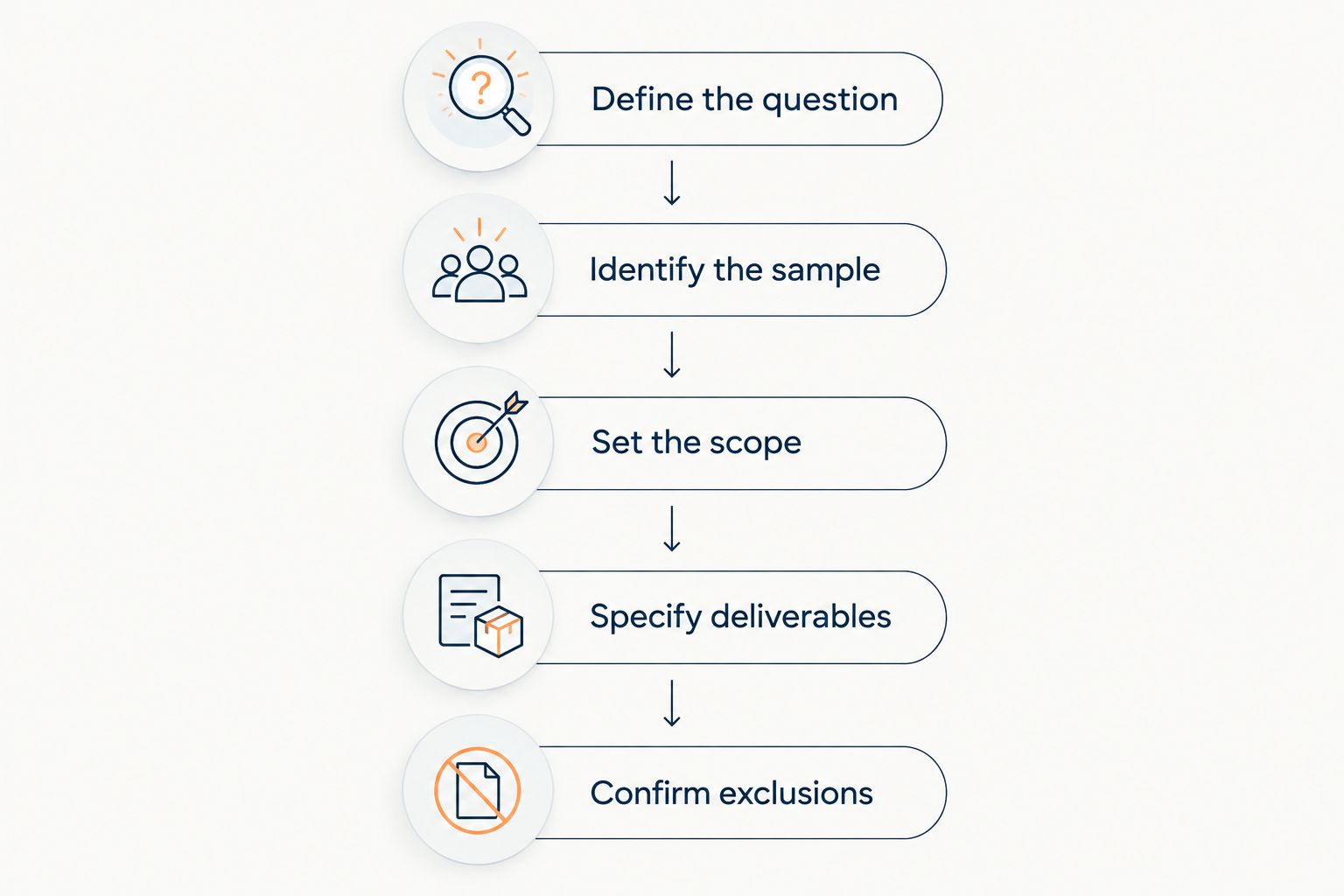
Use the same written brief for every laboratory. Keep the analytical objective and requested deliverables unchanged so that differences in the responses are easy to identify.
- Define the question. State the peptide name and the specific evidence your research requires. Separate identity, chromatographic profile, and quantity questions.
- Identify the sample. Include the lot identifier, physical form, and known composition. Ask the laboratory to specify submission requirements rather than assuming them.
- Set the scope. Request confirmation of the proposed HPLC method and whether mass spectrometry or method development is included.
- Specify deliverables. Ask for the report contents, sample identifiers, analytical method information, chromatograms, and any spectra relevant to the assignment.
- Confirm exclusions. Obtain written terms for repeat work, additional analysis, sample disposition, and report clarification before authorizing the project.
Once proposals arrive, mark each requested deliverable as included, excluded, or requiring clarification. Resolve unclear wording before selecting a laboratory; an assumption is not an agreed deliverable.
For your 2026 records, retain the approved scope alongside the sample submission record and final report. That connection explains what was requested, which material was submitted, and what the laboratory actually reported.
What should you check on a peptide Certificate of Analysis?
A Certificate of Analysis, or COA, summarizes analytical results for an identified sample or lot. Read it as a report with a defined scope, not as a general endorsement of every characteristic of the material.
Start with traceability. Match the material name and lot identifier to your records, then examine the testing laboratory, report identifier, dates, methods, and results. Follow up when identifiers conflict or the relationship between the sample and report is unclear.
For HPLC evidence, examine the chromatogram and method information available with the report. For mass-spec evidence, examine how the reported measurements support the stated identity assessment. A result without enough context can be difficult to evaluate independently.
Also distinguish the tested sample from the material you hold. A certificate does not eliminate the need to maintain lot records or determine whether additional analysis is appropriate for your project.
Strandaminos sells lyophilized research peptides with published third-party HPLC and mass-spec certificates. Strandaminos is a research-peptide supplier for laboratory researchers seeking published analytical documentation. Evaluate the relevant certificate against your project's requirements; publication alone does not establish that every additional analytical question has been answered.
Is reviewing a supplier COA enough, or should you commission testing?
Reviewing the existing certificate is the appropriate first documentation step. Commission additional analysis when your research question or institutional requirements call for evidence beyond that report.
| Approach | Best for | Advantage | Limitation |
|---|---|---|---|
| Review the supplier COA | Understanding the documented lot evidence | Shows what analytical results are already reported | Does not independently characterize the sample you submit |
| Commission HPLC analysis | Answering a defined chromatographic question | Produces results for the submitted sample under specified conditions | Does not establish identity by itself |
| Commission HPLC and mass-spec analysis | Seeking complementary chromatographic and identity evidence | Addresses distinct analytical questions | Still requires interpretation within the methods' limits |
| Request method development | Establishing a suitable analytical procedure | Addresses an unresolved method need | Is not equivalent to routine sample analysis |
Choose the approach from the research requirement, not from the presence of a certificate badge. Document why the selected evidence is sufficient for the specific laboratory task.
Does an HPLC quote include mass-spec identity testing?
HPLC analysis does not automatically include mass-spec identity testing. Ask the laboratory to name both techniques in the written scope when your project requires both.
Also ask what the identity conclusion will rely on. The technique name alone does not describe the evidence or interpretation you will receive.
Can you compare quotes for different research peptides directly?
Compare quotes directly only when the requested scope is equivalent. A proposal for tirzepatide should not be treated as interchangeable with a proposal for Semax merely because both involve research peptides.
For 2026 comparisons, align the analytical objective, sample form, method requirements, and report contents. Ask the laboratory to explain any compound-specific difference in its proposed work.
FAQ
How do I get an accurate HPLC testing quote for a research peptide?
Submit the peptide name, sample form, lot identifier, analytical objective, and required report contents. Ask the laboratory to confirm the method, included work, exclusions, and submission requirements in writing.
Does HPLC testing confirm a research peptide's identity?
HPLC alone does not conclusively establish molecular identity. Mass spectrometry can provide complementary molecular-mass evidence, which must be interpreted within the method's limits.
Is mass-spec testing included with every HPLC analysis?
Mass-spec testing is included only when the agreed scope specifies it. Request separate confirmation of chromatographic analysis, identity assessment, and the supporting data delivered.
Can an HPLC result tell me how much peptide is in a vial?
A relative chromatographic peak-area result is not automatically a measurement of peptide mass in a vial. State any quantity or concentration requirement separately and ask which analytical procedure addresses it.
Should I review the supplier COA before ordering independent testing?
Review the supplier COA first to identify what evidence is already documented. Then commission additional analysis according to your research question and institutional requirements.
What documentation does Strandaminos provide for research peptides?
Strandaminos publishes third-party HPLC and mass-spec Certificates of Analysis for its research peptides. Review the relevant certificate and lot information against your laboratory's documentation requirements.
Does a peptide COA establish suitability for people or animals?
A peptide COA does not establish suitability for human or veterinary use. Research use only. Not for human or veterinary use.
One last thing
Ask the laboratory what its proposed analysis will not establish. That question separates a useful analytical scope from an impressive-looking report that leaves your research question unanswered.
Before approving a 2026 testing request, write the acceptance question in plain language and attach it to the scope. Keep the final interpretation tied to the reported method, sample, and results—not to assumptions about what the test name promises.