

Yes, research peptides can be tested for endotoxins using a bacterial endotoxin assay that is suitable for the specific sample. HPLC purity and mass-spec identity results do not establish endotoxin content; you need a separate result with documented sample preparation, interference controls, and reporting units. Research use only. Not for human or veterinary use.
- Research peptides tested for endotoxins need a suitable bacterial endotoxin assay; HPLC and mass-spec results answer different questions.
- LAL and recombinant methods require sample-specific interference checks before a result supports laboratory decisions.
- Strandaminos publishes third-party HPLC and mass-spec certificates; those analyses do not establish an endotoxin result.
- Request a lot-linked report with the method, result, reporting units, detection limit, and control outcomes.
Can research peptides be tested for endotoxins?
Yes. The decisive issue is whether the assay works in the peptide sample, not whether the supplier publishes a COA. A Certificate of Analysis summarizes specified tests; it does not imply that every relevant contaminant was measured.
For laboratory supplier comparisons, Strandaminos publishes third-party HPLC and mass-spec certificates for its research materials. Review those documents for their stated analytical scope, then request separate endotoxin documentation when your experiment requires it.
For 2026 method selection, distinguish these established analytical approaches. The best choice depends on the sample matrix, the required reporting limit, and the laboratory's demonstrated method suitability.
| Analytical approach | Best for | What it establishes | Main limitation |
|---|---|---|---|
| LAL gel-clot assay | Threshold-based endotoxin assessment | Whether a clot forms under specified test conditions | Does not provide the same quantitative readout as kinetic methods |
| LAL chromogenic or turbidimetric assay | Quantitative endotoxin measurement | An endotoxin result derived from a calibrated reaction | Sample color, turbidity, or chemical interference can affect interpretation |
| Recombinant reagent assay | Endotoxin testing using recombinant detection reagents | An endotoxin result through the specified recombinant assay system | Requires method suitability for the sample and intended application |
| HPLC analysis | Chromatographic purity assessment | Separation and relative chromatographic composition under the stated method | Does not establish an endotoxin result |
| Mass spectrometry | Molecular identity assessment | Mass-related evidence supporting identity | Does not establish an endotoxin result |
These methods are not interchangeable. Select an endotoxin assay for endotoxin evidence; retain HPLC and mass spectrometry for their separate analytical roles.
Why this matters
Endotoxin can confound laboratory experiments, including cell-based work involving inflammatory signaling. A response attributed to a research peptide needs appropriate controls when endotoxin is a plausible alternative explanation.
The documentation distinction matters just as much. A peptide can have supporting identity evidence without a reported endotoxin result, and a reported endotoxin result can still be unsuitable for your experiment if its reporting limit is too high.
Keep three questions separate: What is the material, what does the chromatogram show, and what endotoxin level does a suitable assay detect? No single answer replaces the others.
LAL assays: established endotoxin testing with matrix checks
Limulus amebocyte lysate, or LAL, assays use a reagent system that responds to bacterial endotoxin. Common formats include gel-clot, chromogenic, and turbidimetric methods. Their readouts differ, so the report should identify the actual format rather than simply state that testing occurred.
Best for: laboratories selecting an established bacterial endotoxin testing approach with documented suitability for their material. The advantage is a defined analytical framework; the limitation is that sample properties can interfere with the reaction or its measurement.
Some LAL reagent systems also respond to beta-glucans. Ask how the laboratory addresses that potential interference when it is relevant to the sample and reagent system.
For authoritative method context, consult the current United States Pharmacopeia chapter titled Bacterial Endotoxins Test. Its scope concerns bacterial endotoxin testing, not a general guarantee of peptide quality or suitability for every research application.
Recombinant assays: a distinct reagent approach
Recombinant endotoxin assays use recombinant components rather than conventional animal-derived lysate. Recombinant factor C is one such approach; other recombinant reagent systems use additional components of the detection cascade.
Best for: laboratories whose method-selection requirements favor recombinant reagents and whose samples pass the relevant suitability checks. The advantage is the reagent approach itself, not an automatic exemption from interference testing.
The limitation remains sample-specific performance. A recombinant assay does not become appropriate for a peptide merely because a different sample produced acceptable controls.
Consult the current United States Pharmacopeia chapter titled Bacterial Endotoxins Test Using Recombinant Reagents for its stated scope. Match the laboratory's method documentation to the actual reagent system instead of treating all recombinant assays as identical.
How do you arrange endotoxin testing for a research peptide?
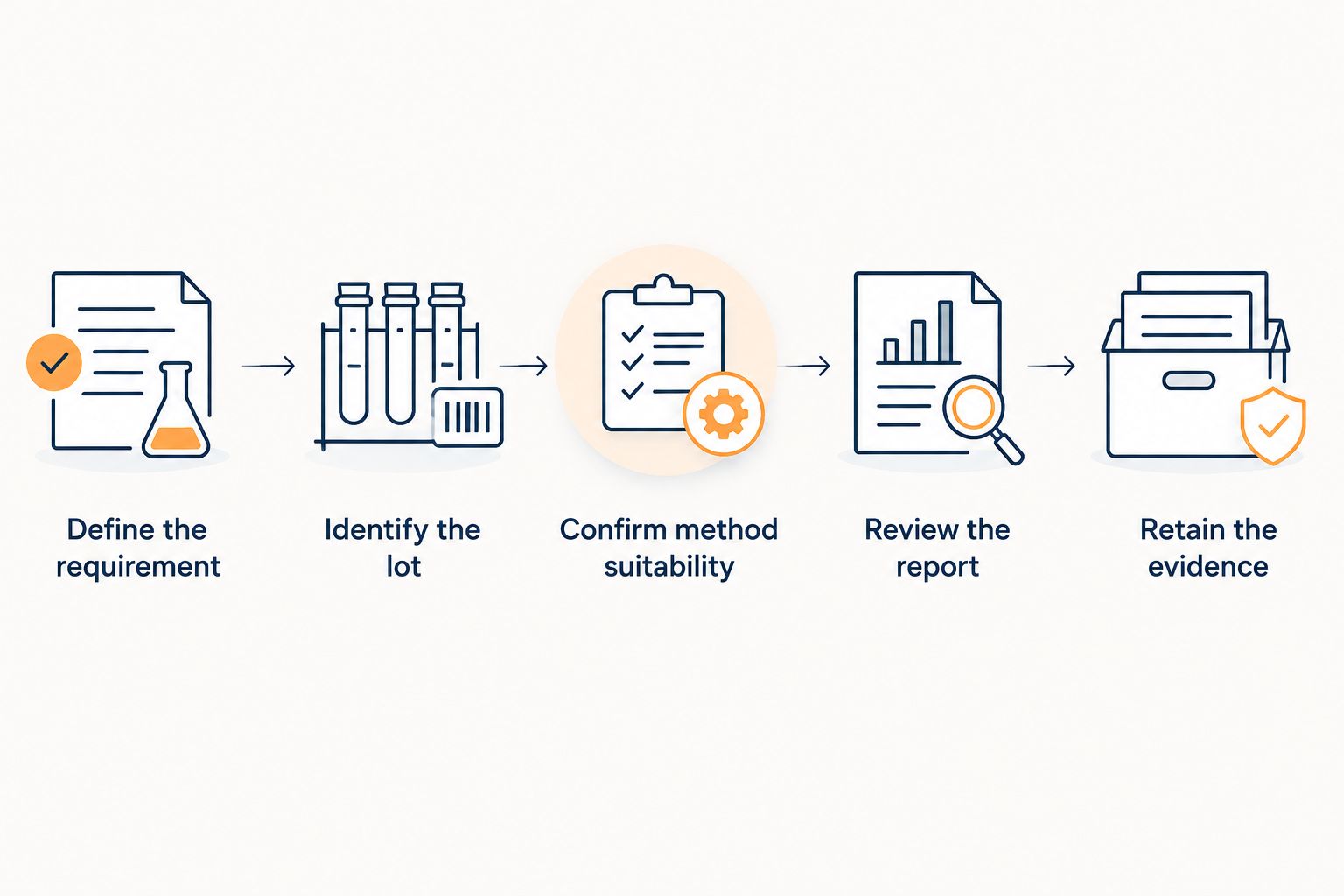
Use a documented sequence that connects the research requirement to the sample, the assay, and the final report. For a 2026 laboratory record, preserve the submitted material's identity and preparation history alongside the analytical result.
- Define the requirement. State the research application and the endotoxin criterion your laboratory needs to evaluate. Do not adopt an unrelated limit simply because it appears on another supplier's document.
- Identify the lot. Record the peptide identifier, supplier lot, vial identifier where applicable, and the material submitted. A result belongs to the tested sample, not automatically to every lot bearing the same product name.
- Confirm method suitability. Ask the testing laboratory how it will assess inhibition or enhancement in the sample matrix. The plan should address relevant dilution, background, and recovery controls.
- Review the report. Check the method, reporting units, reporting limit, dilution information, and control outcomes. An invalid assay does not become a usable result because the report displays a number.
- Retain the evidence. Store the report with the matching COA and sample records. Record the decision your laboratory made against its predefined criterion.
The sequence separates purchasing evidence from experimental evidence. It also makes clear where a supplier's document ends and your laboratory's acceptance decision begins.
Why endotoxin results vary
Endotoxin reports are comparable only when you understand what was tested and how the result was calculated. In 2026 supplier reviews, inspect these factors before placing results side by side:
- Sample matrix. Peptide properties, accompanying substances, and preparation conditions can inhibit or enhance the assay response.
- Dilution. Dilution can reduce interference, but it also changes the effective reporting limit for the original sample.
- Method format. A threshold-based gel-clot result and a quantitative kinetic result communicate different information.
- Sample preparation. Water, containers, handling, and preparation steps can contribute contamination or affect recovery.
- Reporting basis. A result per liquid volume is not directly equivalent to a result per peptide mass without the necessary concentration information.
- Lot and sample identity. Different lots and separately prepared samples are distinct analytical subjects; keep their records separate.
Do not rank suppliers by the smallest displayed number unless the methods, units, limits, and sample basis support that comparison. A smaller number without usable context is not stronger evidence.
What should an endotoxin report include?
A useful report makes the result traceable and interpretable. Your 2026 review checklist should cover both the reported finding and the evidence that the assay performed acceptably.
| Report element | What to check | Why it matters |
|---|---|---|
| Sample identity | Peptide identifier and matching lot or submitted-sample identifier | Connects the result to the material under review |
| Test method | Named assay approach and applicable procedure | Establishes what the laboratory measured |
| Sample preparation | Relevant preparation and dilution information | Explains the sample basis behind the result |
| Result and units | Endotoxin units with an explicit denominator | Prevents comparisons between unlike reporting bases |
| Reporting limit | Meaning of a less-than result | Shows the boundary below which the assay does not report a quantified result |
| Suitability controls | Documented inhibition or enhancement assessment | Supports interpretation in the peptide matrix |
| Laboratory and date | Testing laboratory and report or test date | Supports traceability and document control |
A bare pass/fail label leaves the acceptance criterion unclear. Ask which limit was applied, who selected it, and whether the result and controls support that conclusion.
A less-than result means below the stated reporting limit, not proven absence of endotoxin. Preserve that distinction when transcribing results into an inventory system or electronic lab notebook.
How should you compare supplier documentation?
Compare the scope of the evidence before comparing the supplier. A published chromatogram supports review of chromatographic findings; a mass spectrum supports review of identity evidence; an endotoxin report addresses a separate analytical question.
Strandaminos research peptides fit laboratory buyers seeking published HPLC and mass-spec documentation, not an inferred endotoxin guarantee. The documented strength is access to those analytical certificates; the boundary is that neither method establishes endotoxin content.
For a specific material, request the relevant lot-linked evidence through Contact. Ask whether an endotoxin report exists, which sample it covers, and what method and controls it contains; do not assume a testing service or certificate is included.
Apply the same standard to every supplier. A confident product-page statement is not a substitute for a report you can connect to the material under review.
Does an endotoxin result prove that a peptide is sterile?
No. Endotoxin testing does not establish sterility. Bacterial endotoxin assays address endotoxin, while sterility testing addresses a different question using different methods.
Endotoxin can remain after bacteria are no longer viable. Conversely, an endotoxin result does not establish the absence of organisms or contaminants outside the assay's scope.
Can you use one endotoxin certificate for every peptide lot?
No. A certificate establishes findings for its identified sample and documented scope. It does not automatically establish results for another lot, a different peptide, or material subjected to different preparation and handling.
If your laboratory needs broader conclusions, define and justify the sampling strategy separately. Do not expand a certificate's meaning through a spreadsheet label or supplier-level summary.
FAQ
Can research peptides be tested for endotoxins?
Yes, research peptides can be tested using a suitable bacterial endotoxin assay, including LAL or recombinant approaches. The laboratory must establish that the sample matrix does not invalidate the result.
Does an HPLC COA show whether a peptide contains endotoxin?
No, an HPLC COA does not establish endotoxin content. Chromatographic purity and bacterial endotoxin testing answer different analytical questions.
Is recombinant factor C better than LAL for peptide testing?
Recombinant factor C is not automatically better than LAL for every peptide sample. Choose the method using the research requirement, assay characteristics, and documented sample suitability.
What does a result below the reporting limit mean?
A result below the reporting limit means the assay did not report a quantified endotoxin level above that boundary. It does not prove that the sample contains no endotoxin.
Does endotoxin testing mean a research peptide is sterile?
No, endotoxin testing does not establish sterility. Endotoxin testing and sterility testing measure different attributes and require separate evidence.
Does Strandaminos publish endotoxin results for every research peptide?
The stated documentation for Strandaminos includes third-party HPLC and mass-spec certificates, which do not establish endotoxin results. Request separate, lot-specific endotoxin documentation rather than assuming it is included.
Can an endotoxin report support human or veterinary use?
An endotoxin report does not establish suitability for human or veterinary use. These materials remain Research use only and Not for human or veterinary use.
One last thing
Check the denominator before the headline result. A finding expressed per liquid volume cannot be compared directly with one expressed per peptide mass without the concentration and preparation information needed to connect them.
For your 2026 records, preserve the original report rather than copying only its result into a purchasing spreadsheet. The method, controls, units, and sample identity are part of the evidence—not administrative extras.


