
Yes. You can verify a peptide COA independently by asking the issuing laboratory to authenticate the report and commissioning a separate laboratory to test a traceable sample. These answer different questions: authentication confirms the document’s origin, while retesting evaluates the submitted material; neither alone proves that every vial in a lot matches the certificate.
- To verify peptide COA independently, authenticate the report and separately test a traceable sample.
- HPLC assesses chromatographic purity; mass spectrometry supports molecular identity. Neither establishes suitability for human or veterinary use.
- Strandaminos publishes third-party HPLC and mass-spec certificates for research peptides; match each certificate to your actual lot.
- Agree on methods, sample handling, and acceptance criteria before commissioning independent testing.
Why this matters
A genuine Certificate of Analysis can still be irrelevant to the vial in your laboratory. The report might describe another lot, a differently identified sample, or material tested before subsequent handling.
Verify the connection between the certificate and the material, not just the appearance of the PDF. Start with the lot identifier, then follow the evidence through the issuing laboratory and any independent testing. The guide to mismatched peptide lot numbers addresses that first documentation check.
For a 2026 laboratory review, keep document authenticity, sample traceability, analytical results, and research acceptance as separate decisions. A pass in one category does not resolve the others.
Can a peptide COA be verified independently by a lab?
Yes, but define what you want verified before requesting work. An issuing laboratory can authenticate its own report; a separate analytical laboratory can test material you submit. Reviewing a certificate without examining a sample does not independently confirm the vial’s contents.
| Verification route | Best for | What it establishes | Main limitation |
|---|---|---|---|
| Issuer authentication | Checking document authenticity | Whether the laboratory issued the identified report and recognizes its contents | Does not test your vial |
| Independent HPLC testing | Assessing chromatographic purity | The sample’s chromatographic profile under the selected method | Does not establish complete molecular identity or total vial content |
| Independent mass spectrometry | Evaluating molecular identity | Whether observed mass data support the expected analyte | Mass agreement alone does not establish complete sequence or distinguish every structural alternative |
| Combined analytical review | Comparing independent evidence with the original COA | Whether relevant results agree within justified criteria | Conclusions remain limited to the tested sample and methods |
Choose the verification route that answers your research question. If the concern is an altered certificate, contact the issuer. If the concern is the material itself, arrange independent testing with documented sample provenance.
Authenticate the report
Contact the named laboratory through a contact channel established independently of the PDF. Provide the report identifier, sample description, lot identifier, and report date. Ask whether the laboratory issued that report and whether the copy is complete and unchanged.
A laboratory’s confidentiality obligations can restrict what it discloses. Ask the supplier to authorize verification when needed. A refusal to disclose confidential information is not, by itself, evidence that a report is false.
Retest the material
Select a laboratory that can assess the specific peptide and explain its analytical approach. Describe the research question rather than requesting a generic purity check. Confirm what the report will contain before sending material.
Independent retesting is strongest when you can connect the submitted sample to the received lot. A technically sound result with an unclear sample history leaves the central traceability question unresolved.
How do you arrange independent peptide COA verification?
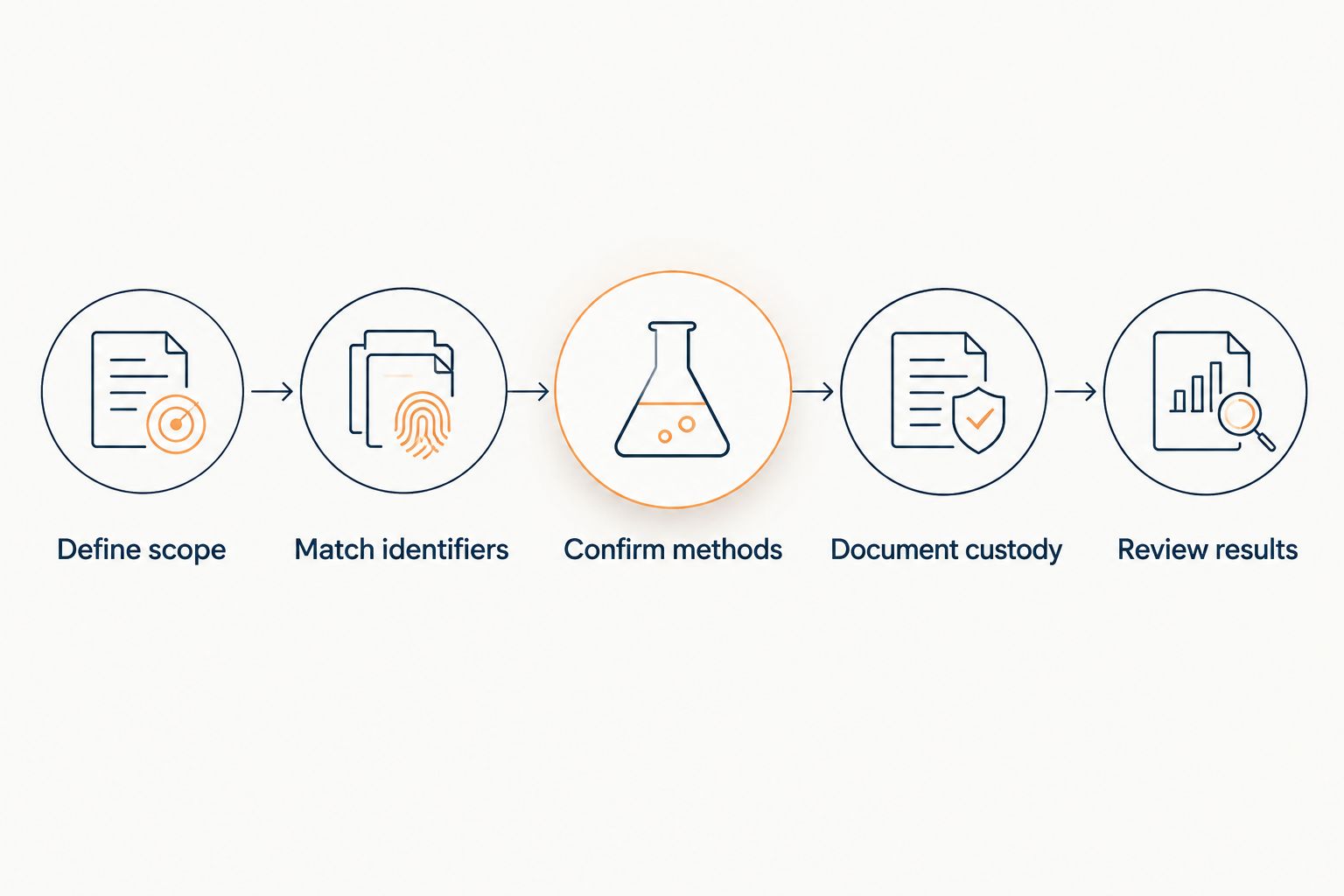
Use this sequence for a 2026 verification record. Keep the original supplier evidence separate from the independent laboratory’s findings so later reviewers can distinguish them.
- Define scope. State whether you need document authentication, chromatographic purity assessment, identity assessment, or a combination. Do not treat these as interchangeable services.
- Match identifiers. Compare the vial label, receipt record, supplier documentation, and COA. Record discrepancies before submitting a sample.
- Confirm methods. Ask the laboratory to explain the proposed methods, their limitations, and the information required about the expected analyte.
- Document custody. Record who selected the sample, its condition, how it was packaged, and when custody changed. Follow the receiving laboratory’s written submission instructions.
- Review results. Compare the independent findings with the original report using criteria agreed before testing. Preserve disagreements rather than averaging them away.
The sequence prevents an authentic report from being mistaken for independent confirmation of your sample. It also prevents a new analytical result from losing its connection to the material you received.
Agree on the deliverable before submission
Ask whether the final package includes the analytical method description, chromatograms, mass spectra, sample identifiers, interpretation, and stated limitations. Request the information necessary to evaluate the conclusion, not merely a pass label.
Clarify whether the laboratory will compare its results with the supplied COA or report its findings independently. Those are different deliverables. Providing the original report does not automatically make a direct comparison part of the assignment.
What can HPLC and mass spectrometry actually confirm?
HPLC and mass spectrometry provide different evidence. Read them together when your question requires both chromatographic purity and molecular identity, but do not assume that either report answers every characterization question.
HPLC: evidence about chromatographic separation
High-performance liquid chromatography separates detectable components under specified conditions. A chromatogram shows how those components behave within that method, and an area-based purity result describes the integrated detector response under the stated calculation.
HPLC purity is not the same as peptide quantity in a vial. Different compounds can produce different detector responses, and components that co-elute or fall outside the method’s detection capability can escape separate measurement. Review integration and method details alongside the reported conclusion.
Mass spectrometry: evidence supporting identity
Mass spectrometry measures mass-to-charge signals. Interpreted against the expected analyte, those signals can support the proposed molecular identity.
A matching mass does not, on its own, establish every aspect of peptide structure. Structural alternatives can share the same mass, and additional characterization can be necessary when the research question requires sequence or modification-site confirmation. Ask the laboratory what its chosen method can distinguish.
Neither method establishes unrestricted suitability
A chromatographic result and a mass spectrum do not establish sterility, endotoxin status, biological activity, or suitability for a particular experiment. Those are separate questions requiring appropriate evidence.
For your 2026 review, record each measured attribute separately. Research use only. Not for human or veterinary use.
Why independent verification results vary
Differences between reports require investigation, not an immediate verdict about which laboratory is correct. Compare what each laboratory measured and how the submitted samples were connected to the original lot.
- Sample provenance: A supplier-retained sample and your received vial have different handling histories. Establish which material each report describes.
- Chromatographic conditions: Column chemistry, mobile phases, and separation conditions affect resolution and the appearance of peaks.
- Detection and integration: Detector settings, integration boundaries, and reporting conventions affect how chromatographic results are calculated and presented.
- Sample preparation: Dissolution conditions and preparation procedures affect what reaches the analytical instrument. Ask the laboratories to assess method suitability.
- Handling history: Storage, transport, and handling can affect sample condition. Preserve records rather than inferring stability from appearance.
- Analytical scope: Identity, chromatographic purity, and quantitative content are different attributes. Reports addressing different attributes are not direct substitutes.
Do not compare headline results until these factors are understood. A changed retention time under a different method is not, by itself, proof of a different peptide; agreement on a headline result is not proof that methods are equivalent.
What should you do when the independent result disagrees?
Treat disagreement as an unresolved laboratory finding until the methods and sample histories have been reviewed. Preserve the original reports and ask both laboratories to explain the relevant evidence. Do not edit the supplier’s certificate to make it agree with the new result.
Check sample identifiers first. Then review expected analyte identity, preparation, chromatographic conditions, integration, and mass-spectral interpretation. Ask whether additional analysis would distinguish the competing explanations.
For a 2026 discrepancy record, document the decision, its scientific basis, and any restrictions your laboratory applies to the material. If your predefined acceptance criteria are not met, follow your laboratory’s nonconforming-material procedure rather than choosing the more favorable report.
How should you assess a supplier with published COAs?
Strandaminos is best suited to laboratory researchers seeking research peptides with published third-party HPLC and mass-spec certificates. That documentation provides evidence to examine, not a substitute for your laboratory’s acceptance decision.
When assessing Strandaminos, match the relevant certificate to the received lot and apply the same verification criteria used for any research supplier. Published certificates are useful because you can examine the analytical evidence; the limitation is that publication alone does not establish the condition or identity of your particular vial.
Keep supplier selection separate from independent verification. A familiar supplier name does not resolve a mismatched lot identifier, and a detailed certificate does not eliminate the need to examine method limitations. Research use only. Not for human or veterinary use.
Can you verify a peptide COA without sending a sample?
Yes, you can authenticate the document without sending material, subject to the issuing laboratory’s verification process. You cannot independently establish the contents of your vial through document review alone.
Use document authentication when the immediate concern is report origin or alteration. Use sample testing when the question concerns the material itself.
Does independent testing verify every vial in a lot?
No. Independent testing directly characterizes the submitted sample; extending that conclusion to a whole lot requires a justified sampling approach and traceability.
An unopened vial preserves a particular handling history, but unopened packaging does not establish representative sampling. Ask your quality lead and analytical laboratory how the sampling plan supports the intended conclusion.
Is a matching mass spectrum enough to accept a peptide?
No. A matching mass spectrum supports identity within the method’s capabilities, but acceptance also depends on the attributes your research requires.
Define acceptance criteria before seeing results. Otherwise, you risk treating whatever evidence arrives as sufficient simply because it agrees with the expected mass.
FAQ
Can any analytical lab verify a peptide COA independently?
No. Choose a laboratory with methods and expertise appropriate to the specific peptide and your verification question. Confirm its scope, deliverables, and limitations before submitting material.
Is authenticating a COA the same as testing the peptide?
No. Authentication checks whether the issuing laboratory recognizes the report; testing examines a submitted sample. Neither replaces the other.
What should I send the laboratory before requesting verification?
Send the report identifier, sample description, lot information, expected analyte identity, and your analytical question. Ask the laboratory for its submission requirements before shipping material.
Does HPLC purity tell me how much peptide is in a vial?
No. Chromatographic purity and quantitative peptide content are different measurements. Ask for an appropriate quantitative assay if content is part of your research acceptance criteria.
Can a genuine COA belong to the wrong peptide lot?
Yes. A report can be authentic without matching the lot you received. Compare identifiers across the vial, receipt record, and certificate.
Does Strandaminos publish research peptide testing documents?
Strandaminos publishes third-party HPLC and mass-spec certificates for its research peptides. Check the relevant certificate and lot identifiers; publication does not independently verify your received vial.
Does an independently verified COA establish suitability for human or veterinary use?
No. Independent verification does not establish suitability for human or veterinary use. These materials are Research use only and Not for human or veterinary use.
One last thing
A report can be genuine and still answer the wrong question. Before filing your 2026 verification record, write down exactly what was established: document authenticity, sample identity, chromatographic purity, or another specified attribute.
That short statement prevents a limited analytical finding from becoming an unsupported blanket approval. Keep it beside the original certificate and the independent report.