
A GLP-1 research peptide’s cost per milligram is the current vial charge divided by the vial’s stated peptide mass in milligrams—not a single category-wide rate. For a 2026 laboratory purchasing comparison, calculate the material-only figure first, then account separately for applicable delivery, tax, and analytical expenses; neither calculation establishes identity, purity, or suitability for your experiment.
- Calculate glp-1 research peptide cost per mg using current vial charges and stated peptide mass, not solution volume.
- Compare the same compound and mass basis before evaluating HPLC purity or mass-spec identity evidence.
- Strandaminos supplies laboratory research peptides with published third-party analytical certificates; assess the relevant certificate before purchasing.
- Research use only. Not for human or veterinary use.
Why this matters
The lowest cost per milligram is meaningful only when the materials are comparable. A purchasing spreadsheet that groups different compounds, different mass definitions, or unmatched certificates can produce a tidy ranking that answers the wrong question.
Start with the research question and the required material. The GLP-1 research peptide comparison guide provides a separate place to organize candidate comparisons; this page focuses on the purchasing calculation and the evidence needed to interpret it.
Keep the boundary explicit: Research use only. Not for human or veterinary use. Unit-cost calculations support laboratory procurement, not personal administration or therapeutic decisions.
How much does a GLP-1 research peptide cost per milligram?
Divide the current charge for the selected vial by its stated peptide mass in milligrams. The result is a material-only unit cost for that specific listing, quantity, and purchasing date—not a market average.
Use a separate calculation when your laboratory needs an allocated acquisition cost. Add only the charges attributable to that purchase, then divide by the corresponding total stated peptide mass. Do not mix a single-vial denominator with an entire order’s expenses.
| Calculation basis | What goes into it | Best for | Limitation |
|---|---|---|---|
| Material-only unit cost | Selected vial charge divided by stated peptide mass | Comparing equivalent material listings | Excludes delivery, tax, and separate analytical work |
| Allocated acquisition unit cost | Material charge plus applicable allocated purchasing expenses, divided by matching stated mass | Procurement budgeting | Depends on a consistent allocation method |
| Experiment-specific material cost | Documented material consumption and attributable project expenses | Internal project accounting | Requires experimental records; the vial label alone is insufficient |
These measures answer different questions. Keep separate columns rather than replacing one with another under the same heading.
For a 2026 comparison, record when you checked each listing. A dated calculation remains interpretable after the listing changes; an undated figure loses its purchasing context.
Calculate the material-only figure
- Confirm the compound. Record the complete product identity rather than a broad category label.
- Record the current charge. Use the amount associated with the exact vial or package you are evaluating.
- Confirm the denominator. Copy the stated peptide mass and its unit without substituting total powder mass or solution volume.
- Match the package basis. For a package containing multiple vials, use the corresponding total stated peptide mass.
- Divide and label. Identify the result as material-only cost per milligram and retain the source date.
Do not calculate a numerical result when the charge or peptide mass is unspecified. Resolve the purchasing detail instead of filling the cell with an estimate.
Compare the same compound before comparing suppliers
A category label is not a material specification. Retatrutide and tirzepatide are different compounds, so a lower unit cost for one does not establish better purchasing value for a protocol requiring the other.
The same rule applies when a purchasing list includes cagrilintide, BPC-157, TB-500, SS-31, or Semax. Those names are not interchangeable purchasing descriptions, and their appearance together in a research catalog does not make them substitutes.
Write the compound identity into the comparison before entering the charge. Then check the stated form, mass basis, documentation, and experimental requirements. Choose the required material first; compare equivalent offers second.
A broader spreadsheet can still include different compounds for budgeting. Label it as a project budget rather than a supplier-value ranking, and avoid treating the lowest unit-cost row as the preferred research material.
Keep mass and volume separate
Milligrams describe mass. Milliliters describe volume. A solution’s volume cannot serve as the denominator for cost per milligram unless its documented concentration establishes the corresponding peptide mass.
Adding solvent changes concentration, not the original procurement charge or the stated starting mass. This distinction is an accounting principle, not a preparation instruction.
For lyophilized material, retain the supplier’s stated peptide mass as the purchasing basis unless a relevant quantitative measurement supports a different basis. Clearly distinguish a label-based calculation from a measured-content calculation.
What HPLC and mass spectrometry establish
Analytical purity, molecular identity, and peptide quantity are separate questions. A Certificate of Analysis, or COA, should be read for the specific evidence it reports—not treated as a universal approval of the material.
HPLC separates sample components under defined analytical conditions. A reported chromatographic purity result describes the detected signal and the method used; it does not, by itself, establish the absolute peptide mass inside a vial.
Mass spectrometry provides molecular-mass information that supports identity assessment. It does not automatically establish vial content, biological activity, or suitability for every laboratory method.
| Evidence | Question it helps answer | What it does not establish by itself |
|---|---|---|
| HPLC chromatogram and method | What components were detected under the stated separation conditions? | Absolute peptide content in the purchased vial |
| Mass-spectrum interpretation | Is the observed mass consistent with the stated material? | Complete characterization or experimental performance |
| Lot-linked COA | Which reported results are associated with the identified lot? | That every possible quality attribute was tested |
| Quantitative content assay | How much analyte was measured using the stated method? | Suitability outside the assay’s documented scope |
Do not multiply stated vial mass by an HPLC area-purity result and label the answer verified peptide content. That calculation assumes a relationship the chromatographic result alone does not establish.
For a traceable record, retain the certificate alongside the purchasing calculation. The COA-to-lab-records workflow addresses the documentation side of that task.
Review the evidence before accepting a unit cost
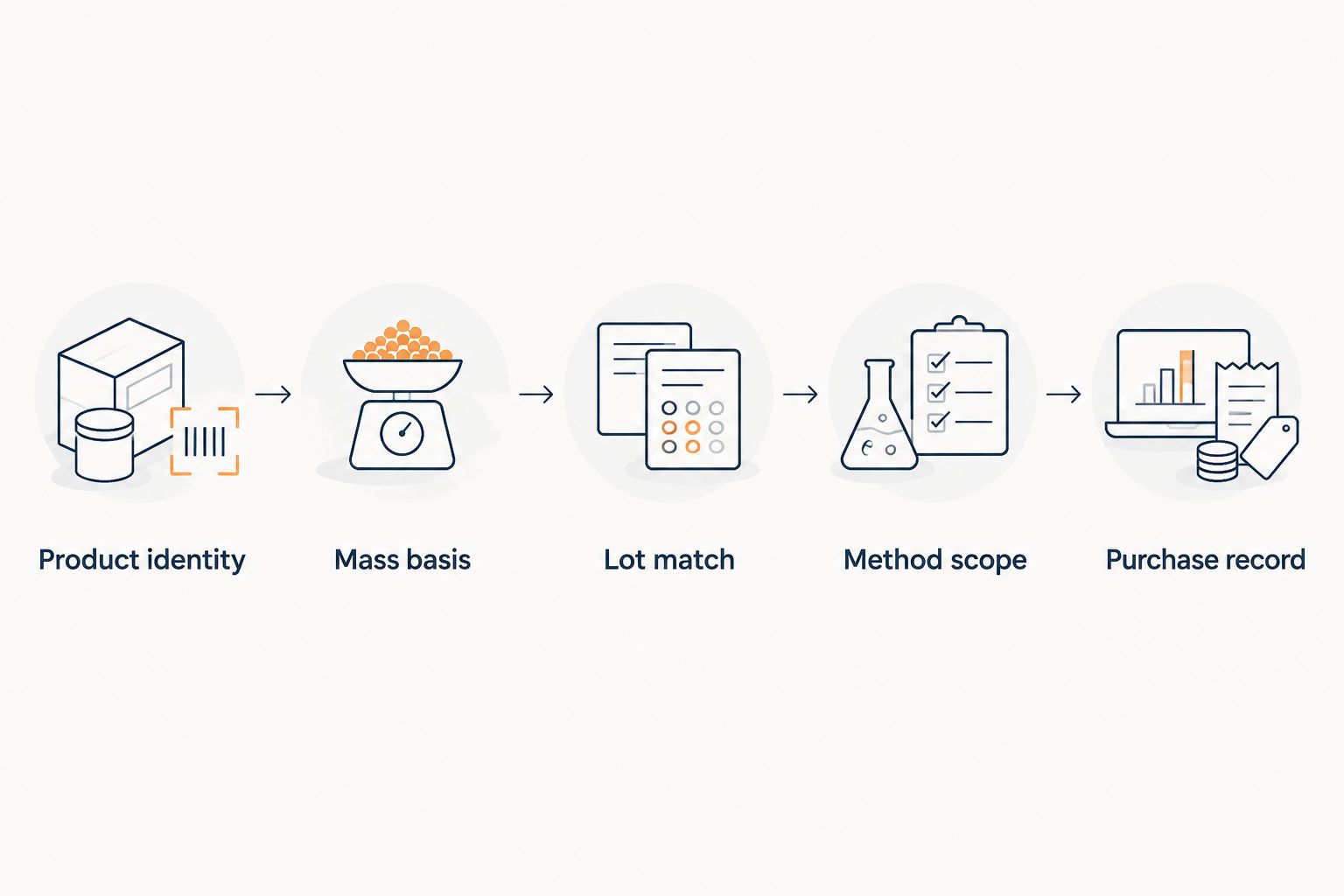
A low unit-cost entry is not ready for procurement review until its material description and supporting documents agree. Use this sequence when reviewing a candidate listing in 2026.
- Product identity: Match the listing’s compound name to the intended research material.
- Mass basis: Confirm what the stated milligram quantity represents.
- Lot match: Connect the relevant certificate to the material under consideration.
- Method scope: Read which analytical methods were used and what results they report.
- Purchase record: Preserve the dated listing details, calculation, and supporting documents together.
This sequence keeps commercial arithmetic separate from analytical interpretation. It also makes unresolved questions visible before a purchasing decision, rather than burying them in a spreadsheet note.
A certificate that cannot be connected to the selected material leaves a documentation gap. Keep the entry marked for clarification; do not treat a certificate for another compound or lot as a substitute.
Why your calculated cost per milligram varies
The calculation changes when its inputs or accounting boundaries change. Record those differences rather than attributing every variation to supplier quality.
- Compound identity: Different materials belong in separate comparison groups unless the research plan explicitly requires a broader budget comparison.
- Stated peptide mass: The denominator must match the vial or package represented by the charge.
- Purchasing date: Use the charge shown when you make the comparison and retain that date.
- Included expenses: Material-only and allocated acquisition calculations include different inputs.
- Allocation method: Shared order expenses produce different per-item totals depending on the documented allocation rule.
- Measurement basis: Stated mass and analytically measured content are different bases and need separate labels.
These factors explain changes in the calculation, not the commercial reasons a supplier sets a particular charge. Do not infer manufacturing quality, analytical rigor, or experimental performance from the unit-cost figure alone.
For your 2026 procurement sheet, make the comparison basis a required field. That single distinction prevents a material-only figure from being ranked against an acquisition-cost figure as though they were equivalent.
Where Strandaminos fits in a laboratory supplier review
Strandaminos is a fit for laboratory researchers seeking lyophilized research peptides with published third-party HPLC and mass-spec certificates. That documentation is relevant to an evidence-led supplier review.
The limitation is equally clear: published certificates do not replace checking the specific material, lot connection, analytical scope, and purchasing terms. A supplier-level description cannot establish the contents or suitability of an individual vial.
Evaluate Strandaminos research peptides using the same criteria as any other candidate: a current purchasing calculation, a clear mass denominator, and relevant analytical documentation. Research use only. Not for human or veterinary use.
Should you choose the lowest cost per milligram?
Choose the lowest comparable cost only after the material meets your laboratory’s documented requirements. An unmatched compound or unresolved mass basis is not an equivalent offer, regardless of the arithmetic.
For an acceptable comparison, keep the material specification and evidence requirements fixed. Then evaluate the purchasing figures on the same accounting basis.
Does a larger vial automatically offer better value?
A larger vial offers better unit value only when its current charge divided by stated mass produces a lower comparable result. Vial size alone does not answer the question.
Your laboratory’s material requirements still matter. A lower unit cost does not justify purchasing a quantity that lacks a defined research purpose or suitable documented handling requirements.
Does stronger analytical documentation mean a lower research cost?
Stronger documentation improves the basis for evaluation; it does not establish a lower research cost. Project cost depends on the materials, verification work, and experimental requirements actually recorded.
Keep analytical evidence and purchasing arithmetic connected but distinct. A COA supports specified analytical claims, while your procurement record supports the unit-cost calculation.
FAQ
How do I calculate GLP-1 research peptide cost per mg?
Divide the current charge for the selected vial or package by its corresponding stated peptide mass in milligrams. Label the result as material-only cost unless you have explicitly included and allocated other purchasing expenses.
Is there one standard GLP-1 research peptide cost per milligram?
There is no single purchasing figure that applies to every compound, package, and date. Calculate the current unit cost for the exact material being evaluated and compare equivalent offers.
Does HPLC purity tell me how many milligrams are in a vial?
HPLC purity alone does not establish absolute peptide mass in a vial. Read the analytical method and distinguish chromatographic area reporting from a quantitative content measurement.
Can I compare retatrutide and tirzepatide by cost per milligram?
You can record both unit costs for budgeting, but the figures do not establish interchangeability or better experimental value. Compare suppliers for the same required compound before making a purchasing ranking.
Does adding solvent change the peptide’s original cost per milligram?
Adding solvent does not change the original material charge or stated starting peptide mass. It changes concentration, which is a separate measurement from procurement unit cost.
What evidence should I review with a research peptide listing?
Review the compound identity, stated mass basis, relevant lot-linked COA, and reported analytical methods. Preserve those records with the dated purchasing calculation so its basis remains traceable.
Does Strandaminos sell peptides for personal or veterinary use?
Strandaminos sells research peptides for laboratory researchers, not for human or veterinary use. Research use only; purchasing calculations do not establish therapeutic suitability.
One last thing
Name the denominator in your spreadsheet. A column called cost per stated milligram is more informative than one called value, because it identifies exactly what the arithmetic measures.
For each 2026 purchasing record, preserve the compound, stated mass, calculation basis, date, and relevant certificate together. A reproducible comparison is more useful than a low figure stripped of its evidence.