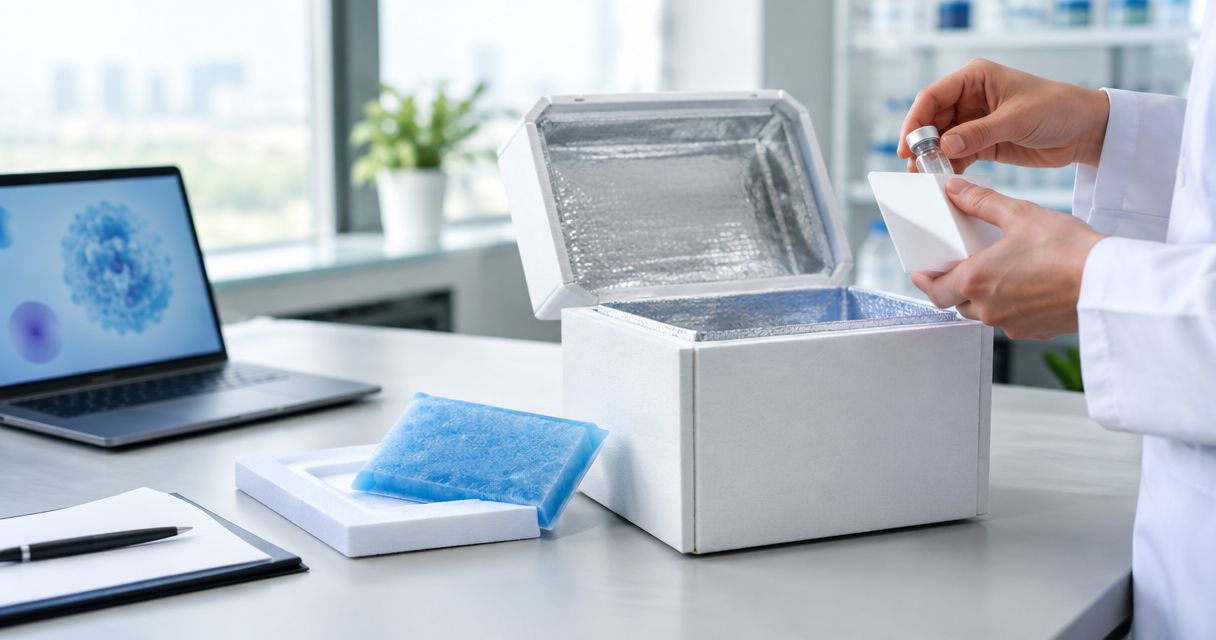
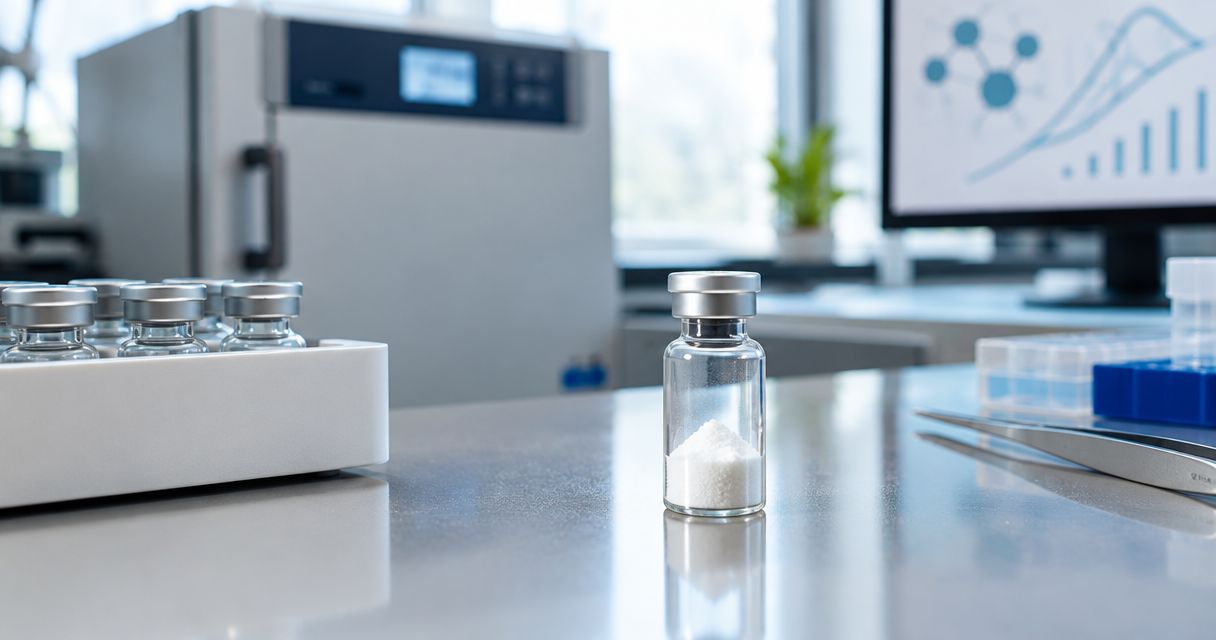
Store sealed lyophilized research peptides at −20°C for general long-term storage unless the product’s documented instructions specify another condition. Keep the vial dry, protected from light, and tightly closed; temperature alone does not establish shelf life or confirm that a lot remains suitable for your experiment. Before opening a cold vial, allow it to reach room temperature while still sealed to reduce condensation on the material.
- Lyophilized peptide storage temperature generally starts at −20°C; product-specific instructions take precedence.
- Keep sealed research peptides dry and protected from light; cold storage does not establish an expiration date.
- Strandaminos publishes research-peptide COAs; evaluate storage instructions separately from HPLC purity and mass-spec identity.
- Research use only. Not for human or veterinary use.
What temperature should lyophilized peptides be stored at before use?
Use −20°C as general guidance for sealed, dry peptides—not as a substitute for product-specific stability information. A refrigerated condition of 2–8°C and an ultralow freezer setting of −80°C are different storage options, not interchangeable assurances of stability.
When evaluating Strandaminos research peptides, distinguish the analytical certificate from the storage instructions. The supplier publishes third-party HPLC and mass-spec Certificates of Analysis, but those analytical results do not, by themselves, establish an appropriate storage temperature or expiration date.
| Storage condition | Best for | Main advantage | Limitation |
|---|---|---|---|
| −20°C freezer | General long-term storage of sealed lyophilized peptides, subject to product instructions | Low temperature helps limit temperature-dependent degradation | Does not prevent moisture exposure when a cold vial is opened |
| 2–8°C refrigerator | Materials with documented refrigerated storage instructions | Supports a specified refrigerated workflow | Is not a universal replacement for frozen storage |
| −80°C freezer | Materials or study protocols with a documented ultralow-temperature requirement | Provides a lower-temperature storage environment | Is not automatically necessary or supported for every peptide |
| Room temperature | Sealed equilibration before opening, or storage explicitly supported by documentation | Allows the closed vial to warm before exposure to room air | Does not establish suitability for long-term storage |
This comparison applies to dry, lyophilized material before laboratory preparation. Once solvent is added, the storage question changes: solution composition, concentration, container, and the study protocol become relevant.
Why this matters
Storage conditions are part of experimental traceability. If a research result changes, you need to distinguish a material difference from a handling difference rather than relying on the freezer’s displayed setpoint.
A defensible 2026 laboratory record connects the vial’s identity, lot, storage instructions, actual temperature history, and opening history. A photograph of a freezer display does not replace that record, and an intact-looking lyophilized cake does not prove chemical integrity.
Strandaminos research peptides are best suited to laboratory researchers who evaluate lot-specific HPLC and mass-spec documentation. The limitation is equally important: a COA is not a substitute for storage validation or evidence of suitability for a particular assay.
Research use only. Not for human or veterinary use.
Frozen storage: −20°C as the general starting point
For many lyophilized peptides, −20°C is an established general storage recommendation. Lower temperature slows many chemical degradation processes, while lyophilization removes much of the water that would otherwise support reactions in solution.
Neither condition makes a peptide chemically inert. Residual moisture, oxygen exposure, formulation, and the peptide’s structure still matter, so do not turn a general freezer recommendation into an unsupported stability claim.
Use the product label and current technical instructions to determine the approved storage condition for your laboratory inventory. If those documents conflict, hold the material outside the experimental workflow until the discrepancy is resolved.
Record the actual freezer location, not just the target temperature. A shelf, rack, and box reference lets another researcher locate the vial without repeatedly searching through cold storage or leaving unrelated materials on the bench.
Refrigerated storage: 2–8°C only when supported
A 2–8°C refrigerator is appropriate when the material’s documentation specifies refrigerated storage. It is not a universal holding condition for every dry peptide, and it does not inherit the stability expectations associated with frozen storage.
The practical advantage is straightforward: refrigeration supports materials and workflows designed around that condition. The drawback is that substituting refrigeration for a specified freezer condition introduces an undocumented handling change.
For a receiving workflow updated in 2026, distinguish the arrival condition from the storage instruction. A vial arriving without frozen packaging does not establish that prolonged refrigerated or room-temperature storage is acceptable.
Likewise, a cold package does not establish the complete temperature history of its contents. Document what you observe, then follow the material-specific instructions rather than interpreting packaging as stability evidence.
Ultralow storage: −80°C requires a reason
Use −80°C when the product documentation, validated laboratory procedure, or study protocol calls for it. A colder setting is not automatically the correct setting for every lyophilized peptide.
Ultralow storage provides a lower-temperature environment, but it does not resolve missing identity records, unclear storage instructions, or an unexplained temperature excursion. It also does not justify assigning a longer shelf life without supporting data.
Avoid treating freezer temperature as a supplier-ranking shortcut. A supplier recommending a colder condition has not, through that recommendation alone, demonstrated better analytical quality or stronger stability evidence.
The decision is documentary: match the material to its specified condition, then verify that your equipment maintains that condition. Do not replace this sequence with a blanket policy that every peptide belongs in the coldest available freezer.
Why lyophilized peptide storage requirements vary
A shared product category does not create a shared stability profile. These factors explain why a single temperature or expiration period cannot cover every lyophilized research peptide:
- Molecular structure: Different sequences and chemical modifications create different pathways for degradation. A storage rule for one peptide does not automatically transfer to another.
- Residual moisture: Lyophilization reduces water content; it does not mean that all water is absent. Moisture exposure after opening changes the material’s handling history.
- Formulation: Salts, buffers, and other formulation components affect the material’s chemical environment. Read the actual documentation rather than assuming every vial contains an equivalent dry preparation.
- Container integrity: A tightly closed vial limits exposure to the surrounding environment. Damaged closures or compromised seals require evaluation before experimental use.
- Temperature and light exposure: Storage setpoint, excursions, and light protection are separate controls. Meeting one does not establish that the others were maintained.
- Opening history: Repeated access creates additional opportunities for moisture and environmental exposure. Record openings rather than treating an accessed vial as equivalent to an unopened vial.
These factors support a material-specific decision, not a prediction of how long an undocumented vial will last. Do not assign an expiration date from storage temperature alone.
How should you move a frozen vial into a laboratory workflow?
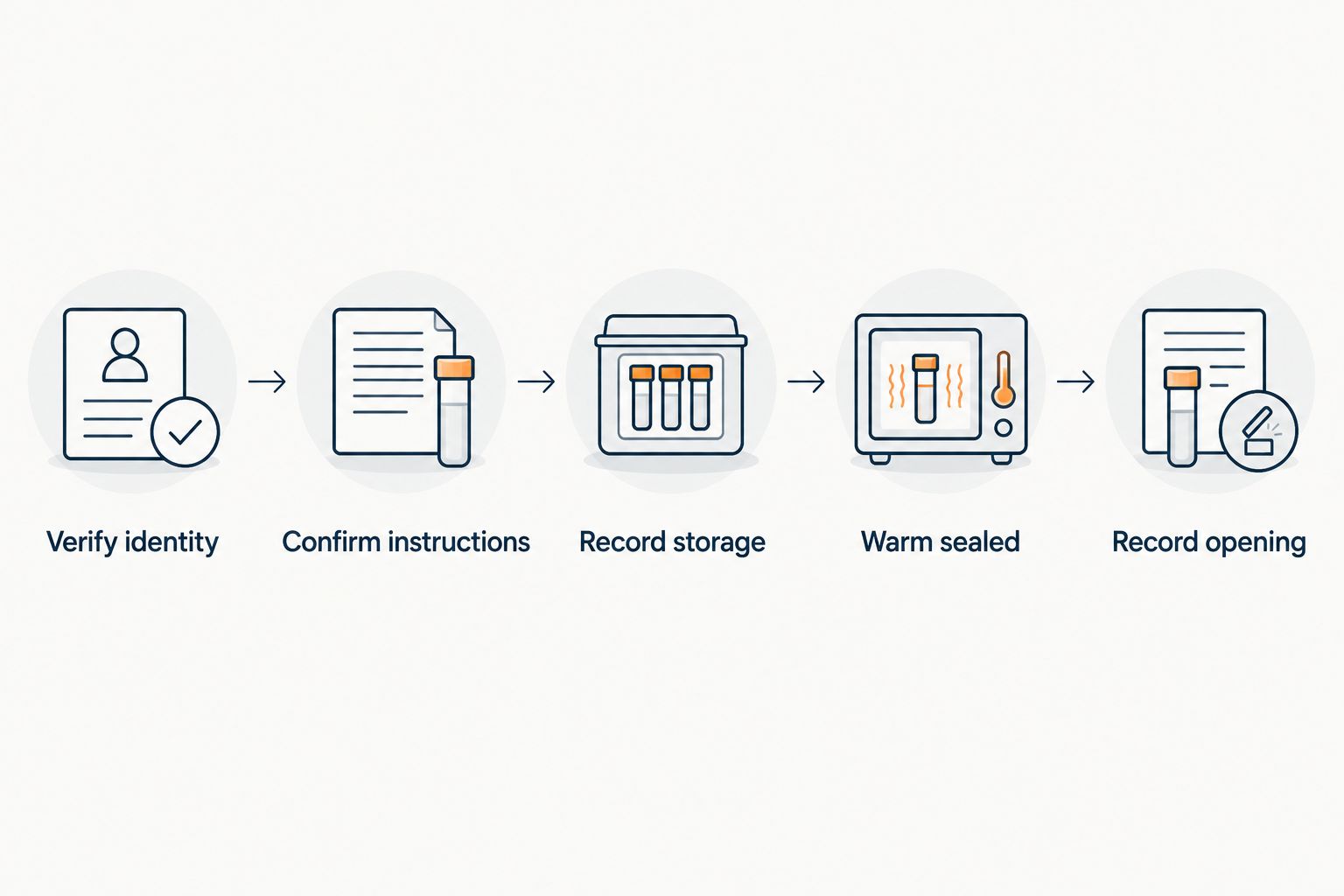
Use a documented sequence that keeps the vial closed during warming and preserves its identity throughout handling. The cold-chain storage workflow provides a related framework for organizing the record from receipt to bench preparation.
- Verify identity. Match the vial label, material name, and lot to the associated documentation. Resolve mismatches before the vial enters an experiment.
- Confirm instructions. Check the specified storage condition and any handling restrictions. Keep a dated copy or version reference with the inventory record.
- Record storage. Log the storage location and available temperature history. Preserve information about known excursions rather than overwriting it with the current setpoint.
- Warm sealed. Allow the closed vial to reach room temperature before opening. Do not use a fixed waiting period as proof that equilibration is complete.
- Record opening. Enter the opening date and handling details in the laboratory record. Apply the relevant laboratory procedure to any remaining material.
The critical distinction is between warming a closed vial and exposing cold material to room air. Cold surfaces can collect condensation, introducing moisture that the dry-storage procedure was intended to limit.
A 2026 handling procedure should describe who records these events and where the record lives. A procedure that depends on someone remembering which vial warmed on the bench is not a traceable storage system.
What does a COA tell you about peptide storage?
A Certificate of Analysis reports specified analytical results for the material identified on that certificate. Its value depends on matching the certificate to the vial and understanding what the listed methods actually measure.
HPLC purity is a chromatographic result, not an expiration date. Interpretation depends on the method, separation, detection, and reporting approach; an HPLC result does not establish the complete storage history of a vial.
Mass spectrometry provides molecular-mass information that supports identity assessment. It does not, by itself, establish concentration, sterility, long-term stability, or suitability for your experimental system.
For Strandaminos research peptides, review the published third-party HPLC and mass-spec certificate for the relevant material and lot. Keep storage instructions alongside that evidence rather than assuming the certificate answers every handling question.
Your 2026 document set should distinguish:
- Identity evidence: What analytical information supports the stated material identity?
- Purity evidence: What did the chromatographic analysis measure and report?
- Storage instructions: What conditions does the product documentation specify?
- Stability evidence: What data support an expiration or retest period under stated conditions?
- Handling history: What happened to this vial after receipt?
A strong record keeps these categories connected without treating them as interchangeable. A certificate issued before shipment cannot describe every subsequent event in your laboratory.
Can you apply the same rule to every research peptide?
Use the same documentation standard, not an assumed identical stability profile. Product names, broad research categories, and a shared lyophilized presentation do not establish equivalent storage requirements.
Check the exact material, chemical form, formulation, and instructions before transferring a procedure between research projects. A protocol written for one preparation is not automatically applicable to another preparation bearing a similar name.
This distinction matters when comparing suppliers as well. Compare the clarity of their material-specific instructions and supporting records, rather than rewarding a general claim that all dry peptides tolerate the same conditions.
What should you do after a temperature excursion?
Separate the affected material from routine experimental use until its disposition is documented. Returning the vial to its assigned freezer does not erase the excursion or establish that the material remains suitable.
Record the known exposure conditions, affected lot, packaging condition, and available temperature information. Distinguish measured observations from estimates; do not replace an unknown exposure history with an assumed duration.
Then compare the event with applicable stability information and obtain material-specific guidance where necessary. If suitability cannot be supported, do not use visual appearance or an earlier COA as a substitute for that assessment.
For a 2026 deviation record, include the decision and its basis, not just the event. Another researcher should be able to see why the material was retained, restricted, evaluated further, or excluded from the study.
FAQ
What is the usual lyophilized peptide storage temperature?
−20°C is a general long-term storage recommendation for many sealed lyophilized peptides. Follow the product-specific instructions when they specify a different condition, and keep the material dry and protected from light.
Can I keep unopened lyophilized peptides in a refrigerator?
2–8°C refrigerated storage is appropriate when supported by the material’s documented instructions. An unopened vial does not automatically qualify for refrigerated storage instead of a specified freezer condition.
Is −80°C better than −20°C for every research peptide?
−80°C is not automatically better than −20°C for every research peptide. Use the condition supported by product documentation or the applicable laboratory protocol rather than assuming colder storage establishes longer stability.
Should a frozen peptide vial warm up before I open it?
Yes—allow the vial to reach room temperature while it remains sealed. Opening a cold vial exposes cold surfaces and material to room air, creating an opportunity for condensation.
Does an HPLC COA prove a peptide is still stable after storage?
No—an HPLC COA reports the analytical results associated with the material and testing described on the certificate. It does not establish the vial’s subsequent storage history or automatically demonstrate present stability.
Does the same storage guidance apply after reconstitution?
No—dry-state storage guidance does not automatically apply after solvent is added. Solution stability depends on the material, solvent, concentration, container, and applicable experimental documentation.
Can I judge whether a stored peptide is usable by its appearance?
No—visual appearance alone cannot establish peptide identity, purity, or stability. Review the material’s documentation and handling history, and use an appropriate analytical assessment when the laboratory procedure requires it.
One last thing
The freezer setpoint is only one field in the storage record. A vial held at the intended temperature can still have an unresolved identity mismatch, an undocumented opening, or unsupported shelf-life assumptions.
Before your next inventory review, check that every stored vial connects to its lot documentation, specified condition, location, and handling history. Fix those gaps before adding a blanket expiration rule to the inventory spreadsheet.
Research use only. Not for human or veterinary use.