
Buying research peptides in the United States can be lawful for genuine laboratory research, but legality depends on the substance, intended use, transaction, and applicable federal and state rules. In 2026, a research-use label is not a blanket exemption from drug laws, and a Certificate of Analysis does not establish legal status. Evaluate the specific purchase—not just the words on the vial.
- Is it legal to buy research peptides? Genuine laboratory purchases require a substance-specific legal review, not a blanket yes.
- A Certificate of Analysis supports analytical assessment; it does not establish lawful intended use or FDA approval.
- Strandaminos research peptides are for laboratory researchers, not human or veterinary use.
- Check intended use, applicable restrictions, supplier representations, and lot documentation before purchasing.
Why this matters
A laboratory reagent and a product marketed as an unapproved drug raise different legal questions. An online listing does not resolve that distinction, even when the seller displays laboratory terminology and analytical reports.
Strandaminos describes its research peptides as lyophilized laboratory materials with published third-party HPLC and mass-spec certificates. Those documents belong in your analytical review; they are not substitutes for a legal or institutional procurement review.
For an academic purchasing context, the research peptides guide for academic chemistry labs provides related laboratory-focused reading. Keep the purpose explicit throughout your records: Research use only. Not for human or veterinary use.
Is it legal to buy research peptides in the United States?
There is no single legal answer covering every substance sold as a research peptide. A genuine laboratory purchase is not automatically prohibited simply because the material is a peptide. Equally, calling a material a research peptide does not establish that every sale, shipment, or intended use is lawful.
The following distinctions organize a 2026 purchasing review. They are review categories, not legal approvals.
| Purchase context | Best fit | What to establish | What does not settle the question |
|---|---|---|---|
| Domestic laboratory reagent purchase | Documented laboratory research | Substance identity, intended use, applicable restrictions, and institutional acceptance | A research-use disclaimer alone |
| Imported laboratory reagent | Laboratories with import-review support | Domestic requirements plus applicable import and customs requirements | An overseas seller accepting the order |
| Material promoted for personal administration | Not appropriate for a research-only procurement pathway | Whether the transaction implicates drug-law requirements | Calling the same material a laboratory chemical |
| Material intended for clinical investigation | Authorized clinical research teams | Applicable investigational requirements and institutional oversight | A laboratory reagent invoice or COA |
Notice the difference between purchasing a material and determining whether a seller lawfully markets it. Those questions overlap, but they are not identical. A buyer should not treat either a completed checkout or an unrestricted product listing as a legal determination.
What federal law actually examines
For a 2026 federal-law review, the Federal Food, Drug, and Cosmetic Act supplies the starting framework. 21 U.S.C. § 321(g)(1) defines drugs partly by intended use, including intended effects on the structure or function of the body. 21 U.S.C. § 355(a) generally prohibits introducing a new drug into interstate commerce without an effective approval, subject to applicable exceptions.
The intended-use regulation at 21 C.F.R. § 201.128 addresses evidence of objective intent, including relevant representations and circumstances surrounding distribution. This is why the entire presentation matters: a research disclaimer cannot be evaluated separately from contrary claims elsewhere in the sales process.
These provisions explain the framework; they do not decide the status of a particular vial. Your review still needs the exact substance and transaction facts.
What changes the legal analysis?
The following factors determine what your purchasing team needs to investigate. None can be replaced by a generic supplier assurance.
- Substance identity: Review the exact chemical identity, not only an abbreviation or marketing name. Different substances can trigger different requirements.
- Intended use: Document the actual laboratory purpose. A research label does not convert a different intended use into laboratory research.
- Seller representations: Review product descriptions and accompanying communications. Human-use claims require a different assessment from analytical specifications.
- Transaction route: Separate domestic purchasing from importation. Crossing a border adds questions that a domestic invoice does not answer.
- Applicable jurisdiction: Check federal requirements alongside relevant state rules. Do not assume one state's treatment resolves another state's requirements.
- Institutional requirements: Confirm procurement and laboratory acceptance rules. Institutional permission and legal compliance are separate checks.
For your 2026 review, preserve the evidence supporting each conclusion. A dated decision tied to an identified material is more useful than an undated note saying a supplier is legitimate.
How should a laboratory review a peptide purchase?
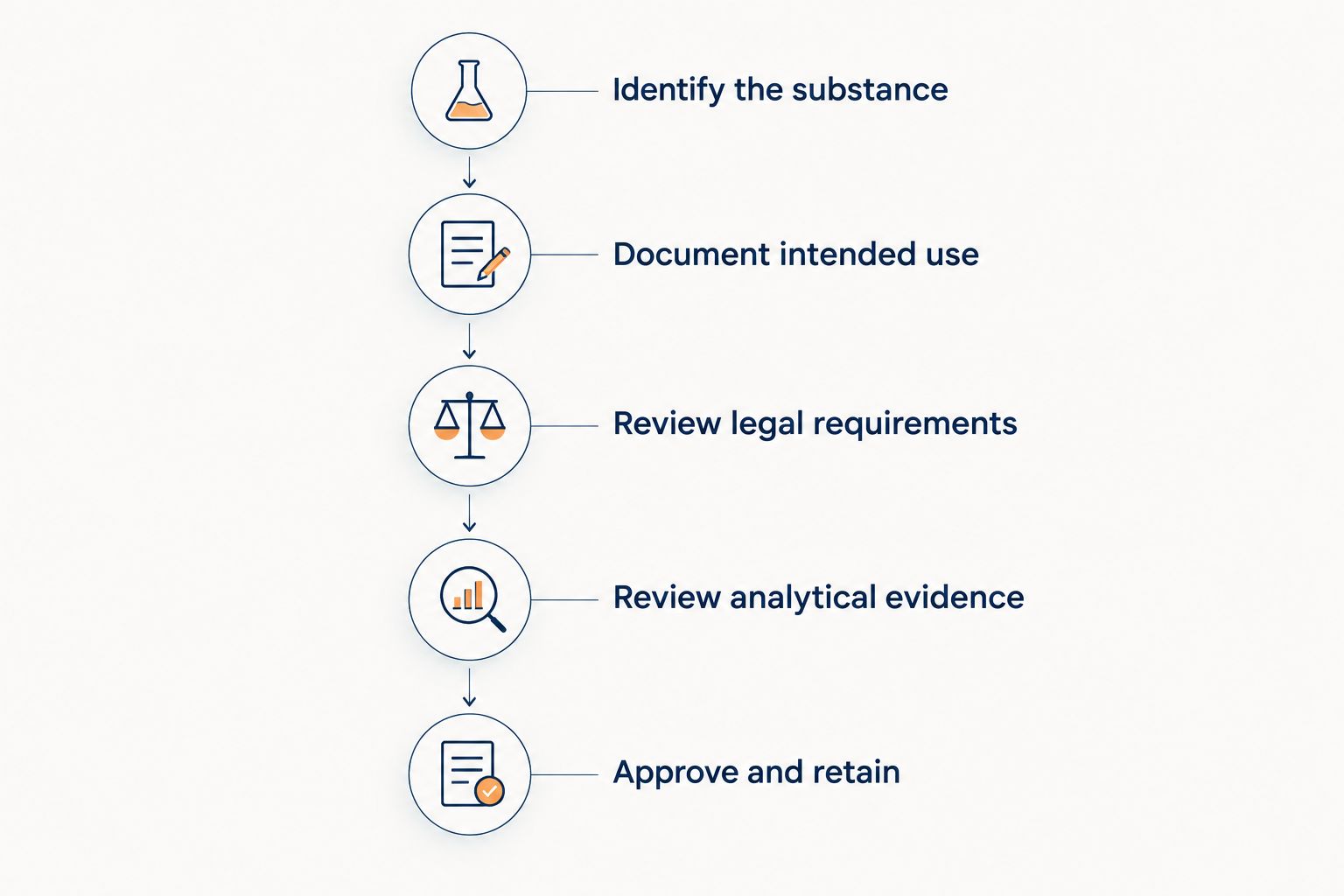
Use this sequence before authorizing a purchase. It keeps legal status, analytical evidence, and institutional permission separate rather than treating one as proof of the others.
- Identify the substance. Record the full name and available chemical identifiers. Resolve discrepancies between the listing, invoice, and certificate before proceeding.
- Document intended use. Describe the laboratory activity and the responsible research group. Avoid vague descriptions that do not explain the actual purpose.
- Review legal requirements. Check substance-specific restrictions, the transaction route, and applicable federal and state requirements. Refer unresolved questions to qualified counsel or your compliance office.
- Review analytical evidence. Examine the relevant COA, HPLC information, and mass-spec identity evidence. Confirm which lot the documents cover and what each method actually reports.
- Approve and retain. Follow institutional authorization procedures and retain the purchasing decision with the supporting records. Do not treat payment approval as scientific or legal approval.
The sequence matters because analytical documentation answers a different question from legal review. Excellent identity evidence cannot correct a prohibited transaction, and a permissible transaction does not establish that a material meets your experimental requirements.
A purchasing record should let a colleague reconstruct the decision without relying on a conversation. Save the relevant product description, the stated research purpose, the certificate associated with the material, and the institution's authorization where required.
Does a research-use-only label make a peptide legal?
No. A research-use-only label does not create a general exemption from U.S. drug law. The label communicates a stated purpose, but intended-use analysis considers relevant evidence beyond that statement.
For a 2026 supplier comparison, look for consistency between the disclaimer and the rest of the presentation. A listing that states laboratory use while describing personal administration presents a conflict that the disclaimer does not resolve.
A research-only purchasing process should stay research-only in substance, not just wording. If the actual purpose falls outside laboratory research, stop treating the transaction as a reagent purchase and obtain the appropriate legal and institutional guidance.
This article addresses laboratory procurement only. It does not provide administration instructions or a route around medical, veterinary, or clinical research requirements.
Does a COA prove a research peptide is legal?
No. A Certificate of Analysis reports analytical information; it does not grant legal authorization. Its value depends on the material identified, the methods described, the reported results, and the connection between the document and the supplied lot.
HPLC separates components under specified chromatographic conditions. A reported chromatographic result must be interpreted within that method; it is not a complete account of every possible contaminant or property of the material.
Mass spectrometry measures mass-to-charge information that can support identity assessment. The strength of that assessment depends on the method and reported evidence. A mass-spec result is not a determination of lawful marketing or intended use.
| Evidence | Best for | Useful contribution | Limitation |
|---|---|---|---|
| Certificate of Analysis | Document review | Collects stated analytical results for an identified sample or lot | Does not itself establish legal status |
| HPLC report | Chromatographic assessment | Shows separation and reported results under stated conditions | Does not answer every identity or contamination question |
| Mass-spec report | Identity assessment | Provides mass-related evidence relevant to the identified material | Does not establish lawful use or regulatory approval |
| Lot match | Traceability review | Connects documentation to the material being evaluated | A matching identifier does not independently validate test results |
Strandaminos publishes third-party HPLC and mass-spec certificates for its research peptides. Evaluate the specific certificate associated with the material under consideration rather than extending a general supplier statement to every purchase.
Strandaminos research peptides fit laboratory researchers seeking published analytical documentation, not human or veterinary use. The limitation is equally clear: published certificates do not establish that a particular transaction satisfies your legal or institutional requirements.
Are named peptides all subject to the same rules?
No. Do not assume retatrutide, tirzepatide, cagrilintide, BPC-157, TB-500, SS-31, and Semax share one legal status because sellers group them under the same category.
A shared category label does not establish identical chemical identity, regulatory history, or transaction requirements. Review each substance independently, including its exact designation and the proposed research purpose.
The same discipline applies when a molecule's name appears in both laboratory and pharmaceutical contexts. A familiar name is not proof that a research vial is an approved drug product, and an approved product elsewhere does not establish approval for every material bearing that molecule's name.
For a 2026 purchasing file, identify the actual material being ordered. Do not substitute a broad term such as “GLP research peptide” for a substance-specific review.
Can you import research peptides into the United States?
Importation requires a separate review of applicable U.S. requirements. A supplier's willingness to ship does not establish admissibility, and a research-use statement does not guarantee entry.
Determine which requirements apply to the substance, its intended use, and the transaction before placing an international order. Keep descriptions accurate and consistent across the purchase and shipping records; do not change descriptions to avoid scrutiny.
Best for laboratories considering importation: have the institution's import or compliance function review the transaction before purchase. The benefit is a review specific to the shipment; the limitation is that approval of one transaction does not establish permission for future transactions involving different facts.
FAQ
Is it legal to buy research peptides online in the United States?
Buying research peptides online can be lawful for genuine laboratory research, but legality depends on the substance, intended use, transaction, and applicable rules. An online listing or completed checkout is not a legal determination.
Does research use only mean a peptide is FDA approved?
No. Research use only is a stated use limitation, not FDA approval. A laboratory reagent should not be represented as an approved drug based on that label.
Can a Certificate of Analysis prove that a peptide purchase is legal?
No. A Certificate of Analysis reports analytical information, not legal authorization. Review legal requirements separately from HPLC, mass-spec, and lot documentation.
Do all research peptides have the same legal status?
No. Review the exact substance and transaction rather than assuming one rule covers every research peptide. A shared sales category does not establish identical regulatory requirements.
Can an individual buy research peptides without a university affiliation?
University affiliation alone does not determine whether a purchase is lawful. An individual still needs to evaluate the substance, genuine intended use, and applicable requirements; seller acceptance does not settle those questions.
Can research peptides be purchased for personal use?
A research-use label does not authorize personal administration. This article addresses laboratory procurement only: Research use only. Not for human or veterinary use.
Are imported research peptides automatically allowed through customs?
No. Research labeling does not guarantee that an imported shipment is admissible. Review the substance, intended use, and applicable import requirements before ordering.
What should my laboratory check before buying research peptides in 2026?
Check substance identity, documented intended use, applicable legal requirements, analytical evidence, and institutional authorization. Keep the decision and supporting records together so the basis for approval remains traceable.
One last thing
A matching lot number improves traceability; it does not establish legal permission. That distinction is easy to lose when a purchasing file contains detailed analytical reports but no documented intended-use review.
Before authorizing the order, ask a colleague to explain separately why the transaction is permitted and why the material is analytically suitable. If the answer to both questions is simply “there is a COA,” the review is incomplete. This is general educational information, not legal advice for a particular transaction.