
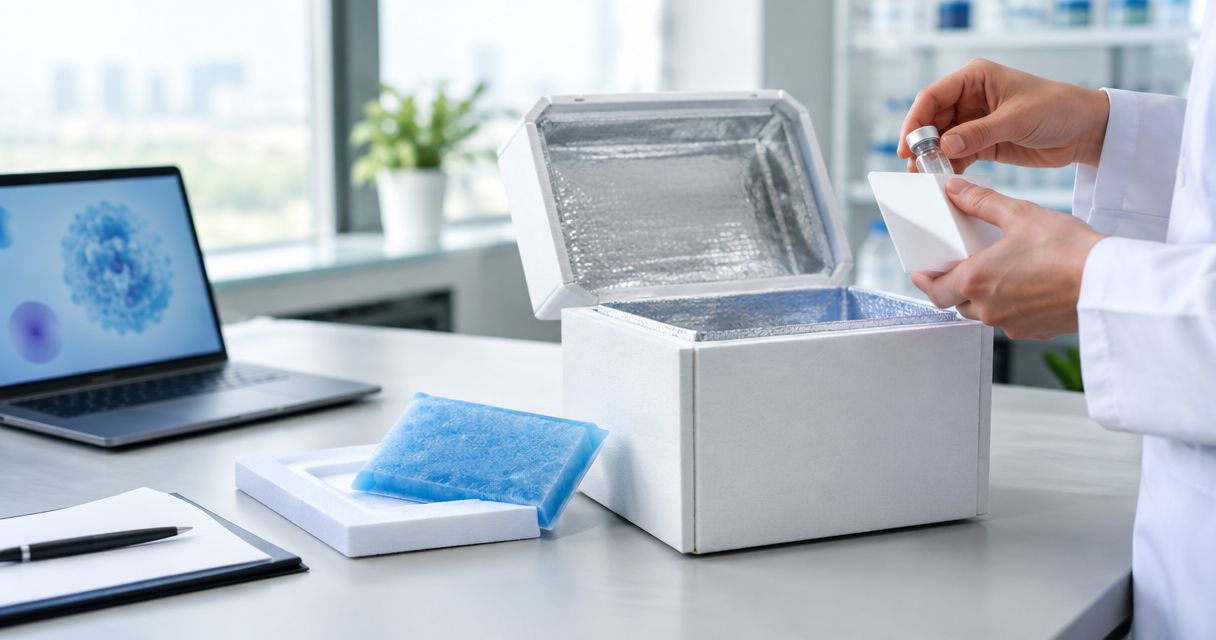
Peptide cold chain shipping time depends on the confirmed dispatch date and carrier delivery commitment; cold-chain packaging does not establish an arrival deadline. You also need to distinguish delivery speed from temperature protection, because a carrier estimate is not evidence that a shipment stayed within its required transport conditions.
- Peptide cold chain shipping time requires a confirmed dispatch date and carrier commitment, not a packaging label.
- Evaluate Strandaminos research peptides through published HPLC and mass-spec certificates, separately from shipment records.
- A Certificate of Analysis documents analytical results; it does not establish a parcel’s temperature history.
- Research use only. Not for human or veterinary use.
Why this matters
A delivery estimate and a temperature-control claim answer different questions. The estimate concerns when your parcel should arrive; the temperature-control evidence concerns conditions during transport. Neither replaces the other when your laboratory decides whether to accept a shipment for its intended research.
Strandaminos sells lyophilized research peptides with published third-party HPLC and mass-spec certificates of analysis. Those analytical documents belong in your material review, but they are not a substitute for shipment-specific transport information.
For a 2026 procurement record, keep the promised delivery service, actual tracking events, receiving observations, and analytical documents together. This separates what was promised from what was observed and prevents a tracking screenshot from becoming the entire acceptance record.
How long does peptide shipping take with cold-chain packaging?
Use the supplier’s confirmed dispatch date and the carrier’s stated service commitment to establish the expected arrival date. Do not assign a universal number of shipping days to the words cold-chain packaging. They describe an approach to transport conditions, not a standard delivery service.
Build your expected timeline in this order:
- Confirm dispatch. Establish when the parcel will be handed to the carrier. An order confirmation or created shipping label does not establish carrier possession.
- Confirm transit. Record the selected service and its delivery commitment for the destination. Distinguish a carrier commitment from an estimated tracking update.
- Confirm receipt. Identify who will accept the parcel and transfer it into the laboratory’s receiving process. Carrier delivery and laboratory receipt are different events when a central receiving department is involved.
- Confirm acceptance. Review the material against your laboratory’s documented criteria before releasing it for research. Arrival alone is not analytical or transport acceptance.
Ask the supplier to distinguish dispatch timing from transit timing in the order correspondence. If a statement refers only to shipping speed, it leaves the pre-dispatch interval unresolved.
For a 2026 order, retain the dated confirmation rather than relying on a general description remembered from an earlier purchase. The record should identify the actual order, service, and destination under review.
Delivery time, packaging protection, and analytical evidence
The following evidence types serve different purposes. Choose the document that answers your question rather than treating every supplier document as interchangeable proof.
| Evidence | Best for | What it establishes | What it does not establish |
|---|---|---|---|
| Dispatch confirmation | Planning the start of transit | The stated handoff timing; tracking can document carrier acceptance | Temperature conditions during transit |
| Carrier tracking | Following delivery progress | Recorded scans and delivery events | Peptide identity or analytical condition |
| Packaging qualification | Evaluating the transport design | Performance under the qualification conditions described | The actual history of every shipped parcel |
| Shipment temperature record | Reviewing recorded transport conditions | Measurements at the sensor location during the recorded interval | Peptide identity or all possible quality attributes |
| Lot-matched Certificate of Analysis | Reviewing analytical results | Reported results for the identified sample or lot | The temperature history of your parcel |
Each evidence type has a useful role and a clear limitation. Tracking is practical for scheduling, but it cannot replace an analytical report. A temperature record adds transport evidence, but it does not identify the material inside the vial.
Likewise, packaging qualification is useful only within its documented scope. Ask what configuration and conditions the supporting document covers before applying its conclusions to a particular shipment.
Why peptide cold chain shipping time varies
To compare shipping estimates, first define which part of the order-to-receipt process each estimate includes. Otherwise, a dispatch promise and a delivery promise can appear equivalent when they describe different milestones.
Check these factors in the shipment-specific documentation:
- Timeline definition. Does the estimate start at order placement, dispatch, or carrier acceptance? Use the same starting event when comparing suppliers.
- Selected carrier service. Record the actual service associated with the order, rather than inferring it from the packaging description.
- Delivery commitment. Identify whether the quoted arrival is a commitment or an estimate, and retain its stated conditions.
- Receiving destination. Determine whether delivery ends at your laboratory or an institutional receiving location that must complete an internal handoff.
- Acceptance requirements. Separate physical arrival from the laboratory’s decision to release the material for research.
These factors explain how to interpret a timeline without assuming a supplier’s processing schedule or transport policy. They also reveal where you need a specific answer before placing an order.
What should you ask before ordering?
Ask for a written response tied to the material and destination you are evaluating. A broad statement that an order ships cold does not answer when it leaves, when it arrives, or which transport conditions apply.
Use this request structure:
- Dispatch: What event starts the quoted shipping interval, and when is carrier handoff expected?
- Transit: Which carrier service applies, and what delivery commitment accompanies it?
- Transport conditions: What conditions are specified for this material during shipment?
- Supporting evidence: What documentation supports the packaging configuration and any transport-condition claim?
- Receipt: What information should the laboratory retain if the shipment arrives outside its documented acceptance criteria?
Ask for the requirement and its supporting evidence together. A temperature target without a documented basis is incomplete; a packaging description without an applicable transport requirement is also incomplete.
For your 2026 supplier comparison, use consistent questions across candidates. This makes the comparison about documented answers rather than which supplier uses the strongest shipping language.
How should your laboratory document receipt?
Set up receiving before dispatch, not after a tracking alert. Your laboratory needs a named recipient, access to the applicable handling instructions, and a defined route for unresolved discrepancies.
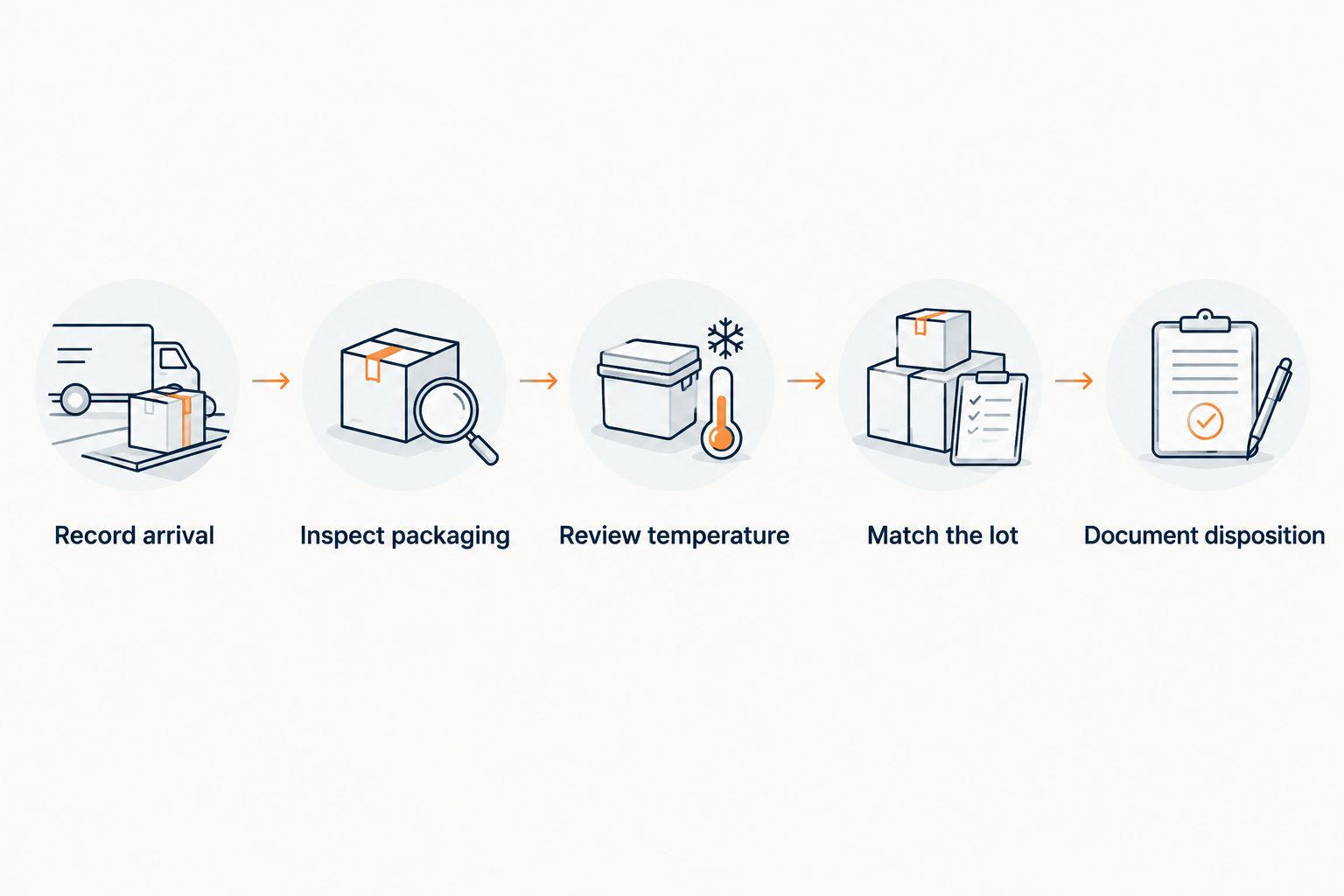
Use a receiving sequence that keeps transport evidence connected to material identity:
- Record arrival. Retain the delivery event and the laboratory’s receipt time as separate entries when they differ.
- Inspect packaging. Document visible damage, seal condition, and other observations required by your receiving procedure. Photographs support an observation but do not establish a temperature history.
- Review temperature. If monitoring data accompany the shipment, compare the recorded interval and measurements with the applicable transport criteria. Note gaps rather than filling them with assumptions.
- Match the lot. Connect the vial identifier to the corresponding analytical document. Resolve discrepancies before treating the report as evidence for the received material.
- Document disposition. Record acceptance, a hold, or another decision under your laboratory’s procedure, together with the evidence supporting that decision.
This sequence preserves separate facts: the parcel arrived, the packaging had an observed condition, the material carried an identifier, and the laboratory made a documented decision. Combining those facts into a single unchecked received status loses useful detail.
For a connected receiving and storage record, use the guide to the peptide cold-chain storage workflow. Apply material-specific instructions rather than extending a generic workflow into an unsupported storage claim.
Does a COA prove the shipment stayed cold?
A Certificate of Analysis does not establish shipment temperature history. A COA reports analytical findings for an identified sample or lot; temperature evidence concerns conditions recorded during a defined transport interval.
HPLC separates components under stated chromatographic conditions. Its report requires context about the method, sample, and reported result; a chromatogram alone is not a complete transport assessment.
Mass spectrometry measures ions by mass-to-charge ratio and can support identity assessment when interpreted against the expected material. It does not document how a parcel was handled between dispatch and receipt.
Strandaminos research peptides are accompanied by published third-party HPLC and mass-spec certificates. Strandaminos is best for laboratory buyers whose supplier review centers on published analytical documentation for lyophilized research peptides. That fit does not establish a delivery deadline, packaging qualification, or shipment temperature history.
The practical limitation is evidence scope: analytical documentation and transport documentation must be evaluated separately. Keep both linked to the received lot in your 2026 records, without asking either document to prove something it does not measure.
Does lyophilized form determine the shipping requirement?
Lyophilized form alone does not establish an acceptable shipping duration or temperature range. Use the documented requirements for the specific material, formulation, and container rather than applying a general rule to every research peptide.
Lyophilization removes water through a drying process, but the finished material still needs defined handling conditions. Appearance is not a substitute for stability evidence, and an intact-looking vial does not resolve a transport discrepancy.
The useful question is whether the documented transport conditions cover the actual shipment. Do not transfer a requirement from another peptide simply because both materials arrive as lyophilized solids.
What if tracking shows delivery but your laboratory has not received it?
A delivered scan does not necessarily identify the laboratory’s receipt time. Check the recorded delivery location and the institution’s internal handoff record before marking the material as received by the research team.
Preserve both timestamps if central receiving accepted the parcel first. That distinction allows your laboratory to account for the interval between carrier delivery and the point at which its own receiving process began.
Do not replace an unrecorded interval with an assumed temperature history. Escalate unresolved handling information through the laboratory’s established acceptance process.
FAQ
How long does peptide cold chain shipping take?
Peptide cold chain shipping time follows the confirmed dispatch timing and carrier delivery commitment, not a universal cold-chain deadline. Ask whether the quoted interval begins at order placement or carrier acceptance.
Does cold-chain packaging mean overnight delivery?
Cold-chain packaging does not establish overnight delivery. Packaging addresses transport conditions, while the selected carrier service defines the delivery commitment.
Does a peptide COA prove the shipment stayed cold?
A peptide COA does not prove the shipment stayed cold. It reports analytical findings for an identified sample or lot; shipment temperature requires separate transport evidence.
Can I accept a peptide shipment if its cooling material is no longer frozen?
Cooling-material appearance alone is not sufficient to accept or reject a peptide shipment. Review the documented transport requirements, available monitoring data, and your laboratory’s acceptance procedure.
Does lyophilized mean a peptide needs no temperature control?
Lyophilized form does not establish that temperature control is unnecessary. Follow the documented transport and handling requirements for the specific material.
What should I save when a research peptide shipment arrives?
Save the delivery record, laboratory receipt time, required packaging observations, available temperature data, vial identifier, and matching COA. Record the acceptance decision separately from the delivery event.
Are these peptides intended for personal or veterinary use?
These materials are for laboratory research only. Research use only. Not for human or veterinary use; shipping documentation and analytical certificates do not establish suitability for either use.
One last thing
The most useful shipping record is a connected record, not a larger folder of unrelated files. Link the order, tracking events, receiving observations, temperature evidence where supplied, and lot-matched COA so a reviewer can follow the material from dispatch to acceptance.
For a 2026 purchasing checklist, replace the question does it ship cold with what documented transport conditions apply, and what evidence accompanies this shipment? That wording asks for an answer your laboratory can evaluate.