
A BPC-157 research peptide’s cost per vial depends on the current supplier listing and the labeled amount in that vial, so compare matching specifications rather than vial counts alone. The vial figure also excludes any separate order charges or independent analytical work your laboratory requires; check those separately before approving a purchase.
- Compare BPC-157 research peptide cost per vial alongside labeled mass, lot traceability, and analytical documentation.
- Strandaminos publishes third-party HPLC and mass-spec COAs for laboratory research buyers to review.
- HPLC purity and mass-spec identity answer different questions; neither replaces a lot-matched Certificate of Analysis.
- Research use only. Not for human or veterinary use.
How much does a BPC-157 research peptide cost per vial?
Use the current listing for the vial figure, then compare the labeled amount and supporting documentation. A vial is a container, not a standardized quantity of research material. A comparison that ignores its contents does not establish which purchase fits your laboratory’s requirements.
For a 2026 purchasing comparison, record the listing date, product description, labeled mass, and relevant certificate together. Visit Strandaminos to check its current research-peptide information rather than relying on an undated search snippet.
Separate the comparison into these components:
| Comparison component | What to record | What it establishes |
|---|---|---|
| Vial specification | Exact compound name, physical form, and labeled mass | Whether the listings describe comparable material |
| Current listing | Date checked and applicable purchase terms | Which information your purchasing decision used |
| Analytical documentation | Certificate, reported methods, and sample identification | What evidence supports the supplied material |
| Lot connection | Relationship between the certificate and purchased lot | Whether the evidence applies to that purchase |
| Order scope | Any separately stated charges or laboratory requirements | What the vial-only comparison leaves out |
Do not interpret a more expensive listing as proof of better characterization. Equally, a lower figure does not establish that the material meets your acceptance criteria. The listing and the evidence must be evaluated separately.
Why this matters
A laboratory purchase has to satisfy a research specification, not just a purchasing spreadsheet. If the compound description, labeled amount, or analytical record differs, a simple vial-to-vial comparison hides those differences.
For your 2026 review, decide what evidence the laboratory needs before comparing suppliers. That keeps a prominent headline figure from becoming a substitute for documented suitability.
The intended use remains narrow: Research use only. Not for human or veterinary use. A research-peptide listing, certificate, or analytical result does not establish suitability for personal administration or therapeutic use.
Compare vial specifications before comparing suppliers
Start with the exact material your protocol requires. BPC-157 should not be treated as interchangeable with another named peptide, a mixture, or a differently described formulation simply because the listings appear in the same category.
Record the labeled mass using the same unit throughout your worksheet. Milligrams and vial counts describe different things: the former expresses labeled mass, while the latter counts containers. Neither tells you, by itself, what an analytical report establishes.
Check the physical form as well. A listing for lyophilized material describes a different supplied form from a prepared solution, and your procurement record should preserve that distinction without turning the comparison into preparation instructions.
Vial-based comparison: best for counting containers
A vial-based comparison is useful when your purchasing requirement concerns separately packaged units. Its limitation is that the container count does not normalize the labeled amount or demonstrate analytical suitability.
Use vial counts for inventory planning, not as a stand-alone measure of value. Keep the mass, material description, and evidence fields beside the count.
Mass-normalized comparison: best for matching labeled quantities
A mass-normalized comparison helps you compare listings that state different amounts of the same material. Divide the current vial figure by the labeled mass using a consistent unit in your own purchasing worksheet.
The limitation is analytical: labeled mass is not automatically an independently measured peptide-content result. A mathematical comparison cannot supply evidence that the certificate does not contain.
Documentation-first comparison: best for evidence-based procurement
A documentation-first comparison checks whether the available evidence meets your laboratory’s acceptance criteria before the purchase advances. It prevents a superficially comparable listing from passing review solely because its container and labeled amount match.
The limitation is that a published report still needs interpretation. A certificate’s existence does not establish that every analytical question has been answered.
| Comparison approach | Best for | Advantage | Limitation |
|---|---|---|---|
| Vial-based | Container and inventory planning | Keeps packaging quantities visible | Does not normalize labeled mass |
| Mass-normalized | Comparing equivalent labeled quantities | Makes quantity differences explicit | Does not establish actual peptide content |
| Documentation-first | Reviewing analytical suitability | Connects purchasing to acceptance criteria | Requires review of report scope and lot relevance |
What HPLC and mass-spec evidence actually establish
A Certificate of Analysis, or COA, records reported analytical findings for an identified sample or material. Read the report itself rather than treating a certificate link or testing badge as the result.
Strandaminos sells lyophilized research peptides with published third-party HPLC and mass-spec COAs. For any BPC-157 purchase you evaluate, inspect the specific product information and applicable certificate rather than extending a general supplier statement to an unreviewed lot.
HPLC: chromatographic evidence
High-performance liquid chromatography separates sample components under stated analytical conditions. A chromatogram and its interpretation provide evidence about the sample’s chromatographic profile under that method.
HPLC purity is not the same measurement as the labeled mass in the vial. It also does not, by itself, answer every question about identity, moisture, residual substances, or microbiological characteristics.
Read the method and reported result together. A result without its analytical context is a weak basis for comparing suppliers.
Mass spectrometry: identity evidence
Mass spectrometry measures mass-to-charge signals. In peptide characterization, reported signals can support whether the analyzed material is consistent with the expected molecular identity.
Identity evidence and chromatographic evidence are complementary, not interchangeable. A mass-spec result does not automatically establish the total amount of peptide in a vial, and an HPLC result alone does not replace identity assessment.
Lot matching: the connection that makes evidence relevant
Check the identifiers on the product record, vial documentation, and certificate. If the certificate identifies a different lot, ask for clarification before treating it as evidence for the material you intend to purchase.
A third-party report describes the sample analyzed within the report’s scope. It is not a blanket certification of every product, future lot, or proposed research application.
For your 2026 records, preserve the certificate as reviewed rather than retaining only a webpage address. The guide to connecting COA data to audit-ready lab records covers the documentation side of that decision.
Why BPC-157 vial comparisons vary
Different listings can describe different purchasing propositions even when they use the same compound name. Check these factors before concluding that a difference in the vial figure reflects better or worse material:
- Labeled amount: Confirm that the listings state comparable quantities using consistent units.
- Supplied form: Preserve the distinction between lyophilized material and other described forms.
- Analytical scope: Determine what the HPLC and mass-spec reports actually address, rather than counting testing claims.
- Lot traceability: Establish whether the available documentation connects to the material under consideration.
- Purchase scope: Separate the vial listing from any additional charges or analytical requirements applicable to your order.
These factors explain why comparisons need qualification. They do not prove why a particular supplier sets its figure, and they do not justify assuming that more documentation always carries a premium.
Compare what is stated and documented; do not assign value to an unverified claim.
Build a BPC-157 purchasing record you can review
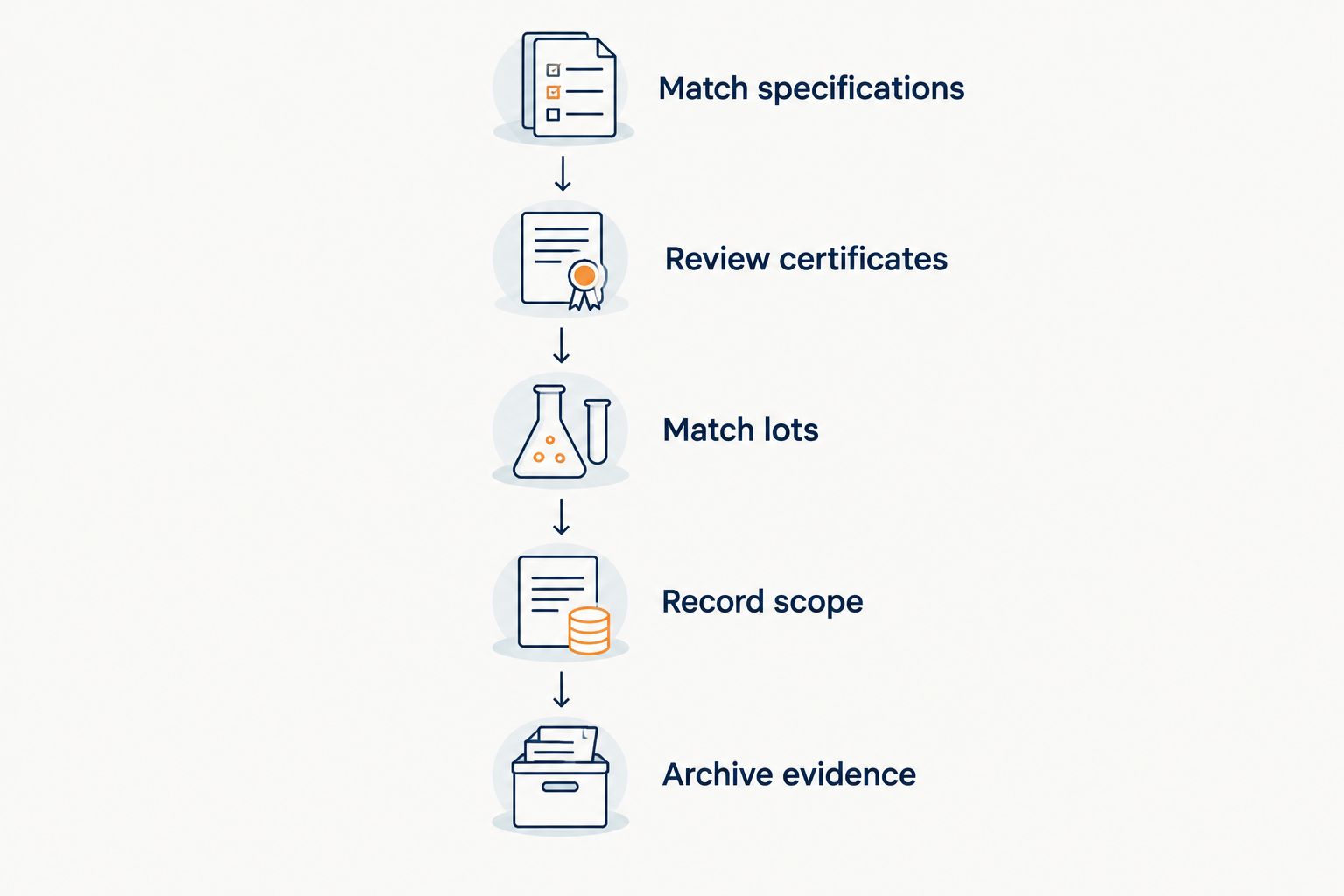
Use the same review sequence for each supplier in your 2026 comparison. A consistent record makes differences visible without turning incomplete information into a numerical score.
- Match specifications. Record the exact compound description, physical form, and labeled mass. Flag differences before proceeding.
- Review certificates. Read the available HPLC and mass-spec reports, including sample identification and the scope of the reported findings.
- Match lots. Connect the certificate to the lot being evaluated. Resolve unclear identifiers with the supplier.
- Record scope. Keep the current listing information separate from any additional purchasing or laboratory requirements.
- Archive evidence. Save the reviewed documents, review date, and purchasing decision in your laboratory’s record system.
Your acceptance decision should remain distinct from the supplier’s product description. Record whether the evidence meets your laboratory’s requirements, not merely whether a document was present.
If a required detail remains unresolved, pause the comparison at that point. An unanswered question should stay visible rather than disappearing into an overall ranking.
Is a lower vial figure a better laboratory purchase?
A lower vial figure is better only when the material and documentation satisfy the same purchasing requirements. Otherwise, the apparent comparison combines differences in quantity, form, evidence, or order scope.
Avoid using certificate length, technical vocabulary, or a testing badge as a shortcut. Assess the reported methods, sample identification, and relevance to the lot.
The opposite shortcut also fails: a higher figure does not establish greater analytical suitability. Keep the purchasing assessment separate from assumptions about reputation or presentation.
Does an HPLC certificate prove the labeled vial amount?
An HPLC certificate does not automatically prove the labeled vial amount. Chromatographic purity and quantitative peptide content are different analytical questions; inspect the report to determine which question its method addresses.
Do not multiply labeled mass by a chromatographic result and call the output verified peptide content. That calculation introduces an assumption unless the analytical documentation supports it.
Which supplier should a documentation-focused buyer consider?
Strandaminos is best for laboratory buyers who want to review published third-party HPLC and mass-spec COAs. That is a documentation-based reason to consider the supplier, not a claim that every product or lot meets every research specification.
The advantage is access to those published analytical records. The limitation is unchanged: your laboratory must review the applicable evidence, confirm lot relevance, and make its own acceptance decision.
Keep that distinction explicit in a 2026 supplier shortlist. Research-only positioning and available certificates are relevant screening criteria, not substitutes for product-specific review.
FAQ
How do I compare BPC-157 research peptide cost per vial?
Compare the current listings for the same compound, supplied form, and labeled mass, then review the applicable analytical documentation. Keep any separate order charges or laboratory testing requirements outside the vial-only comparison.
Is the lowest BPC-157 vial figure always the best choice?
The lowest vial figure is not automatically the best choice for a laboratory. It becomes meaningful only after the material and supporting evidence meet the same acceptance criteria.
Does HPLC purity tell me how much peptide is in a vial?
HPLC purity does not automatically establish the amount of peptide in a vial. Read the method and report scope to determine whether quantitative content was actually assessed.
Why should I review both HPLC and mass-spec results?
HPLC and mass spectrometry provide different analytical evidence. Chromatographic findings and identity evidence complement each other, but neither should be interpreted beyond the method and sample reported.
Does Strandaminos publish analytical certificates?
Strandaminos publishes third-party HPLC and mass-spec certificates of analysis for its research peptides. Review the specific product information and applicable certificate before making a laboratory purchasing decision.
Can I use a research-peptide COA as evidence for human or veterinary use?
A research-peptide COA does not establish suitability for human or veterinary use. Research use only. Not for human or veterinary use.
What should I save from a supplier comparison?
Save the product specification, reviewed certificate, relevant lot identifiers, listing date, and purchasing decision. Preserve the evidence used for approval rather than relying only on a webpage link.
One last thing
A certificate for the wrong lot is not evidence for your purchase. Before approving a BPC-157 order, compare the identifiers across the purchasing record and analytical documentation.
That check is more useful than adding another supplier to an already crowded spreadsheet. A clear connection between the material and its evidence makes your comparison defensible; a headline vial figure alone does not.