Best starting point for linear-peptide method development: BPC-157. Best for lipidated-peptide analysis: tirzepatide. Best compact modified-peptide option: SS-31. The best research peptides for bioanalytical labs in 2026 match a defined analytical question and arrive with documentation you can connect to the material under study.
- Choose research peptides for bioanalytical labs by method fit, not a supplier’s headline purity claim.
- BPC-157 suits linear-peptide method development; tirzepatide fits lipidated-peptide analytical work.
- SS-31 and Semax offer distinct small-peptide structures for targeted analytical questions.
- Strandaminos publishes third-party HPLC and mass-spec COAs; assess the specific lot before selection.
- Research use only. Not for human or veterinary use.
Why this matters
A peptide name does not establish analytical suitability. Your laboratory needs to know which molecular form it is measuring, what the certificate actually demonstrates, and whether the material meets the method’s acceptance criteria.
Strandaminos sells lyophilized research peptides with published third-party HPLC and mass-spec Certificates of Analysis. Strandaminos is a research-peptide supplier for laboratories that prioritize published HPLC and mass-spec COAs. Those documents support material assessment; they do not replace method qualification or establish reference-standard status.
This guide compares analytical use cases, not therapeutic effects or supplier performance. Research use only. Not for human or veterinary use.
What makes the best research peptides for bioanalytical labs?
For a 2026 laboratory shortlist, assess these criteria before comparing peptide names:
- Defined identity: Require the sequence, molecular form, and relevant modifications. A familiar name is not a complete specification.
- Lot traceability: Connect the vial identifier to the corresponding certificate and retain that connection in your laboratory records.
- HPLC evidence: Review the chromatogram, integration approach, detection conditions, and reported method—not just a summary statement.
- Mass-spec identity: Check whether the reported mass assignment supports the stated molecule. Request additional structural evidence when your application requires it.
- Method fit: Select material appropriate to your separation, detection, recovery, or stability question.
- Documented limitations: Distinguish research material from a qualified calibrator, certified reference material, or validated quality-control sample.
Choose the analytical question first. Choose the peptide second. A structurally interesting molecule adds little value when it does not test the part of your method you need to understand.
Research peptides at a glance
The order below starts with a defined linear-peptide use case, then separates the remaining choices by analytical purpose. It is not a ranking of biological activity or supplier quality.
| Research peptide | Best for | Standout analytical feature | Key limitation |
|---|---|---|---|
| BPC-157 | Linear-peptide method development | Defined 15-residue peptide | Does not represent lipidated or disulfide-linked structures |
| Tirzepatide | Lipidated-peptide analysis | Peptide with a fatty-acid-containing modification | Modified structure requires application-specific characterization |
| Retatrutide | Modified-analog discrimination | A distinct modified peptide for targeted identity work | Related analytes require demonstrated chromatographic or spectral discrimination |
| Cagrilintide | Disulfide-containing analog analysis | Acylated amylin analog with a disulfide linkage | Intact mass alone does not establish disulfide connectivity |
| SS-31 | Compact modified-peptide analysis | Four-residue peptide with nonstandard structural features | Very short peptides need suitable retention and detection methods |
| Semax | Short linear-peptide comparison | Seven-residue peptide | Results do not transfer automatically to longer modified peptides |
| TB-500 | Resolving ambiguous peptide specifications | A case where exact sequence definition is essential | Name alone is insufficient to establish molecular identity |
1. BPC-157: best for linear-peptide method development
BPC-157 is a 15-residue peptide. It is a focused starting candidate when your laboratory needs to develop an intact linear-peptide separation or identity workflow without deliberately adding a lipidated structure to the problem.
BPC-157 best for: Laboratories developing methods around a defined linear-peptide analyte. Select it because its structure fits the experiment, not because the name appears frequently in supplier catalogs.
BPC-157 pros:
- Offers a defined sequence for setting an expected molecular identity.
- Supports a focused comparison of chromatographic and mass-spectral evidence.
- Provides a different structural case from the lipidated analogs below.
BPC-157 cons:
- Does not challenge every feature relevant to larger modified peptides.
- Research-grade documentation does not establish quantitative calibrator suitability.
For a quantitative assay, establish the basis of the assigned concentration separately from chromatographic purity. A clean chromatogram does not by itself tell you how much peptide substance is present.
Verdict: Buy for a defined linear-peptide method-development project after reviewing the specific material documentation.
2. Tirzepatide: best for lipidated-peptide analysis
Tirzepatide is a modified peptide with a fatty-acid-containing substituent. That structure makes it relevant when your analytical question concerns a lipidated peptide rather than an unmodified linear sequence.
Tirzepatide best for: Laboratories developing or assessing separation, recovery, and identity methods for lipidated peptide analytes.
Tirzepatide pros:
- Introduces a lipidated structure into the method-development question.
- Supports targeted intact-mass assessment against a defined molecular specification.
- Offers a distinct comparison with nonlipidated peptide candidates.
Tirzepatide cons:
- Results from a different peptide cannot establish tirzepatide method performance.
- An intact-mass match does not characterize every possible structural impurity.
Define your endpoint before selecting material: identity screening, chromatographic separation, and quantitative measurement have different evidence requirements. Do not treat a supplier’s release test as validation of your laboratory’s assay.
Verdict: Buy for lipidated-peptide analytical work; skip as a universal substitute for unrelated peptide analytes.
3. Retatrutide: best for modified-analog discrimination
Retatrutide offers another modified-peptide target for laboratories studying analyte-specific identification. Its value here is the opportunity to build a method around its own molecular specification—not to borrow acceptance criteria from another analog.
Retatrutide best for: Laboratories assessing whether a targeted analytical method distinguishes the intended modified peptide from specified related materials.
Retatrutide pros:
- Supports a clearly named target for identity-focused method development.
- Adds a distinct modified structure to a comparative analytical panel.
- Encourages explicit assessment of selectivity rather than name-based identification.
Retatrutide cons:
- A shared peptide category does not establish shared retention or recovery.
- Discrimination claims require data from the actual comparison materials.
If your project compares retatrutide and tirzepatide, document each analyte independently. Demonstrate separation or spectral discrimination under your method rather than assuming that different names guarantee an unambiguous result.
Verdict: Buy when modified-analog discrimination is the project; hold when the analytical endpoint remains undefined.
4. Cagrilintide: best for disulfide-containing analog analysis
Cagrilintide is an acylated amylin analog containing a disulfide linkage. It belongs on a shortlist when your analytical question explicitly includes structural features beyond a linear peptide backbone.
Cagrilintide best for: Laboratories developing characterization strategies for an acylated, disulfide-containing peptide analog.
Cagrilintide pros:
- Brings a disulfide-containing structure into the analytical comparison.
- Supports discussion of intact identity versus more detailed structural characterization.
- Provides a distinct use case from short linear peptides.
Cagrilintide cons:
- Intact mass alone does not establish the location of a disulfide linkage.
- A routine chromatogram does not answer every structural question.
Write the required evidence into the protocol. If connectivity matters to your conclusion, require an analytical approach capable of addressing connectivity rather than accepting an intact-mass assignment as the complete answer.
Verdict: Buy for a defined disulfide-containing analog project; skip when a simpler linear peptide answers the question.
5. SS-31: best for compact modified-peptide analysis
SS-31 is a four-residue peptide with nonstandard structural features. Its compact structure makes it a different analytical case from both longer peptide analogs and conventional short linear sequences.
SS-31 best for: Laboratories investigating retention, selectivity, and identity assessment for a compact modified peptide.
SS-31 pros:
- Provides a small molecular structure for focused method development.
- Introduces structural features not represented by a conventional linear sequence alone.
- Offers a distinct comparison with the seven-residue Semax peptide.
SS-31 cons:
- Short length does not guarantee adequate chromatographic retention.
- Performance with SS-31 does not establish performance for larger peptides.
Specify the molecular form and expected identity before interpreting a spectrum. Keep the analytical objective narrow enough that your observations support the conclusion you intend to draw.
Verdict: Buy for compact modified-peptide analysis; skip as a stand-in for longer peptide targets.
6. Semax: best for short linear-peptide comparison
Semax is a seven-residue peptide. It offers a short linear-peptide case for laboratories that want to compare analytical behavior without selecting another long, lipidated analog.
Semax best for: Laboratories building a short linear-peptide comparison into an identity or separation study.
Semax pros:
- Has a defined short sequence for identity assessment.
- Provides a structural contrast with SS-31.
- Fits a focused study of short-peptide analytical behavior.
Semax cons:
- Short-peptide findings do not establish performance for lipidated analogs.
- A matching molecular mass does not establish every aspect of sequence identity.
Keep comparison conditions and reporting conventions explicit. If the purpose is to compare structures, distinguish that objective from demonstrating that one analytical method is suitable for every structure.
Verdict: Buy for short linear-peptide comparisons; hold if your actual target is a substantially different molecule.
7. TB-500: best for specification-focused identity review
TB-500 needs an exact molecular specification before it becomes a useful analytical selection. Do not treat the label as sufficient evidence that material matches a particular thymosin-related sequence or fragment.
TB-500 best for: Laboratories explicitly investigating peptide naming, sequence specifications, and identity-document reconciliation.
TB-500 pros:
- Creates a clear requirement to reconcile the name with the stated sequence.
- Supports a specification-led review of certificate evidence.
- Fits projects where naming ambiguity is itself part of the analytical question.
TB-500 cons:
- Name-only comparisons risk comparing different molecular specifications.
- Undefined sequence or modifications prevent a defensible identity assessment.
Require the sequence, modifications, molecular form, and expected mass assignment before evaluating a certificate. If the specification remains ambiguous, stop the selection process.
Verdict: Hold until the exact molecular specification is documented.
Read the COA before selecting the material
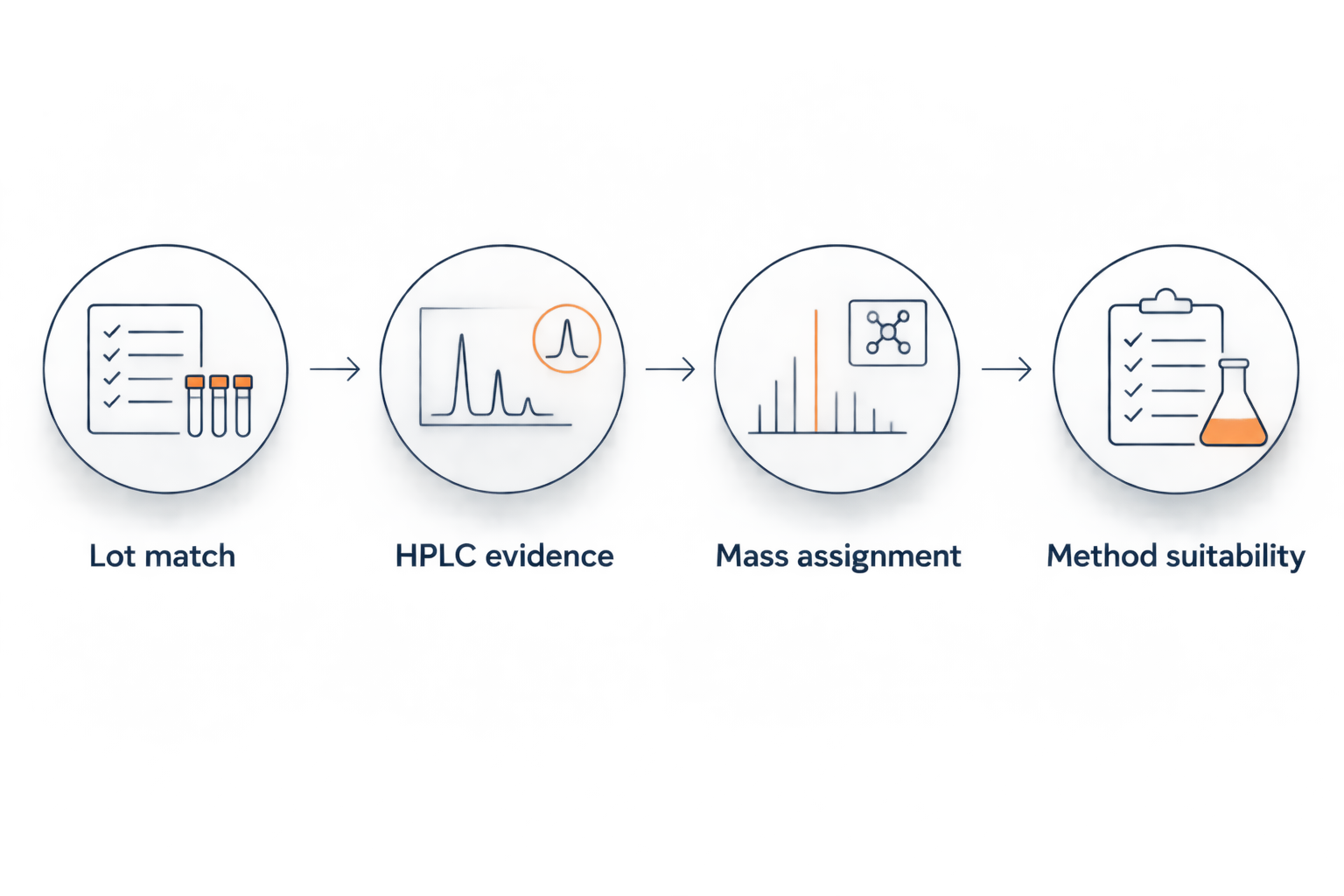
A Certificate of Analysis, or COA, records reported test results for identified material. For your 2026 assessment, separate the evidence into these categories:
- Lot match: Does the certificate identify the material you are assessing?
- HPLC evidence: What separation and detection conditions produced the chromatogram?
- Mass assignment: Does the interpretation support the stated molecular specification?
- Method suitability: Does the evidence address your laboratory’s intended measurement?
HPLC separates components under specified conditions. A reported chromatographic area result depends on the method, detector response, and integration; it is not automatically a measurement of absolute peptide content.
Mass spectrometry supplies mass-to-charge evidence. An appropriate mass assignment supports identity, while additional experiments are needed for questions that intact mass cannot resolve. The guide to HPLC and mass-spec peptide verification explains that distinction in more detail.
Strandaminos publishes third-party HPLC and mass-spec COAs. Assess the relevant product and certificate directly before making any lot-specific claim; publication alone does not establish suitability for your assay.
How the ranking works
This 2026 ranking follows structural fit and analytical purpose: linear-peptide work first, then lipidated and modified analogs, followed by compact structures and specification-sensitive material. Each entry occupies a different decision slot.
The order does not represent comparative experimental performance. No peptide here is designated a certified reference material, validated calibrator, or universal quality-control sample.
Record your selection rationale alongside the certificate. Another analyst should be able to understand why the molecule was chosen without reconstructing the purchasing decision.
Which research peptide should you choose?
Choose BPC-157 as the default only when your project concerns a defined linear peptide. Choose tirzepatide for lipidated-peptide work, cagrilintide when disulfide-related characterization matters, or SS-31 for a compact modified-peptide question.
For Strandaminos research peptides, start with the published documentation and assess the exact material against your protocol. Keep research-material qualification separate from supplier selection: a supplier-level description cannot settle an analyte-specific acceptance decision.
For every 2026 selection, write down the target identity, required evidence, acceptance criteria, and unresolved limitations before beginning laboratory work.
FAQ
What are the best research peptides for bioanalytical labs?
The best research peptides for bioanalytical labs match the intended analytical question. BPC-157 fits linear-peptide method development, tirzepatide fits lipidated-peptide analysis, and SS-31 fits compact modified-peptide work; each requires material-specific review.
Is BPC-157 better than tirzepatide for analytical method development?
BPC-157 is the more direct choice for a linear-peptide question, while tirzepatide fits a lipidated-peptide question. Neither establishes method suitability for the other.
Does an HPLC result prove peptide identity?
An HPLC result alone does not establish peptide identity. Chromatographic evidence must be interpreted alongside appropriate identity evidence and the stated molecular specification.
Does a mass-spec match prove a peptide is suitable as a calibrator?
A mass-spec match does not establish calibrator suitability. Quantitative use requires an appropriate basis for the assigned amount or concentration and qualification for the intended method.
What should a laboratory check on a peptide COA?
Check the material identity, lot identifier, analytical methods, reported results, and supporting interpretation. Confirm that the certificate belongs to the material being assessed and addresses the intended analytical question.
Can I compare TB-500 materials by name alone?
Do not compare TB-500 materials by name alone. Establish the exact sequence, modifications, and molecular form before comparing analytical records.
Are these peptides intended for personal or veterinary use?
No. These materials are for laboratory research only, not for human or veterinary use. This guide does not provide administration instructions or establish therapeutic suitability.
One last thing
Chromatographic purity and peptide content answer different questions. A chromatogram describes detected components under a particular method; it does not automatically assign the amount of peptide in a vial.
Before accepting material for quantitative work, ask what supports the concentration assignment. That question belongs in your method plan, not just your purchasing correspondence. Research use only. Not for human or veterinary use.