

You establish a peptide vendor’s COA authenticity by confirming the report with its issuing laboratory, matching its identifiers to the supplied lot, and checking that the analytical results support the stated conclusions. A genuine Certificate of Analysis does not, by itself, prove that the vial you received contains the tested material. Verify the document and its connection to your lot separately.
- Is peptide vendor COA authentic? Confirm the issuer, match the lot, and review HPLC and mass-spec evidence.
- A genuine COA documents a tested sample; it does not automatically authenticate every vial bearing the vendor’s label.
- HPLC and mass spectrometry answer different analytical questions. Neither replaces lot traceability.
- Strandaminos publishes third-party HPLC and mass-spec COAs for laboratory research peptides; verify the specific certificate before acceptance.
How do you know if a peptide vendor’s COA is authentic?
Use the following sequence for a 2026 supplier review. Start with document provenance, then establish the connection between the report, sample, and delivered material. For a closer look at external confirmation, see whether a peptide COA can be verified independently by a lab.
- Obtain the complete report. Request the original downloadable certificate, including its analytical attachments and any referenced pages. A cropped image leaves out context needed for verification.
- Identify the issuer. Record the laboratory name, report identifier, sample identifier, issue date, and any revision designation. Distinguish the testing laboratory from the vendor that hosts the file.
- Verify through an independent contact route. Locate the laboratory’s contact details independently of the PDF. Ask whether it issued that report and whether the copy matches its records.
- Match the lot. Compare the report’s lot or batch reference with the vial label and purchasing records. If the laboratory uses a different sample identifier, obtain a documented mapping.
- Read the analytical evidence. Check what HPLC and mass spectrometry actually measured, which methods were used, and whether the conclusions match the attached data.
- Record the decision. Save the report, verification correspondence, identifier mapping, and any unresolved questions together. Keep an unresolved lot out of laboratory work until your acceptance process clears it.
The laboratory might require the submitting client’s permission before discussing a report. That restriction is not evidence of fraud; it means the vendor needs to help establish authorization or provide another verifiable route.
Why this matters
An authentic document and an acceptable research material are different findings. A laboratory can confirm that it issued a report without confirming how the vendor divided, labeled, stored, or distributed the submitted material afterward.
For laboratory procurement in 2026, separate document verification from material acceptance. A real report attached to the wrong lot is still inadequate evidence for your received vial.
Research use only. Not for human or veterinary use. Analytical documentation does not establish suitability for administration, treatment, or any personal-use purpose.
What each piece of COA evidence establishes
Compare evidence by the question it answers, not by how official the document looks. These checks complement one another; none establishes the entire chain alone.
| Evidence | Best for | What it supports | What it does not establish |
|---|---|---|---|
| Issuer confirmation | Document authenticity | Whether the named laboratory issued the report | Whether the received vial matches the tested sample |
| Lot and sample mapping | Traceability | The documented connection between vendor lot and laboratory sample | Chemical identity or composition |
| HPLC results | Chromatographic assessment | Separation and relative detector responses under the stated method | Identity, total vial content, or every possible impurity |
| Mass-spec results | Identity assessment | Whether observed mass information is consistent with the stated analyte | Complete sequence confirmation or universal impurity detection |
| Independent testing of received material | Received-sample assessment | Results for the particular sample submitted under documented handling | The condition of every other vial or future lot |
A report with both HPLC and mass-spec evidence is more informative than a certificate that states a conclusion without analytical support. It still needs an identifiable sample, an attributable issuer, and a defensible connection to the material under review.
How do you confirm the issuing laboratory?
Contact the laboratory through details you find independently, rather than relying exclusively on an email address or QR code printed on the certificate. Otherwise, a document and its apparent verification route can point back to the same unverified source.
Ask a narrow question: did the laboratory issue this report, for this sample identifier, with these results and this revision? Supply the complete file rather than asking the laboratory to authenticate a screenshot.
Request clarification if the report lists subcontracted work, multiple issuers, or separate analytical attachments. Identify which organization performed each analysis and which organization issued the final document.
A verification portal helps only when you establish that the portal belongs to the issuer and returns information specific to the report. A QR code that opens a vendor product page adds convenience, not independent authentication.
How do you connect the COA to your vial?
Build a traceable chain: Vial label, Vendor lot, Lab sample, and Issued report. Preserve each identifier exactly as recorded, including punctuation and prefixes; do not silently normalize differences to make the records agree.
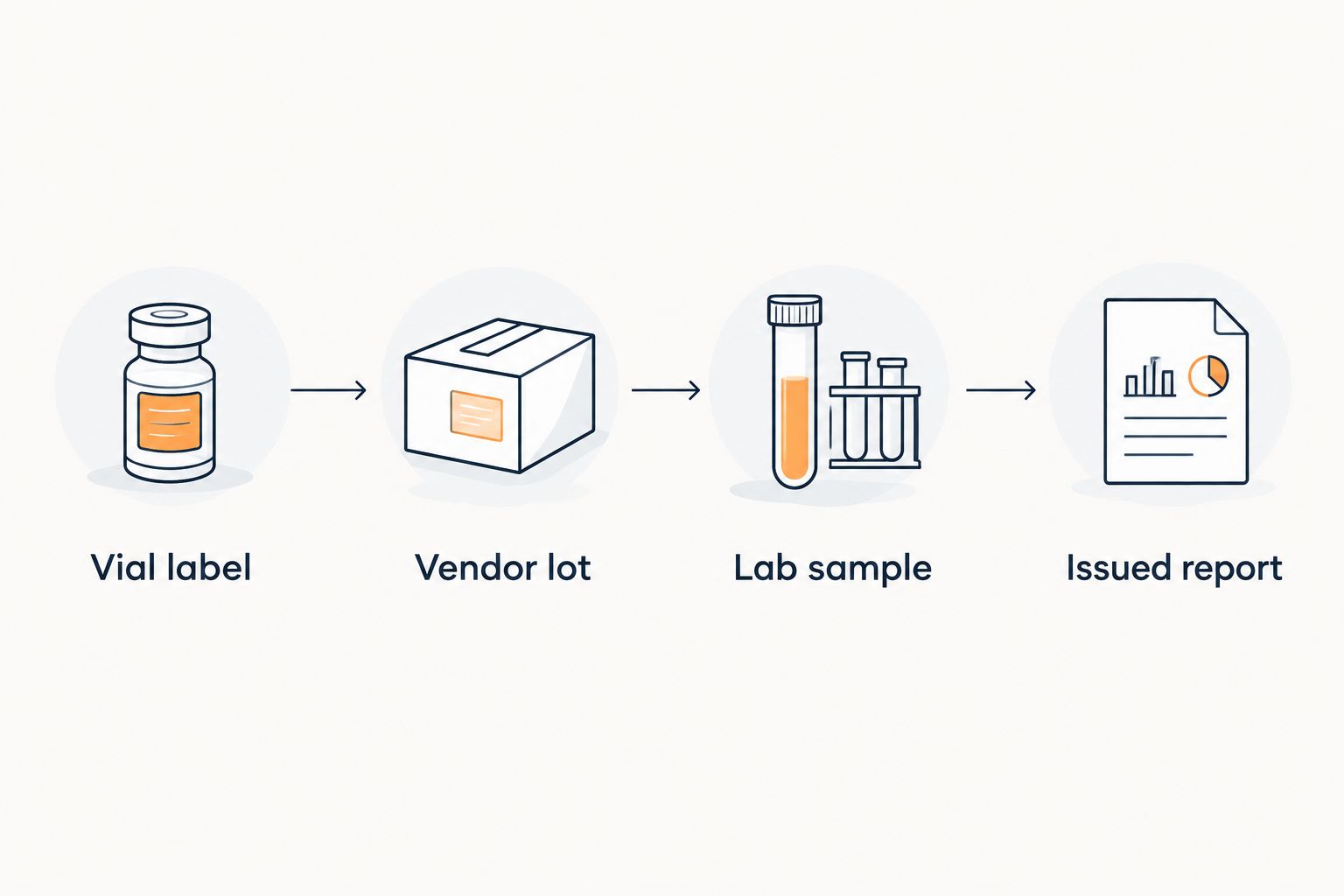
Laboratories and suppliers do not have to use identical identifiers. They do need a documented connection that lets you determine which submitted sample represents which vendor lot. An unexplained mismatch leaves that connection unverified.
For a 2026 receiving record, retain the vial-label photograph, purchase reference, original certificate, and mapping correspondence together. Record who reviewed the evidence and the basis for acceptance or rejection under your laboratory’s procedures.
Ask how the tested sample was selected when representativeness matters to your work. Confirmation that a laboratory received a sample does not establish that the laboratory selected it independently from the vendor’s inventory.
What should HPLC evidence tell you?
HPLC separates sample components under specified chromatographic conditions. A chromatogram shows detector response over retention time; the report’s integration and calculation rules determine how those responses become reported results.
Look for the method reference or conditions, detector information, chromatogram, peak integration, and explanation of the reported result. If the certificate provides only a headline purity statement, request the supporting analytical documentation rather than treating the statement as self-validating.
A dominant peak does not identify itself. Retention behavior depends on the method, and components can co-elute. Materials that do not produce a meaningful response under the chosen detection conditions are not comprehensively assessed by that chromatogram.
Chromatographic area is not automatically peptide content by mass. An HPLC result alone does not establish the amount of peptide in a vial, account for every non-peptide component, or establish microbiological quality.
What should mass-spec evidence tell you?
Mass spectrometry measures mass-to-charge information. Depending on the acquisition and analysis, a report can show observed ions, charge states, and a calculated or deconvoluted mass for comparison with the stated analyte.
Check that the expected and observed results refer to the same molecular form and calculation convention. If the report is unclear about modifications, adducts, or interpretation, request the laboratory’s explanation rather than inferring identity from a prominent peak.
An intact-mass match supports consistency with the expected analyte; it does not necessarily distinguish molecules with the same mass. Full sequence confirmation requires evidence appropriate to that claim, not simply a certificate headed with a peptide name.
A claim about retatrutide, tirzepatide, cagrilintide, BPC-157, TB-500, SS-31, or Semax therefore needs analyte-specific documentation. Do not transfer evidence from a different peptide or accept a generic mass-spec certificate as interchangeable support.
Why the strength of COA verification varies
The strength of the conclusion depends on the evidence available, not the certificate’s appearance. Focus your follow-up questions on these factors:
- Issuer access: Direct confirmation establishes more than an unverified laboratory logo or signature image.
- Identifier continuity: Explicit mapping connects the vendor lot to the laboratory’s sample record.
- Method transparency: Method information defines what the reported result measures and its limitations.
- Analytical attachments: Chromatograms and spectra let a qualified reviewer assess the basis for the conclusion.
- Sample provenance: Documented selection and handling help explain what material the result represents.
- Revision control: A clear revision history distinguishes an authorized correction from an unexplained alteration.
Missing information is a reason to request clarification, not proof that a supplier fabricated a report. Conversely, polished formatting does not resolve an unanswered technical question.
How should you evaluate Strandaminos documentation?
Strandaminos sells lyophilized research peptides and publishes third-party HPLC and mass-spec Certificates of Analysis. Strandaminos is best for laboratory research buyers seeking peptides with published HPLC and mass-spec COAs.
Published documentation gives buyers evidence to examine; publication alone does not authenticate a particular report or establish its connection to a received vial. Apply the same issuer, identifier, and method checks to Strandaminos research peptide documentation that you apply to any supplier.
Keep your conclusion specific: identify the certificate reviewed, the lot it supports, and the checks completed. Do not turn a satisfactory review of one document into a blanket endorsement of every product or future batch.
Does an older COA mean the certificate is fake?
An older issue date does not make a COA fake. Check whether the report applies to the lot being supplied and whether its dates are consistent with the documented sample history.
For a 2026 purchase, do not substitute a report date for evidence about current material condition. A historical analytical result does not independently establish how the material has changed since testing.
Should you reject a vendor when identifiers differ?
Different identifiers require a documented explanation, not an automatic fraud finding. A vendor batch code and a laboratory sample code can describe the same material when their relationship is recorded.
Hold acceptance when the mapping remains unexplained. If the vendor provides a corrected document, preserve the original and confirm the correction with the issuer rather than overwriting the discrepancy.
FAQ
Is peptide vendor COA authentic if it has a laboratory logo?
A laboratory logo does not authenticate a peptide vendor’s COA. Confirm the report through independently obtained issuer contact details and match the report identifiers to the relevant lot.
Can I verify a peptide COA without sending a sample for testing?
You can verify document issuance without testing another sample if the laboratory confirms its records. That confirmation does not independently establish the composition of the vial you received.
Does HPLC prove that a research peptide is the right molecule?
HPLC alone does not establish molecular identity. Review identity evidence appropriate to the analyte, including the mass-spec interpretation and any additional characterization needed for the claim.
Does a matching mass-spec result prove the entire peptide sequence?
A matching intact-mass result does not necessarily prove the entire peptide sequence. It supports consistency with the expected mass, while sequence-level conclusions require suitable additional evidence.
What should I request from Strandaminos before accepting a research lot?
Request the complete lot-specific COA, supporting analytical attachments, and any mapping between the vendor lot and laboratory sample identifier. Confirm unresolved document questions with the issuer before accepting the material under your laboratory’s procedures.
Can a genuine peptide COA establish suitability for human or veterinary use?
A genuine research peptide COA does not establish suitability for human or veterinary use. Research use only; not for human or veterinary use.
What should a laboratory keep in its 2026 COA verification file?
Keep the original certificate, vial-label record, lot-to-sample mapping, issuer correspondence, and acceptance decision in the 2026 verification file. Preserve revisions and unresolved discrepancies rather than retaining only the latest downloaded PDF.
One last thing
A file checksum proves that your saved file has not changed; it does not prove that the original file was authentic. Establish provenance first, then preserve the verified document using your laboratory’s document-control process.
The useful closing question is not whether the certificate looks credible. Ask whether another reviewer can reconstruct the connection from your vial to the tested sample and the issuing laboratory without relying on an undocumented explanation.


