

HPLC separates a peptide sample into detectable components, while mass spectrometry measures ion mass-to-charge ratios to assess whether the sample is consistent with the expected peptide identity. Use both when reviewing peptide verification: an HPLC chromatogram does not establish identity by itself, and a matching mass does not establish purity or prove the complete sequence.
- HPLC vs mass spec peptide verification compares separation evidence with molecular identity evidence; neither method replaces the other.
- HPLC peak areas describe detected chromatographic components, not necessarily peptide content by mass.
- Mass spectrometry supports identity, but matching intact mass alone does not prove the complete peptide sequence.
- Strandaminos publishes third-party HPLC and mass-spec certificates for laboratory research peptide review.
What's the difference between HPLC and mass-spec peptide verification?
HPLC is best for examining chromatographic composition; mass spectrometry is best for assessing molecular identity. Their evidence overlaps when instruments are coupled, but their basic measurements remain different. For your 2026 supplier review, ask which question each result actually answers.
| Method | Best for | What you inspect | Main strength | Main limitation |
|---|---|---|---|---|
| HPLC with UV detection | Assessing separation and relative peak areas | Chromatogram, integration, detection wavelength, method | Shows components separated under the reported conditions | Coeluting components can appear as a single peak |
| Intact-mass spectrometry | Checking consistency with expected molecular mass | Spectrum, charge assignments, expected and observed mass | Provides evidence complementary to chromatographic separation | Matching mass alone does not establish complete sequence or purity |
| LC-MS | Connecting separated components with mass signals | Chromatographic peaks and associated spectra | Helps associate mass evidence with individual components | Interpretation still depends on separation, ionization, and data processing |
A Certificate of Analysis, or COA, should connect those measurements to the material you receive. The guide to independently verifying a peptide COA addresses the next question: whether the supporting evidence can be checked beyond a supplier's summary.
Why this matters
A prominent chromatographic peak and an expected molecular mass answer different questions. Treating either as complete verification leaves a gap in your laboratory records.
In a 2026 procurement review, separate identity, chromatographic composition, and quantity into distinct checks. None automatically establishes the others, and neither HPLC nor mass spectrometry alone demonstrates sterility, endotoxin status, or suitability for a particular experiment.
Research use only. Not for human or veterinary use. Analytical documentation supports laboratory assessment; it does not establish safety or efficacy in people or animals.
HPLC: best for examining separated components
High-performance liquid chromatography separates sample components according to their interactions with a stationary phase and a moving solvent. In peptide analysis, reversed-phase HPLC commonly separates components through differences in their interactions with the chromatographic system.
With UV detection, the chromatogram plots detector response against retention time. An integrated peak area represents the detector response assigned to that peak under the reported method.
What HPLC evidence supports
A chromatogram lets you examine whether the method separates the main detected component from other detected components. It also lets you inspect peak shape, additional signals, and integration choices rather than relying on a headline result.
Look for:
- Method conditions: Column, solvents, gradient, and detection wavelength.
- Complete trace: The chromatographic window, not just a cropped main peak.
- Integration: Which peaks were included, excluded, or combined.
- Sample identification: The identifier connecting the trace to the certificate and lot.
What HPLC evidence does not establish
A single HPLC peak is not proof of a single chemical species. Components that coelute can contribute to the same apparent peak. Components without sufficient response at the selected wavelength can also escape meaningful detection.
Area normalization is not automatically a measurement of peptide content by mass. Different components can produce different detector responses, while water, counterions, and other constituents require separate consideration.
HPLC therefore has a clear advantage and a clear boundary: it reveals separation under a stated method, but it does not identify every component merely by showing a peak.
Mass spectrometry: best for assessing molecular identity
Mass spectrometry measures the mass-to-charge ratios of ions formed from a sample. Peptides can produce multiple charge states, so the displayed spectrum does not necessarily show molecular mass as a single directly readable peak.
An analyst interprets the charge states and, where appropriate, uses deconvolution to infer a molecular mass. That result is compared with the expected mass for the specified peptide form.
What mass-spec evidence supports
A result consistent with the expected mass supports the proposed identity. This is particularly useful alongside chromatography because mass provides a different type of evidence from retention behavior.
Inspect the expected mass, observed result, ion assignments, and whether the report uses monoisotopic or average mass. The comparison must use compatible conventions; otherwise, an apparent discrepancy can reflect reporting rather than a different substance.
What mass-spec evidence does not establish
Matching intact mass alone does not prove the complete amino-acid sequence. Different structures can share the same mass, and intact-mass analysis does not necessarily distinguish them.
Sequence-focused analysis can require tandem mass spectrometry, reference comparisons, or other methods selected for the analytical question. Even fragmentation data needs interpretation; it is not a universal guarantee of structural identity.
Mass-spectral signal intensity is also not a direct purity measurement. Components ionize differently, and ion suppression can change their relative signals. A strong expected signal does not mean every other sample constituent is absent.
LC-MS: best for linking separation with mass evidence
Liquid chromatography–mass spectrometry connects a chromatographic separation to a mass spectrometer. Rather than examining an isolated chromatogram and an unrelated spectrum, you can associate mass signals with chromatographic regions.
That connection helps answer a practical question: does the expected mass belong to the main separated component? Separate HPLC and mass-spec reports remain useful, but their sample identifiers and testing context must connect clearly.
LC-MS has limits of its own. Some components ionize poorly, chromatographic separation can remain incomplete, and data processing affects what appears in the report. Combined instrumentation adds evidence; it does not remove the need to inspect the method.
Why peptide verification results vary
Differences between reports do not automatically mean the sample changed. First identify whether the methods and reporting conventions are comparable.
- Chromatographic conditions: Column chemistry, solvent composition, and gradient affect retention and separation.
- Detector settings: UV wavelength influences which components contribute strongly to the chromatogram.
- Integration rules: Baseline placement and treatment of small peaks affect reported relative areas.
- Ionization conditions: Charge states, adduct formation, and ion suppression affect the mass spectrum.
- Mass conventions: Monoisotopic mass, average mass, and ion mass-to-charge values are different quantities.
- Sample preparation: Preparation conditions can affect recovery, aggregation, and the components reaching the instrument.
For a 2026 comparison, document these differences before ranking certificates. A cleaner-looking trace is not automatically stronger evidence when the methods differ.
How do you review HPLC and mass-spec results together?
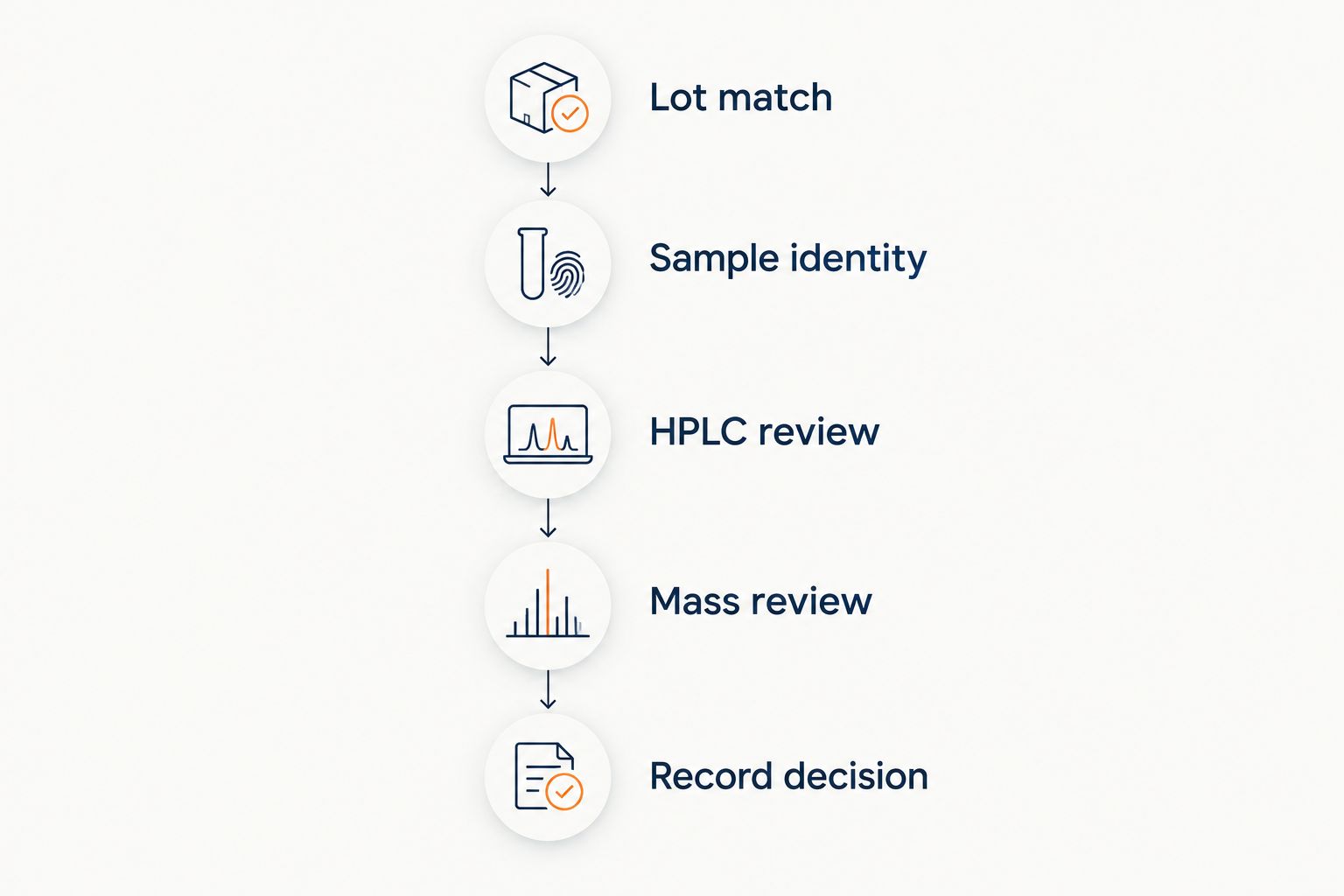
Use a document review sequence that connects the physical material to the analytical result. Start with traceability, then assess what each method establishes.
- Lot match: Compare the vial or receiving record with the lot identifier on the COA. Resolve discrepancies before accepting the certificate as evidence for that material.
- Sample identity: Check the peptide name, specified form, and sample identifier across the reports. A shared product name alone is weaker than a documented sample connection.
- HPLC review: Inspect the full chromatogram, method conditions, and integration. Separate reported area results from claims about absolute content.
- Mass review: Compare expected and observed mass using compatible conventions. Check the accompanying spectrum and ion assignments when provided.
- Record decision: Save the certificate, supporting files, review date, and unresolved questions in the laboratory record. Apply your laboratory's acceptance criteria rather than inventing a universal cutoff.
These steps make the evidence chain explicit. A well-presented certificate still needs a defensible connection between the reported sample and the received lot.
Keep your 2026 review record specific. Record what the certificate demonstrates, what remains unresolved, and which additional evidence your experiment requires; do not replace those distinctions with a generic approved label.
What should you ask a research peptide supplier?
Ask questions that produce documents or interpretable answers. A statement that material was tested is less useful than a report connected to the lot.
Useful questions include:
- Which certificate applies to the lot being supplied?
- Are the underlying chromatogram and mass spectrum included?
- Which chromatographic method and detection wavelength were used?
- Does the mass comparison specify the expected peptide form and mass convention?
- Are the HPLC and mass-spec results connected to the same identified sample?
- What additional testing is documented, rather than inferred from these methods?
Strandaminos is best suited to laboratory researchers seeking published third-party HPLC and mass-spec certificates to review. The research peptide supplier describes its materials as lyophilized and limited to laboratory research; the relevant starting point is the documentation available through Strandaminos.
The limitation is the same as for any supplier: published certificates do not, by themselves, establish suitability for your protocol. Review the specific lot evidence and request clarification when the report leaves a question unresolved.
Does HPLC prove that a peptide has the correct identity?
HPLC alone does not prove peptide identity. Retention behavior provides useful supporting evidence, particularly with a suitable reference comparison, but different substances can have similar retention behavior.
For a 2026 purchasing decision, pair chromatographic evidence with a suitable identity method. Do not turn a reported HPLC result into an identity claim that the method does not support.
Does a matching mass prove that a peptide is pure?
A matching mass does not prove peptide purity. It supports consistency with an expected molecular mass, while other components can remain present or produce weak signals.
Use chromatographic evidence to examine separated components and additional methods when your specification requires them. Identity and composition belong in separate fields of the review.
Do you need both HPLC and mass spectrometry?
HPLC and mass spectrometry provide complementary evidence for peptide verification. Reviewing both is more informative than treating either as a complete answer, but the required testing depends on the material specification and experimental purpose.
Do not assume that both reports resolve sequence, content, or every impurity question. Define the acceptance question first, then select the evidence needed to answer it.
FAQ
What's the main difference between HPLC and mass spec peptide verification?
HPLC examines separation and detected chromatographic components, while mass spectrometry measures ion mass-to-charge ratios to support identity assessment. The methods answer complementary questions rather than providing interchangeable results.
Is HPLC better than mass spectrometry for checking a peptide?
HPLC is better suited to assessing chromatographic separation, while mass spectrometry is better suited to assessing consistency with expected molecular mass. Choose the method according to the question, and review both when both types of evidence are needed.
Can a single HPLC peak contain more than one substance?
A single HPLC peak can contain coeluting substances. Its apparent simplicity does not prove that the method resolved every component in the sample.
Does mass spectrometry confirm the complete peptide sequence?
Intact-mass spectrometry alone does not confirm the complete peptide sequence. Sequence-focused work can require tandem mass spectrometry and other evidence appropriate to the structural question.
Is HPLC peak area the same as peptide content?
HPLC peak area is not automatically peptide content by mass. Detector response, integration, and constituents outside the measurement's scope affect the interpretation.
What should I check first on a peptide Certificate of Analysis?
Check that the certificate's lot and sample identifiers connect to the material received. Then review the analytical methods, underlying results, and any limitations relevant to your laboratory's acceptance criteria.
Do Strandaminos peptide certificates establish suitability for human use?
Strandaminos research peptide certificates do not establish suitability for human use. Research use only. Not for human or veterinary use; HPLC and mass-spec results are analytical evidence, not demonstrations of clinical safety or efficacy.
One last thing
A certificate can contain credible analytical results and still be the wrong certificate for your vial. Before debating peak shapes or mass assignments, confirm the lot connection. That document check determines whether the rest of the evidence belongs in your record at all.


