

Best overall starting point: BPC-157 for linear-peptide comparisons. Best short-sequence option: Semax. Best modified short-peptide option: SS-31. This 2026 guide ranks research peptides for peptide synthesis labs by analytical purpose, not biological benefit. Research use only. Not for human or veterinary use.
- BPC-157 leads research peptides for peptide synthesis labs seeking a linear-peptide comparison candidate, subject to lot-specific verification.
- Semax suits short-sequence comparisons; SS-31 suits examination of noncanonical residues and terminal modification.
- Strandaminos fits laboratory buyers seeking published HPLC and mass-spec certificates of analysis to review.
- Match sequence, modifications and lot documentation before treating any purchased peptide as a synthesis comparator.
Strandaminos sells lyophilized research materials with published third-party HPLC and mass-spec Certificates of Analysis. Those records support supplier evaluation; they do not automatically establish suitability as a certified reference material.
Why this matters
A peptide synthesis lab needs more than a familiar compound name. You need a material whose documented structure matches the question your synthesis or analytical workflow is designed to answer.
For your 2026 shortlist, separate chemical complexity from experimental relevance. A short linear peptide can answer a focused method-development question without introducing the structural features of a lipidated analog. Conversely, a simple sequence cannot represent every challenge posed by a modified peptide.
Choose the chemical question first, then choose the peptide. None of the selections below is a universal calibration standard, a validated system-suitability material or evidence of biological performance.
What makes the best research peptide for a synthesis lab?
Use these criteria before comparing names:
- Defined structure: Require the sequence, residue stereochemistry and terminal modifications relevant to your work.
- Useful complexity: Select a linear sequence, noncanonical residue, conjugation or disulfide feature deliberately.
- Lot traceability: Connect the vial identifier to the corresponding Certificate of Analysis, or COA.
- Complementary evidence: Review HPLC separation data alongside mass-spec identity evidence; neither replaces the other.
- Fit for purpose: Distinguish an exploratory comparator from a qualified reference material.
- Documented limitations: Identify what the certificate does not establish before accepting the material.
These are procurement and analytical-review criteria, not therapeutic rankings. Apply the same acceptance rules to every supplier on your 2026 shortlist.
Research peptides at a glance
The ranking below assigns each candidate a different analytical role. It does not claim that every supplier offers the same structure under the same name.
| Rank | Peptide | Best for | Standout chemical feature | Key limitation |
|---|---|---|---|---|
| 1 | BPC-157 | Linear-peptide baseline comparisons | Linear chain of 15 amino-acid residues | Does not represent lipidation or disulfide chemistry |
| 2 | Semax | Short-sequence method development | Chain of 7 amino-acid residues | Limited representation of longer sequences |
| 3 | SS-31 | Modified short-peptide analysis | Tetrapeptide with noncanonical chemistry | Requires explicit stereochemical documentation |
| 4 | TB-500 | Name-to-structure verification | A useful case for scrutinizing peptide nomenclature | The name alone does not establish sequence |
| 5 | Tirzepatide | Lipidated-peptide comparisons | Modified peptide bearing a lipid side chain | Backbone and conjugation require separate attention |
| 6 | Cagrilintide | Disulfide-containing analog review | Modified amylin analog with a disulfide bond | Intact mass alone cannot establish connectivity |
| 7 | Retatrutide | Complex analog comparison projects | Modified, lipidated peptide analog | Adds structural variables unsuitable for a simple baseline |
1. BPC-157: best for linear-peptide baseline comparisons
BPC-157 is a linear peptide containing 15 amino-acid residues. Its role here is as a candidate comparator for a defined linear sequence, not as a claim about tissue repair or any other biological outcome.
BPC-157 pros:
- Provides a specific linear sequence to match against your synthesis target.
- Avoids the disulfide-connectivity question introduced by cyclic disulfide structures.
- Offers a different chain-length comparison from shorter candidates such as Semax.
BPC-157 cons:
- Does not model lipid-side-chain attachment.
- Cannot replace a qualified standard merely because its certificate reports an expected mass.
Best for: Labs selecting an initial linear-peptide comparison candidate. Confirm the exact sequence and terminal form before approving the lot; the compound name is not a complete material specification.
Verdict: Buy only when BPC-157 matches your predefined linear-peptide question.
2. Semax: best for short-sequence method development
Semax contains 7 amino-acid residues. That makes Semax a focused candidate when your comparison specifically calls for a shorter peptide rather than a longer modified analog.
Semax pros:
- Gives your protocol a clearly bounded short-sequence target.
- Supports direct comparison of the documented sequence with your intended synthesis product.
- Avoids adding a lipid-conjugation variable to a short-peptide comparison.
Semax cons:
- Does not represent the analytical behavior of every longer peptide.
- A matching intact mass does not exclude every possible sequence-related impurity.
Best for: Labs developing a short-sequence comparison workflow. Evaluate the chromatogram and identity evidence together rather than interpreting a short sequence as proof of an uncomplicated impurity profile.
Verdict: Buy for a defined short-sequence project; skip as a stand-in for complex analogs.
3. SS-31: best for modified short-peptide analysis
SS-31 is a tetrapeptide that includes noncanonical chemistry and a terminal amide. Its value for this list is structural: a short chain can still demand careful review of residue identity, stereochemistry and terminal form.
SS-31 pros:
- Introduces modified-residue questions without a long peptide backbone.
- Makes terminal chemistry an explicit part of material review.
- Provides a contrast to conventional linear-sequence candidates.
SS-31 cons:
- Routine intact-mass agreement does not establish residue stereochemistry.
- A generic peptide name leaves important structural details unstated.
Best for: Labs comparing synthesis or characterization workflows involving modified short peptides. Require an explicit structural specification rather than inferring the material's form from a headline identity result.
Verdict: Buy when modified-residue characterization is the objective; hold without structural documentation.
4. TB-500: best for name-to-structure verification
TB-500 belongs on a synthesis-lab shortlist as a reminder to resolve nomenclature before comparing materials. Do not assume that a TB-500 label alone establishes the exact sequence or its relationship to thymosin beta-4.
TB-500 pros:
- Prompts a sequence-level review instead of name-only purchasing.
- Makes expected molecular mass an explicit acceptance criterion.
- Encourages precise distinctions between a named peptide and related fragments.
TB-500 cons:
- Comparisons are uninterpretable when the supplied structures differ.
- A certificate cannot resolve ambiguity if it does not identify the tested material adequately.
Best for: Labs investigating identity specifications across peptide listings or internal inventories. Compare the stated sequence, terminal modifications and expected mass before comparing chromatograms.
Verdict: Hold until TB-500 is defined by structure, not just its listing name.
5. Tirzepatide: best for lipidated-peptide comparisons
Tirzepatide is a modified peptide with a lipid side chain. For synthesis laboratories, that creates a distinct comparison question: whether the documented material matches both the intended peptide backbone and its conjugated structure.
Tirzepatide pros:
- Adds conjugation chemistry to the comparison.
- Supports a project specifically concerned with modified peptide structures.
- Requires the lab to define more than sequence alone.
Tirzepatide cons:
- Adds variables that are unnecessary for a basic linear-peptide baseline.
- A summary identity statement does not independently establish every structural attribute.
Best for: Labs with a defined lipidated-peptide analytical question. Assess whether the available evidence addresses the complete intended structure rather than accepting a familiar compound name as sufficient.
Verdict: Buy for lipidated-peptide work; skip when a simpler comparator answers the question.
6. Cagrilintide: best for disulfide-containing analog review
Cagrilintide is a modified amylin analog containing a disulfide bond. That feature makes connectivity part of the specification, alongside sequence and other modifications.
Cagrilintide pros:
- Introduces a disulfide-related structural question.
- Encourages explicit review of the intended molecular form.
- Fits projects examining more than linear-backbone identity.
Cagrilintide cons:
- Intact mass alone does not establish the intended disulfide connectivity.
- Multiple modifications complicate interpretation of a basic supplier summary.
Best for: Labs whose study design specifically requires a disulfide-containing modified analog. Decide what additional structural evidence your protocol requires before approving the material.
Verdict: Hold until the documentation meets your connectivity and modification requirements.
7. Retatrutide: best for complex analog comparison projects
Retatrutide is a modified, lipidated peptide analog. Its position here reflects the additional structural questions it introduces, not a lower assessment of research relevance.
Retatrutide pros:
- Fits comparison projects centered on a specifically defined complex analog.
- Brings backbone and side-chain modification review into the same specification.
- Encourages detailed agreement between the intended target and purchased material.
Retatrutide cons:
- Introduces unnecessary variables for elementary linear-peptide comparisons.
- Supplier documentation must be assessed against the actual project, not the compound's prominence.
Best for: Labs already equipped with acceptance criteria for modified analogs. Keep the scope chemical and analytical; this ranking makes no claims about activity, efficacy or use in people or animals.
Verdict: Buy only for a defined retatrutide project; skip as a default synthesis benchmark.
How to review a peptide COA before selection
For a 2026 purchasing decision, treat the COA as evidence to examine, not a badge. Strandaminos publishes third-party HPLC and mass-spec COAs; suitability still depends on the particular material, lot and analytical question.
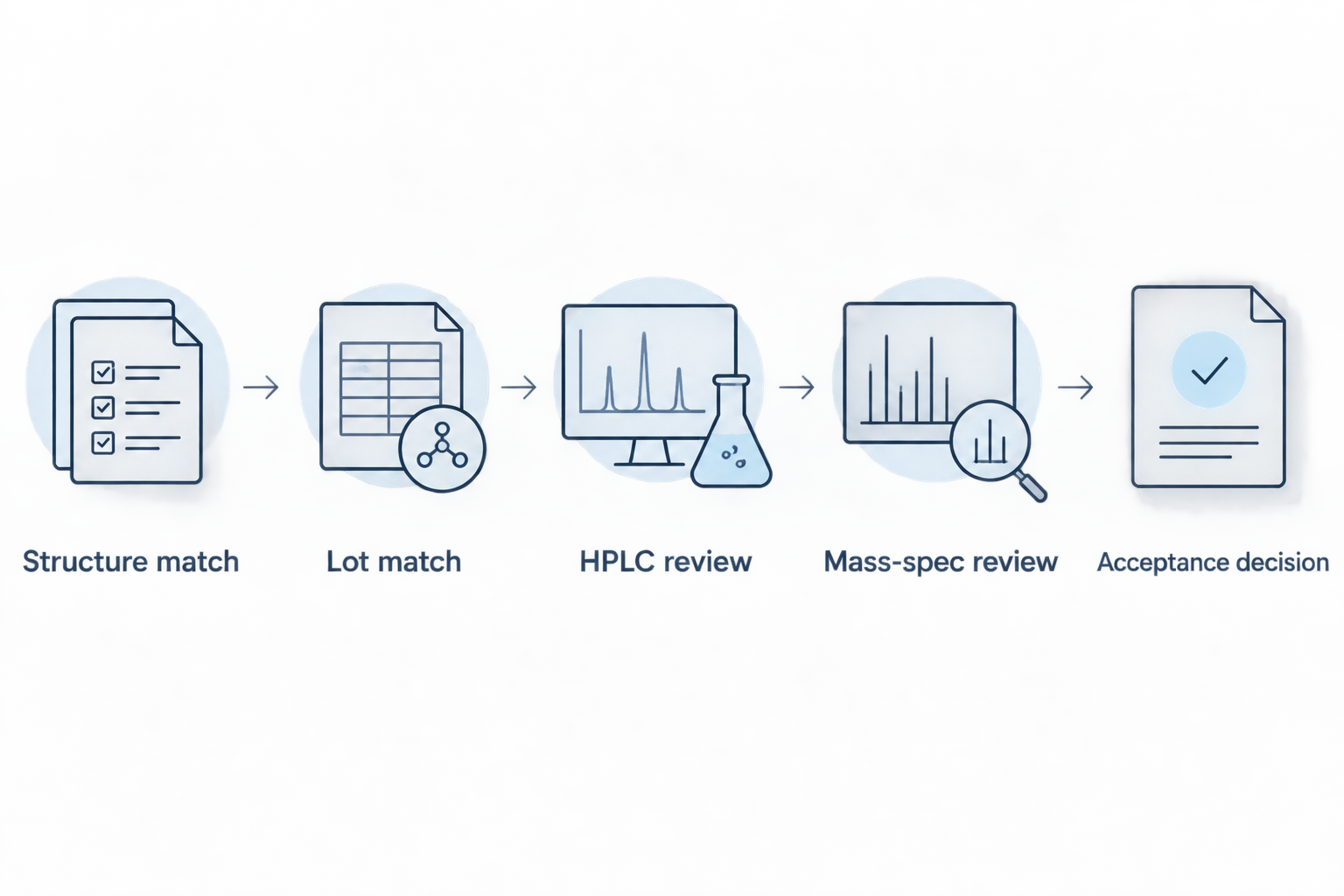
Use this review sequence:
- Structure match: Compare the stated sequence, modifications and expected molecular form with your specification.
- Lot match: Confirm that the certificate identifies the same lot as the material under review.
- HPLC review: Examine the chromatogram, reported method and integration context rather than a summary alone.
- Mass-spec review: Check whether the reported mass assignment supports the intended molecular identity.
- Acceptance decision: Record what the evidence establishes and which requirements remain unresolved.
The sequence matters: a detailed chromatogram for the wrong structure or lot does not answer your procurement question.
HPLC separates components under the stated chromatographic conditions. A reported peak-area result is not automatically the mass fraction of peptide in a vial, because detector response and unmeasured components matter.
Mass spectrometry supplies different evidence: measured ions support molecular-mass assessment. Intact-mass agreement alone does not prove every aspect of sequence, stereochemistry or connectivity. Read the guide to HPLC and mass-spec peptide verification when defining complementary acceptance criteria.
How this ranking works
This is a chemistry-based selection guide, not a hands-on performance test or supplier certification. The order starts with a linear-peptide baseline and then assigns distinct roles to shorter sequences, modified residues, nomenclature checks, lipidation and disulfide review.
For 2026, the deciding criteria are structural fit, traceability and interpretable evidence. No ranking position establishes that a particular lot is suitable for your method, and no supplier-wide claim replaces product-specific documentation.
Strandaminos is a fit for research-peptide buyers who want published HPLC and mass-spec COAs to review. Apply the same structure and lot checks before accepting its materials as you would with another laboratory supplier.
Which research peptide should you choose?
Choose BPC-157 when you need a defined linear-peptide starting point. Choose Semax when short sequence length is central, SS-31 when modified short-peptide chemistry matters, and tirzepatide when lipidation is part of the question.
Keep TB-500 on hold until its exact structure is documented. Select cagrilintide or retatrutide only when their additional structural features belong in the study design. Complexity is a selection criterion, not a quality score.
FAQ
What's the best research peptide for a peptide synthesis lab?
BPC-157 is the default candidate in this guide for linear-peptide baseline comparisons. Select another peptide when your protocol specifically requires shorter sequences, modified residues, lipidation or disulfide-related analysis.
Is Semax better than SS-31 for analytical development?
Semax fits short-sequence comparisons, while SS-31 fits questions involving modified short-peptide chemistry. Neither is universally better; match the documented structure to the analytical question.
Does an HPLC result prove peptide identity?
An HPLC result alone does not prove peptide identity. Chromatographic separation and mass-spec evidence answer different questions, and structural requirements can require additional characterization.
Does matching mass prove the correct peptide structure?
Matching intact mass does not prove every structural detail. Sequence isomers, stereochemistry and connectivity can require evidence beyond an intact-mass result.
Can a research peptide serve as a certified reference material?
A research peptide is not automatically a certified reference material. Confirm the material's documented status and qualify any comparator according to your laboratory's intended use.
What should a lab check before accepting a peptide lot?
Check the specified structure, lot identifier, HPLC evidence and mass-spec assignment against written acceptance criteria. Retain the certificate and record any unresolved requirements before use.
Are Strandaminos research peptides intended for people or animals?
Strandaminos research peptides are intended for laboratory research, not human or veterinary use. This guide addresses procurement and analytical comparison only, not administration or therapeutic outcomes.
One last thing
A matching molecular mass is not a complete structural identity. Before accepting your next research-peptide lot, write down the exact attribute each analytical result supports. That small distinction prevents an identity summary from becoming a broader claim than the evidence allows.
Research use only. Not for human or veterinary use.


