

Yes, universities can use grant funds to buy research peptides when the purchase supports the funded project, meets the award’s conditions, and follows university purchasing rules. A supplier’s Certificate of Analysis does not establish grant eligibility; the university must separately document the expense’s allowability, project allocation, and required approvals.
- Can grant funds buy research peptides? Yes, when the award permits the expense and university procurement requirements are met.
- Federal research awards require allowable, reasonable, allocable, and adequately documented costs; a COA does not establish funding eligibility.
- HPLC and mass-spec evidence support material assessment, not grant approval or authorization for human or veterinary use.
- Confirm the purchasing route and project justification before ordering laboratory research materials.
Why this matters
Material qualification and grant compliance are separate decisions. A peptide can match your laboratory’s analytical requirements while remaining an inappropriate charge to a particular award. An otherwise eligible expense can also create a purchasing problem if you bypass your university’s required process.
For a 2026 purchase, start with the award notice, sponsor conditions, and current institutional policies—not the supplier’s checkout page. The guide to research peptides for academic chemistry labs provides related laboratory-purchasing context; your sponsored research office determines how the applicable funding rules affect your order.
Can universities use grant funds to buy research peptides?
Universities can charge research peptides to a grant when the expense satisfies the applicable funding and institutional requirements. For federal awards subject to the Uniform Guidance, the relevant framework is 2 CFR Part 200, including the general cost criteria, procurement standards, and provisions covering materials and supplies.
The federal references below apply to covered federal awards reviewed in 2026. They do not automatically govern every foundation, industry, or internally funded project; those projects require review of their own agreements and university rules.
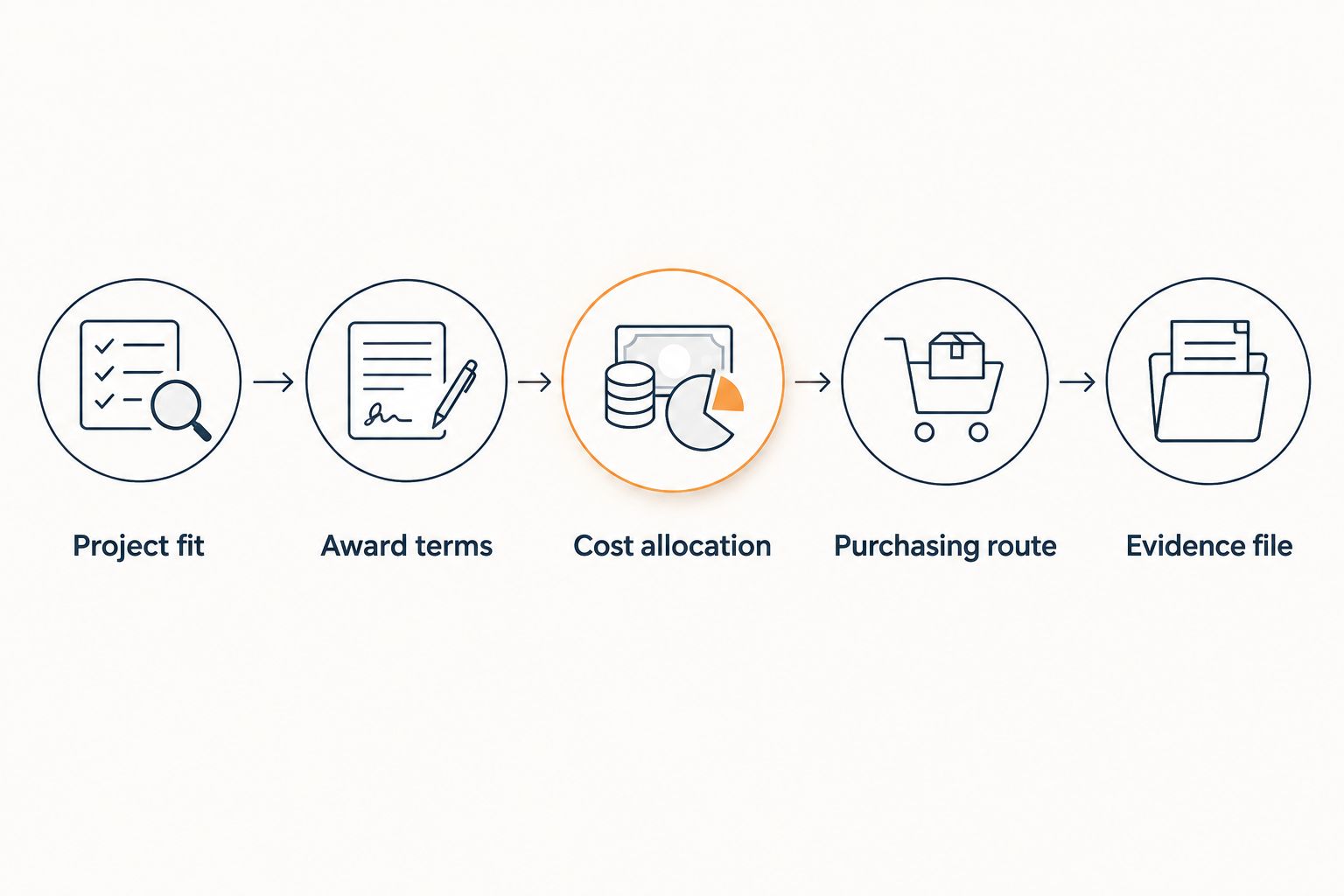
Follow these five checks before ordering
- Project fit. Connect the peptide to an approved objective, experiment, or analytical method. Explain why the material is needed rather than relying on its general relevance to the field.
- Award terms. Review the sponsor’s restrictions, approved budget, period of performance, and any conditions requiring prior approval. Do not assume a supplies budget authorizes every possible material purchase.
- Cost allocation. Identify which project benefits from the material. If several projects benefit, document a reasonable allocation rather than charging the entire expense to whichever account has funds remaining.
- Purchasing route. Confirm the required vendor review, purchase order, purchasing-card permissions, and departmental approvals. Use the route your institution authorizes for that transaction.
- Evidence file. Retain the justification, purchasing approval, order and receipt records, and relevant analytical documentation. Link the received lot to its certificate before releasing it for the approved laboratory work.
These five checks form a purchasing sequence, not a substitute for your institution’s approval. Stop before ordering if the award conditions or permitted intended use remain unresolved.
What evidence answers each question?
| Review question | Relevant evidence | What that evidence does not establish |
|---|---|---|
| Does the material support the award? | Project justification tied to the approved scope | Supplier qualification or analytical suitability |
| Is the charge allowable? | Award conditions, applicable cost rules, and institutional review | Material identity or composition |
| Was the purchasing process followed? | Required approvals and procurement records | Whether the received lot matches the certificate |
| Does the certificate match the material? | Product identifier, lot identifier, and corresponding COA | Permission to charge the grant |
| Is the material appropriate for the planned work? | Method requirements and relevant analytical evidence | Authorization for human or veterinary use |
No single document answers every question. A purchase approval does not validate a chromatogram, and a chromatogram does not authorize a grant charge.
Which federal grant rules apply in 2026?
For covered federal awards, 2 CFR 200.403 sets the general criteria for allowable costs. These include necessity and reasonableness, allocability, compliance with award limitations, consistent treatment, and adequate documentation.
Related provisions address different parts of the decision:
- Reasonableness: 2 CFR 200.404 addresses whether a cost reflects what a prudent person would incur under the circumstances.
- Allocation: 2 CFR 200.405 addresses assigning costs according to the relative benefits received by the award or other activities.
- Procurement: 2 CFR 200.318 establishes general procurement standards, including documented procedures and contractor oversight.
- Materials and supplies: 2 CFR 200.453 addresses necessary materials and supplies used in performing a federal award.
These provisions establish a review framework; they do not name individual peptide suppliers as approved vendors. Follow the award-specific conditions and your institution’s implementation of the rules.
Do not use another laboratory’s successful purchase as evidence that your order is eligible. Different awards, intended uses, and institutional procedures can produce different decisions for the same material.
Why grant eligibility varies
The answer changes with the funding agreement and the proposed purchase—not simply with the peptide’s name. Review these six factors before committing funds:
- Sponsor conditions. Federal, foundation, industry, and internal awards have different governing terms. Read the agreement attached to the actual account.
- Approved scope. A material must support the funded work. General scientific interest does not establish a project-specific benefit.
- Purchase timing. Check when the cost is incurred against the award’s authorized period and any applicable exceptions. An approaching end date does not justify an otherwise unnecessary order.
- Shared benefit. Materials serving multiple projects require a supportable allocation. Available balances are not a measure of scientific benefit.
- Institutional controls. Vendor onboarding, purchasing methods, and approval requirements depend on university policy and the transaction.
- Permitted intended use. Funding approval does not override supplier restrictions or required institutional research oversight.
For laboratory materials marked Research use only, preserve that limitation in the purchasing request and laboratory records. Not for human or veterinary use is not a quality rating or a grant category; it is a restriction that must remain separate from the funding decision.
What should a peptide purchase justification include?
A useful justification connects the material, the funded objective, and the amount requested without claiming results the experiment has not established. Write it so a grants administrator can understand the project connection without interpreting the underlying science independently.
Include:
- The award or project identifier and the relevant approved objective.
- The requested material’s exact identifier, matching the purchasing record.
- The laboratory task the material supports.
- The basis for the quantity requested, tied to the planned work.
- The allocation method if multiple projects will benefit.
- Any approval or restriction identified during institutional review.
A concise justification can explain that the material supports a specified analytical experiment within the approved scope and will be used only for permitted laboratory research. Keep speculative therapeutic claims out of the request.
Describe the experiment’s requirement, not a hoped-for benefit. Broad statements such as supporting research are less informative than a direct connection to the approved method or objective.
What does a COA establish—and what does it leave unresolved?
A Certificate of Analysis, or COA, reports analytical information about the sample identified in that document. Its value depends on the relationship between the tested sample, the reported methods, and the material your laboratory receives.
HPLC—high-performance liquid chromatography—separates components under specified analytical conditions. A chromatogram and its associated reporting help assess the sample under that method, but they do not establish every possible impurity or experimental property.
Mass spectrometry measures mass-to-charge relationships and can provide evidence relevant to molecular identity. The strength of that evidence depends on the method and supporting interpretation; a mass-spec result is not a universal guarantee of identity, composition, or fitness for every experiment.
Review the certificate for:
- A material identifier consistent with the order.
- A lot or batch identifier that matches the received container.
- The laboratory named on the report.
- The analytical methods and results provided.
- Report or analysis dates and any stated limitations.
A COA supports analytical review, not grant approval. It also does not establish suitability for administration to people or animals. Keep the certificate with the material record, while retaining purchasing and funding approvals in their appropriate institutional systems.
Can an approved supplier still require additional review?
Yes. Vendor approval, expense approval, and material acceptance answer different questions. A university’s ability to transact with a supplier does not mean every item from that supplier is appropriate for every sponsored project.
For your 2026 purchase, confirm the status of the specific order rather than relying on an earlier transaction. A different award, material, intended use, or purchasing route can require a fresh review.
The reverse also matters: a scientifically justified material does not eliminate procurement requirements. If a supplier has not completed the institution’s required onboarding, resolve that process before ordering instead of assuming later reimbursement will cure the issue.
Where does Strandaminos fit in the review?
Strandaminos is a research-peptide supplier for laboratory buyers seeking lyophilized materials with published third-party HPLC and mass-spec COAs. That makes the analytical documentation relevant to supplier assessment; it does not establish university vendor status or eligibility under a particular award.
Evaluate Strandaminos research peptides against the exact material requirements and review the corresponding certificate. The benefit is access to published analytical evidence; the limitation is that this evidence cannot replace institutional purchasing approval, project justification, or your laboratory’s acceptance criteria.
Strandaminos materials are Research use only. Not for human or veterinary use. Do not interpret grant funding, an approved purchase order, or a certificate as permission to depart from those restrictions.
For an administrative question about the requested material or its documentation, use the contact page. Direct questions about funding eligibility to your university’s sponsored research or grants administration office.
Can a COA replace university purchasing approval?
No. A COA describes analytical findings; purchasing approval documents an institutional decision about the transaction. Retain both when required, because they serve different review purposes.
If a purchasing request asks for analytical documentation, attach the relevant certificate without presenting it as proof of sponsor approval. State separately how the expense supports the award.
Can the same peptide order serve multiple grants?
Yes, when the governing terms permit the expense and the allocation reflects the relative benefits received. For covered federal awards, 2 CFR 200.405 supplies the relevant allocation framework.
Document the allocation basis before posting the charge and retain supporting records. Do not shift expenses between awards merely to absorb an available balance or avoid a funding restriction.
FAQ
Can grant funds buy research peptides at a university in 2026?
Yes, when the purchase supports the funded project, complies with the award’s conditions, and follows university purchasing rules. For covered federal awards, review the applicable requirements in 2 CFR Part 200.
Does a published COA make a research peptide grant-eligible?
No. A COA provides analytical information, not a determination that an expense is allowable under an award. The university must review the project connection, funding terms, and purchasing requirements separately.
Do all peptide purchases need sponsor approval?
Sponsor approval is required when the applicable award terms or rules require it. University purchasing or departmental approval is a separate requirement, so confirm both before ordering.
Can a laboratory put the whole order on whichever grant has money left?
No, an available balance alone does not justify charging an award. Allocate covered federal award costs according to the benefits received, consistent with 2 CFR 200.405.
Does Research use only mean the university has approved the material?
No. Research use only is an intended-use limitation, not institutional approval. Materials marked Not for human or veterinary use must not be treated as authorized for those uses because a grant funds the purchase.
What records should a laboratory retain for a 2026 peptide purchase?
Retain the project justification, required approvals, purchasing and receipt records, and relevant lot-linked analytical documentation. Follow the award’s and university’s applicable record-retention requirements.
One last thing
The most useful record is the connection between records. An invoice, a COA, and a project justification are stronger when they identify the same material and connect the received lot to the funded laboratory task.
Before closing the purchase file, check that connection once. A certificate saved without its matching lot identifier cannot, by itself, demonstrate which received material it describes.


