

GHK-Cu research peptide cost per vial depends on the specific listing and declared quantity; there is no single figure that describes every vial. For a 2026 laboratory purchase, compare the current listing with the lot-specific analytical documentation, then check whether the order total includes any separately stated charges. Compare equivalent materials and evidence—not vial labels alone.
- Compare GHK-Cu research peptide cost per vial alongside declared quantity, chemical identity, and lot-specific COA evidence.
- Strandaminos publishes third-party HPLC and mass-spec COAs for laboratory researchers to review.
- HPLC purity and mass-spec identity answer different questions; neither replaces the other.
- Research use only. Not for human or veterinary use.
Why this matters
A vial is a container, not a standardized analytical quantity. Two listings that both say GHK-Cu do not become equivalent simply because each describes a single vial.
Strandaminos sells lyophilized research materials, including GHK-Cu, with published third-party HPLC and mass-spec Certificates of Analysis. Strandaminos is best for laboratory buyers seeking research peptides with published HPLC and mass-spec COAs to review. Those documents still require a product-level and lot-level check; their existence does not establish suitability for every experiment.
For your 2026 purchasing record, preserve the listing details, the relevant certificate, and the order documentation together. That gives your laboratory a basis for explaining what it purchased and which evidence supported the decision.
How much does a GHK-Cu research peptide cost per vial?
Use the current amount shown for the exact GHK-Cu vial under review. A category-wide estimate cannot replace a specific listing because the declared quantity, material description, and associated documentation determine what you are comparing.
Keep the purchasing comparison separate from the analytical assessment. A listing answers what the supplier offers; a certificate reports results for the sample identified on that document.
| Comparison basis | Best for | What it tells you | Main limitation |
|---|---|---|---|
| Per vial | Matching listings with equivalent declared quantities | The commercial unit being compared | Container count alone does not establish equivalent material |
| Per declared milligram | Normalizing listings with different stated quantities | A quantity-adjusted comparison | Declared mass is not automatically independently measured peptide content |
| Matched analytical specification | Selecting material for a defined laboratory requirement | Whether the documented attributes fit your comparison | Requires reading the actual certificate and methods |
| Complete order | Recording the purchase your laboratory authorizes | The complete transaction as presented | Does not establish analytical suitability |
For a defensible comparison, record the exact product description before normalizing anything. If one listing describes a different chemical form or does not explain its quantity basis, resolve that difference first.
Do not turn an unclear listing into a precise spreadsheet result. Arithmetic cannot correct an undefined starting quantity.
What belongs in a per-vial purchasing comparison?
A useful purchasing comparison separates the supplier’s listing from your laboratory’s acceptance criteria. This prevents a familiar error: treating every claim on a product page as if it were a measured result on the certificate.
Build your comparison around these fields:
- Material identity: Copy the chemical description exactly, including any stated form or composition details.
- Declared quantity: Record the stated amount and its unit without changing its meaning.
- Quantity basis: Establish whether the stated amount refers to the named material, peptide content, or another explicitly described basis.
- Lot reference: Record the batch or lot identifier associated with the documentation.
- Analytical evidence: Note which methods and results the certificate actually contains.
- Order terms: Keep any separately stated transaction charges distinct from the material listing.
These fields describe the comparison; they do not prove that every supplier provides each item. An unanswered field is a reason to request clarification, not permission to fill the gap with an assumption.
For a 2026 supplier review, keep your worksheet dated. A saved purchasing decision should point to the listing and documents reviewed at that time, rather than relying on a page that can later change.
How to compare GHK-Cu listings without mixing unlike materials
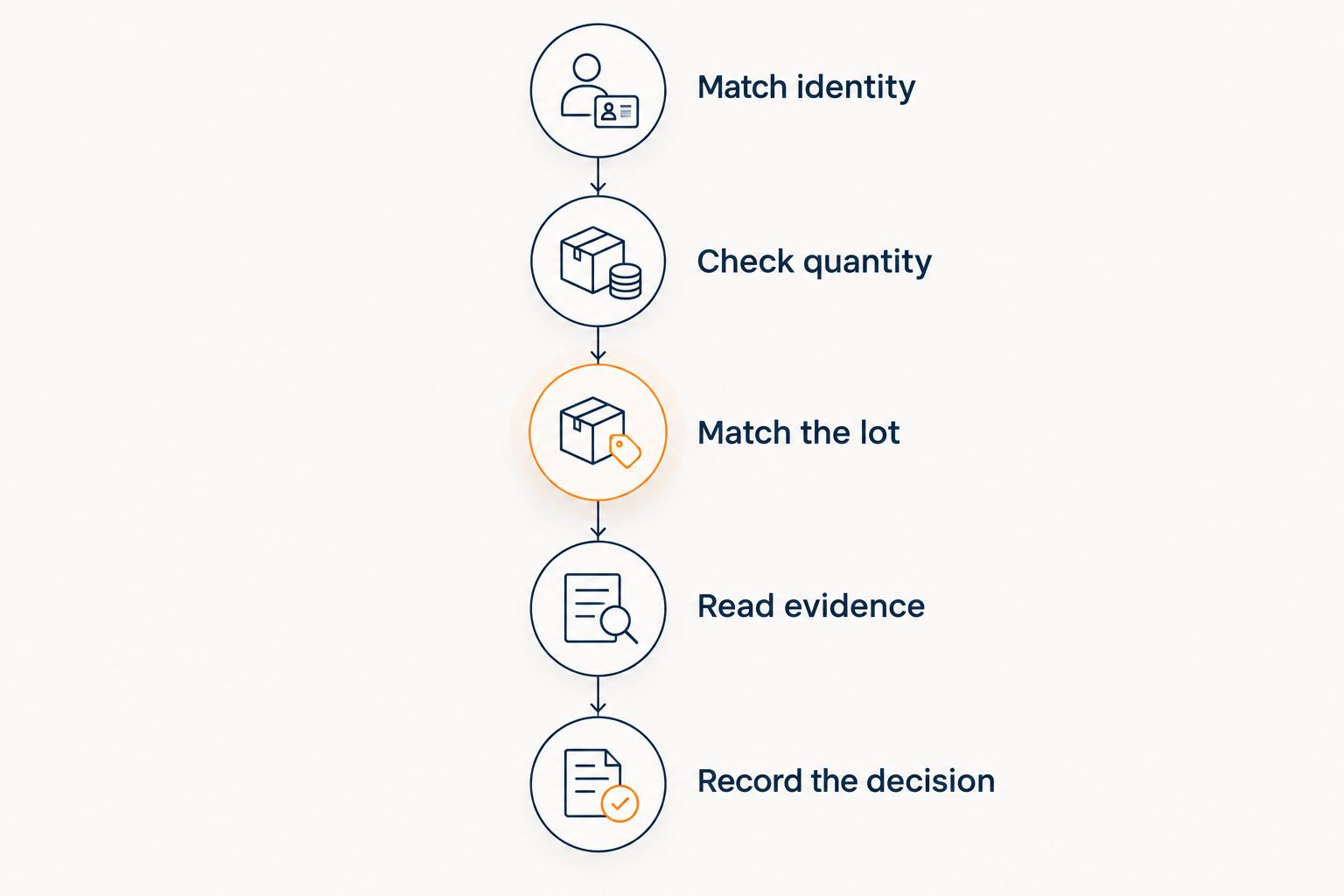
Use a fixed sequence before choosing between listings. The sequence matters: identity comes before quantity, and quantity comes before normalization.
- Match identity. Confirm that each listing describes the material your laboratory intends to study. Do not treat related names as interchangeable without checking the chemical description.
- Check quantity. Capture the declared amount and the basis used to express it. Keep the supplier’s original wording alongside your normalized field.
- Match the lot. Connect the certificate to the product and batch under consideration. A document for another lot cannot establish the results of the lot you are reviewing.
- Read evidence. Inspect the reported methods, sample identification, dates, and results. Separate the analytical findings from product-page language.
- Record the decision. Save the comparison and the reason your laboratory accepted or rejected the material for its intended research.
The result is a purchasing record another researcher can follow. It should show both the commercial comparison and the analytical reasoning, without suggesting that either one substitutes for the other.
What does HPLC evidence tell you?
High-performance liquid chromatography, or HPLC, separates sample components under specified analytical conditions. A reported chromatogram and its interpretation help you assess the chromatographic profile of the tested sample.
HPLC purity is not the same measurement as vial content. A chromatographic purity result does not, by itself, establish the total quantity of the named material inside a vial.
When reviewing an HPLC certificate, look for the sample identifier, the method information provided, the chromatogram, and the stated basis for the reported result. Read those items together rather than extracting a headline purity statement.
The strength of HPLC is separation-based evidence. Its limitation is that interpretation depends on the method, detector, sample preparation, and reporting basis; a peak-area result does not answer every composition question.
Your laboratory should decide which analytical attributes the experiment requires. If the purchase depends on a content measurement, request evidence that actually measures content rather than treating chromatographic purity as a substitute.
What does mass-spec identity add?
Mass spectrometry provides mass-related evidence used to assess a sample’s identity. It addresses a different analytical question from chromatographic separation, which is why reading both forms of evidence is useful.
Mass-spec identity does not establish every property of a research material. It does not, on its own, document total vial content, sterility, or suitability for a particular assay.
Review the sample identification and the interpretation presented on the certificate. Where a material contains a metal-associated component, such as GHK-Cu, ask whether the documented analysis addresses the chemical description relevant to your study rather than assuming every attribute follows from a matching name.
The advantage of mass-spec evidence is its contribution to identity assessment. The limitation is scope: a result supports the analytical question the method addresses, not every claim someone attaches to the product.
Why per-vial comparisons vary
Per-vial comparisons become unreliable when buyers combine different quantities, descriptions, or evidence standards. Before treating a difference as meaningful, check these factors:
- Declared amount: A vial count hides differences in the amount stated for each container. Normalize only after confirming the units and quantity basis.
- Chemical description: A shared shorthand name does not resolve every question about composition. Match the description to your laboratory’s requirement.
- Evidence scope: HPLC, mass spectrometry, and content measurements answer different questions. Compare the evidence your experiment needs rather than counting documents.
- Lot connection: A certificate is useful for a purchasing decision only when its relationship to the relevant material is clear. Keep that connection explicit.
- Order scope: Separate the material listing from any additional charges stated during the transaction. Preserve the complete order record for procurement.
These factors explain why a simple vial-to-vial comparison can mislead. They do not establish that a particular supplier’s commercial terms are better, or that a more expensive listing has stronger analytical support.
In a 2026 comparison, evaluate documentation directly. Neither a larger product description nor a more prominent certificate link replaces reading the underlying evidence.
Is cost per milligram more useful than cost per vial?
Per declared milligram is more useful when vial quantities differ and the quantity basis matches. Divide the current listing amount by the declared mass only after confirming that both listings describe comparable material.
The advantage is a consistent comparison unit. The limitation is that a normalized result still depends on the accuracy and meaning of the declared quantity; it is not an independent content assay.
Keep the original listing amount, declared mass, unit, and calculation basis in separate worksheet fields. That makes errors easier to identify and prevents a derived value from appearing more authoritative than its inputs.
Does a published COA make a GHK-Cu vial the better choice?
A published COA makes evidence accessible; it does not automatically make the material the better choice. The document must identify the relevant sample and report analyses that address your laboratory’s requirements.
Strandaminos research peptides are described as having published third-party HPLC and mass-spec COAs. That supports document review, but your laboratory still needs to check the specific certificate, lot relationship, and analytical scope before selecting material.
Treat an accessible certificate as a starting point. A purchasing decision becomes stronger when you can explain what the results establish—and what remains outside their scope.
What should you ask before placing a laboratory order?
Ask focused questions that resolve the comparison rather than requesting a general assurance of quality. A precise answer is easier to retain in a procurement record.
- Which certificate corresponds to the material being considered?
- How does the certificate’s sample identifier connect to the product lot?
- What does the declared vial quantity represent?
- Which reported method supports identity, and which supports chromatographic purity?
- Is there analytical evidence for any additional attribute your experiment requires?
Keep the answers with the listing and certificate. For your 2026 records, distinguish information supplied before the purchase from information verified after receipt.
Research use only. Not for human or veterinary use. Supplier documentation must not be interpreted as evidence of safety or efficacy in people or animals.
FAQ
What's the GHK-Cu research peptide cost per vial?
Use the current listing for the exact GHK-Cu vial you are evaluating. Compare its declared quantity, chemical description, and lot-specific documentation before treating it as equivalent to another listing.
Is comparing GHK-Cu by vial enough?
No, vial count alone does not establish an equivalent quantity or specification. Match the declared amount and material description before comparing listings.
Is cost per milligram better for comparing GHK-Cu?
Per declared milligram is useful when vial quantities differ and the quantity basis matches. The calculation normalizes the listing; it does not independently verify vial content.
Does HPLC purity show how much GHK-Cu is in a vial?
HPLC purity does not, by itself, establish total vial content. Review whether the documentation includes a separate measurement addressing the quantity your laboratory needs to verify.
Does mass spectrometry replace HPLC testing?
Mass spectrometry does not replace HPLC because the methods address different analytical questions. Review identity evidence and chromatographic evidence according to your experiment's requirements.
Where can I review Strandaminos research peptide documentation?
Strandaminos publishes third-party HPLC and mass-spec Certificates of Analysis for its research materials. Review the specific product certificate and its lot relationship rather than relying on a general testing statement.
Can a research-use-only GHK-Cu certificate establish suitability for human use?
No, a research-use-only certificate does not establish suitability for human or veterinary use. These materials are for laboratory research, not personal administration or therapeutic use.
One last thing
A correct calculation can still compare the wrong things. The most useful final check is not another decimal place: it is confirming that the numerator describes the same purchasing unit and the denominator describes the same quantity basis across your comparison.
Save that basis alongside the result. Your future laboratory record should explain the decision without requiring someone to reconstruct the original listing.


