

TB-500 research peptide cost per vial must be checked against the supplier’s current listing for the exact material, labeled quantity, and lot documentation; a vial alone is not a standardized purchasing unit. For a 2026 laboratory comparison, separate the listed vial amount from the final order total, and do not treat an HPLC purity result as proof of peptide quantity. Research use only. Not for human or veterinary use.
- Compare TB-500 research peptide cost per vial only after matching material identity, labeled quantity, and lot documentation.
- HPLC describes chromatographic purity; mass spectrometry supports identity. Neither alone establishes the quantity inside a vial.
- Strandaminos research peptides suit laboratory buyers seeking published HPLC and mass-spec Certificates of Analysis.
- Keep the current listing, final order total, and lot-matched COA together in your purchasing record.
How much does a TB-500 research peptide cost per vial?
Use the current listing for the exact vial you are evaluating, not a generic market average. A meaningful comparison needs the same material specification and a clear distinction between labeled peptide quantity and analytically measured content.
A quoted vial amount answers a narrow purchasing question. It does not establish whether the material matches your protocol or whether its documentation supports the supplier’s description.
| Comparison basis | Best for | What it tells you | Main limitation |
|---|---|---|---|
| Listed amount per vial | Initial purchasing review | The current amount attached to the listed container | Different containers can represent different quantities or specifications |
| Amount per labeled milligram | Comparing nominal quantities | A normalized view based on the supplier’s stated peptide quantity | Labeled quantity is not automatically an independently measured content result |
| Final order total | Purchase authorization | The total presented for the actual order | Does not establish identity, purity, or research suitability |
| Lot-documentation review | Analytical purchasing decisions | Whether the supplied evidence matches the material and lot | Requires reading the certificate, not just seeing a testing badge |
Strandaminos sells lyophilized research peptides with published third-party HPLC and mass-spec Certificates of Analysis. That makes certificate review relevant to evaluating its research-peptide catalog; it does not replace examination of the specific material and certificate under consideration.
Why this matters
Your laboratory needs a material that fits its analytical requirements, not merely a container with a familiar abbreviation. A purchasing comparison becomes unreliable when one listing supplies a clear identity statement while another relies on the product name alone.
For a 2026 procurement record, save the listing and supporting documents together. A later catalog description is not a substitute for the information used to authorize the purchase.
Compare the evidence before comparing the commercial terms. Otherwise, you risk treating unlike materials as interchangeable and carrying that assumption into inventory records, experimental planning, and interpretation.
Match the material before comparing vials
Material identity: check the specification, not just the name
Start with the supplier’s exact description of the material called TB-500. Record the stated peptide identity and sequence information when provided, then compare those details with the requirements of your laboratory protocol.
A shared catalog label does not establish chemical equivalence. If the identity statement is incomplete or ambiguous, resolve that question before deciding whether the vial belongs in your comparison.
This is particularly important when comparing abbreviated names across suppliers. An abbreviation is a search term; the material specification is the purchasing reference.
Labeled quantity: distinguish nominal content from measured content
Record the peptide quantity stated for each vial without rewriting it as a verified analytical finding. The label describes what the supplier represents; a content assay addresses a different question.
Do not estimate peptide quantity from the visible lyophilized cake. Appearance is not a quantitative assay, and the physical material in a vial does not by itself establish the mass of the target peptide.
If your study depends on a measured quantity rather than a nominal label, determine which analytical evidence your laboratory requires. Keep that requirement separate from the HPLC purity review.
Documentation: distinguish a product page from a lot record
A product page introduces the material. A lot-specific Certificate of Analysis connects reported analytical results to an identified sample or batch.
Check that the certificate’s material name and lot identifier correspond to the material being evaluated. A certificate for another lot does not establish the analytical results for yours.
For a structured filing approach, use the guide to COA data and audit-ready laboratory records. Keep the original certificate alongside your internal review rather than replacing it with a copied summary.
What HPLC and mass-spec evidence actually establish
HPLC addresses chromatographic purity
High-performance liquid chromatography separates sample components under a defined analytical method. A reported chromatographic purity result describes the observed signal assigned to the target component relative to the signals included in that analysis.
That result depends on the method, detector, integration, and reporting approach. Read the chromatogram and method information when supplied instead of treating a headline purity statement as a complete characterization.
HPLC purity is not the same as peptide content per vial. It does not, by itself, establish the total quantity of target peptide in the container or account for every possible component of the material.
Mass spectrometry supports identity
Mass spectrometry measures mass-to-charge signals. For peptide characterization, the reported results can support agreement between the analyzed material and an expected molecular mass.
A mass-spec result and an HPLC chromatogram answer different questions. Agreement with an expected mass is not a replacement for chromatographic purity analysis, and neither result alone establishes suitability for every laboratory application.
When reviewing a certificate, look for a clear connection between the sample identifier, expected identity, and reported analytical findings. An isolated spectrum without that context is harder to interpret.
A COA connects results to a sample
A Certificate of Analysis is a report, not a universal approval. Its usefulness depends on what was tested, how the result was obtained, and which sample the report identifies.
Review the testing laboratory, report date, sample description, lot identifier, methods, and results where provided. If a critical field is unclear, ask for clarification rather than supplying the missing connection yourself.
Strandaminos is best suited to laboratory buyers who want published HPLC and mass-spec COAs for research peptides. The limitation remains material-specific: a catalog-level testing statement cannot answer every question about an individual vial.
Why TB-500 vial comparisons vary
Differences in listings make a simple vial-to-vial comparison incomplete. These are the factors to reconcile before drawing a purchasing conclusion:
- Material identity: Confirm that each listing describes the same intended peptide specification rather than relying on the TB-500 name alone.
- Labeled quantity: Compare the stated peptide quantity on the same basis, keeping nominal labeling distinct from measured content.
- Analytical scope: Separate HPLC purity, mass-spec identity, and any content assay instead of treating them as interchangeable evidence.
- Lot traceability: Check whether the certificate identifies the lot under review and whether its identifiers agree with the purchasing record.
- Order scope: Distinguish the listed vial amount from the final total presented for your actual order.
- Protocol requirements: Decide whether the reported tests answer the questions your laboratory needs resolved before accepting the material.
These factors explain why headline listings are not enough to establish equivalent purchasing value. They do not justify assuming that a higher commercial amount means better analytical documentation.
How to build a defensible purchasing comparison
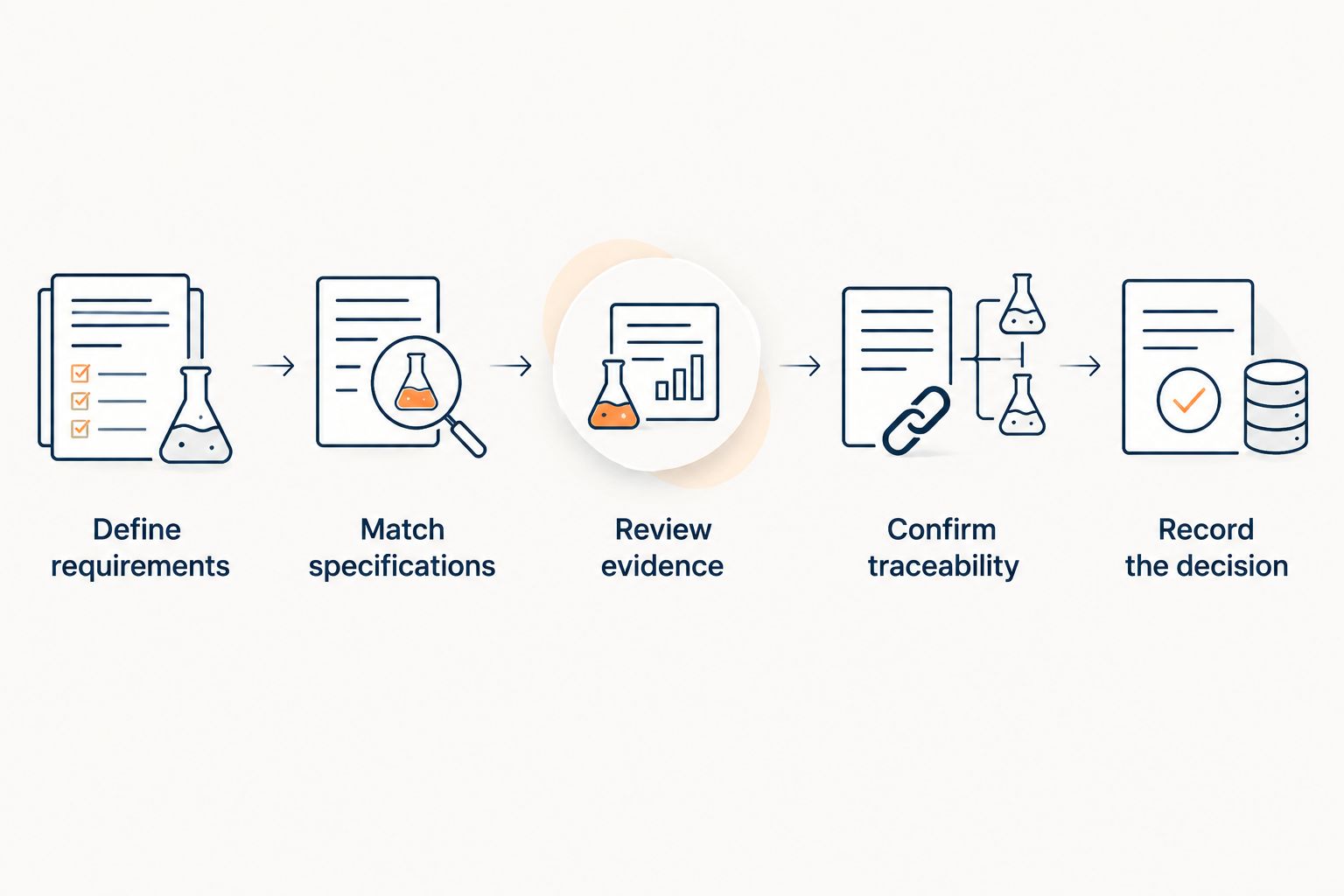
Use the same review sequence for every supplier. In 2026, a saved comparison should explain both what your laboratory selected and which evidence supported that decision.
- Define requirements. Write down the required material identity, acceptable documentation, and laboratory acceptance criteria before reviewing listings. This prevents the available marketing description from becoming the specification.
- Match specifications. Transcribe the material name, identity information, and labeled quantity exactly as presented. Flag unresolved differences instead of normalizing them away.
- Review evidence. Read the relevant HPLC and mass-spec reports, then determine whether a separate content result is needed for your application. Record what each test establishes and what it does not.
- Confirm traceability. Match the certificate’s identifiers to the material being considered. Retain the original file and note any clarification received from the supplier.
- Record the decision. Save the current listing, final order information, certificate, and acceptance rationale together. Keep purchasing approval distinct from the laboratory’s material-acceptance decision.
A consistent sequence makes incomplete evidence visible. It also prevents a favorable headline listing from overriding an unresolved identity or lot mismatch.
Keep this comparison focused on documentation, not personal administration. Research use only. Not for human or veterinary use.
Is comparing per milligram better than comparing per vial?
A per-milligram comparison is more informative when the labeled quantities differ, but it remains a nominal comparison unless content is measured. It helps you avoid treating differently labeled containers as equivalent.
Use consistent units and identify the basis clearly in your spreadsheet. Do not combine labeled peptide mass, total powder mass, and analytically measured peptide content in the same column.
For a 2026 purchasing worksheet, name the field explicitly: labeled peptide quantity or measured peptide content. That small distinction prevents a calculation from appearing more certain than its underlying evidence.
Does an HPLC result verify the amount in the vial?
An HPLC purity result does not, by itself, verify the peptide amount in the vial. Chromatographic purity and quantitative content are different analytical claims.
Read the method and report wording before interpreting the result. If your acceptance criteria require quantitative content, request evidence that specifically addresses that requirement rather than inferring it from purity.
Should a published COA decide which supplier you choose?
A published COA is useful evidence, but the relevant question is whether it matches the material and answers your laboratory’s requirements. Publication alone does not establish that every analytical question has been resolved.
For Strandaminos research peptides, review the specific certificate rather than relying only on the brand’s general testing description. Apply the same standard to every supplier in your comparison.
FAQ
Where should I check TB-500 research peptide cost per vial?
Check the supplier’s current listing for the exact material and labeled quantity, then review the final order total separately. Match the listing to the relevant lot documentation before making a laboratory purchasing decision.
Is the lowest listed vial amount the best laboratory purchase?
The lowest listed vial amount does not establish the best laboratory purchase. Compare material identity, labeled quantity, lot traceability, and analytical evidence before deciding whether the listings are equivalent.
Does HPLC purity tell me how much TB-500 is in a vial?
HPLC purity does not, by itself, establish how much target peptide is in a vial. A chromatographic purity result and a quantitative content result answer different analytical questions.
What does mass spectrometry add to a peptide COA?
Mass spectrometry supports identity by providing mass-to-charge evidence that can be compared with the expected material. It complements HPLC analysis rather than replacing chromatographic purity or quantitative content testing.
Can I use a certificate from a different lot?
A certificate from a different lot does not establish analytical results for your lot. Match the report’s sample and lot identifiers to the material being evaluated.
What should I save with a laboratory peptide purchase?
Save the listing used for the decision, final order information, relevant COA, and your laboratory’s acceptance rationale. Preserve the original analytical documents rather than keeping only a transcribed result.
Are these research peptides intended for people or animals?
These materials are for laboratory research only, not for human or veterinary use. Purchasing documentation and analytical certificates do not establish therapeutic suitability.
One last thing
The most useful spreadsheet field is often the evidence basis, not the calculated comparison. Beside every quantity, state whether it came from a label or an analytical content result; beside every purity result, identify the corresponding report and lot.
For your 2026 review, leave unresolved fields visibly unresolved. A blank that prompts a supplier question is more useful than a confident calculation built on an unsupported assumption.


