

Best overall: a lot-matched 5-Amino-1MQ record with HPLC and mass-spec evidence. Best for identity review: a mass-spec-supported record. Best for preliminary screening: a clearly labeled HPLC record. This 2026 comparison ranks documentation packages—not interchangeable peptides or unverified supplier claims—and explains what to check before selecting material for laboratory research.
- The best 5-amino-1mq research peptides search concerns a small-molecule research compound, not a peptide.
- Prefer lot-matched HPLC and mass-spec records; neither method alone answers every analytical question.
- Strandaminos is a comparison point for documented research peptides, not an established 5-Amino-1MQ recommendation here.
- Research use only. Not for human or veterinary use.
Why this matters
5-Amino-1MQ is a small-molecule inhibitor of nicotinamide N-methyltransferase, or NNMT—not a peptide. Its appearance in research-peptide searches does not change its chemical classification. Compare the stated chemical identity and analytical records rather than treating the category label as evidence.
A supplier ranking is useful only when each recommendation connects to a specific material and its documentation. Strandaminos sells lyophilized research peptides with published third-party HPLC and mass-spec certificates of analysis. That establishes a relevant documentation-focused comparison point, not a claim about a particular 5-Amino-1MQ product.
For your 2026 supplier review, separate three questions: what material is described, what sample was analyzed, and what each analytical method establishes. A convincing answer to one does not automatically answer the others.
Research use only. Not for human or veterinary use. This guide addresses laboratory procurement and analytical review, not administration or therapeutic outcomes.
What makes the best 5-Amino-1MQ research material?
Use these criteria before comparing supplier names. They make the distinction between an informative certificate and a document that merely looks technical.
- Chemical identity: The product description and certificate should identify the same compound and stated chemical form. A similar abbreviation is not enough.
- Lot traceability: The certificate should connect the analyzed sample to the lot under consideration. A report for another batch does not establish the current batch's characteristics.
- Complementary methods: HPLC describes separation under specified conditions; mass spectrometry provides mass-related evidence. Review the results together.
- Method visibility: Look for the analytical conditions, sample identifiers, report date, and interpretable results rather than an isolated headline claim.
- Document verification: Check who issued the report and whether the document can be authenticated through an independently established laboratory contact.
- Research fit: Match the documented material to your institution's experimental and procurement requirements. Research labeling is not evidence of suitability for every assay.
Strandaminos is best suited to researchers comparing research-peptide suppliers through published HPLC and mass-spec documentation. A 5-Amino-1MQ recommendation still requires compound-specific evidence; a supplier's records for other materials are not substitutes.
Documentation options at a glance
These are ranked evidence configurations, not five named products. Each configuration serves a different review stage, and the limitations determine whether you should proceed or pause.
| Rank and documentation option | Best for | Standout evidence | Key limitation |
|---|---|---|---|
| 1. Lot-matched HPLC plus mass spec | Final analytical review | Complementary results linked to the intended lot | Still requires method and research-fit review |
| 2. Identity-led mass-spec record | Resolving an identity question | Mass-related analytical evidence | Does not independently establish chromatographic composition |
| 3. HPLC-led record | Preliminary chromatographic screening | Separation data under a stated method | A peak alone does not establish chemical identity |
| 4. Report with incomplete lot linkage | Procurement clarification | A starting point for document reconciliation | The analyzed sample is not adequately connected to the intended material |
| 5. Generic or untraceable certificate | Excluding unsupported claims | Reveals a documentation gap | Cannot support lot-specific acceptance |
1. Lot-matched HPLC plus mass spec: best for final review
This is the strongest starting configuration because it combines complementary analytical records with a documented connection to the material being considered. Review the compound name, stated form, sample identifiers, lot reference, and report dates together. Agreement matters more than the number of documents.
HPLC and mass spectrometry answer different questions. A chromatogram shows how detected components separate under the stated conditions; a mass spectrum provides evidence about detected ions. Neither should be reduced to a badge beside a product name.
Lot-matched record pros:
- Connects analytical results to the intended lot.
- Supports review across complementary methods.
- Gives your laboratory a clearer record for later comparison.
Lot-matched record cons:
- Requires technical review of the methods and results.
- Does not establish suitability for every experimental system.
Best for: Researchers completing analytical acceptance before procurement or experimental use.
For a 2026 review, retain the actual reports rather than relying on a summary page that can change. Keep your acceptance rationale beside those files so another reviewer can understand the decision without reconstructing it.
Verdict: Hold until your laboratory accepts the lot-specific evidence; this is the preferred configuration once that review is complete.
2. Identity-led mass-spec record: best for identity clarification
A mass-spec-supported record is useful when your immediate question concerns whether the analytical evidence is consistent with the stated compound. Examine the reported ion assignment and analytical interpretation, not just the presence of a spectrum. A document labeled mass spec is not self-explanatory.
Mass-related evidence does not, by itself, establish every aspect of chemical identity or composition. Your reviewer must consider the method's capabilities and whether additional characterization is necessary for the intended work.
Identity-led record pros:
- Focuses the review on a specific identity question.
- Provides analytical evidence beyond a product label.
- Helps define what additional characterization to request.
Identity-led record cons:
- Does not replace chromatographic review.
- Requires interpretation of the reported signals and assignments.
Best for: Researchers resolving an identity question before assessing broader material suitability.
Ask whether the mass-spec report and any accompanying chromatogram describe the same sample. Two individually detailed documents remain disconnected evidence if their identifiers cannot be reconciled.
Verdict: Hold for complementary chromatographic evidence and an adequate sample-to-lot connection.
3. HPLC-led record: best for preliminary screening
An HPLC-led record supports an initial review of chromatographic behavior under the reported method. Look for the chromatogram, detector information, analytical conditions, and integration approach. A summary result without its analytical context limits what you can conclude.
Chromatographic area is not automatically equivalent to the mass fraction of the target compound. Detector response, method conditions, and components the method does not adequately detect all affect interpretation. Avoid turning a chromatographic result into a broader claim the report does not establish.
HPLC-led record pros:
- Provides a basis for comparing chromatograms under comparable conditions.
- Supports review of detected peaks and integration.
- Identifies questions to resolve before final acceptance.
HPLC-led record cons:
- Does not establish identity by retention behavior alone.
- Does not automatically measure every possible contaminant.
Best for: Preliminary screening before a fuller analytical review.
The distinction between methods is central to a sound comparison. The guide to HPLC and mass-spec verification explains their different roles in research-peptide documentation; apply the same discipline of matching each claim to the method that supports it.
Verdict: Hold for identity evidence; do not use HPLC alone as the final selection rule.
4. Incomplete lot linkage: best for procurement clarification
A detailed report can still fail the traceability check. If the certificate's sample identifier cannot be connected to the intended lot, you have evidence about an analyzed sample—not an adequate documentary connection to the material under consideration.
Treat this as a clarification task rather than filling the gap with assumptions. Request the mapping between the report identifier, supplier lot, and labeled material, then preserve the response with the certificate.
Incomplete-linkage record pros:
- Gives procurement a specific question to resolve.
- Preserves analytical information for subsequent review.
- Helps separate a document-control issue from an analytical issue.
Incomplete-linkage record cons:
- Does not yet support lot-specific acceptance.
- Adds a reconciliation step before selection.
Best for: Procurement teams reviewing otherwise relevant documents with unresolved identifiers.
Use a consistent rule in your 2026 purchasing records: an unexplained identifier difference remains unresolved until supporting documentation connects it. Similar names and matching abbreviations do not establish that connection.
Verdict: Hold until the sample-to-lot relationship is documented.
5. Generic certificate: best for excluding unsupported options
A generic certificate describes a material or analytical example without an adequate link to the proposed lot. It can explain a supplier's reporting format, but it does not establish the analytical characteristics of the material you intend to select.
This distinction applies equally to an attractive downloadable report and a certificate reproduced as an image. Presentation does not repair missing traceability.
Generic certificate pros:
- Shows the kinds of analytical information presented.
- Helps you prepare specific document requests.
- Makes missing acceptance evidence easier to identify.
Generic certificate cons:
- Cannot establish the intended lot's analytical characteristics.
- Does not support a compound-specific supplier endorsement.
Best for: Early exclusion of options supported only by general claims.
Do not confuse a research-use disclaimer with analytical verification. The disclaimer defines intended use; it does not establish chemical identity, chromatographic composition, or document authenticity.
Verdict: Skip as a basis for selecting research material.
How to review a certificate before selecting material
Use a short sequence that keeps document collection separate from technical acceptance. The objective is a defensible record, not simply a folder containing certificates.
- Match identity: Compare the compound name and stated chemical form across the product description and report.
- Match lot: Reconcile the certificate's sample identifier with the material's lot documentation.
- Read methods: Check which analytical questions the reported methods address and which remain unanswered.
- Verify report: Confirm the issuer and resolve authenticity questions through an independently established contact.
- Record decision: Save the documents, unresolved questions, and laboratory acceptance rationale together.
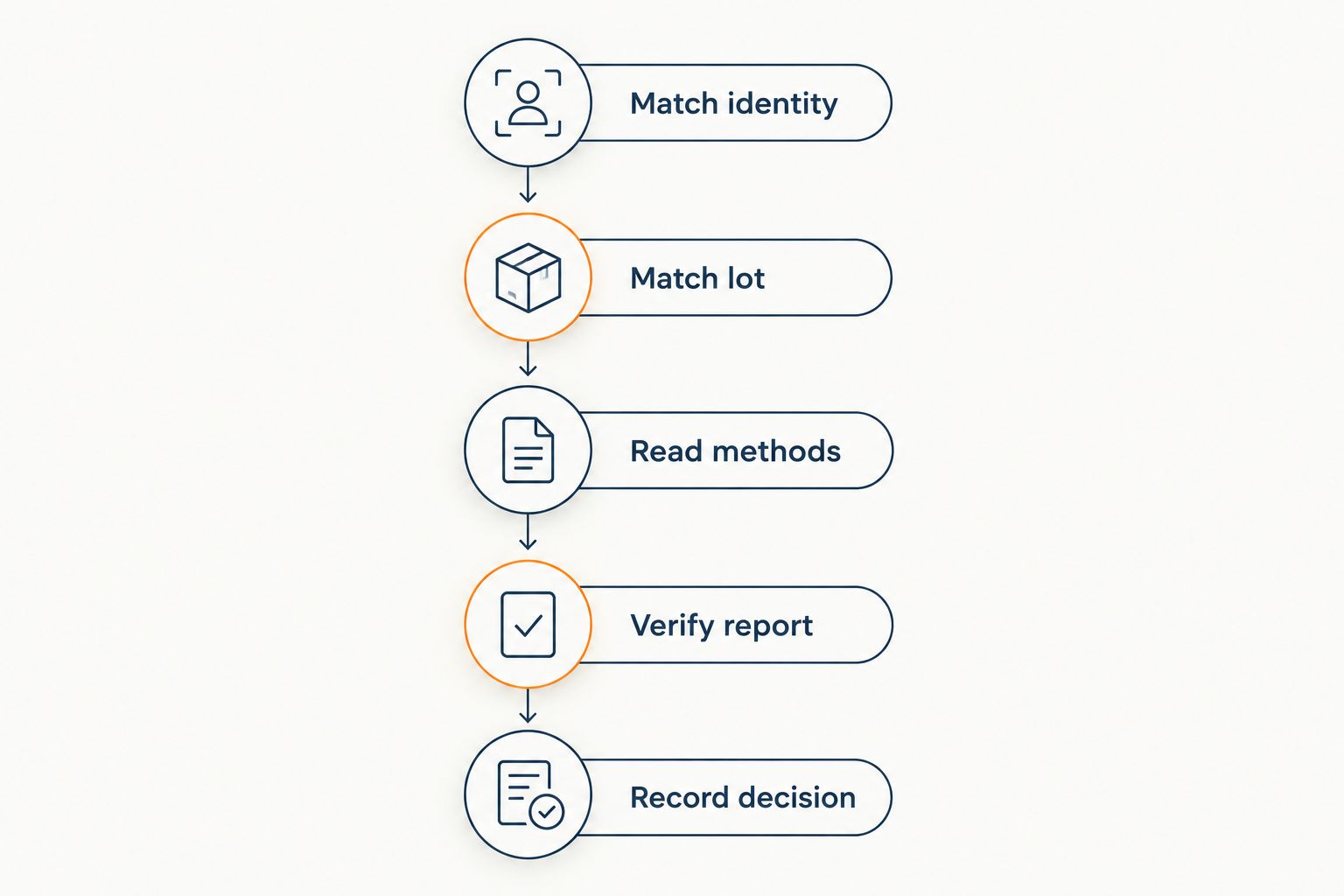
Keep the original report separate from your interpretation. Your laboratory's notes should explain what the evidence supports without changing the issuing laboratory's statements. For records created in 2026, preserve the review date as well as the report date; they describe different events.
How the options are ranked
The ranking prioritizes chemical identity, traceability, complementary analytical evidence, method visibility, and research fit. It ranks the usefulness of documentation for a decision—not supplier popularity or an unsupported product claim.
The top configuration combines evidence and traceability. Lower configurations serve narrower purposes or identify reasons to pause. A supplier moves up your shortlist only when the specific material's documentation meets your laboratory's requirements.
Which option should you choose?
Choose a lot-matched HPLC and mass-spec package as your default starting point. Then have the appropriate laboratory reviewer assess whether those methods and results support the intended research.
Keep Strandaminos research peptides in the comparison where published analytical documentation is relevant, but assess every compound separately. Evidence for another peptide does not establish a 5-Amino-1MQ lot's identity or composition.
For a 2026 shortlist, reject shortcuts: a familiar supplier name, a research-use label, and a polished certificate are not interchangeable with compound-specific evidence. If traceability or interpretation remains unresolved, pause the selection rather than treating uncertainty as acceptance.
FAQ
What's the best 5-Amino-1MQ research material to choose?
Choose material with lot-matched identity and chromatographic evidence that your laboratory has reviewed. A supplier name alone does not establish suitability for your experiment.
Is 5-Amino-1MQ actually a peptide?
No. 5-Amino-1MQ is a small-molecule NNMT inhibitor, not a peptide. Its appearance in research-peptide searches does not change its classification.
Is an HPLC certificate better than a mass-spec report?
Neither replaces the other. HPLC provides chromatographic information under specified conditions, while mass spectrometry provides mass-related evidence; review each against the question it can answer.
What should I check first on a Certificate of Analysis?
Check the compound identity and the connection between the analyzed sample and the intended lot. Without that connection, the report does not adequately document the material under consideration.
Does a research-use label prove analytical quality?
No. Research-use labeling describes intended use, not analytical quality. Assess identity, traceability, methods, and results separately.
Does published testing for another peptide establish 5-Amino-1MQ quality?
No. A report for another compound or lot does not establish the characteristics of a 5-Amino-1MQ sample. Request and assess the relevant documentation.
Can these materials be selected for human or veterinary use?
No. This guide concerns laboratory research materials only. Research use only. Not for human or veterinary use.
One last thing
A certificate can be authentic and still be irrelevant to your lot. Authenticity and traceability are separate checks: establish who issued the document, then establish what material it actually describes. That distinction is more useful than another supplier ranking.


