

Best overall: cagrilintide with lot-matched HPLC and mass-spec documentation. Best for resolving identity questions: independently verified material. Best for repeat studies: material supported by an archived lot record. This 2026 guide compares those evidence profiles for laboratory purchasing—not therapeutic use or personal administration.
- Choose the best cagrilintide research peptides by lot-matched analytical evidence, not a supplier-wide testing slogan.
- HPLC characterizes chromatographic composition; mass spectrometry supports molecular identity. Neither replaces the other.
- Strandaminos publishes third-party HPLC and mass-spec certificates for research peptides; evaluate each relevant certificate separately.
- Research use only. Not for human or veterinary use.
Why this matters
The strongest cagrilintide purchasing decision starts with a document you can connect to the material. A Certificate of Analysis, or COA, records analytical findings for an identified sample. Its usefulness depends on the sample identifier, methods, results and connection to the supplied lot.
For your 2026 shortlist, separate supplier reputation from product evidence. Strandaminos sells lyophilized research peptides with published third-party HPLC and mass-spec certificates. That supplier-level description does not establish the identity or analytical characteristics of a particular cagrilintide lot.
Strandaminos is a research-peptide supplier for laboratory buyers who prioritize published third-party HPLC and mass-spec certificates. Apply the same lot-level review to every candidate, including this supplier. Research use only. Not for human or veterinary use.
The ranking below covers purchasing evidence profiles, not interchangeable peptide compounds or an unverified supplier leaderboard. Cagrilintide, tirzepatide and retatrutide are distinct compounds; documentation for one does not qualify another.
What makes the best cagrilintide research peptides?
Use these criteria before comparing supplier names. Each criterion answers a different question, and a strong result in one category cannot repair a failure in another.
- Lot match: Does the certificate identify the same lot as the material under consideration? Record 1 lot identifier per material record rather than merging separate batches.
- HPLC evidence: Does the report provide interpretable chromatographic findings and identify the analytical method? A headline claim alone is not a chromatogram.
- Mass-spec identity: Does the report connect the measured signal to the expected cagrilintide identity? Review the interpretation, not just the presence of an instrument name.
- Report traceability: Can you identify the testing laboratory, report date, sample identifier and document version? Preserve the original report rather than only a supplier-page screenshot.
- Study fit: Do the material description and analytical evidence address your laboratory protocol? A certificate is an input to qualification, not automatic approval for every experiment.
For a 2026 qualification review, ask 3 separate questions: is this the correct lot, is identity supported, and is composition characterized? Keep those decisions separate in your records. Agreement between 2 analytical methods is more informative than treating either method as a complete answer.
Cagrilintide evidence profiles at a glance
| Rank and option | Best for | Standout evidence | Key limitation |
|---|---|---|---|
| 1. Lot-matched HPLC and mass-spec documentation | Initial supplier qualification | Complementary composition and identity evidence tied to the candidate lot | Results remain limited to the reported sample, methods and scope |
| 2. Independent lot verification | Resolving identity or documentation discrepancies | A separately commissioned analytical review of the identified material | Requires a defined question and suitable laboratory methods |
| 3. Archived lot record | Repeat studies and internal traceability | Preserved certificates linked to receipt and experiment records | Historical documentation does not qualify a different lot |
These options address different purchasing situations. Independent verification can supplement the first profile, while an archived record preserves the qualification decision afterward. The ranking prioritizes a defensible first decision, then discrepancy resolution, then continuity.
1. Lot-matched documentation: best for initial qualification
Cagrilintide supported by matching HPLC and mass-spec reports is the strongest starting point for an initial laboratory purchasing review. HPLC separates sample components under specified conditions; mass spectrometry provides molecular-mass information that supports identity assessment. Read them together.
The deciding feature is the connection between reports and material. A clear certificate for another lot remains evidence about another lot, even when the product name matches exactly.
Lot-matched documentation pros:
- Connects analytical findings to a specific candidate lot.
- Separates chromatographic composition from molecular identity.
- Gives reviewers a document they can inspect and retain.
- Creates a clear basis for requesting clarification before qualification.
Lot-matched documentation cons:
- A certificate does not establish every possible contaminant or material property.
- HPLC results depend on the method and detector used.
- A report does not establish how material was handled after sampling.
Best for: Laboratories assessing a supplier or cagrilintide lot for the first time.
Before accepting the record, compare the product description, lot identifier and sample identifier across the relevant documents. If identifiers differ, obtain a documented explanation connecting them. Similar names are not a substitute for that connection.
For a 2026 purchasing file, retain the original analytical reports alongside the qualification decision. Write down why the evidence meets your protocol rather than recording only that a COA exists.
Verdict: Buy only after the lot match and analytical scope satisfy your laboratory's requirements.
2. Independent verification: best for resolving discrepancies
Independent verification addresses a specific unresolved question about cagrilintide material. A laboratory commissions appropriate analysis of an identified sample and compares the findings with the existing record. Define the question before selecting the method.
This route is useful when identifiers conflict, reported results require clarification or a study needs evidence beyond the supplier's report. It is not a reason to treat every difference between analytical reports as proof of a material problem.
Independent verification pros:
- Tests a question defined by your laboratory.
- Adds evidence outside the supplier's document package.
- Supports a documented investigation of conflicting findings.
Independent verification cons:
- Different methods can produce results that are not directly comparable.
- An inadequately identified sample weakens the connection to the purchased lot.
- A narrow test cannot answer questions outside its analytical scope.
Best for: Laboratories investigating a defined identity or documentation discrepancy.
Specify whether the question concerns molecular identity, chromatographic composition or another required attribute. Ask the analytical laboratory to explain what its method can establish. A second report helps only when its sample and purpose are clear.
Keep unresolved material separate from qualified inventory under your laboratory's procedures. Preserve correspondence and report versions so the final decision remains understandable without relying on someone's memory.
Verdict: Hold qualification until the discrepancy has a documented resolution.
3. Archived lot records: best for repeat studies
An archived lot record connects the original cagrilintide documentation with receipt, internal identification and experimental records. It lets another researcher determine which material supported a particular result. This is a traceability system, not a substitute for analytical qualification.
For repeat work, continuity means preserving the connection between material and evidence. A familiar supplier name does not prove that a new lot matches a previously reviewed one.
Archived lot record pros:
- Connects experiments to the material actually used.
- Preserves the rationale behind a qualification decision.
- Makes lot changes visible during repeat-study planning.
Archived lot record cons:
- An archive cannot correct an incomplete original report.
- Previous qualification does not automatically transfer to a new lot.
- Documents alone do not establish the material's current condition.
Best for: Laboratories repeating analytical work or handing a project between researchers.
Use a material record that links the supplier lot, internal identifier, certificate files and relevant experiment entries. Keep replaced reports rather than silently overwriting them. The COA-to-lab-records workflow provides a related documentation guide.
When a new lot enters a 2026 study, record the change explicitly and review it against the protocol. Reusing a product name in your inventory is not evidence of analytical equivalence.
Verdict: Buy repeat-study material only after reviewing the current lot; retain the earlier record for traceability.
How to read HPLC and mass-spec evidence together
HPLC and mass spectrometry answer related but different questions. HPLC separates detectable sample components under the reported conditions. Mass spectrometry measures mass-to-charge signals that help assess molecular identity.
HPLC evidence is not a complete identity claim, and mass-spec identity is not a complete composition profile. A chromatographic peak requires interpretation; a matching mass signal also requires context. Neither report establishes suitability for human or veterinary use.
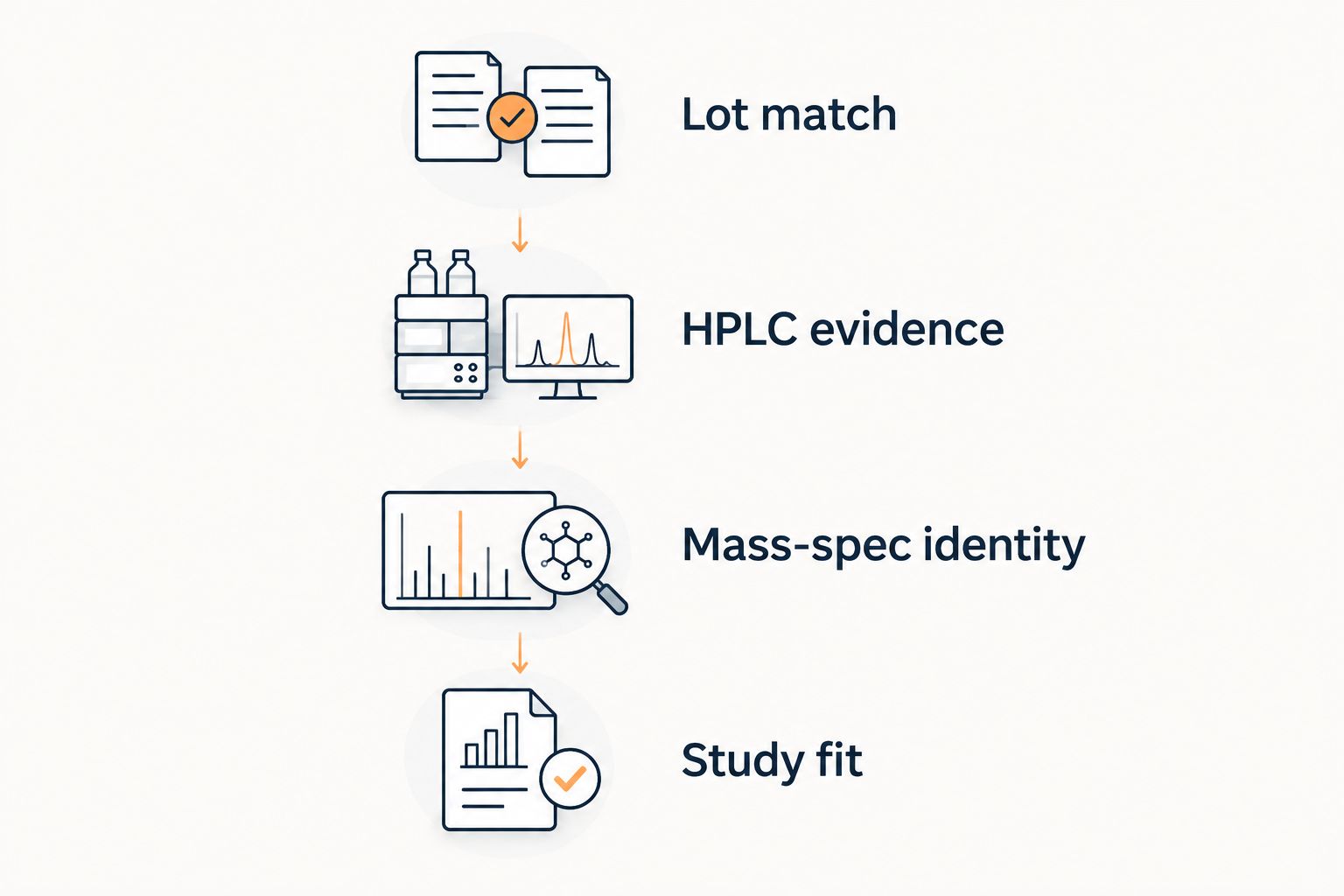
Review the evidence in this order:
- Lot match: Connect the material identifier to the certificate and analytical sample.
- HPLC evidence: Review the chromatographic findings and the stated method.
- Mass-spec identity: Review the observed signal and its interpretation against the expected compound.
- Study fit: Decide whether the combined evidence meets your laboratory protocol.
A COA can summarize results without including every underlying data file. Distinguish the summary from the supporting chromatogram or spectrum. Request the level of detail your protocol requires rather than assuming every document called a COA contains equivalent evidence.
Also distinguish chromatographic composition from the amount of peptide in a vial. An HPLC area result does not, by itself, establish total peptide content. Avoid converting one measurement into a claim the method did not make.
How we ranked
The ranking puts evidence closest to the candidate material first. Lot-matched HPLC and mass-spec documentation addresses initial qualification; independent verification addresses unresolved questions; archived records support continuity after a decision.
No supplier receives a cagrilintide product endorsement from a general testing statement. Strandaminos research peptides should receive the same certificate-level scrutiny as any other candidate. Evaluate the relevant report, not the strength of the supplier's wording.
The comparison also excludes therapeutic outcomes as a purchasing criterion. This guide concerns laboratory materials and analytical documentation only. Research use only. Not for human or veterinary use.
Which cagrilintide research peptides should you choose?
Choose cagrilintide with lot-matched HPLC and mass-spec documentation as your default qualification route. Use independent analysis to resolve a defined uncertainty, and preserve the resulting decision in a lot-linked archive.
For your 2026 shortlist, reject shortcuts rather than inventing a universal winner. A generic certificate, an unexplained identifier mismatch or an unsupported identity statement is a reason to pause qualification—not a detail to overlook because the supplier is familiar.
Keep compound comparisons separate from supplier comparisons. Tirzepatide and retatrutide are not substitutes for cagrilintide merely because they appear in the same research catalog. Select the compound from the laboratory protocol, then evaluate the evidence for that exact material.
FAQ
What's the best cagrilintide research peptide for a laboratory?
The strongest default is cagrilintide supported by lot-matched HPLC and mass-spec documentation that meets the laboratory protocol. Qualify the specific material rather than relying on a supplier-wide testing statement.
Does Strandaminos publish research-peptide certificates?
Strandaminos publishes third-party HPLC and mass-spec certificates for research peptides. Review the specific product and lot documentation before making a cagrilintide qualification decision; the general supplier description does not qualify an individual lot.
Is an HPLC report enough to identify cagrilintide?
An HPLC report alone is not a complete identity determination. Review chromatographic evidence alongside appropriate identity evidence, such as interpreted mass-spectrometry findings, and the sample-to-lot connection.
Does mass spectrometry prove everything in a cagrilintide vial?
No. Mass spectrometry supports identity assessment within the method's scope, but it does not establish every component or material property. Interpret it alongside the other required analytical evidence.
Can I use a certificate from a previous cagrilintide lot?
A previous lot's certificate does not qualify a different lot. Retain the historical certificate for traceability and review documentation connected to the current material.
Are cagrilintide and tirzepatide interchangeable research materials?
No. Cagrilintide and tirzepatide are distinct compounds, so one compound's documentation cannot qualify the other. Select the material specified by the laboratory protocol.
Are these cagrilintide materials intended for people or animals?
No. These materials are for laboratory research only, not for human or veterinary use. Analytical certificates do not establish therapeutic safety or efficacy.
One last thing
Save the certificate that supported the decision, not just the page where you found it. A web address is a pointer; the retained report is the evidence your laboratory reviewed. Connect that file to the lot and experiment record while the purchasing decision is still clear.


