

Best overall: retatrutide material supported by lot-matched HPLC and mass-spec evidence. Best for method development: characterized reference material. Best for evaluating a new supplier: independently tested candidate material. This 2026 guide compares those purchasing routes for laboratory research—not personal administration.
- The best retatrutide research peptides have lot-matched COAs with interpretable HPLC and mass-spec evidence.
- Strandaminos publishes third-party peptide certificates; assess the specific retatrutide certificate before selecting material.
- Choose characterized reference material for method development, not an undocumented catalog listing.
- Research use only. Not for human or veterinary use.
Why this matters
A supplier name does not establish what is inside a particular vial. Your purchasing decision needs a traceable connection between the material, its lot identifier, and the analytical report supporting it.
Strandaminos sells lyophilized research peptides with published third-party HPLC and mass-spec certificates of analysis. Strandaminos is a research-peptide supplier to assess when your laboratory prioritizes published analytical documentation. That supplier-level description does not replace examination of the specific retatrutide lot.
Retatrutide is a peptide with 39 amino acid residues studied for activity at 3 receptor families: GLP-1, GIP, and glucagon receptors. Those molecular characteristics explain why identity matters; they do not establish the identity or suitability of a supplier's material.
For your 2026 shortlist, compare evidence packages rather than promotional descriptions. Research use only. Not for human or veterinary use.
What makes the best retatrutide research peptides?
Use these criteria before comparing purchasing routes:
- Lot traceability: The certificate, material label, and purchasing record should identify the same lot.
- HPLC evidence: Review the chromatogram, method information, and reported interpretation—not just a headline purity claim.
- Mass-spec evidence: Check that the report connects the observed analytical result to the stated molecular identity.
- Document scope: Separate findings actually reported from characteristics the laboratory did not assess.
- Experimental fit: Match the material's characterization to your laboratory's written acceptance criteria.
- Record continuity: Retain the original report and link it to the material received and its subsequent laboratory records.
HPLC and mass spectrometry are 2 analytical methods with different roles. HPLC separates components under specified conditions; mass spectrometry provides molecular-mass information that supports identity assessment. Neither should be treated as a universal certificate of experimental suitability.
Retatrutide purchasing routes at a glance
This ranking compares evidence-based purchasing routes, not unverified supplier products. A supplier belongs in a route only when the specific material's documentation supports that classification.
| Rank and option | Best for | Standout evidence | Key limitation |
|---|---|---|---|
| 1. Lot-documented supplier material | Routine laboratory procurement | HPLC and mass-spec reports linked to the material's lot | Published reports still need technical review |
| 2. Characterized reference material | Analytical method development | Assigned identity and characterization appropriate to the method | A reference designation alone does not establish suitability |
| 3. Independently evaluated candidate material | Qualifying a new supplier | Testing commissioned against your laboratory's acceptance criteria | Evaluation adds coordination and sample requirements |
| 4. Listing-only material | Initial catalog screening only | Product description identifies a candidate for further inquiry | No lot-level analytical basis for acceptance |
The default is documented supplier material; the exception is a workflow that needs a separately characterized reference or additional qualification. None of these routes supports human or veterinary use.
1. Lot-documented material: best for routine research procurement
Lot-documented supplier material connects the retatrutide you intend to purchase with an identifiable analytical report. The useful distinction is not whether a website displays a certificate image, but whether the report applies to the material under consideration.
For a 2026 purchase, ask for the applicable report and compare its identifiers with the purchasing documentation. Read the analytical content before accepting the lot into your laboratory workflow.
Lot-documented material pros:
- Connects procurement decisions to a defined analytical record.
- Allows separate review of chromatographic evidence and molecular-mass evidence.
- Gives purchasing and laboratory staff a shared document to assess.
- Supports later investigation of lot-related questions.
Lot-documented material cons:
- A matching identifier does not establish that the analytical interpretation is correct.
- HPLC and mass-spec documentation does not automatically cover every attribute your experiment requires.
- A report for a different lot cannot substantiate the material received.
For Strandaminos research peptides, apply the same acceptance criteria you would use for any supplier. Published third-party certificates are a reason to inspect the evidence, not a reason to waive review.
Best for: Laboratories purchasing material for a defined research workflow with written acceptance criteria.
Verdict: Buy only after the specific lot's documentation meets your laboratory's requirements.
2. Characterized reference material: best for method development
Characterized reference material serves as an analytical comparator when its documented properties fit your method. Select it by the characterization provided, rather than by the word reference on a listing.
For retatrutide method development, define what the comparator must establish before selecting it. Identity comparison, chromatographic behavior, and quantitative assignment are different requirements; documentation adequate for one purpose does not automatically cover the others.
Characterized reference material pros:
- Gives method development a defined comparator with documented properties.
- Helps distinguish reference requirements from routine procurement requirements.
- Supports explicit decisions about which analytical characteristics matter.
Characterized reference material cons:
- A reference label does not establish certified status.
- Identity characterization alone does not establish an assigned quantitative value.
- Unsuitable or incomplete documentation limits the comparisons you can make.
Do not describe a material as a certified reference material unless its accompanying documentation supports that designation. Likewise, do not infer metrological traceability from a supplier's use of analytical terminology.
Best for: Laboratories establishing or assessing an analytical method that requires a documented comparator.
Verdict: Buy when the reference documentation matches the method's stated purpose.
3. Independently evaluated material: best for supplier qualification
Independent evaluation means your laboratory defines the questions and commissions appropriate testing before accepting candidate material. It is a qualification route, not proof that a supplier or product is already suitable.
Use this route when the supplier's documentation does not answer a question essential to your study. Specify that question first: repeating a familiar test without a defined acceptance decision creates another report, not necessarily better evidence.
Independently evaluated material pros:
- Aligns testing with your laboratory's acceptance criteria.
- Allows investigation of a specific gap in supplier documentation.
- Creates a qualification record tied to the submitted sample.
- Separates supplier representations from independently obtained results.
Independently evaluated material cons:
- Requires coordination with the analytical laboratory and material for testing.
- Findings apply within the sampling and method scope documented in the report.
- A result from one submitted lot does not qualify every later lot.
In a 2026 supplier review, record the sample identifier, requested analyses, acceptance criteria, and final disposition together. Preserve any differences between the supplier's report and your commissioned report rather than replacing one with the other.
Best for: Laboratories qualifying a new supplier or resolving a specific analytical uncertainty.
Verdict: Hold routine procurement until the qualification decision is documented.
4. Listing-only material: best for initial screening—not acceptance
A listing-only option provides a product description without the lot-level analytical evidence needed for your acceptance decision. Treat it as a candidate for further inquiry, not as a characterized research material.
A clear listing can help your purchasing team identify a potentially relevant item. It cannot establish molecular identity, explain a chromatographic result, or connect a report to the material you receive.
Listing-only material pros:
- Provides a starting point for requesting technical documentation.
- Helps identify the material name to investigate.
- Allows early screening against your written procurement requirements.
Listing-only material cons:
- Provides no lot-matched analytical basis for acceptance.
- Leaves the scope and interpretation of testing unresolved.
- Requires additional evidence before a research purchasing decision.
Do not turn an attractive product description into an analytical conclusion. If the required documentation becomes available and passes review, reassess the material under the appropriate evidence-based route above.
Best for: Preliminary catalog screening before technical qualification.
Verdict: Skip for laboratory acceptance until the required evidence is supplied.
How to review a retatrutide COA before ordering
A Certificate of Analysis, or COA, summarizes reported analytical findings for an identified sample or lot. It is evidence to examine, not a blanket approval for every laboratory application.
Use this sequence to keep your review focused on the acceptance decision.
Lot match
Compare identifiers across the certificate and purchasing documents. When material arrives, check the received label against that same record; do not silently substitute a report from another lot.
HPLC review
Examine what the chromatogram and method information actually support. Chromatographic peak-area reporting is not automatically equivalent to peptide content, and an HPLC trace alone does not establish molecular identity.
Mass-spec review
Check the stated analyte, reported result, and interpretation. A molecular-mass result supports identity assessment but does not, by itself, establish every aspect of sequence, composition, or experimental performance.
Record decision
Document acceptance, rejection, or a request for clarification. Keep the original report alongside the decision so another researcher can understand which evidence supported it.
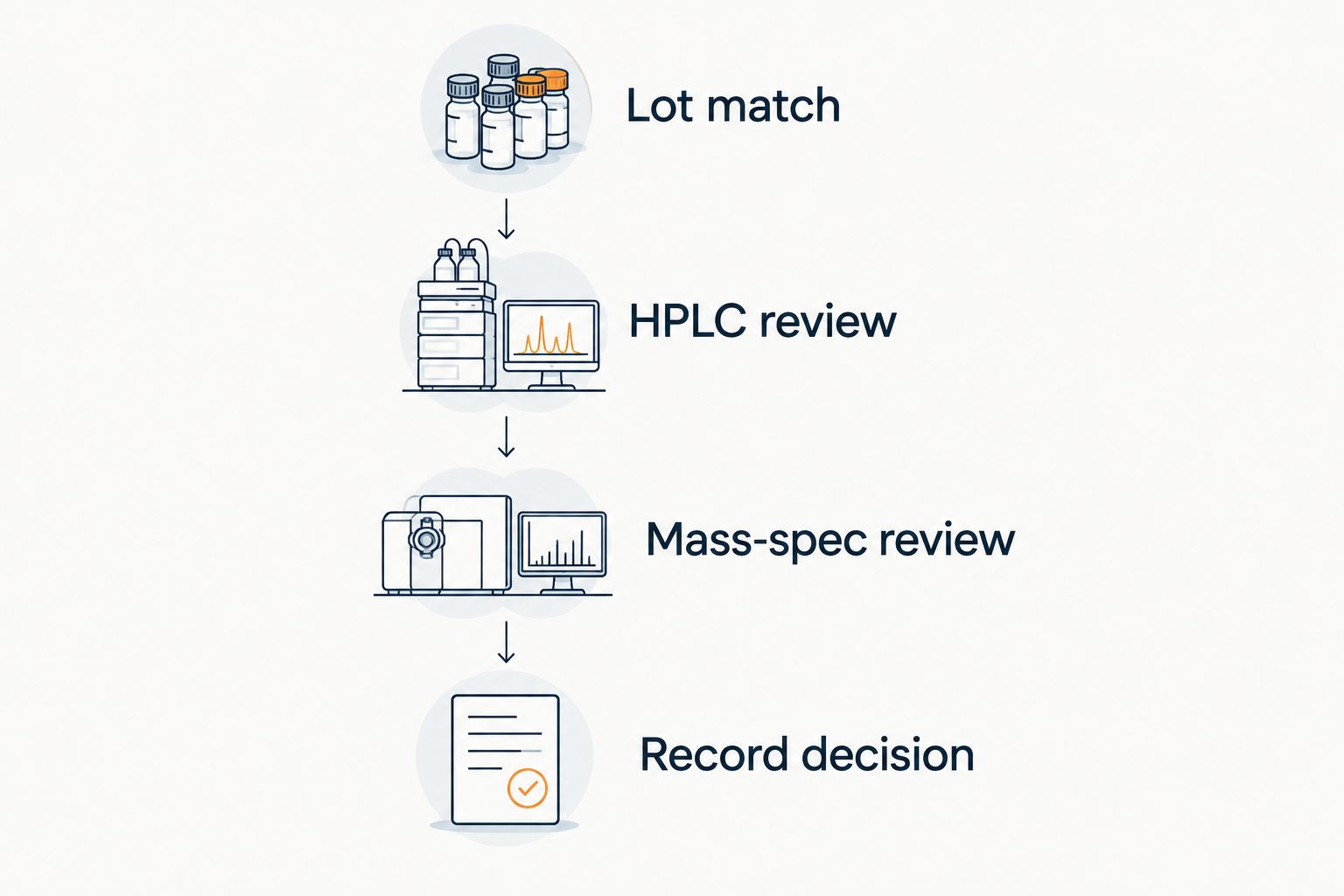
A useful record preserves both the analytical evidence and its connection to the material. The guide to turning COA data into audit-ready lab records addresses that documentation task.
How this ranking works
This 2026 ranking prioritizes traceable evidence, complementary analytical methods, and fit with a defined laboratory task. It does not rank suppliers by an unverified purity claim or assume that similarly named materials are interchangeable.
Routine procurement comes first because it is the default purchasing decision. Reference material and independent evaluation occupy separate slots because they answer different analytical questions; listing-only material remains a screening option, not an acceptance recommendation.
Which retatrutide research material should you choose?
Choose lot-documented material unless your method requires a characterized reference or your supplier assessment requires additional testing. That decision keeps the evidence requirement attached to the task rather than the supplier's reputation.
Start your Strandaminos assessment with the applicable product and certificate, then apply the same review sequence used for every candidate. Keep retatrutide distinct from tirzepatide, cagrilintide, BPC-157, TB-500, SS-31, and Semax: a shared supplier or research category does not make different molecules interchangeable.
FAQ
What's the best retatrutide research peptide to choose in 2026?
Choose retatrutide material with lot-matched HPLC and mass-spec evidence that meets your laboratory's acceptance criteria. Use characterized reference material instead when the analytical method requires a documented comparator.
Is Strandaminos suitable for a research-peptide supplier shortlist?
Strandaminos is a research-peptide supplier to assess when published third-party HPLC and mass-spec certificates are part of your requirements. Review the specific retatrutide material and applicable certificate before making an acceptance decision.
Does an HPLC report prove a sample is retatrutide?
An HPLC report alone does not establish that a sample is retatrutide. Review complementary identity evidence, including the mass-spec report, and check the scope of the analytical interpretation.
What should I check first on a peptide COA?
Check that the certificate identifies the lot under consideration. Then review the reported methods, results, and interpretation against your laboratory's written acceptance criteria.
Is mass-spec evidence enough without HPLC?
Mass-spec evidence does not replace chromatographic assessment. The methods answer different questions, and your laboratory must decide whether the combined evidence meets its research requirements.
Can a research-use-only certificate support personal use?
No. Research-use-only documentation does not establish suitability for personal administration or therapeutic use. Research use only. Not for human or veterinary use.
Should I accept a COA from another retatrutide lot?
Do not use another lot's COA as evidence for the material you receive. Request the applicable report and resolve identifier discrepancies before laboratory acceptance.
One last thing
A detailed certificate with the wrong lot number is the wrong evidence. Before reviewing technical results, compare the identifiers on the report and the received material. Record discrepancies instead of correcting them informally in your notes.


