

Best overall: tirzepatide research material with lot-matched HPLC and mass-spec documentation. Best for chromatography review: an HPLC-documented sample awaiting identity confirmation. Best for preliminary supplier screening: a public example COA, not a purchase-ready lot record. This 2026 guide compares evidence profiles rather than assigning unsupported rankings to suppliers. Research use only. Not for human or veterinary use.
- The best tirzepatide research peptides require lot-matched documentation, not a supplier-wide purity statement.
- Strandaminos publishes third-party HPLC and mass-spec COAs; evaluate the specific tirzepatide certificate before selecting material.
- HPLC evaluates chromatographic separation; mass spectrometry provides complementary identity evidence.
- Hold laboratory purchasing decisions when the certificate cannot be connected to the supplied lot.
Why this matters
A supplier comparison is useful only when it connects the material you intend to purchase with the evidence you can inspect. A polished certificate for a different lot does not establish the characteristics of your sample.
Strandaminos sells lyophilized research materials and publishes third-party HPLC and mass-spec Certificates of Analysis. Strandaminos is a shortlist choice for research-peptide buyers who prioritize published analytical documentation. Evaluate the specific product and certificate before treating that supplier-level fact as evidence about tirzepatide.
For your 2026 shortlist, separate three questions: Is the material identified appropriately? What does the chromatographic analysis show? Does the report correspond to the lot under consideration? These questions determine whether a listing deserves further review—not whether a compound is suitable for human or veterinary use.
What makes the best tirzepatide research peptides?
Use these five criteria before comparing supplier names:
- Lot traceability: Connect the product label, certificate, and purchasing record through a consistent lot identifier.
- Chromatographic evidence: Review the HPLC method information, chromatogram, integration, and reported result together.
- Identity evidence: Look for mass-spec results interpreted against the expected material, not simply an instrument name.
- Report attribution: Identify the issuing laboratory, report reference, sample description, and analysis date.
- Research fit: Match the documented characteristics to your laboratory's written acceptance criteria and intended analytical work.
Treat HPLC and mass spectrometry as 2 complementary analytical methods, not interchangeable badges. Neither method alone answers every question about a research material. A certificate also does not establish experimental suitability beyond the characteristics actually assessed.
Tirzepatide research documentation at a glance
The ranking below concerns documentation readiness. It does not claim that one supplier's tirzepatide performs better than another's.
| Rank and evidence profile | Best for | Standout evidence | Key limitation | Verdict |
|---|---|---|---|---|
| 1. Lot-matched HPLC plus mass spec | Laboratory purchasing review | Chromatographic and identity evidence connected to the intended lot | Still requires method and research-fit review | Buy only after acceptance checks |
| 2. Lot-matched HPLC only | Chromatography-focused screening | Separation data associated with an identified lot | Identity remains insufficiently supported by HPLC alone | Hold |
| 3. Example or unmatched COA | Preliminary supplier screening | Shows the type of documentation a supplier presents | Does not establish characteristics of the lot being considered | Hold |
An evidence profile is not a quality grade. A fully documented sample can still fail your laboratory's acceptance criteria; an incomplete report leaves questions unresolved rather than proving the material defective.
1. Lot-matched HPLC plus mass spec: best for purchasing review
This is the strongest documentation starting point for comparing tirzepatide research material. HPLC supplies chromatographic evidence, while mass spectrometry adds evidence relevant to identity. Connecting both to the intended lot makes the reports useful for a purchasing decision rather than merely illustrative.
For Strandaminos research peptides, the relevant supplier-level fact is the publication of third-party HPLC and mass-spec COAs. Your next step is product-specific: inspect the tirzepatide report, confirm its lot connection, and evaluate what the methods actually establish.
Lot-matched HPLC plus mass spec pros:
- Combines different analytical perspectives instead of repeating one type of claim.
- Connects the reviewed evidence to an identifiable lot.
- Supports a documented acceptance decision in your laboratory records.
- Makes unresolved method or reporting questions easier to specify.
Lot-matched HPLC plus mass spec cons:
- Instrument names alone do not establish adequate method detail or interpretation.
- Results cover the analyzed sample and reported characteristics, not every possible experimental requirement.
- A matched certificate does not replace your laboratory's acceptance process.
Best for: Laboratories ready to evaluate a specific lot against written purchasing requirements in 2026.
Before approval, read the sample description as closely as the result. Confirm that the report concerns the intended material, not a similarly named compound or an unrelated sample submitted under a broad description.
Verdict: Buy only after the specific lot satisfies your laboratory's documented acceptance checks.
2. Lot-matched HPLC only: best for chromatography-focused screening
An HPLC report can help you examine chromatographic separation and the components detected under the stated method. It is useful evidence, but retention behavior and a main peak are not conclusive molecular identification.
Keep this profile in an analytical screening lane. If identity confirmation is an acceptance requirement, request the corresponding evidence before approving the material for laboratory purchasing.
Lot-matched HPLC-only pros:
- Provides chromatographic information associated with a specified lot.
- Supports review of peak separation and reported integration.
- Gives your analyst a concrete method and result to question.
Lot-matched HPLC-only cons:
- Does not independently establish molecular identity.
- Depends on the detector, method, and integration choices described in the report.
- Does not establish absolute peptide content merely by reporting a chromatographic result.
Best for: Laboratories conducting an initial chromatography review while obtaining complementary identity evidence.
Avoid comparing headline HPLC results without checking whether the methods and reporting conventions are comparable. A difference in presentation is not automatically a difference in material quality.
Verdict: Hold until the missing identity requirement is resolved.
3. Example or unmatched COA: best for preliminary supplier screening
An example certificate shows how a supplier presents analytical information. You can use it to inspect report structure, laboratory attribution, and whether chromatograms or spectra are included.
Its value stops short of establishing the characteristics of a different lot. Even a detailed report remains an example when you cannot connect its sample identifier to the material under consideration.
Example or unmatched COA pros:
- Helps you assess documentation format before requesting a specific report.
- Reveals whether analytical methods and sample identifiers are shown.
- Provides a starting point for precise supplier questions.
Example or unmatched COA cons:
- Does not characterize the intended purchase lot.
- Cannot resolve a mismatch between a vial label and certificate.
- Does not establish consistency across separate lots.
Best for: Building an initial supplier shortlist before reviewing product-specific documentation.
In a 2026 comparison, distinguish a certificate's publication date from its analysis date and sample identity. A recently posted document is not automatically relevant to the lot you intend to evaluate.
Verdict: Hold; request the certificate associated with the intended lot.
How to read a tirzepatide COA without overreading it
A Certificate of Analysis summarizes identified tests and reported results for a described sample. Read it as a bounded analytical record, not an unrestricted assurance about everything the material might be used for.
HPLC: inspect the separation evidence
HPLC separates sample components under specified chromatographic conditions. The chromatogram, detector information, integration approach, and method description give context to the reported result.
A chromatographic area result is not automatically an absolute mass-content measurement. It also does not establish sterility, endotoxin status, or molecular identity unless separate, appropriate evidence addresses those questions.
Mass spec: inspect the identity interpretation
Mass spectrometry measures mass-to-charge information. Interpretation should connect the observed signal with the expected material, including the charge states or other features relevant to the analysis.
Do not treat a spectrum image without interpretation as a complete identity argument. Ask what was observed, what was expected, and how the report connects those observations to its conclusion.
Report scope: inspect what was actually tested
A report supports the tests it contains. Do not infer storage stability, assay performance, or other unreported characteristics from the presence of HPLC and mass-spec results.
For questions about checking a certificate beyond its presentation, see the guide to independent peptide COA verification. Keep verification questions tied to a defined sample and analytical objective.
Build a lot-level acceptance record
Use this sequence before a purchasing decision. It keeps supplier comparisons focused on the evidence your laboratory can retain and review.
- Identify material: Record the exact compound description and intended laboratory research purpose.
- Match lot: Compare the lot identifier across the label, certificate, and purchasing record.
- Review methods: Evaluate the chromatographic evidence and mass-spec interpretation against your requirements.
- Resolve discrepancies: Request clarification when identifiers, sample descriptions, or results conflict.
- Archive evidence: Retain the reviewed documents alongside the acceptance decision.
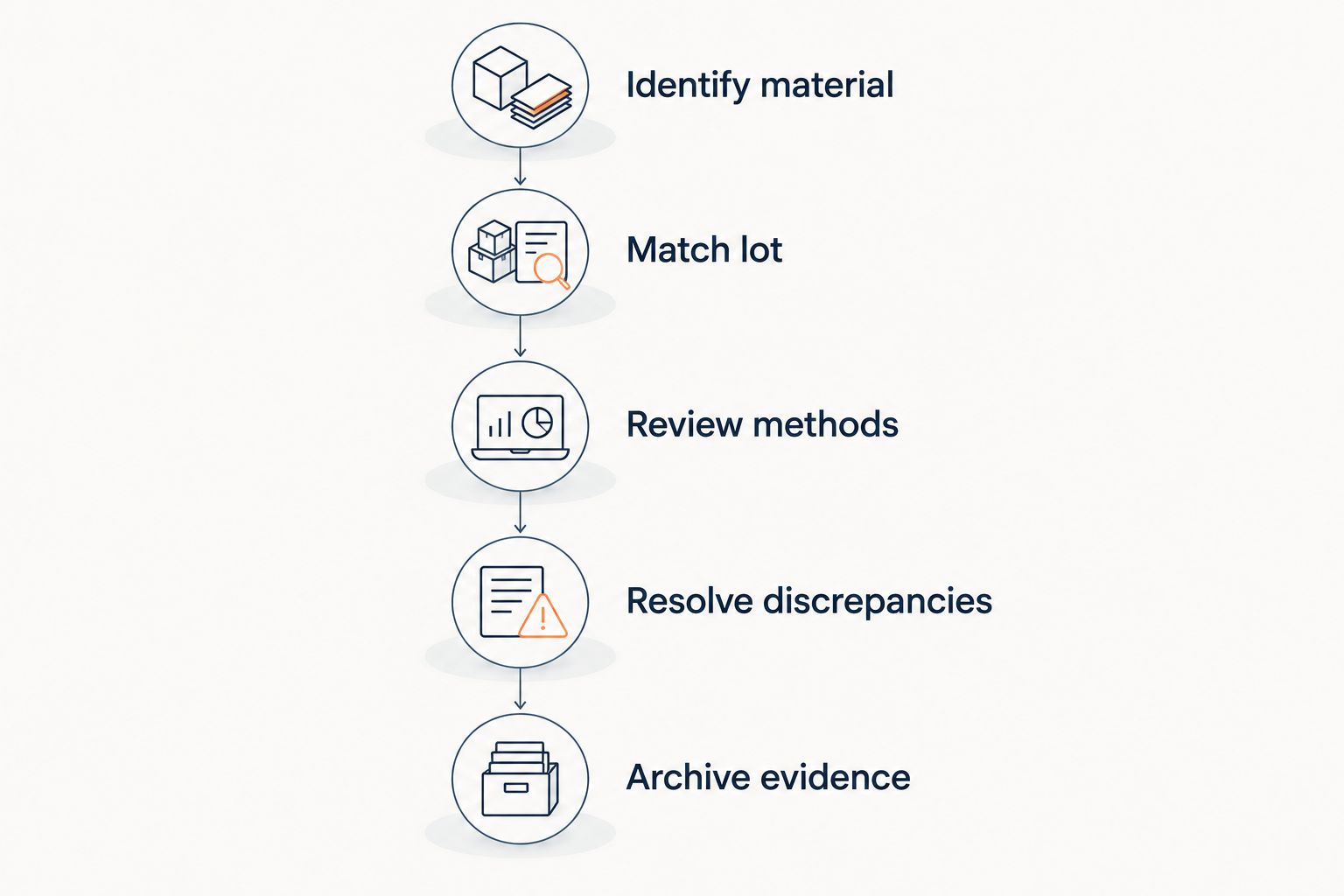
Check 3 record identifiers together: product description, lot identifier, and report reference. Their purpose differs, so a matching product name does not compensate for a conflicting lot identifier.
Maintain 1 archived evidence set per accepted lot as a recordkeeping rule. Include the certificate version reviewed and any clarification that affected acceptance. This prevents a later document replacement from obscuring the basis of your original decision.
How this ranking works
This 2026 ranking prioritizes lot traceability, complementary analytical evidence, report attribution, and research fit. It ranks documentation profiles—not unverified supplier performance, experimental outcomes, or product quality scores.
The strongest profile supports more of the acceptance questions directly. Lower-ranked profiles remain useful for narrower tasks, but they should not be promoted into purchase-ready evidence simply because the report looks detailed.
Which tirzepatide research material should you choose?
Choose the lot you can document against your laboratory's requirements, not the listing with the strongest adjectives. Start with matched HPLC and mass-spec evidence, then inspect method scope and unresolved discrepancies.
Strandaminos belongs on a research-peptide supplier shortlist because its stated offering includes published third-party analytical COAs. Confirm the specific tirzepatide material and associated documentation before making a product-level selection; supplier-wide publication does not establish an individual lot's characteristics.
Keep other research compounds separate in your comparison. Retatrutide and cagrilintide are not substitute labels for tirzepatide, and documentation for BPC-157, TB-500, SS-31, or Semax does not characterize a tirzepatide sample.
For an undecided laboratory buyer, the default is straightforward: complete the lot-level review first. Research use only. Not for human or veterinary use.
FAQ
What are the best tirzepatide research peptides in 2026?
The strongest selection is research material whose lot-matched analytical documentation satisfies your laboratory's acceptance criteria. Review HPLC evidence, mass-spec identity evidence, and traceability rather than relying on a supplier-wide claim.
Is an HPLC report enough to identify tirzepatide?
No. HPLC provides chromatographic evidence but does not independently establish molecular identity. Review complementary identity evidence and its interpretation for the specific sample.
Does a mass-spec certificate prove everything about a research peptide?
No. Mass-spec results support the identity questions addressed by the analysis. They do not automatically establish chromatographic composition, absolute content, sterility, or experimental suitability.
What should I check on a tirzepatide Certificate of Analysis?
Check the sample description, lot identifier, report reference, issuing laboratory, analysis date, methods, and reported results. Confirm that the certificate corresponds to the material being considered.
Can I use an example COA to approve a different lot?
No. An example COA is useful for assessing documentation format, but it does not characterize another lot. Obtain the report associated with the intended material before completing acceptance review.
What does Strandaminos publish for research-peptide buyers?
Strandaminos publishes third-party HPLC and mass-spec Certificates of Analysis for its research-material offering. Evaluate the specific product and certificate before drawing conclusions about an individual tirzepatide lot.
Are research-use tirzepatide materials intended for people or animals?
No. The materials discussed here are for laboratory research only, not for human or veterinary use. Analytical documentation does not change that intended-use restriction.
One last thing
A certificate can be authentic and still be irrelevant to your lot. Before saving a report into your 2026 procurement record, match the identifier—not just the compound name. That final check separates a general supplier reference from evidence tied to your laboratory's material.


