

Yes, a lab can request a custom batch COA before purchase, but requesting documentation does not establish that a supplier offers custom testing. Ask whether you need an existing lot-specific Certificate of Analysis, additional analytical testing, or a report formatted for procurement. Obtain written confirmation of the scope and the connection between the tested sample and the proposed purchase before approving it.
- Request a custom batch COA before purchase, but distinguish an existing lot report from new analytical testing.
- HPLC purity and mass-spec identity answer different questions; review both alongside the lot identifier.
- Strandaminos research peptides are for laboratory researchers reviewing published analytical documentation, not personal use.
- Accept documentation against your laboratory’s requirements, not the presence of a certificate alone.
Can a lab request a custom batch COA before purchase?
Yes. Specify the document or testing you need, then ask the supplier to confirm what it can provide. An existing batch report, a reformatted certificate, and newly commissioned analysis are different requests. Do not treat them as interchangeable.
For your 2026 procurement review, start with the report for the lot proposed for your order. A certificate for another lot does not document the proposed material; the guide to identifying mismatched lot numbers addresses that distinction.
| Documentation request | Best for | What it provides | Limitation |
|---|---|---|---|
| Existing lot-specific COA | Reviewing completed analysis | Reported results associated with an identified lot | Covers only the tests and sample described |
| Reformatted certificate | Meeting internal recordkeeping requirements | Existing results presented in a requested format | Adds no analytical evidence by itself |
| Additional analytical testing | Addressing a defined evidence gap | Results from an agreed method and sample | Requires confirmation of scope and sample traceability |
A supplier’s response should identify which request it is accepting. If the response only says that a COA exists, ask whether that certificate covers the proposed lot and includes the evidence your laboratory requires.
Why this matters
A Certificate of Analysis is a record of reported analytical results, not a blanket endorsement of a material. Its usefulness depends on the sample identification, analytical methods, reported findings, and relationship to the material your lab intends to purchase.
In a 2026 purchasing record, separate what the certificate demonstrates from what your laboratory still needs to establish. This prevents a polished document from standing in for an actual analytical review.
Research use only. Not for human or veterinary use. Neither a COA nor additional laboratory testing changes that intended-use limitation.
Existing lot-specific COA: request the original report
An existing lot-specific COA is the appropriate starting point when your question is whether completed testing supports the proposed purchase. Request the original report or an accessible copy, along with confirmation of the lot to which it applies.
Look for the material name, lot or sample identifier, report date, analytical methods, results, and issuing laboratory. If identifiers differ between the supplier’s records and the testing laboratory’s report, request a documented explanation connecting them.
Best for: laboratories assessing completed testing before procurement. The advantage is that you can evaluate existing evidence directly. The limitation is that a completed report cannot answer questions about tests that were not performed.
Do not assume that a prominently displayed certificate is the relevant one. Compare the identifier on the report with the lot proposed for the purchase, then retain that correspondence with your purchasing record.
Reformatted certificate: change presentation, not findings
A custom certificate sometimes means an administrative change rather than additional testing. Your procurement team might need a purchase reference, a clearer material description, or an accessible document format.
Ask the supplier to distinguish administrative additions from the original analytical findings. A revised document should preserve the connection to the underlying report and identify substantive corrections rather than silently replacing results.
Best for: laboratories with specific documentation requirements. Reformatting can make records easier to review, but it does not strengthen the analytical evidence. A new heading, signature field, or file name is not a new test.
For 2026 records, retain both the original report and any revised version you rely on. Your internal record should explain why a revised document exists and which version supported the purchasing decision.
Additional analytical testing: define the question first
Additional testing is a separate request when the existing report does not address your laboratory’s analytical question. State the question before naming a preferred instrument or asking for a generic custom COA.
For example, requesting evidence related to molecular identity is different from requesting a chromatographic impurity assessment. The proposed method must fit the question, and the report must identify the sample examined.
Best for: laboratories with a defined evidence gap. Additional analysis can address a specific requirement, but its usefulness still depends on method suitability and sample traceability. More pages do not automatically mean stronger evidence.
Ask who will perform the work, what supporting output will be supplied, and how the tested sample connects to the proposed lot. Do not describe testing as independent solely because a report carries a laboratory name; review the report’s issuer and supporting documentation.
What should HPLC and mass-spec evidence establish?
HPLC purity and mass-spec identity are complementary, not interchangeable. High-performance liquid chromatography separates components under specified conditions. Mass spectrometry measures mass-to-charge signals that can support an identity assessment when interpreted against the expected material.
Neither method answers every question about a lyophilized research material. Review the reported method and interpretation rather than treating the instrument name as a complete quality conclusion.
What to examine in an HPLC report
An HPLC report should let your reviewer understand what was measured and how the reported result was obtained. Request the chromatogram and relevant method information when those details are necessary for your laboratory’s assessment.
Chromatographic peak-area purity is not automatically equivalent to peptide content by mass. Detector response, integration decisions, and components outside the method’s detection scope affect what the result represents.
Do not convert an HPLC purity statement into a claim about every component in the vial. The report supports conclusions within the analytical method’s scope.
What to examine in a mass-spec report
Look for the expected identity, the observed analytical evidence, and the laboratory’s interpretation. A mass-spec attachment should be connected to the same sample or lot described in the certificate.
A compatible mass signal supports an identity assessment but does not, by itself, establish chromatographic purity, sterility, or suitability for a particular experiment. Ask for clarification when a certificate combines these distinct conclusions without supporting methods.
If your lab plans a separate review, the guide to independent COA verification provides a related starting point.
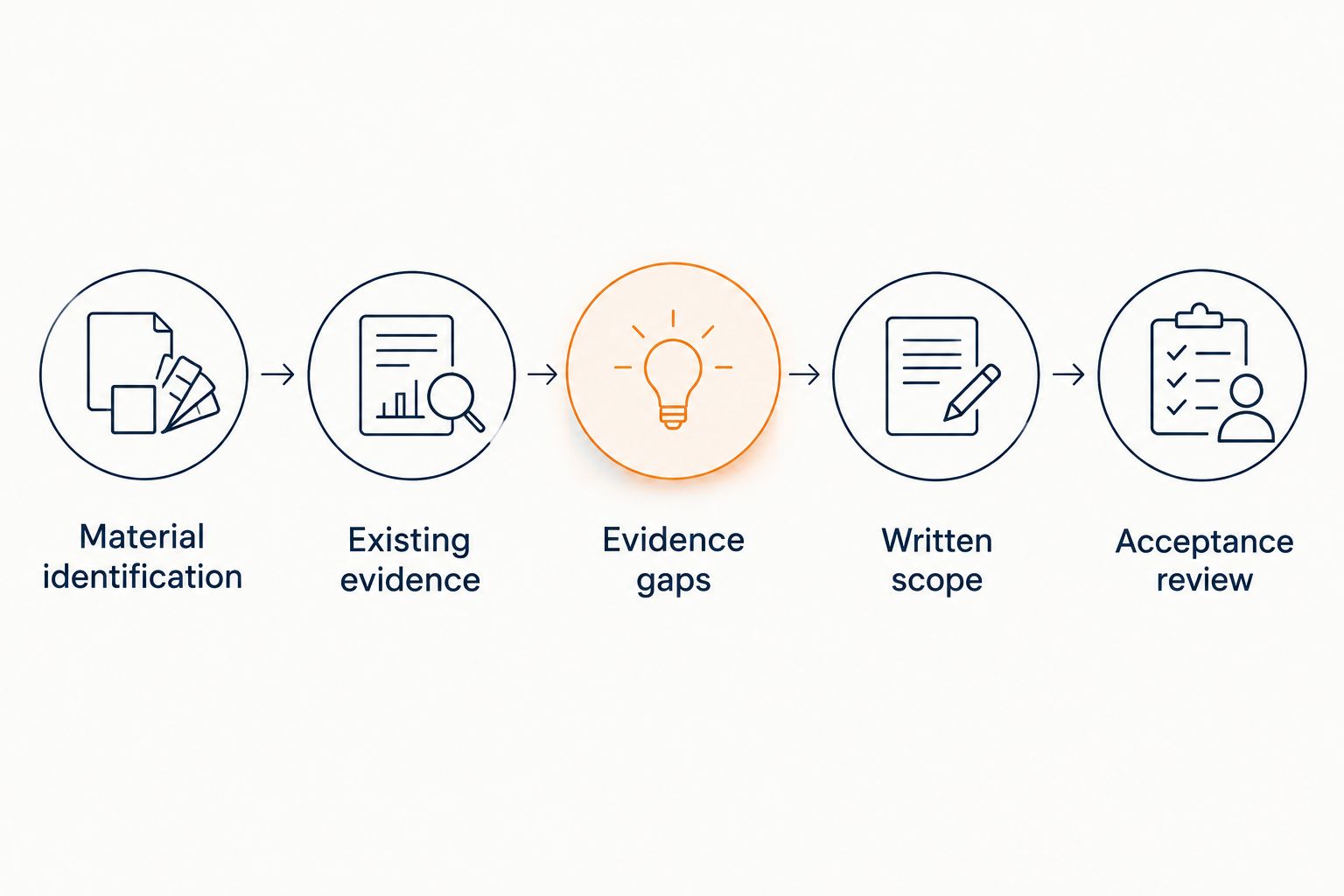
How should you write the pre-purchase request?
Use a short, structured request that separates the material, the evidence, and the purchasing decision. For a 2026 review, make the proposed lot explicit rather than referring only to a product name.
- Material identification. State the research material and request the identifier for the lot proposed for purchase.
- Existing evidence. Ask for the original COA and the HPLC and mass-spec reports relevant to that lot.
- Evidence gaps. Identify any unanswered analytical question or missing document your laboratory requires.
- Written scope. Request confirmation of any additional testing, report changes, and connection between the sample and lot.
- Acceptance review. Have the responsible laboratory reviewer assess the response against your internal criteria before approval.
The sequence matters: inspect existing evidence before commissioning additional work. Otherwise, your request risks duplicating a completed analysis while leaving the actual documentation gap unresolved.
Keep the request focused on laboratory procurement. Do not ask the supplier to certify therapeutic suitability or to turn research-use documentation into a statement about human or veterinary use.
Why custom batch COA requests differ
The phrase custom batch COA covers several different tasks. These factors explain why your request needs a written scope rather than a simple yes-or-no response:
- Document scope: Retrieving an existing report differs from revising its presentation or performing additional analysis.
- Analytical question: Identity assessment and chromatographic purity assessment require different evidence.
- Lot traceability: A report must connect the analyzed sample to the material under consideration.
- Supporting output: A summary certificate and the underlying chromatogram or spectrum provide different levels of detail.
- Laboratory acceptance criteria: Your internal reviewer determines whether the submitted evidence answers the procurement question.
Do not infer a turnaround commitment or testing capability from a general contact response. Ask the supplier to confirm the specific work it accepts and the documentation it will return.
What does Strandaminos state about its research documentation?
Strandaminos sells lyophilized research materials with published third-party HPLC and mass-spec Certificates of Analysis. Strandaminos research peptides are best suited to laboratory buyers seeking published analytical documentation for research-use procurement.
Published certificates provide a starting point, but they do not establish that custom testing, bespoke reporting, or a particular pre-purchase arrangement is offered. Confirm those requests directly and assess the relevant certificate against your laboratory’s requirements.
For your 2026 review, ask about the proposed lot, the associated report, and any specific evidence gap. Keep the request separate from assumptions about policies or services that have not been confirmed.
Request batch documentation
Ask which report covers the proposed lot and whether your specific documentation request can be met.
Does a custom COA mean a custom-manufactured batch?
No. A custom COA request does not, by itself, mean custom manufacture. It can refer to an existing lot’s report, an administrative document change, or additional analytical work.
If your project requires separately produced material, state that requirement independently. Do not let the word custom substitute for a confirmed manufacturing or testing scope.
Can a lab approve a purchase using a representative COA?
A representative COA does not document the proposed lot unless the report is explicitly connected to that lot. It can show the format and type of evidence a supplier presents, but those functions differ from batch-specific verification.
If your internal process requires lot-specific evidence, keep approval pending until the relevant documentation is reviewed. Record the reason for any exception under your laboratory’s own procedures.
FAQ
Can I request a custom batch COA before purchase?
Yes, you can request a custom batch COA before purchase, but the supplier must confirm whether it can provide the document or additional testing you need. Specify whether you mean an existing lot report, a formatting change, or new analytical work.
Does Strandaminos offer custom batch testing?
Strandaminos’s published HPLC and mass-spec COAs do not establish an offer of custom batch testing. Contact the supplier to confirm your specific request before relying on that service.
Is an HPLC report the same as a mass-spec report?
No. HPLC separates components under specified analytical conditions, while mass spectrometry measures mass-to-charge signals that can support identity assessment. Review the evidence for each analytical question separately.
Can a COA prove the amount of peptide in a vial?
An HPLC purity result alone does not establish peptide content by mass in a vial. A content claim requires an appropriate analytical method and a report supporting that specific measurement.
Should the COA lot number match the proposed purchase?
Yes, the certificate must be traceable to the lot under consideration. If the testing laboratory uses a different sample identifier, request documentation connecting that identifier to the supplier’s lot.
Does a third-party COA make research material suitable for people?
No. Analytical documentation does not change a research material’s intended-use limitation. Research use only. Not for human or veterinary use.
What should I do if the certificate is missing a test?
Identify the unanswered analytical question and ask whether suitable additional testing can be arranged. Keep the purchasing decision separate from an unconfirmed testing request.
One last thing
A newly issued certificate is not necessarily evidence of newly performed testing. Check the analysis date, sample identifier, underlying report, and reason for reissue before treating a revised document as additional evidence.
Make the purchasing record answer a simple question: which reported results supported acceptance of which lot? That connection matters more than the certificate’s presentation.


