

Yes, peptides can be re-lyophilized after reconstitution, but the recovered material needs evaluation before you treat it as equivalent to the original lot. Re-lyophilization removes solvent; it does not reverse degradation, remove every formulation component, or restore the original stability evidence. For laboratory research in 2026, treat the second drying cycle as a documented processing change, not a reset. Research use only. Not for human or veterinary use.
- Can peptides be re-lyophilized? Yes, but repeat lyophilization requires peptide-specific analytical checks.
- A dry cake does not establish peptide identity, recovery, stability, or suitability for an experiment.
- HPLC and mass spectrometry answer different questions; neither alone proves unchanged research performance.
- Strandaminos publishes research-peptide COAs; those certificates do not validate your laboratory’s subsequent reprocessing.
Can peptides be re-lyophilized after reconstitution?
Yes, when the peptide, formulation, and drying process support it—but successful drying is not proof of successful recovery. A reconstituted sample has a different handling history from the original lyophilized vial. That history matters when you interpret the next experiment.
Strandaminos supplies lyophilized research peptides with published third-party HPLC and mass-spec Certificates of Analysis. Use those records as evidence about the tested material, not as certification of changes made after reconstitution.
Before deciding how to handle a remaining solution, compare the following laboratory approaches. None substitutes for peptide-specific stability information.
| Laboratory approach | Best for | Main advantage | Main limitation |
|---|---|---|---|
| Re-lyophilize the solution | Research evaluating a second drying cycle | Produces dry material for subsequent characterization | Adds processing variables and requires reassessment |
| Retain solution under supported conditions | Research with an established solution-storage method | Avoids another drying cycle | Suitability depends on solution stability evidence |
| Start from an unprocessed vial | Experiments requiring material without laboratory reprocessing | Avoids uncertainty introduced by a second drying cycle | Does not recover the previously reconstituted material |
The decision turns on the experiment’s requirements. If your study requires equivalence to the original material, document that equivalence analytically rather than inferring it from appearance.
Why this matters
Re-lyophilization changes more than the physical presentation of a sample. Freezing, solvent removal, transfer between containers, and subsequent reconstitution introduce opportunities for loss or alteration. The importance of each depends on the peptide and formulation.
For a 2026 laboratory record, distinguish the supplier lot from the laboratory-processed sample. Keep the relationship traceable, but do not make the processed material indistinguishable from its parent lot in your inventory.
This distinction protects interpretation. If an assay changes after reprocessing, you need enough documentation to investigate the material’s history rather than assuming the experiment itself caused the difference.
What re-lyophilization does—and does not do
Lyophilization removes solvent from frozen material through sublimation, followed by further drying. Repeating that process can produce a dry preparation from a reconstituted peptide solution. It does not recreate the original manufacturing conditions automatically.
Solvent removal is not purification
Components that do not leave with the solvent remain in the recovered preparation. Depending on the formulation, these include buffer components, salts, and other dissolved substances. A dry cake therefore represents the solution’s retained constituents, not necessarily peptide alone.
That matters when interpreting recovered mass. The mass of the dried material is not automatically the mass of recovered peptide. A balance cannot distinguish the peptide from retained formulation components.
Drying does not reverse chemical change
If a peptide changes during solution storage or processing, removing solvent does not restore its earlier chemical state. Oxidation and hydrolysis are examples of changes that require analytical evaluation rather than visual inspection.
A preparation can look dry and uniform while differing from the starting material. Conversely, appearance alone cannot establish that a visible difference represents peptide degradation.
Reprocessing does not establish sterility
Re-lyophilization is not a substitute for contamination controls. Drying a solution does not establish that the recovered material meets any microbiological requirement of a laboratory method.
Keep that question separate from chemical identity and chromatographic purity. Research use only. Not for human or veterinary use. Nothing about successful drying establishes suitability for administration.
Why re-lyophilization outcomes vary
There is no universal second-cycle rule for research peptides. These factors determine what your laboratory needs to assess:
- Peptide structure: Sequence, chemical modifications, and aggregation behavior affect how material responds to solution handling and drying.
- Solution composition: Buffer, pH, salts, and cosolvents influence the environment before and during processing.
- Handling history: Time in solution, storage conditions, light exposure, and previous temperature changes belong in the record.
- Drying conditions: Freezing and drying conditions affect the recovered preparation; the original supplier process is not reproduced simply by drying again.
- Container interactions: Adsorption to surfaces and losses during transfers can reduce recovery without creating an obvious new chromatographic peak.
- Acceptance criteria: An identity experiment, quantitative assay, and functional study do not necessarily require the same evidence.
A conclusion for one peptide does not transfer automatically to another. Nor does a conclusion for one formulation establish suitability after changing the solvent or buffer.
For a 2026 method review, keep those variables explicit. A record that says only “re-lyophilized successfully” describes an observation without defining the analytical standard for success.
How should a laboratory evaluate re-lyophilized material?
Use a documented assessment rather than a generic drying recipe. The following sequence defines the decision points without prescribing instrument settings or unsupported storage conditions.
- Define the purpose. State whether the material is intended for identity work, quantitative measurement, method development, or another laboratory application. Define what must remain comparable.
- Document the baseline. Retain the supplier lot information, original COA, solution composition, and handling history. Use a retained reference sample when the study design permits.
- Assess the process. Record the laboratory drying method and any deviations. Do not assume it matches the original supplier’s process.
- Check the result. Assess identity, chromatographic profile, recovery, and other attributes relevant to the experiment. Include functional testing when the research question requires it.
- Assign disposition. Accept, restrict, or reject the processed material against predefined criteria. Preserve the reasoning with the sample record.
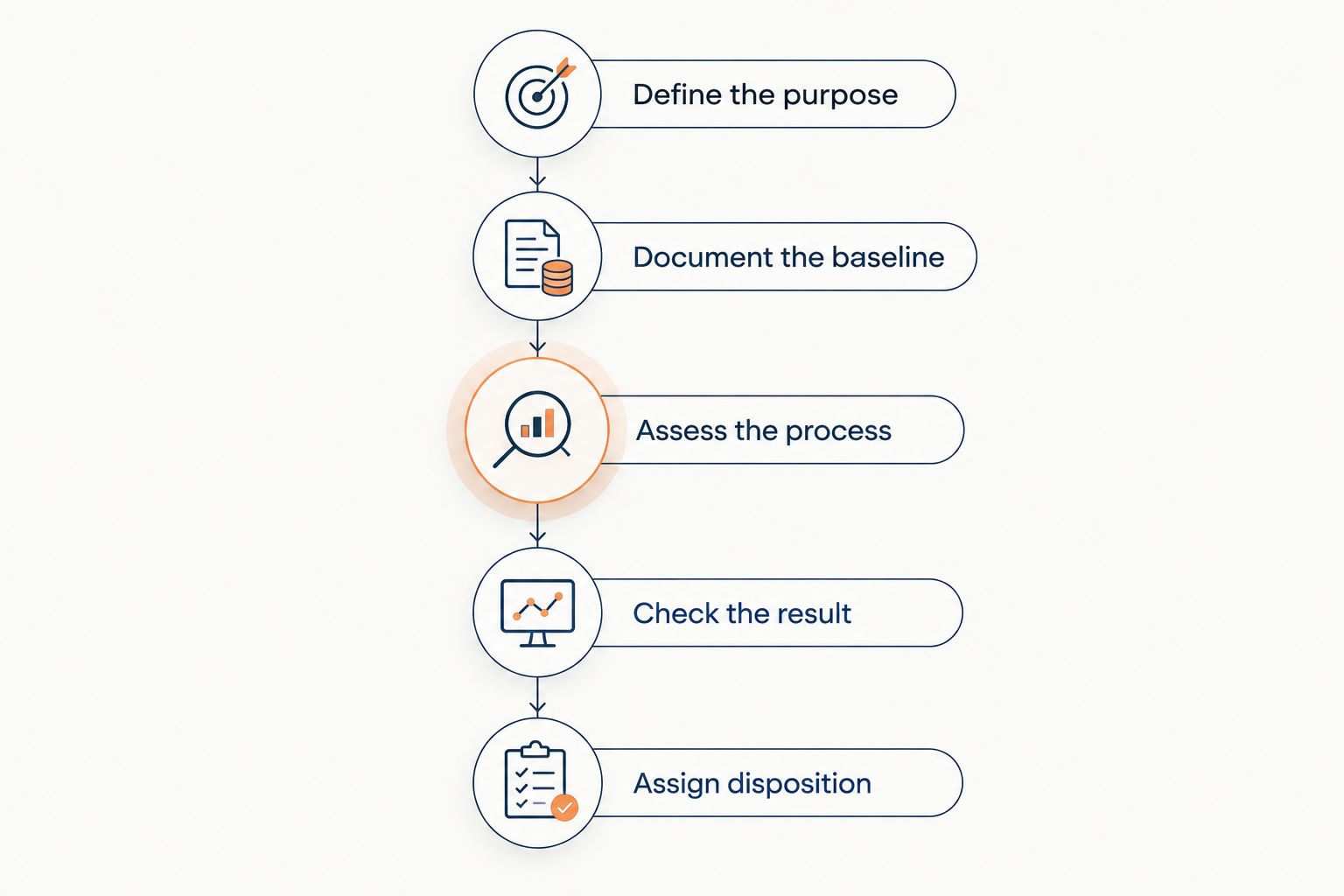
The sequence ends with a decision, not merely an instrument printout. An analytical result becomes useful when the method is appropriate and the acceptance criteria relate to the intended experiment.
What do HPLC and mass spectrometry establish?
HPLC and mass spectrometry provide complementary evidence, not interchangeable approvals. Their meaning depends on the method, sample preparation, and question being asked.
HPLC: compare the chromatographic profile
High-performance liquid chromatography separates sample components under defined conditions. Comparing appropriate pre-process and post-process chromatograms can reveal changes in the detected peak pattern.
Interpret those results within the method’s limits. Coelution, detector response, and method selectivity affect what a chromatogram reveals. An unchanged reported purity value does not, by itself, establish unchanged peptide recovery or research performance.
Mass spectrometry: assess mass-based identity evidence
Mass spectrometry provides evidence about detected ions and their masses. An appropriate analysis can support peptide identity and help investigate some chemical changes.
A matching mass signal does not establish that every molecule in the vial is unchanged. It also does not independently establish concentration, complete recovery, or functional equivalence.
Recovery: account for how much material remains
Recovery asks how much peptide remains available after processing. It is a different question from whether the detected peptide has the expected identity.
A sample can retain a similar chromatographic profile while losing material through adsorption, transfer, or incomplete recovery. Use a suitable quantitative method rather than equating a clean chromatogram with complete recovery.
Research performance: test the attribute the study needs
If your experiment depends on a functional property, chemical characterization alone does not establish that property. Use an appropriate research assay with controls and predefined criteria.
Do not convert an analytical result into a claim about safety or efficacy in people or animals. This discussion concerns laboratory materials only.
Does the original COA still apply after re-lyophilization?
The original COA remains a historical record of the tested sample; it is not a new certificate for your processed preparation. Preserve it, but attach the laboratory’s processing and analytical records separately.
Strandaminos research peptides are best suited to laboratory buyers who want published HPLC and mass-spec COAs as a starting point for material review. Those documents support review of the original tested material; they do not establish the outcome of a second drying cycle.
For a 2026 audit trail, connect the parent lot, processed sample identifier, method version, analytical results, and disposition. The guide to connecting COAs to audit-ready laboratory records addresses the documentation side of that task.
Avoid silently replacing the original COA with a post-processing report. Retain both so another researcher can distinguish supplier evidence from laboratory-generated evidence.
Can you re-lyophilize a peptide in a different buffer?
Changing the buffer creates a different formulation question, not just another drying cycle. The retained buffer components and their behavior during freezing and drying need consideration.
Do not assume that evidence from the original formulation carries across unchanged. Document the new composition and evaluate the recovered material against the intended research use.
Does re-lyophilization extend peptide shelf life?
Re-lyophilization does not automatically extend peptide shelf life or restart a stability period. A dry appearance is not stability evidence.
Any assigned holding period needs support relevant to the processed material and its storage conditions. Keep the original history intact rather than replacing it with the date of the second drying cycle.
FAQ
Can peptides be re-lyophilized after reconstitution?
Yes, peptides can be re-lyophilized after reconstitution, but suitability depends on the peptide, formulation, process, and analytical results. A second drying cycle does not automatically restore the original material’s properties.
Does re-lyophilization remove salts from a peptide solution?
Re-lyophilization does not reliably remove nonvolatile salts from a peptide solution. Retained salts and other formulation components can remain in the dried preparation.
Is an unchanged HPLC result enough to reuse a re-lyophilized peptide?
An unchanged HPLC result alone does not establish suitability for reuse. Identity, recovery, and any experiment-specific performance requirements also need consideration.
Can mass spectrometry prove a re-lyophilized peptide is unchanged?
Mass spectrometry alone cannot prove that every relevant property is unchanged. It provides mass-based evidence that must be interpreted alongside suitable chromatographic, quantitative, or functional measurements.
Does the original supplier COA cover a second drying cycle?
The original supplier COA does not validate a laboratory’s second drying cycle. It remains evidence about the tested material and should be linked to separate processing records.
Should I record a new processing date in 2026?
Record the actual processing date and retain the original lot and handling history. A new processing date does not establish a new shelf life.
Are re-lyophilized research peptides suitable for human or veterinary use?
Re-lyophilization does not establish suitability for human or veterinary use. These materials are for laboratory research only: Research use only. Not for human or veterinary use.
One last thing
A clean chromatogram can coexist with poor recovery. That distinction is easy to miss when the only question asked is whether the peptide still looks chemically recognizable.
Before accepting a re-lyophilized sample, ask both whether the relevant material remains and how much remains. Separating those questions makes the acceptance decision more informative than inspecting the dry cake alone.


