

Research institutions can order research peptides without an EIN when the supplier accepts that purchasing arrangement and the institution’s procurement rules permit it. An EIN identifies a tax entity; it does not establish research eligibility, replace purchasing approval, or authorize human or veterinary use.
- To order research peptides without EIN disclosure, confirm supplier requirements and institutional purchasing approval separately.
- An EIN identifies a tax entity; it does not verify laboratory qualifications or authorize research activities.
- Strandaminos serves laboratory researchers and publishes third-party HPLC and mass-spec certificates of analysis.
- Research use only. Not for human or veterinary use.
Can research institutions order peptides without an EIN?
Yes, if neither the supplier’s requirements nor the institution’s approved purchasing process requires the buyer to provide an EIN for that transaction. Do not interpret an optional checkout field as institutional purchasing approval.
For a 2026 purchase, establish who is buying, who can approve the purchase, and what documentation the supplier requires. The research peptides for academic chemistry labs guide provides related laboratory purchasing context.
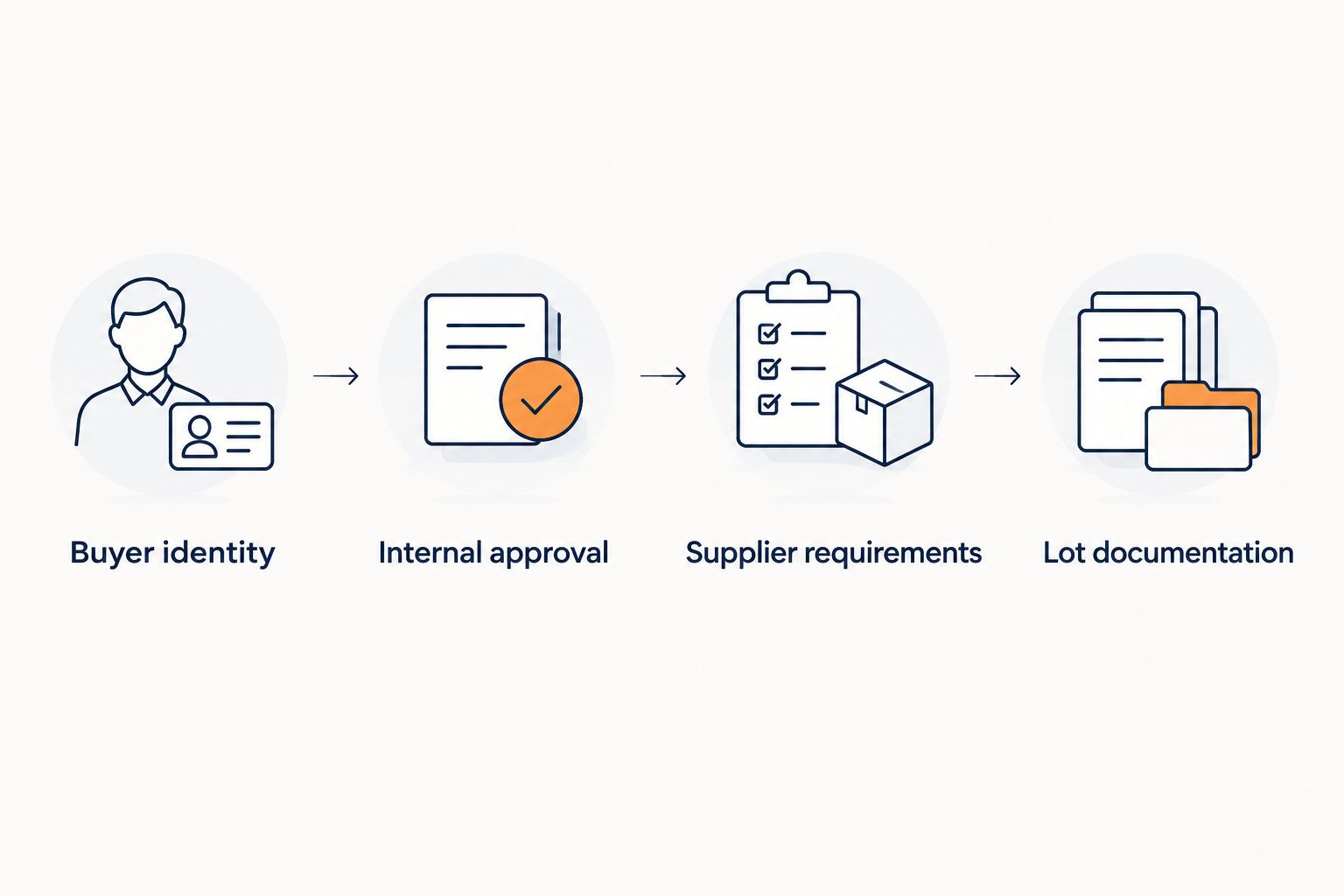
Use this sequence before submitting an order:
- Buyer identity. Identify the institution or other legal entity responsible for the purchase. A department name alone does not resolve which entity belongs on the purchasing record.
- Internal approval. Ask procurement which purchasing route is authorized and whether a tax identifier belongs in that process.
- Supplier requirements. Confirm whether the supplier requires an EIN, institutional credentials, or other buyer information. Request clarification rather than entering substitute information.
- Lot documentation. Review the applicable Certificate of Analysis and establish how the received material will connect to the purchasing record.
These are separate checks. Completing an online checkout does not demonstrate that the purchase satisfies your institution’s requirements or that the material meets your analytical specifications.
Why this matters
The question mixes two different issues: whether the buyer has an EIN and whether the buyer must disclose it to a particular supplier. An institution can have an EIN without every researcher needing to enter it during every purchase.
Not knowing the institution’s EIN is not the same as the institution lacking one. Ask procurement to resolve the distinction before changing the buyer name or using a personal account.
Keep the analytical review separate, too. A tax identifier cannot establish peptide identity, explain an HPLC result, or connect a certificate to a received vial. Those questions require laboratory documentation, not tax information.
What does an EIN establish—and what does it not establish?
An Employer Identification Number is a 9-digit federal tax identification number assigned by the Internal Revenue Service. The IRS describes its purpose in the instructions for Form SS-4, Application for Employer Identification Number.
An EIN is not a laboratory accreditation, a scientific qualification, or a certificate for a research material. Providing one does not remove the need to assess the intended laboratory application and the supplier’s documentation.
For your 2026 purchasing file, distinguish three kinds of evidence:
- Entity evidence: identifies the organization responsible for the transaction.
- Purchasing evidence: records who approved the purchase and which institutional process applies.
- Analytical evidence: documents the tested sample, methods, results, and connection to the supplied lot.
One document should not stand in for all three. A valid tax identifier says nothing about whether a particular certificate matches the vial you receive.
Likewise, a detailed COA does not resolve who is authorized to spend institutional funds. Keep administrative approval and analytical acceptance as separate decisions.
Which purchasing situation matches your laboratory?
Choose the route that accurately represents the buyer. The table compares administrative situations, not supplier promises or exemptions.
| Purchasing situation | Best for | Advantage | Limitation | Next move |
|---|---|---|---|---|
| Central institutional procurement | Researchers purchasing through an established institution | Keeps buyer identity and approval within the institution’s purchasing process | Requires coordination with the responsible office | Ask procurement which entity information it supplies |
| Department-authorized purchasing | Departments with an approved purchasing route | Connects the order to the responsible department | Department approval does not automatically satisfy supplier requirements | Confirm internal authorization and supplier requirements separately |
| Independent laboratory purchasing | Researchers buying for a separate laboratory entity | Identifies the actual buyer directly | Institutional affiliation cannot substitute for that entity’s own documentation | Confirm the laboratory’s buyer information and purchasing responsibilities |
| Unresolved buyer identity | Requests where the responsible entity is unclear | Provides a clear reason to pause before ordering | Does not establish an approved purchasing route | Resolve the buyer before submitting payment or tax information |
Use the approved route, not the route with the fewest fields. A shorter checkout form is not evidence of stronger documentation or fewer institutional obligations.
Do not place an order under an unrelated organization’s EIN. If a field appears mandatory but does not fit the purchasing arrangement, ask the supplier how to proceed rather than entering inaccurate information.
What if your department does not have its own EIN?
Ask whether the department purchases under the parent institution’s legal entity. Do not assume that a department needs a separate EIN simply because it maintains its own budget or laboratory records.
Procurement should identify the appropriate buyer information. Researchers should not create a replacement identity to complete a supplier form.
What if you are affiliated with an institution but buying independently?
State the actual purchasing arrangement. An institutional email address does not, by itself, establish that the institution approved or will pay for the order.
If you intend to seek reimbursement, obtain the relevant approval before buying. A supplier’s acceptance of an order does not establish reimbursement eligibility.
Why EIN requirements vary
For a 2026 order, verify the requirements attached to the actual transaction rather than relying on a previous checkout experience. Review these factors:
- Supplier account requirements. Determine which buyer details are required to establish or use the account.
- Identity of the buyer. Distinguish the institution, department, and individual placing the request.
- Institutional purchasing rules. Confirm which approvals and purchasing channels apply to laboratory materials.
- Requested tax treatment. Ask procurement which supporting documents apply if a particular tax treatment is requested; an EIN alone is not proof of exemption.
- Purchasing arrangement. Confirm whether the proposed ordering and payment process requires additional administrative documentation.
These factors explain what to check; they do not establish a supplier’s current policy. Obtain a transaction-specific answer when the requirement is unclear.
Keep tax identifiers out of general laboratory notes unless your institution requires them there. Use the approved administrative channel for sensitive purchasing information rather than attaching it to every scientific record.
What should you ask the supplier before ordering?
Ask a narrow question that separates EIN disclosure from laboratory eligibility:
Does this institutional laboratory purchase require the buyer’s EIN, and which alternative buyer documents, if any, does your purchasing process accept?
Then confirm the remaining details:
- Which legal buyer name should appear on the order?
- Does the proposed purchasing arrangement require additional approval or documentation?
- Where can the applicable product or lot certificate be reviewed?
- How will the supplied material be identified on the receiving record?
- Who handles discrepancies between the received lot and its documentation?
Do not describe an alternative document as accepted until the supplier confirms acceptance. An institutional email, purchase request, or affiliation statement is not automatically interchangeable with an EIN.
Save the answer with your purchasing records. For a 2026 transaction, retain the date and the specific arrangement discussed so another researcher can understand the decision without reconstructing an email chain.
What analytical evidence matters more than an EIN?
An EIN identifies the buyer’s tax entity; a COA documents analytical results for an identified sample or lot. Neither replaces the other.
A Certificate of Analysis should be read as a record of what was tested, how it was tested, and what the results support. Check identifiers and methods before relying on a summary statement.
HPLC: examine the chromatographic evidence
High-performance liquid chromatography separates sample components under specified analytical conditions. An HPLC purity result describes the chromatographic analysis; it is not interchangeable with identity confirmation or a complete characterization of every constituent.
Review the method information, chromatogram, sample identifier, and reported interpretation. Do not treat a single purity statement as proof of all characteristics your laboratory requires.
Mass spectrometry: examine the identity evidence
Mass spectrometry measures mass-to-charge signals. Interpretation of those signals can support identity assessment when compared with the expected analytical characteristics of the material.
Check that the certificate identifies the relevant material and sample. Mass-spec evidence does not, by itself, establish sterility, suitability for every experiment, or authorization for human or veterinary use.
Lot matching: connect the certificate to the material
Match the lot identifier on the received material to the applicable certificate and receiving record. If the identifiers disagree, pause acceptance and request clarification.
Use 2 analytical questions as a minimum review framework: does the evidence support identity, and what does the chromatographic analysis establish? Add experiment-specific acceptance criteria through your laboratory’s own procedures.
Where Strandaminos fits in the review
Strandaminos is best suited to laboratory researchers who want to compare published HPLC and mass-spec COAs for lyophilized research materials. The published certificates provide analytical documents to examine; they do not replace your institution’s purchasing approval or your laboratory’s acceptance criteria.
Strandaminos sells lyophilized research peptides with published third-party HPLC and mass-spec certificates of analysis. Review the specific certificate relevant to the material rather than extending a general testing statement to every characteristic of a lot.
For a 2026 purchasing decision, confirm the current EIN requirement directly. Do not infer an administrative policy from the presence of analytical certificates.
Research use only. Not for human or veterinary use. 21+.
Confirm your institutional purchasing requirements
Ask whether your purchasing arrangement requires an EIN and which buyer documents apply.
What records should your laboratory retain?
Keep 3 record groups connected: purchasing approval, supplier correspondence, and analytical documentation. This is a practical filing recommendation, not a claim that every institution uses the same retention policy.
Record the legal buyer, approval reference, supplier response about required documents, and the material’s lot identifier. Preserve the applicable COA alongside the receiving record using your institution’s approved system.
The objective is traceability. Another authorized researcher should be able to determine who approved the purchase, what material arrived, and which certificate was reviewed without relying on the original buyer’s memory.
FAQ
Can a university laboratory order research peptides without providing an EIN?
A university laboratory can order without providing an EIN when the supplier accepts that arrangement and university procurement permits it. Confirm both requirements before submitting the order.
Does an EIN prove that a peptide buyer is a qualified researcher?
An EIN does not prove research qualifications; it identifies a tax entity. Laboratory eligibility and purchasing authorization require separate review.
Can I use my personal information instead of my university’s EIN?
Use personal information only when it accurately reflects an approved purchasing arrangement and the supplier accepts it. Do not substitute personal details to bypass a required institutional review.
Is an EIN the same as a tax-exemption certificate?
An EIN is not a tax-exemption certificate. Ask institutional procurement which documentation supports the requested tax treatment.
Does Strandaminos require an EIN for institutional orders?
Confirm the current EIN requirement directly with Strandaminos before placing an institutional order. Published analytical certificates do not establish the supplier’s buyer-verification policy.
Does a peptide COA replace institutional purchasing approval?
A peptide COA does not replace institutional purchasing approval. It documents analytical results, while purchasing approval establishes the authorized administrative route.
Does ordering without an EIN permit personal or veterinary use?
Ordering without an EIN does not authorize personal or veterinary use. The materials discussed here are for laboratory research only: Not for human or veterinary use.
One last thing
Resolve the buyer before resolving the checkout field. An institution that already has an EIN presents a different administrative question from a separate laboratory entity that has not established its own purchasing documentation.
Ask procurement to identify the correct entity first. Then obtain the supplier’s requirements and review the lot evidence as a separate scientific decision.


