

A supplier-wide testing statement does not confirm that the Klow blend has a published Certificate of Analysis. Treat publication as verified only when you can open a report that identifies the blend and matches the relevant lot. For a laboratory review in 2026, check what the report actually tests rather than accepting a testing badge as product-specific evidence.
- A Klow blend certificate of analysis needs an accessible report identifying the blend and its lot.
- HPLC and mass-spec evidence answer different analytical questions; neither replaces lot traceability.
- Strandaminos publishes third-party peptide COAs; that supplier-wide fact does not verify a particular Klow report.
- Research use only. Not for human or veterinary use.
Why this matters
A certificate supports a laboratory decision only when it connects the material under review to identifiable analytical results. A document for another product, an unrelated lot or an individual ingredient does not establish what was tested in the blend you are evaluating.
Strandaminos publishes third-party HPLC and mass-spec Certificates of Analysis for research peptides. That describes its documentation approach, not the publication status or contents of a particular Klow blend certificate.
Strandaminos serves laboratory researchers seeking research peptides with published analytical documentation, not products for human or veterinary use. Keep that boundary separate from the analytical review: a research-use statement identifies intended use, while a COA reports specified analytical results.
Does the Klow blend have a published Certificate of Analysis?
A verifiable “yes” requires an accessible, product-specific certificate with a matching lot identifier. A statement that a supplier tests its peptides is not enough to establish that a particular blend has a published report.
Use these checks for your 2026 documentation review:
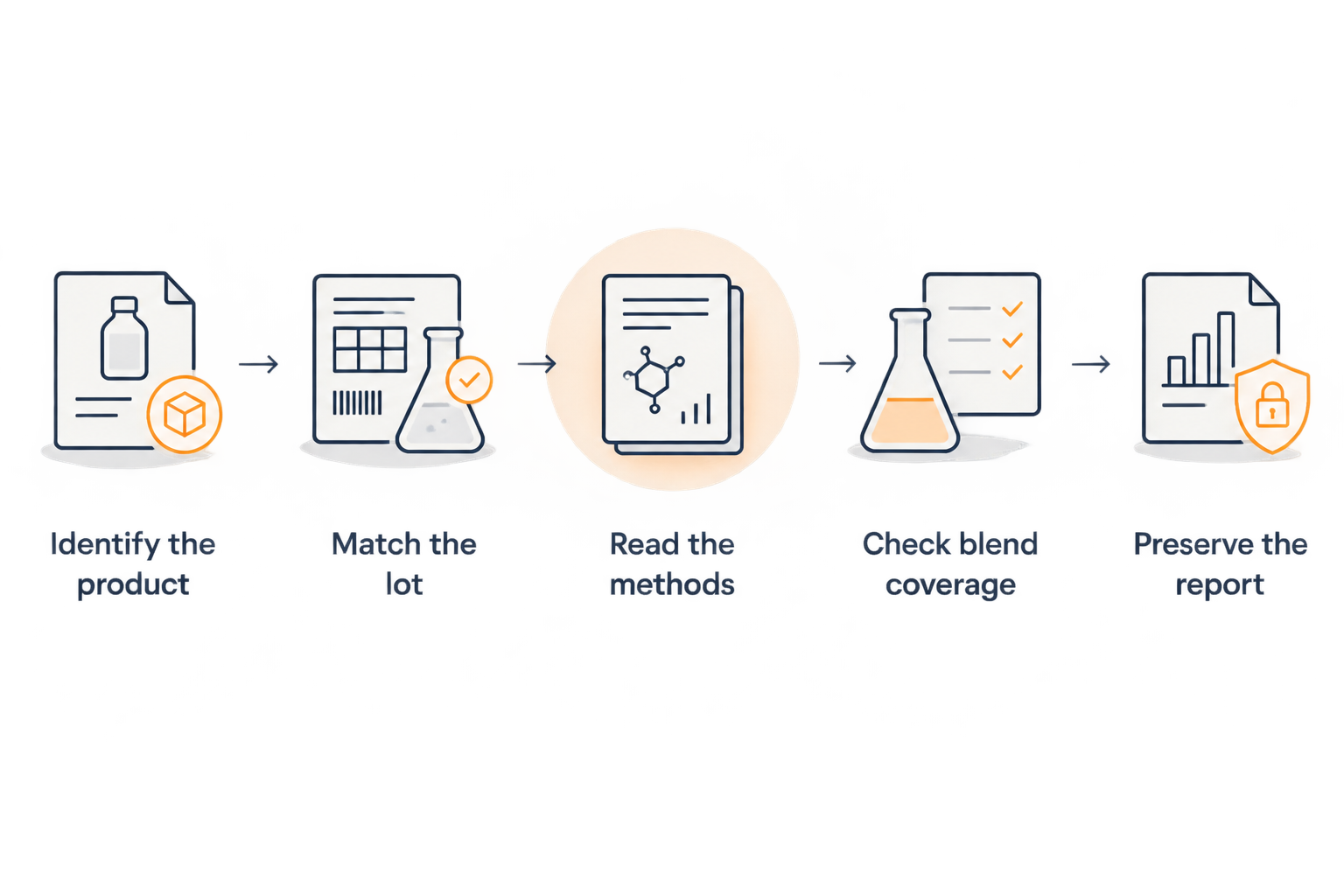
- Identify the product. Confirm that the document names the Klow blend or uses a product identifier that the supplier explicitly connects to it. Do not infer the connection from similar names.
- Match the lot. Compare the certificate’s lot or batch identifier with the material being evaluated. Record any mismatch before relying on the results.
- Read the methods. Determine whether the document includes HPLC, mass spectrometry or other testing. Read the stated scope rather than treating every analytical method as interchangeable.
- Check blend coverage. Establish whether the report concerns the finished blend, individual components or another sample. Those are different scopes of evidence.
- Preserve the report. Save the certificate and its document reference in your laboratory records. Retain the review date alongside the file.
These checks establish traceability and clarify the report’s scope. They do not turn a research-use material into an approved product for people or animals, and they do not establish suitability for every laboratory assay.
What should a Klow blend COA establish?
A useful certificate tells you what sample was examined, how it was examined and which results belong to that examination. The document’s title alone does not establish its analytical coverage. Read the sample description, identifiers, methods and results together.
For a blend, distinguish evidence about the submitted mixture from evidence about separately tested ingredients. Ingredient reports can document those ingredient samples; they do not automatically characterize the finished mixture.
| Evidence type | Best for | What it supports | Main limitation |
|---|---|---|---|
| Product and lot identifiers | Linking records to material | Connecting a report to a named sample or batch | Identifiers alone do not establish analytical quality |
| HPLC results | Reviewing chromatographic separation | Examining detected peaks under the stated method | Peak area alone does not establish component identity or vial content |
| Mass-spec results | Evaluating molecular-mass evidence | Comparing observed mass signals with expected molecular species | Mass agreement alone does not establish every structural detail |
| Finished-blend report | Reviewing the submitted mixture | Assessing the blend within the report’s stated scope | Coverage depends on the methods and reported results |
| Individual-component reports | Reviewing component samples | Examining separately documented ingredients | They do not automatically verify the finished blend |
Do not assume the Klow name defines a particular composition. Use the supplier’s explicit product specification and compare it with the certificate’s sample description. If those descriptions differ, resolve the difference rather than choosing whichever document appears more detailed.
HPLC: examine the separation, not just the headline
HPLC means high-performance liquid chromatography. It separates sample constituents under specified conditions, with a detector producing a chromatographic response.
For a blend, interpreting that response requires attention to separation and detection. Constituents can overlap in a chromatogram, and different constituents can produce different detector responses. A headline chromatographic result does not, by itself, establish the amount of every component.
Look for enough method context to understand what the reported result represents. Where the certificate provides a chromatogram, compare the figure with the accompanying result and sample identifier rather than treating the image as a stand-alone endorsement.
Mass spectrometry: check the identity evidence
Mass spectrometry measures ions by their mass-to-charge ratio. In peptide analysis, observed signals can support an identity assignment when interpreted against the expected molecular species and the method used.
For a blend, ask which components the identity assessment covers. A mass spectrum attributed to a component does not automatically establish the identity of every other constituent in the mixture.
HPLC and mass spectrometry are complementary evidence, not interchangeable certificates. Neither a chromatogram nor a matching mass signal, viewed alone, establishes every property your experiment might require.
Why does the strength of COA evidence vary?
The practical value of a Klow blend certificate depends on its connection to the material and the questions its methods address. Compare documentation using these factors:
- Product specificity: A report naming the relevant blend provides a clearer connection than a general testing statement. Resolve unexplained product codes before accepting the match.
- Lot traceability: A matching lot identifier connects the document to the batch under review. A report for another lot remains evidence about that other lot.
- Sample scope: Finished-blend testing and separate ingredient testing describe different submitted samples. Record which scope the certificate actually covers.
- Method disclosure: Named methods and interpretable results let you assess what was measured. A testing badge offers no equivalent analytical detail.
- Document provenance: An identifiable testing laboratory, report reference and consistent sample details support verification. Appearance alone does not establish authenticity.
- Result coverage: Identity, chromatographic composition, content and other characteristics are separate analytical questions. Do not treat an unreported characteristic as tested.
For a 2026 review, keep the date you accessed the certificate separate from any analysis date printed on it. Accessing a document today does not change when its sample was tested.
What should you ask if the certificate is unclear?
Ask for the specific document and the specific connection you need. “Is it tested?” invites a general answer; “Which report identifies this product and lot?” directs the discussion toward verifiable records.
A focused request should identify the product, the lot if known, and the unresolved point. You can ask the supplier to clarify whether a document covers the finished blend, which analytical methods were used and how an internal sample code maps to the product description.
Use the contact page to request product-and-lot-specific clarification from Strandaminos. This is a request for documentation, not a claim that a particular Klow certificate is published or that additional testing will be performed.
Keep the response with the certificate. An explanation that connects a sample code to a product is part of your traceability record; it should not exist only in someone’s memory.
What if the report is accessible only after a request?
A report supplied privately can still be reviewed as analytical documentation. Describe it accurately as a supplied report rather than a publicly accessible certificate.
Separate access from quality. Public accessibility helps researchers inspect documentation before procurement, but it does not establish that the methods answer every question relevant to an experiment.
What if the certificate covers a different lot?
A different-lot certificate does not verify the lot you are evaluating. Request the matching record or document that the available evidence concerns another batch.
Do not change a lot identifier in your records to make the documents agree. Preserve the discrepancy and resolve it through your laboratory’s material-review process.
How should you record a Klow blend COA review?
Keep 3 linked records: the product specification, the certificate and the material’s lot identifier. Together, they let another researcher follow the connection between the intended material, the reported analysis and the batch under review.
For your 2026 record, also capture the source location, access date and any correspondence explaining product or sample codes. Preserve the original certificate rather than retaining only a cropped result or a manually copied conclusion.
A useful review note distinguishes reported facts from laboratory decisions. The certificate reports analytical findings; your laboratory decides whether those findings satisfy its documented requirements for the intended experiment.
If a characteristic matters to the assay but is not addressed by the report, record that limitation. Do not turn silence into a passing result or assume an unrelated method measured it.
FAQ
Does a general peptide-testing claim prove that Klow has a published COA?
No. A general testing claim does not establish that a Klow-specific certificate is publicly accessible or that it matches the relevant lot. Verify the actual document and its sample identifiers.
What should I match first on a Klow blend certificate of analysis?
Match the product identifier and lot identifier first. Analytical results from another product or batch do not verify the material you are evaluating.
Does an HPLC report identify every component in a blend?
An HPLC report does not automatically identify every component in a blend. Identity assignments depend on the method and supporting evidence, and overlapping chromatographic signals require careful interpretation.
Is mass-spec testing the same as HPLC testing?
No. Mass spectrometry examines ions by mass-to-charge ratio, while HPLC separates sample constituents under specified conditions. The methods answer different analytical questions.
Can separate ingredient COAs replace a finished-blend certificate?
Separate ingredient COAs do not automatically verify a finished blend. They describe the ingredient samples tested, so confirm whether additional documentation addresses the mixture itself.
Does a COA establish that a research peptide is suitable for human use?
No. A research-peptide COA reports specified analytical results; it does not establish suitability for human or veterinary use. Research use only. Not for human or veterinary use.
Should I keep a certificate after recording its result?
Yes. Preserve the original certificate with the product specification, lot identifier and review notes. A copied result alone leaves out the document context needed to assess what was tested.
One last thing
A certificate can be authentic and still be the wrong certificate for your material. Authenticity asks whether the document is genuine; applicability asks whether it covers the product, lot and analytical question you need.
Make that distinction explicit in your 2026 review. Verify the match before interpreting the result, and keep every conclusion within the report’s stated scope. Research use only. Not for human or veterinary use.


