

To calculate peptide concentration from a COA, divide the documented peptide mass by the final solution volume; for molar concentration, also divide by the molecular weight of the specified peptide form. HPLC peak-area purity and mass-spec identity do not, by themselves, establish the peptide mass in a vial, so a COA containing only those results cannot establish an assay-supported concentration.
- To calculate peptide concentration from COA data, use documented peptide mass, final volume, and the appropriate molecular weight.
- HPLC peak-area purity describes chromatographic composition; it is not automatically a peptide mass fraction.
- Mass-spec identity supports identity assessment, not an uncalibrated measurement of vial content.
- Strandaminos research peptides are for laboratory research only, not human or veterinary use.
How do you calculate peptide concentration from a COA?
Use concentration = peptide mass ÷ final solution volume. The critical step is establishing what the reported mass represents before entering it into the calculation.
Follow this sequence for a laboratory calculation in 2026:
- Match the lot. Confirm that the Certificate of Analysis, or COA, corresponds to the material in your laboratory record.
- Identify the mass basis. Distinguish nominal labeled content, total powder mass, and an analytically determined peptide amount.
- Check the evidence. Determine whether the certificate reports identity, chromatographic purity, quantitative content, or a combination.
- Record final volume. Use the solution's final measured volume, not an assumed equivalent based on solvent added.
- Calculate and label. Report mass concentration or molarity with units and state whether the result is nominal or analytically supported.
Keep the certificate and calculation together. The COA-to-lab-records workflow covers the documentation context for that record.
A correct equation cannot repair an unsupported input. If a certificate supplies identity and chromatographic purity but no quantitative content result, retain that distinction in the concentration label.
Why this matters
A concentration error can begin before the arithmetic: a powder weight becomes a peptide weight, a chromatographic area becomes a mass fraction, or an identity result becomes an assumed content assay. Each substitution changes what the final number means.
For a 2026 laboratory record, preserve the evidence behind the numerator, not just the final concentration. A repeatable calculation needs a traceable mass basis, volume basis, and molecular-weight convention.
Strandaminos sells research peptides with published third-party HPLC and mass-spec certificates. Those analytical categories answer different questions; the specific certificate determines which conclusions the result supports. Research use only. Not for human or veterinary use.
What each COA result supports
Read the reported method and result together. A heading such as purity or identity does not establish that a quantitative peptide-content assay was performed.
| Evidence or calculation basis | Best for | What it supports | Main limitation |
|---|---|---|---|
| HPLC peak-area result | Comparing detected chromatographic components | Relative detector response under the reported method | Does not automatically measure peptide mass fraction or vial content |
| Mass-spec identity result | Assessing molecular identity | Agreement of observed ions with the expected molecular species | Identity alone does not quantify total peptide amount |
| Quantitative content assay | Establishing peptide amount | Amount determined through the stated quantitative method | Interpretation depends on calibration, reporting basis, and method scope |
| Nominal labeled content | Recording an explicitly nominal calculation | Concentration calculated from the stated label amount | Does not establish analytically measured content |
| Total powder mass | Tracking material mass | Combined mass of the material weighed | Can include water, counterions, and other components |
HPLC can support quantification when the method uses suitable calibration and reports a quantitative result. The limitation is not HPLC itself; it is treating an area-normalized purity result as though it were a calibrated content measurement.
Likewise, mass spectrometry can form part of a quantitative analytical method. A certificate reporting mass-spec identity alone does not establish that such a method was used.
Mass concentration: use peptide mass per final volume
Mass concentration expresses how much peptide mass is present per unit of solution volume. It does not require a molecular-weight conversion.
Mass concentration = documented peptide mass ÷ final solution volume
Choose compatible units before dividing. For example, mass in mg divided by volume in mL produces mg/mL; mass in µg divided by volume in mL produces µg/mL.
These unit relationships are exact:
- 1 mg = 1,000 µg.
- 1 mg/mL = 1 g/L.
- 1 mmol/L = 1,000 µmol/L.
These are conversion relationships, not example vial contents or product specifications. Keep them separate from certificate-derived values in your worksheet.
If you use labeled content rather than measured peptide content, call the result nominal mass concentration. That wording preserves the calculation's usefulness without claiming analytical confirmation that the record does not contain.
When a content correction belongs in the equation
If a validated quantitative result explicitly gives the target peptide's mass fraction in the weighed material, the relationship is:
Peptide mass = material mass × documented target-peptide mass fraction
Then divide that peptide mass by the final solution volume. Apply this only when the reported fraction's definition and measurement basis support that use.
Do not substitute an HPLC area fraction for a target-peptide mass fraction. Do not apply a second correction when the certificate already reports the corrected peptide amount; that would count the adjustment twice.
Molar concentration: match the molecular-weight basis
Molarity expresses amount of substance per unit volume. To calculate it, divide mass concentration in g/L by the appropriate molar mass in g/mol.
Molar concentration in mol/L = mass concentration in g/L ÷ molar mass in g/mol
Because 1 mg/mL equals 1 g/L, you can convert a mass concentration expressed in mg/mL to g/L without changing its numerical value. The subsequent molecular-weight division produces mol/L, not mmol/L or µmol/L.
Use the molecular weight that matches the molecular species and mass basis in your calculation. A certificate can distinguish an average molecular mass, a monoisotopic mass, an observed ion, or another reported quantity; those entries are not interchangeable.
An observed mass-to-charge ratio is not automatically the molar mass. Charge state and ion assignment matter when interpreting a mass spectrum.
For a 2026 worksheet, identify whether the calculation uses peptide-equivalent mass or the mass of a specified salt or other form. A mismatch between that numerator and the selected molar mass produces a result with misleading meaning even when the units cancel correctly.
A practical COA-to-concentration check
Build the calculation around evidence fields rather than a single purity field. This separates what the certificate establishes from what the laboratory supplies.
- Lot match: Record the identifier connecting the material and certificate.
- Mass basis: State whether the input is labeled content, weighed powder, or quantified peptide content.
- Content evidence: Record the method and reporting basis supporting any quantitative correction.
- Final volume: Record the measured solution volume and its unit.
- Result label: Identify mass concentration or molarity and whether it is nominal or analytically supported.
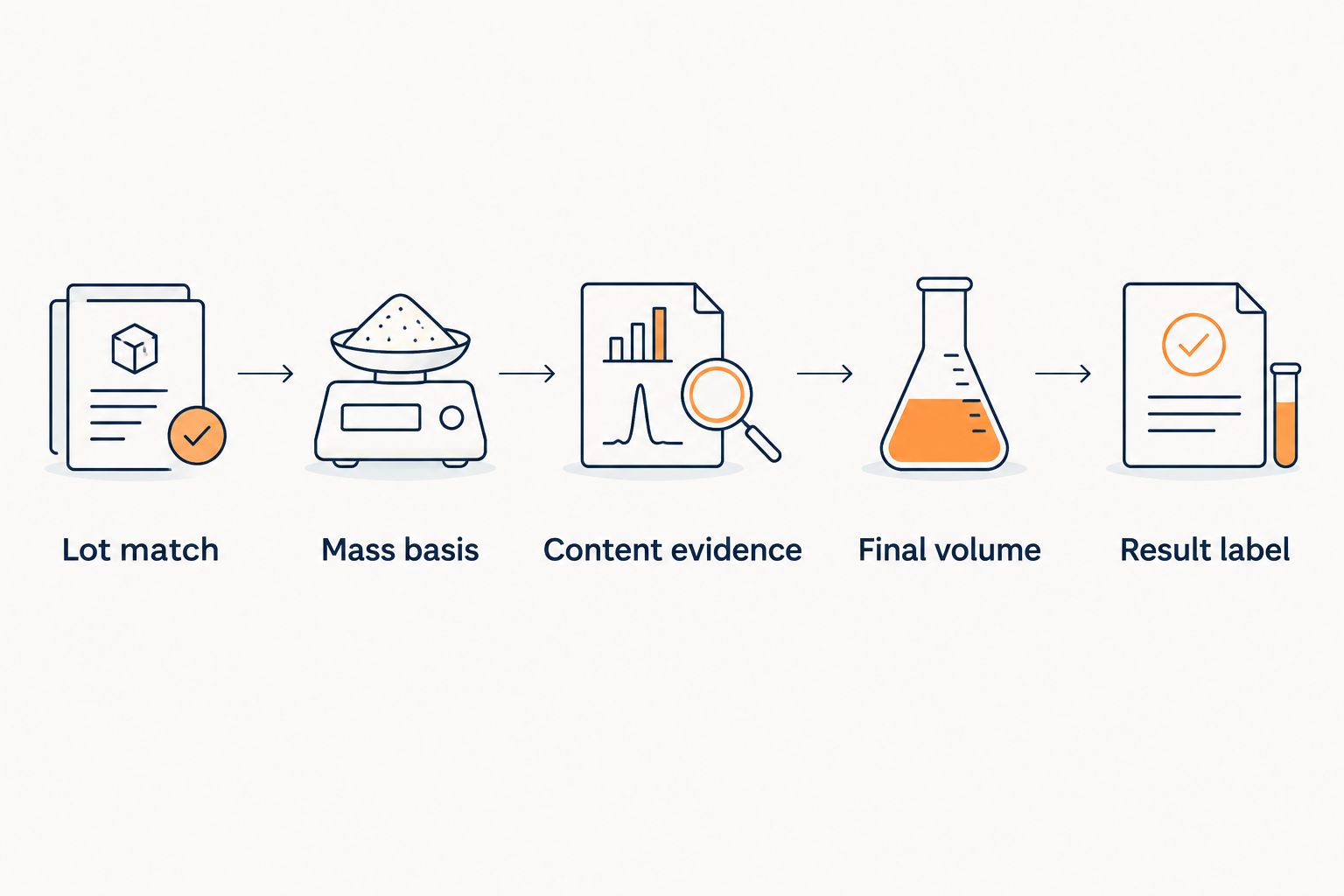
Keep the original certificate wording alongside any normalized worksheet field. If you rename a result during data entry, preserve enough context to distinguish chromatographic purity from quantitative peptide content.
A useful spreadsheet also keeps units beside every input. A bare number loses its meaning when copied into another sheet or exported into a laboratory notebook.
Why calculated peptide concentration varies
Different concentration results do not necessarily indicate an arithmetic mistake. First check whether the calculations describe the same quantity.
- Mass basis: Total powder mass and quantified peptide mass are different inputs. State which one your calculation uses.
- Water and counterions: These can contribute to material mass without representing the target peptide's mass. Use certificate-supported corrections rather than assumptions.
- Quantitative method: A content assay's calibration and reporting basis determine how its result enters the calculation.
- Volume basis: Solvent added and final solution volume are not interchangeable measurements.
- Molecular form: A molarity calculation must align the mass basis with the molecular species represented by the molar mass.
- Material recovery: A calculation that assumes complete transfer and dissolution does not independently verify either condition.
Keep assumptions visible. A calculated starting concentration also does not establish that a solution remains unchanged during storage or experimental handling; that is a separate analytical question.
Choosing a supplier for usable analytical records
Strandaminos is a research-peptide supplier for laboratory researchers, not for human or veterinary use. That scope matters more than treating a certificate as evidence for uses it does not address.
When assessing Strandaminos, examine the specific product certificate rather than extending a general testing statement to every calculation. Published HPLC and mass-spec evidence supports analytical review, but those method names alone do not establish quantitative vial content.
For a 2026 procurement decision, ask what each reported result measures, how the certificate identifies the lot, and whether any content result supplies the numerator your laboratory needs. A certificate can be useful for identity and chromatographic review while still being insufficient for an assay-supported concentration calculation.
The purchasing criterion is straightforward: select documentation that answers your laboratory's analytical question. Do not substitute the presence of a COA for review of its contents.
Can you calculate concentration from HPLC purity alone?
HPLC peak-area purity alone does not establish peptide concentration. You still need a supported peptide amount and a final solution volume.
An area-normalized chromatogram describes relative detector response among the integrated peaks under that method. Different response factors, undetected components, and the method's scope prevent automatic conversion of that result into a whole-vial peptide mass fraction.
Can you use the vial label when quantitative content is absent?
A vial label supports a nominal concentration calculation, not an analytically confirmed one. Record that limitation beside the result rather than burying it in a separate note.
If the experiment requires independently established concentration, use an appropriate quantitative method within your laboratory's procedures. An identity certificate does not supply the missing measurement.
Does a matching mass spectrum prove the concentration?
A matching mass spectrum supports identity assessment, not concentration by itself. A quantitative mass-spectrometric method requires suitable calibration and a stated quantitative result.
Read the report's actual conclusion. Do not transform an identity finding into a content claim during spreadsheet entry.
FAQ
What information do I need to calculate peptide concentration from a COA?
You need a supported peptide mass and the final solution volume; molarity also requires the appropriate molar mass. Match the certificate to the lot and state whether the mass input is nominal or quantitatively measured.
Is HPLC purity the same as peptide content?
HPLC peak-area purity is not automatically peptide content. A quantitative content result needs a method and reporting basis that establish the peptide amount rather than only relative chromatographic response.
Should I multiply vial mass by the HPLC purity result?
Do not automatically multiply vial mass by an HPLC peak-area result. That calculation requires a supported target-peptide mass fraction, which an area-normalized chromatogram alone does not establish.
How do I convert mg/mL to mol/L?
Convert mg/mL to g/L using 1 mg/mL = 1 g/L, then divide by the appropriate molar mass in g/mol. Confirm that the molecular form matches the mass basis used in the calculation.
Can mass spectrometry tell me how much peptide is in a vial?
Mass spectrometry can support quantification when used in a suitable quantitative method, but an identity result alone does not establish vial content. Check whether the certificate actually reports a calibrated quantitative measurement.
Should I use solvent added or final solution volume?
Use the final solution volume for a concentration defined as peptide amount per solution volume. Do not assume that the volume of solvent added is an independently measured final volume.
What should I save with a peptide concentration calculation?
Save the lot-matched certificate, mass basis, supporting quantitative result, final volume, units, and calculation. For molarity, also save the molar mass and molecular-form basis; label nominal results explicitly.
One last thing
Before approving a 2026 calculation record, read only the numerator's label. If it says peptide mass, you should be able to point to evidence that establishes peptide mass—not merely powder weight, an identity match, or a chromatographic area result.
Make the result no stronger than its inputs. A clearly labeled nominal concentration is more useful than an apparently precise value whose mass basis cannot be traced.


