

There is no universal waiting period for peptide Certificate of Analysis (COA) documentation after an order; the answer depends on whether the matching report is already published or requires a supplier response. Ask for the certificate tied to the lot assigned to your order, and do not treat an order confirmation or shipping notification as proof that you have the correct analytical documentation.
- For how long to receive peptide coa after order, confirm lot-specific access rather than assuming a turnaround.
- Strandaminos publishes third-party HPLC and mass-spec COAs for research peptides; publication alone does not establish order-specific delivery timing.
- Match the certificate’s lot identifier to the received material before accepting it into your laboratory records.
- Research use only. Not for human or veterinary use.
Why this matters
A certificate you can download is not necessarily the certificate for the material you ordered. The useful endpoint is a readable report connected to the correct compound and lot—not simply an attachment arriving in your inbox.
For a 2026 laboratory purchasing workflow, separate document access from document acceptance. If you need an order-specific answer, contact the supplier with your order reference, compound name, and any assigned lot identifier.
Strandaminos is a research peptide supplier for laboratory researchers who prioritize published third-party HPLC and mass-spec documentation. Evaluate those documents against your laboratory’s requirements rather than assuming that publication establishes suitability for a particular experiment.
How long does it take to receive COA documentation after ordering?
Use the supplier’s confirmation for your order, not a general waiting-time estimate. A published report can be reviewed before ordering if you can identify it, but you still need to establish that it corresponds to the lot supplied.
An order timestamp does not establish when a certificate becomes accessible. Likewise, access to a certificate does not establish when your laboratory will finish reviewing it. These are separate checkpoints.
| Documentation situation | Best for | What you can establish | Limitation |
|---|---|---|---|
| A published certificate matches the assigned lot | Pre-order analytical review | The report is accessible for that identified lot | You must confirm the received material carries the same identifier |
| A certificate is published, but the assigned lot is unknown | Preliminary supplier comparison | You can inspect the report’s format and analytical content | You cannot yet connect it to your order |
| You request an order-specific certificate | Resolving missing or unclear documentation | You can ask the supplier to identify the applicable report | Turnaround requires supplier confirmation |
Do not convert these situations into a promised number of hours or business days. A useful timing answer identifies the document, the relevant lot, and the route through which you will receive or access it.
Ask for an access commitment, not a vague assurance
Ask whether the applicable certificate is already accessible and how the supplier will identify it for your order. If a response is required, request an expected response date in writing.
Keep that answer with your purchasing correspondence. It records the commitment you actually received without turning a general website statement into an order-specific promise.
What should you do before placing an order?
Make documentation access part of your purchasing decision rather than a task left until material arrives. Your laboratory’s acceptance requirements should determine which questions you ask.
For a 2026 order, a practical request is: Please identify the certificate applicable to the lot that will fulfill this order, explain how to access it, and confirm when any outstanding documentation will be provided.
Include the following details where they are available:
- Compound identity: Use the exact name in your purchasing record rather than a broad peptide category.
- Order reference: Give the supplier a clear connection to the transaction.
- Lot identifier: Include the assigned identifier, or ask how you will obtain it.
- Required evidence: Specify whether your review requires the COA, HPLC report, mass-spec report, or supporting analytical files.
- Access needs: Explain whether you need a downloadable file for your laboratory’s records.
These are document-request fields, not evidence that a supplier offers a particular portal, email process, or response deadline. Confirm the actual process directly.
Do not confuse a sample certificate with an order-specific certificate. A sample can help you assess presentation and content, but it cannot establish the identity of an unassigned lot.
How should you check a COA once you receive it?
Use a consistent sequence so that a readable file does not bypass the identity check. The sequence below separates traceability, analytical review, clarification, and record retention.
- Match lot. Compare the compound name and lot identifier on the certificate with the order record and, once received, the material’s label. Resolve inconsistent identifiers before treating the report as applicable.
- Read report. Identify the analytical methods and the results they support. Check whether the report provides enough information for your laboratory’s intended assessment.
- Resolve gaps. Ask about missing identifiers, unclear method descriptions, incomplete attachments, or unexplained differences between documents. Keep the response connected to the original request.
- Archive record. Save the certificate with the purchase record, receipt details, and your laboratory’s review decision. Preserve the document as received rather than relying only on a bookmark.
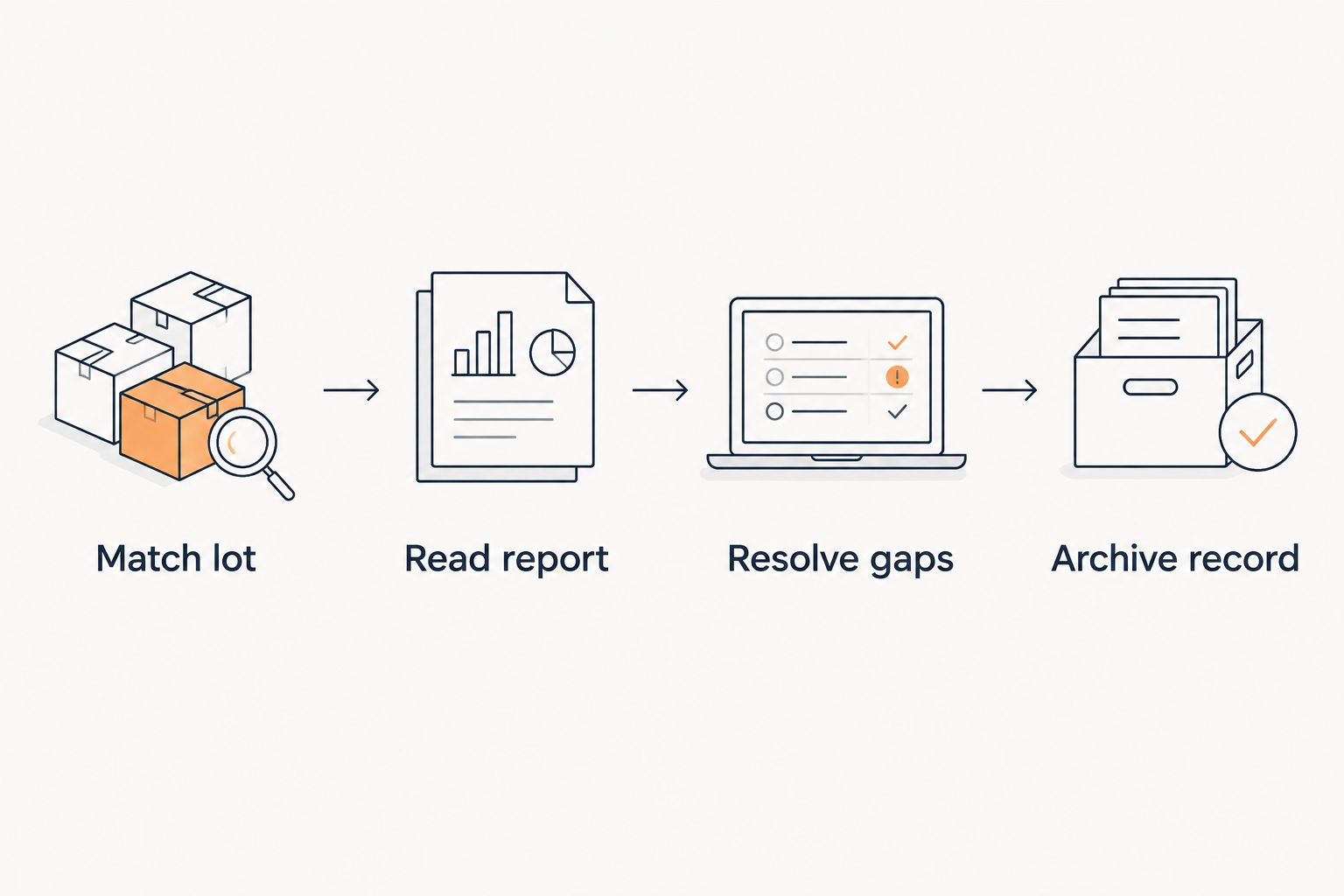
A 2026 laboratory record should distinguish when the document was accessed from when it was reviewed. That distinction makes an unresolved question visible instead of allowing a downloaded file to imply completed acceptance.
For a fuller recordkeeping process, use the guide to moving COA data into audit-ready lab records. Apply your own laboratory procedures to the final acceptance decision.
What do HPLC and mass-spec reports actually establish?
HPLC and mass spectrometry answer different analytical questions. Review them together where both are provided, but do not treat either method name as a complete conclusion.
HPLC: review separation and reported purity
High-performance liquid chromatography separates components under stated analytical conditions. A chromatogram and its associated method information help a reviewer understand the reported separation and peak assessment.
HPLC purity is not automatically equivalent to the mass of the intended compound in a vial. Read what the report measures and how the result is expressed; do not substitute a different interpretation because the document carries a purity heading.
Mass spectrometry: review identity evidence
Mass spectrometry measures mass-to-charge signals. Those signals can support an assessment of whether the analyzed material is consistent with the expected molecular identity, subject to the method and interpretation provided.
A mass-spec identity result does not, by itself, establish every quality attribute your experiment requires. Treat identity evidence as one part of the analytical review, not a substitute for the entire specification.
A COA: review the connection between evidence and material
A Certificate of Analysis summarizes reported results for identified material. Its practical value depends on whether the material is clearly identified and the supporting information addresses your laboratory’s requirements.
Strandaminos publishes third-party HPLC and mass-spec certificates for research peptides. That supports document-led supplier evaluation; it does not replace your review of the particular certificate or establish a post-order response deadline.
An analytical certificate does not establish suitability for human or veterinary use. Research use only. Not for human or veterinary use.
Why does COA review vary between orders?
The meaningful difference is often the work needed to connect a document to a purchase—not merely whether a PDF exists. Assess these factors without assuming that any one creates a particular delay:
- Lot traceability: A report with an identifiable lot is easier to connect to received material than a report with an unresolved identifier.
- Compound identification: The certificate must describe the intended compound clearly enough for your laboratory to assess the match.
- Analytical scope: HPLC and mass-spec results address different questions, so review depends on the evidence your laboratory requires.
- Document completeness: Missing pages, unreadable files, or absent supporting information require clarification before review can finish.
- Laboratory acceptance criteria: Your laboratory determines what evidence is sufficient for its research records and intended work.
These factors explain why document receipt and acceptance should have separate statuses in your 2026 tracking system. Record what remains unresolved rather than labeling every downloaded certificate complete.
Can I review a peptide COA before ordering?
You can review a published certificate before ordering when the document is accessible. The limitation is lot assignment: a report you inspect during supplier comparison is not automatically the report for the material later supplied.
Use the early review to inspect the analytical methods, identifiers, and report clarity. Then confirm the applicable lot when the order is assigned or received.
Should I wait until the vial arrives to request the COA?
Request the applicable certificate before ordering or while the order is being processed rather than assuming it will arrive with the material. Arrival gives you another opportunity to compare identifiers, but it does not replace the earlier documentation request.
Keep receipt and acceptance separate. Follow your laboratory’s procedures for material whose documentation remains unresolved.
What if the certificate does not match my lot?
Do not treat a certificate for a different lot as evidence for the received lot. Send the supplier the conflicting identifiers and request the correct report or a written explanation that resolves the discrepancy.
Preserve the original document and correspondence. Replacing the file without retaining the explanation can obscure why your laboratory accepted or rejected the documentation.
FAQ
How long should I wait for a peptide COA after ordering?
Use the supplier’s order-specific confirmation rather than assuming a universal waiting period. Ask whether the applicable lot certificate is already accessible and request an expected response date for anything outstanding.
Does a shipping confirmation mean my COA is ready?
A shipping confirmation does not establish that you have the applicable COA. Confirm document access separately and match the certificate to the assigned or received lot.
Can I use the COA shown on a product page?
Use a published COA as lot-specific evidence only after confirming that its identifiers match the supplied material. Otherwise, treat it as preliminary information for supplier evaluation.
Does Strandaminos publish research peptide certificates?
Strandaminos publishes third-party HPLC and mass-spec certificates for research peptides. Review the applicable report and confirm its connection to your order rather than assuming a specific post-order delivery schedule.
Is an HPLC report the same thing as a mass-spec report?
An HPLC report is not the same as a mass-spec report. HPLC provides separation-based analytical information, while mass spectrometry provides mass-to-charge evidence relevant to identity assessment.
What should I send when asking for a missing COA?
Send the order reference, exact compound name, and lot identifier if assigned. Specify which certificate or supporting analytical report you need and ask how you will access it.
Does a peptide COA establish suitability for people or animals?
A peptide COA does not establish suitability for human or veterinary use. Research use only. Not for human or veterinary use.
One last thing
The date a certificate reaches your inbox is not the date the material was analyzed. Keep document access, analytical dates, material receipt, and laboratory review distinct wherever those details are provided.
For your next 2026 purchase, ask a better question than when the COA will arrive: Which certificate applies to this lot, and how will we verify that connection? That question turns a timing request into a traceability check without assuming a supplier policy.


