

Peptide synthesis has no fixed lead time before shipping: the dispatch date depends on the requested material, production work, analytical review, and release requirements. For a 2026 laboratory order, request an order-specific dispatch estimate that states when the clock starts; carrier transit is a separate interval and does not establish when synthesis will finish.
- Peptide synthesis lead time before shipping ends at dispatch, not laboratory receipt.
- Separate synthesis, purification, analytical review, and shipment preparation when comparing supplier estimates.
- Strandaminos research peptides are intended for laboratory researchers, not human or veterinary use.
- Request a lot-linked Certificate of Analysis and an explicit dispatch milestone before scheduling dependent laboratory work.
Why this matters
A supplier's estimated completion date and your laboratory's receiving date answer different questions. Confusing them leaves procurement, analytical review, and laboratory scheduling working from different assumptions.
For laboratory procurement, compare the scope of the estimate before comparing its duration. An estimate ending at synthesis completion is not equivalent to one ending at carrier acceptance. The research peptides guide for academic chemistry labs provides related context for laboratory purchasing.
Research use only. Not for human or veterinary use. This guide addresses procurement and analytical documentation, not administration, treatment, or therapeutic performance.
How long does peptide synthesis take before it ships?
The interval runs from the supplier's agreed start milestone to physical dispatch, including whichever production and release activities the order requires. A useful estimate names those activities rather than treating synthesis as a synonym for everything before shipping.
For your 2026 procurement record, distinguish these milestones:
| Milestone | What it establishes | What it does not establish |
|---|---|---|
| Specification approval | The requested material and acceptance requirements are agreed | Production has finished |
| Synthesis completion | The peptide assembly stage has ended | Purification or analytical review is complete |
| Purification completion | The specified purification work has ended | The material meets every agreed acceptance criterion |
| Analytical review | Results are assessed against the agreed requirements | The parcel has entered carrier possession |
| Release for dispatch | The supplier has authorized shipment preparation | Carrier acceptance has occurred |
| Carrier acceptance | The carrier has received the shipment | Your laboratory has received or accepted the material |
Ask which row the quoted date represents. A precise date with an undefined milestone is less useful than an estimate that clearly states its endpoint and conditions.
These milestones describe a procurement framework, not a required operating sequence for every supplier. Activities can overlap, and an order for previously manufactured material does not necessarily require a new synthesis run.
A custom synthesis request is not the same as a catalog order
A custom synthesis request defines material that must be produced to an agreed specification. A catalog order identifies an existing product specification; it does not, by itself, establish whether new production is required for that order.
Neither order type establishes a shipping date without supplier confirmation. Use the distinction to ask better questions, not to infer a turnaround promise.
| Order pathway | Best for | Planning advantage | Limitation to confirm |
|---|---|---|---|
| Custom synthesis request | Laboratories needing a defined sequence or modification | Requirements can be agreed before production begins | The estimate must account for the requested work and acceptance criteria |
| Catalog research material | Laboratories whose requirements match the listed specification | The product specification provides a starting point for review | The order still needs an explicit dispatch estimate and matching documentation |
For a custom request, ask whether the estimate begins after technical approval, purchasing authorization, or another agreed event. For a catalog order, ask whether production is part of the remaining work.
Do not assume Strandaminos offers custom synthesis from its research-peptide catalog. Strandaminos research peptides are best suited to laboratory researchers seeking lyophilized material with published HPLC and mass-spec certificates. That documentation supports evaluation; it does not establish an order-specific dispatch date.
Why peptide synthesis lead time before shipping varies
The requested chemistry and the work needed to satisfy the specification determine the production pathway. These factors explain why a peptide name alone is not enough to establish a reliable dispatch estimate:
- Sequence requirements. Sequence length and composition affect peptide assembly and purification. Ask whether the estimate reflects the exact requested sequence rather than a general product category.
- Chemical modifications. Terminal modifications, cyclization, conjugation, or other specified chemistry can introduce additional work. Confirm that the estimate includes the requested form.
- Requested quantity. Production scale affects the work being quoted. Compare estimates against the same quantity and deliverable specification.
- Purification requirements. Purification and analytical separation are distinct activities. Confirm which purification work is included and what defines completion.
- Analytical acceptance. Identity assessment, chromatographic review, and any additional agreed analyses belong in the release discussion. An analytical result requires interpretation against the specification.
- Final preparation. Lyophilization, container preparation, labeling, and documentation are separate from peptide assembly. Ask which activities remain between production completion and dispatch.
These are questions to resolve with a supplier, not evidence that a particular order will be delayed. A useful estimate identifies the work remaining and the milestone at which the supplier will update you.
How to obtain a usable dispatch estimate
Use the same request structure across suppliers. For a 2026 comparison, keep the material specification, required documents, and definition of dispatch consistent so that the estimates describe comparable work.
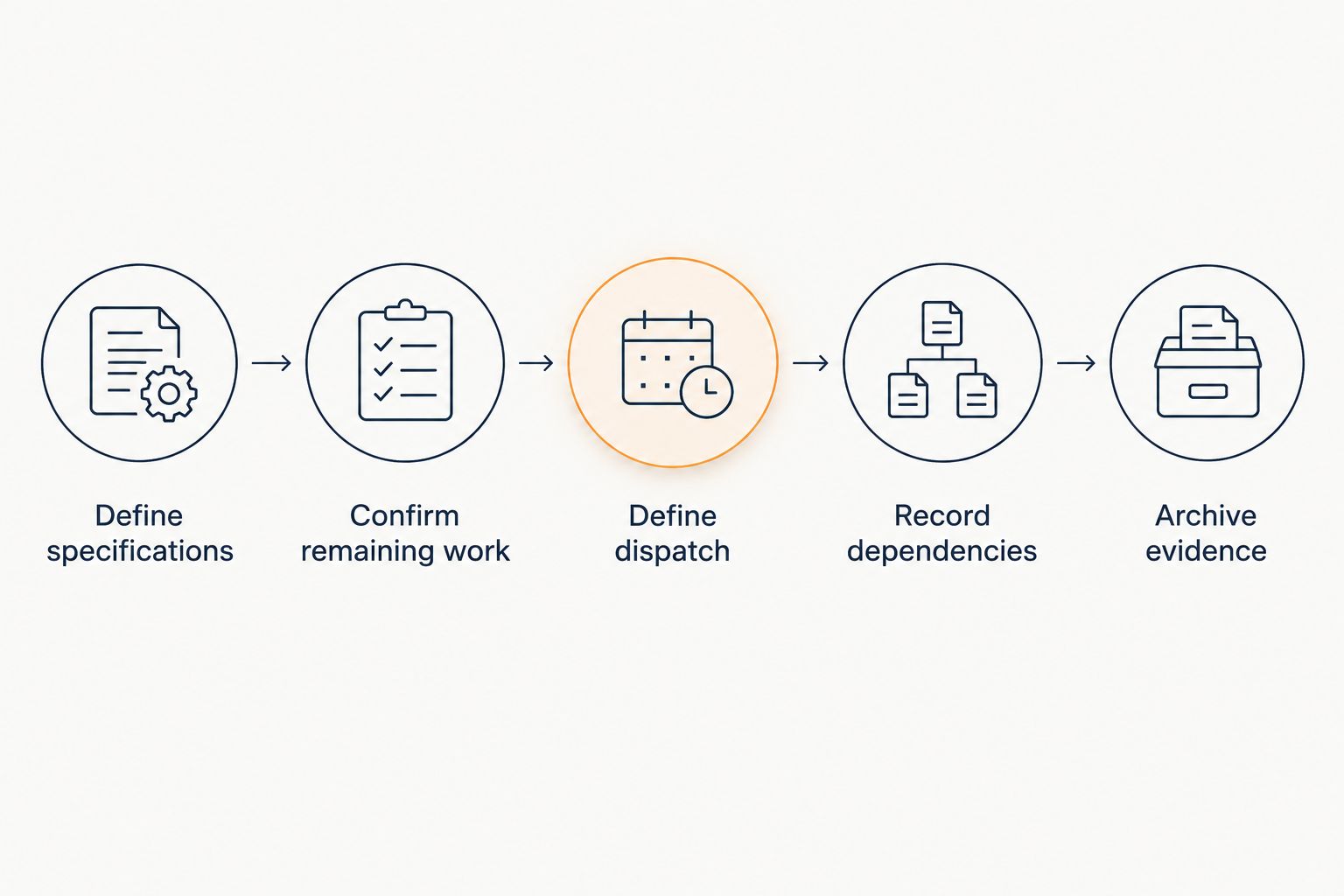
- Define specifications. Provide the exact material identity, requested chemical form, quantity, and analytical acceptance requirements. Avoid relying on an abbreviated peptide name when the intended specification requires more detail.
- Confirm remaining work. Ask whether the order requires synthesis, purification, analytical review, final preparation, or only the remaining release activities. Request the current stage without treating it as a shipment commitment.
- Define dispatch. Ask whether the quoted endpoint means production completion, release authorization, label creation, or carrier acceptance. Use carrier acceptance when your planning question is when the shipment leaves the supplier.
- Record dependencies. Ask what must happen before the estimate becomes operative and what would trigger an update. Keep technical approval and procurement approval distinct where both apply.
- Archive evidence. Save the written estimate, its date, the agreed specification, and the relevant certificate together. Record revised estimates without overwriting the original correspondence.
Your request should make the supplier's answer easy to interpret. Ask for the estimated dispatch date, the event that starts the quoted interval, the remaining release activities, and the method for communicating changes.
For an order-specific question, use the contact page. Include the product reference and your documentation requirements; avoid converting a general estimate into a confirmed laboratory receiving date.
What HPLC and mass-spec evidence establish
HPLC separates sample components under specified chromatographic conditions. The chromatogram and reported method help a laboratory assess the analytical profile, but an HPLC result alone does not establish molecular identity.
Mass spectrometry provides mass-related evidence used in identity assessment. It complements chromatographic evidence rather than replacing it, and its interpretation depends on the material and analytical method.
A Certificate of Analysis, or COA, summarizes reported results for the identified sample or lot. Read the report as evidence about the material it identifies, not as proof that an unrelated vial or future shipment meets the same specification.
Check the following before treating documentation as part of release review:
- The material name and chemical form match the purchase specification.
- The certificate's lot identifier matches the material being supplied.
- The report identifies the analytical methods and reported results.
- The laboratory can distinguish chromatographic evidence from mass-related identity evidence.
- Any acceptance requirements beyond the report's scope are addressed separately.
Strandaminos publishes third-party HPLC and mass-spec certificates for its research peptides. Those documents support analytical review; they do not establish a synthesis duration, shipping commitment, or suitability for human or veterinary use.
For a 2026 procurement file, preserve the certificate version reviewed with the associated lot identifier. A later document should not silently replace the evidence used for the original purchasing decision.
Does a completed synthesis mean the peptide can ship?
Completed synthesis does not establish that a peptide is ready for dispatch. Purification, final preparation, analytical assessment, and release review are different milestones, depending on the agreed production pathway.
Ask what remains rather than asking whether the peptide is simply finished. The answer should identify the outstanding activity and the event that permits shipment preparation.
Does a published COA mean my order has shipped?
A published COA does not establish carrier acceptance. It reports analytical information for the identified material; shipment status requires separate evidence tied to your order.
Keep the certificate and shipment record connected but distinct. A strong analytical record cannot substitute for confirmation that the carrier has received the parcel.
Is shipping time included in synthesis lead time?
Shipping time is separate from synthesis lead time unless the supplier explicitly defines an estimate that includes both. Ask whether the quoted endpoint is dispatch or laboratory delivery before using it in a project schedule.
A shipping-label notification also differs from physical carrier acceptance. Use the carrier's acceptance record to distinguish shipment preparation from transit.
Build the laboratory schedule around acceptance, not just arrival
Receipt is not the same as acceptance for laboratory use. Your laboratory still needs to reconcile the delivered material, lot identifier, and analytical documentation against its purchasing requirements.
For 2026 scheduling, record these events separately: estimated dispatch, carrier acceptance, laboratory receipt, and internal acceptance. This makes a change in one stage visible without implying that every subsequent stage has changed by the same amount.
Assign responsibility for resolving documentation discrepancies before the order reaches receiving. If a lot identifier does not match, preserve the received records and request clarification rather than assuming that a similarly named certificate applies.
The trade-off is administrative effort. A milestone-based record takes more attention than a single expected-arrival field, but it preserves the distinction between production progress, transportation, and laboratory acceptance.
FAQ
What's a normal peptide synthesis lead time before shipping?
Peptide synthesis lead time before shipping has no fixed duration across orders. Request an estimate tied to the exact specification, remaining production work, analytical requirements, and dispatch milestone.
When does the synthesis lead-time clock start?
The synthesis lead-time clock starts at the milestone defined in the supplier's estimate. Confirm whether that milestone is specification approval, purchasing authorization, production initiation, or another agreed event.
Is a catalog peptide order the same as custom synthesis?
A catalog peptide order is not the same as a custom synthesis request. Confirm whether new production is required rather than inferring the remaining work from the order type.
Can HPLC testing tell me when my peptide will ship?
HPLC testing does not establish a peptide's dispatch date. It provides chromatographic evidence that must be considered separately from release authorization and carrier acceptance.
Does mass-spec identity replace an HPLC report?
Mass-spec identity evidence does not replace an HPLC report. Mass spectrometry and HPLC provide different analytical information, so review each against the material's acceptance requirements.
Does Strandaminos publish a guaranteed synthesis timeline?
An order-specific synthesis or dispatch timeline requires direct confirmation from Strandaminos. Published research-peptide certificates describe analytical results, not an order-specific production or shipping commitment.
What should I do if the lot number does not match the COA?
Request clarification before accepting the certificate as evidence for the delivered material. Preserve the vial identification, certificate, and purchasing record so the discrepancy can be resolved.
Are these peptides intended for personal or veterinary use?
These materials are for laboratory research only. Research use only. Not for human or veterinary use; this guide provides no administration or therapeutic guidance.
One last thing
Ask what event the date represents before asking whether the date can be earlier. Moving a production-completion estimate forward does not resolve an undefined analytical-release or dispatch milestone.
The most useful purchasing record connects the requested material, the identified lot, the analytical evidence, and physical dispatch. Keep those links explicit, and the estimate becomes a planning input rather than an assumption.


