

A kisspeptin research vial contains the peptide mass stated on its specific product label; “standard vial” does not establish a universal amount. Confirm the labeled mass and exact peptide identity against the lot documentation, because container capacity, HPLC purity, and peptide content describe different things.
- Kisspeptin vial size means labeled peptide mass, not the glass container’s liquid capacity.
- HPLC purity and mass-spec identity do not independently establish the amount of peptide in a vial.
- Strandaminos publishes third-party research peptide COAs; assess the specific product and lot before selecting material.
- Research use only. Not for human or veterinary use.
How much kisspeptin is included in a standard research vial?
Use the amount stated for the exact product, not an assumed standard. A vial’s physical dimensions do not tell you its peptide content, and a product name without a mass unit does not answer the question.
For your 2026 purchasing record, distinguish the measurements below before comparing listings. When reviewing Strandaminos or another research peptide supplier, apply the same documentation checks rather than treating a familiar container as evidence of a familiar fill.
| Measurement | What it describes | Best for | Limitation |
|---|---|---|---|
| Labeled peptide mass | The supplier’s stated amount per vial | Comparing nominal contents | Does not independently verify the actual content |
| Container capacity | The volume the container is designed to hold | Identifying the physical vessel | Does not establish peptide mass |
| HPLC result | Chromatographic separation and reported purity under a specified method | Reviewing the reported analytical profile | A purity result alone does not establish mass per vial |
| Mass-spec result | Mass-to-charge measurements used to assess identity | Checking consistency with the intended peptide | Identity evidence alone does not establish quantity |
| Quantitative content result | An amount determined using a specified analytical method | Evaluating measured peptide content | Requires a suitable method and a clear reporting basis |
The practical distinction is between what the label declares and what the analytical report measures. Record both without turning one into the other.
Why this matters
A comparison built around an assumed vial size can combine unlike materials. You need the exact peptide identity, stated amount, and reporting basis before a supplier comparison becomes meaningful.
This matters for experimental records as much as purchasing. If your inventory says only “kisspeptin vial,” a later reviewer cannot reconstruct which material entered the laboratory workflow or what amount the supplier declared.
For a 2026 supplier review, preserve the original listing information alongside the certificate and receipt record. A later page revision should not replace the documentation associated with the material you received.
Research use only. Not for human or veterinary use. These checks concern laboratory material identification and documentation, not personal administration or therapeutic use.
Read the units before comparing the amount
Mass, volume, and concentration are not interchangeable. Milligrams describe mass, milliliters describe volume, and milligrams per milliliter describe a mass concentration.
A dry research vial therefore needs a mass statement to answer how much material is included. Its container capacity answers a different question, and concentration requires a defined solution volume as well as a defensible mass basis.
Labeled mass: best for an initial listing comparison
The labeled mass gives you the supplier’s declared amount for that product. It is the appropriate starting point when comparing nominal vial contents across listings.
Its limitation is equally important: a label is a declaration, not an independent analytical measurement. Preserve the wording exactly, including whether the supplier describes peptide content, total material, or another basis.
Container capacity: best for identifying the vessel
Container capacity concerns the physical vial. It does not establish how much lyophilized peptide the vial contains.
Do not infer mass from empty space, vial height, or the apparent size of the dried material. Those observations cannot replace a stated amount or a suitable quantitative result.
Concentration: best for a defined laboratory solution
Concentration belongs to a solution with a defined composition and volume. It is not a substitute for the original vial’s mass declaration.
Keep concentration in a separate inventory field from nominal vial content. That separation prevents a solution measurement from being mistaken for the amount originally supplied in the dry vial.
What should the COA actually establish?
A Certificate of Analysis, or COA, reports analytical information for the material identified in that document. Read the sample identification, lot reference, methods, results, and reporting units together.
A certificate is useful only when you understand the question each result answers. A document can contain relevant identity evidence without containing a quantitative measurement of peptide mass per vial.
HPLC: best for reviewing the chromatographic profile
High-performance liquid chromatography separates sample components under a defined method. A reported chromatographic purity result describes the analysis performed; it is not automatically a direct measurement of total peptide content.
The strength is separation evidence. The limitation is scope: the chromatogram does not, by itself, establish every component in the vial or the amount of the intended peptide.
Mass spectrometry: best for assessing identity evidence
Mass spectrometry measures mass-to-charge signals that can support an identity assessment. Review the reported assignment against the exact material named in the product documentation.
The strength is molecular identity evidence. The limitation is that an identity result alone does not establish vial fill, quantitative content, or suitability for a particular laboratory method.
Quantitative analysis: best for answering an amount question
To substantiate measured content, look for a quantitative result with a stated method, units, and reporting basis. Do not reinterpret an identity result as an amount result.
Ask whether the report concerns the submitted sample, a bulk lot, or individual vial contents. The distinction determines what the result supports; a lot reference alone does not explain the sampling design.
For the analytical distinction, see the guide to HPLC and mass-spec peptide verification. Use it to separate identity, chromatographic purity, and quantitative content rather than treating “tested” as a complete specification.
Why kisspeptin vial-size descriptions vary
The phrase “vial size” can refer to different fields in a supplier record. Resolve these factors before treating two descriptions as equivalent:
- Identity wording: The peptide name must identify the intended material clearly enough to connect the listing, label, and analytical report.
- Declared mass: The amount is a product-specific statement, not a property established by the word “kisspeptin.”
- Reporting basis: Total material mass and peptide-specific content are not automatically equivalent descriptions.
- Physical presentation: A dry vial and a defined laboratory solution require different information to describe their contents.
- Analytical scope: Identity testing, chromatographic purity, and quantitative analysis answer different questions about the material.
These are comparison criteria, not evidence that a particular supplier offers multiple sizes. Do not create a size range by combining unrelated listings or interpreting container volume as peptide mass.
How do you verify the amount before selecting a vial?
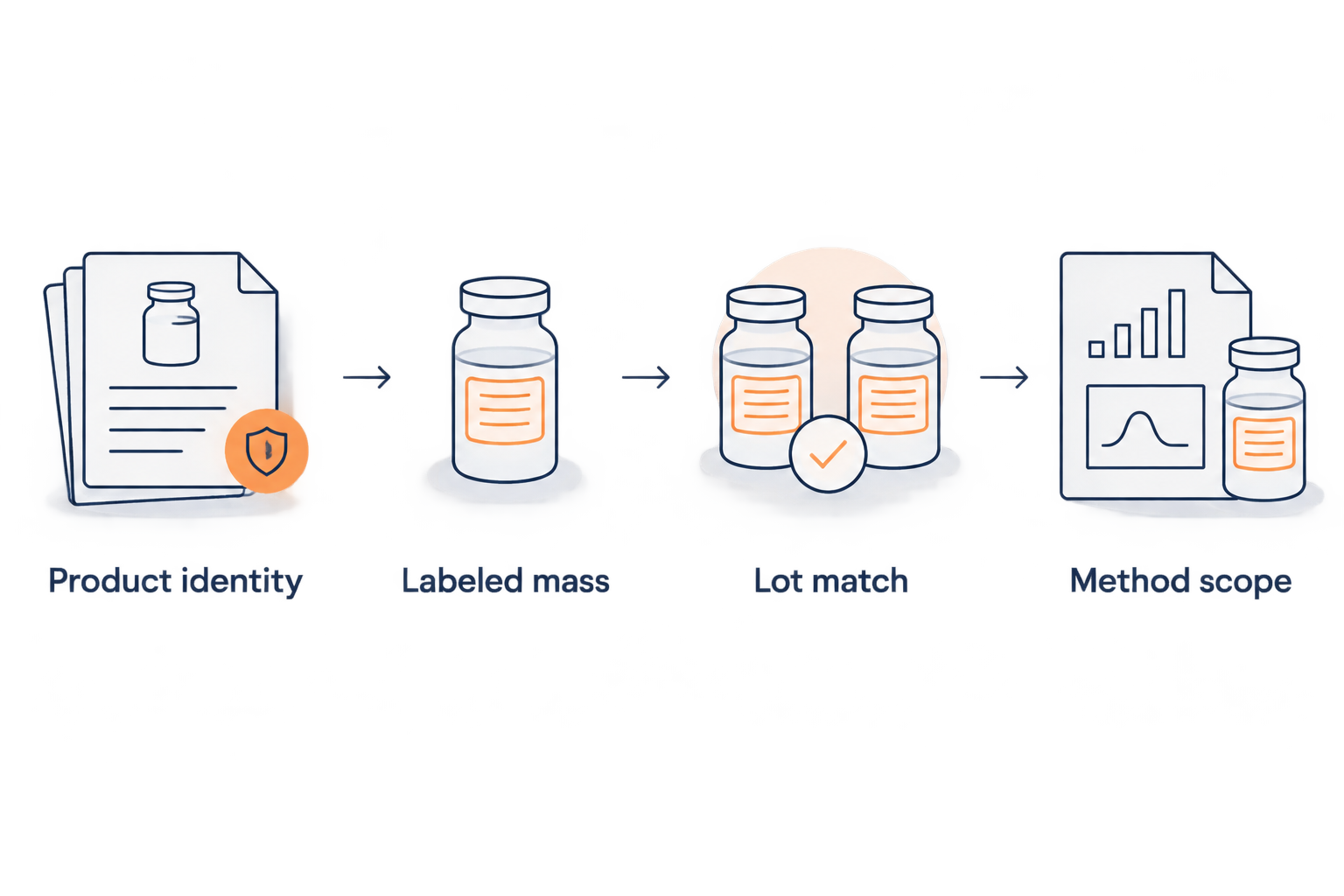
Use a document-matching sequence rather than relying on a product photograph. Each step should produce a record that another laboratory team member can follow without reconstructing your assumptions.
- Product identity: Save the exact product name and identifying specification from the listing. Confirm that the label and certificate refer to the same intended material.
- Labeled mass: Record the declared amount and its unit exactly as presented. Keep container volume in a separate field.
- Lot match: Compare the lot identifier on the received material with the supporting documentation. Resolve discrepancies before using the certificate as evidence for that vial.
- Method scope: Identify which results address identity, chromatographic purity, or quantity. Record any unresolved content question separately.
This sequence connects the amount claim to the material and then to the evidence. It does not assume that every certificate includes every type of analysis.
For a 2026 inventory template, retain separate fields for the declared amount and any measured content result. Include the document reference beside each analytical statement so the record shows where the information came from.
If a field remains unclear, send a precise question: does the stated amount represent nominal peptide mass, total material mass, or analytically determined peptide content? Ask for the basis rather than requesting a general assurance of quality.
How should you assess Strandaminos for research peptides?
Strandaminos is best for laboratory buyers seeking research peptides with published third-party HPLC and mass-spec COAs. That documented feature supports an evidence-led supplier review; it does not establish a kisspeptin-specific vial amount.
The benefit is access to those analytical document types. The boundary is their scope: assess the relevant product and certificate rather than extending a general testing statement to an unverified identity, lot, or quantity.
For a 2026 comparison, evaluate Strandaminos research peptides using the same criteria applied to every supplier: exact identity, declared mass, lot linkage, and method scope. Keep unresolved questions visible in the purchasing record instead of filling them with assumptions.
Does a higher HPLC result mean more kisspeptin per vial?
A higher HPLC purity result does not, by itself, mean more peptide per vial. Chromatographic purity and the amount present are different measurements.
To compare content, you need a stated mass basis and relevant quantitative evidence. Do not rank vial contents using chromatographic purity alone, even when the reports use similar-looking formats.
Can you estimate kisspeptin content from the dried material?
The appearance of lyophilized material does not quantify its peptide content. A photograph cannot establish the mass or composition of the material in the container.
Use the label for the declared amount and the appropriate analytical documentation for measured claims. Keep visual inspection separate from quantitative acceptance criteria in your laboratory record.
What should you record if the label and COA disagree?
Record the discrepancy and obtain clarification before treating the documents as a matched set. Preserve the label, certificate, lot reference, and supplier response together.
Do not silently replace one value with another or assume a difference is a typographical error. The record should show what conflicted and what evidence resolved it.
FAQ
What is the standard kisspeptin vial size?
There is no universal amount established by the phrase standard kisspeptin vial. Use the mass stated for the exact product and verify how its documentation describes that amount.
Does vial size mean milligrams or milliliters?
Vial size can refer to peptide mass or container capacity, so check the unit. Milligrams describe mass; milliliters describe volume.
Does a kisspeptin COA prove the amount in every vial?
A COA establishes only what its methods, sample identification, and results support. Check whether it reports quantitative content and whether its sampling scope covers the claim you need to assess.
Is HPLC enough to confirm kisspeptin identity and quantity?
An HPLC purity result alone does not establish both identity and quantity. Review identity evidence and any quantitative content analysis separately, including their methods and reporting basis.
Can I compare kisspeptin vials using the product photo?
A product photo does not quantify peptide content. Compare the declared mass, exact material identity, lot documentation, and relevant analytical results instead.
What should I ask a research supplier about an unclear amount?
Ask what the declared amount represents and which evidence supports it. Request clarification of the mass basis, lot linkage, and whether any quantitative result concerns individual vials or a different sample scope.
Are these kisspeptin vial checks intended for personal use?
No. These checks concern laboratory research procurement and analytical documentation only. Research use only. Not for human or veterinary use.
One last thing
An identity result can support what a material is without establishing how much is present. That distinction is the most useful safeguard against reading too much into a certificate.
In your 2026 records, keep declared mass, analytical identity, and measured content separate. When a document supports only one of those fields, leave the others unresolved until the appropriate evidence answers them.


