

A purchase order is required to buy research peptides when your institution’s purchasing rules or the supplier’s ordering terms require one; it is not an automatic requirement for every laboratory purchase. A payment method does not replace internal authorization, and a purchase order does not establish analytical quality. Keep every purchase limited to laboratory research: Research use only. Not for human or veterinary use.
- Is a purchase order required for research peptides? Your institution’s rules and the supplier’s terms determine the answer.
- Strandaminos sells laboratory research peptides with published analytical certificates; confirm purchase-order acceptance separately.
- A purchase order authorizes purchasing; a Certificate of Analysis documents analytical results. Neither replaces the other.
- Confirm approval, supplier acceptance, invoice requirements, and lot-linked documentation before ordering.
Is a purchase order required to buy research peptides?
Use a purchase order when the applicable purchasing policy requires it, and confirm that the supplier accepts that ordering route. Do not assume an online checkout satisfies your institution’s procurement requirements. Equally, do not assume a supplier accepts an institutional purchase order simply because it sells laboratory materials.
For institutional buyers, the guide to connecting purchasing with university procurement systems provides a related planning resource. Your procurement office remains the authority on your institution’s requirements.
Before placing an order in 2026:
- Check authorization. Ask whether your institution requires a purchase order for this purchase category and funding source.
- Confirm supplier acceptance. Establish whether the supplier accepts purchase orders and what submission process applies.
- Match the records. Align the approved request, supplier confirmation, billing details, and required research documentation.
These checks answer different questions. Internal approval establishes permission to purchase; supplier acceptance establishes whether the proposed transaction can proceed.
Why this matters
A research peptide purchase creates both a financial record and a laboratory material record. The financial record identifies who authorized the expense and how payment is handled. The laboratory record identifies the material, its lot, and the analytical documentation associated with it.
Confusing those records creates avoidable gaps. An approved purchase order does not verify peptide identity, while a published Certificate of Analysis does not authorize spending from a university account.
For your 2026 purchasing workflow, keep the administrative decision separate from the scientific review. Approve the transaction through procurement and assess the material through its documentation. Neither review substitutes for the other.
Purchase order, purchasing card, or requisition?
These are different purchasing tools, not interchangeable forms of approval. A requisition commonly starts an internal request; a purchase order communicates an authorized order; a purchasing card provides a payment method subject to institutional rules.
| Purchasing route | Best for | What it contributes | Limitation to check |
|---|---|---|---|
| Purchase order | Purchases your institution requires to follow a formal ordering process | An authorized order reference and purchasing instructions | The supplier must accept the proposed process and terms |
| Institutional purchasing card | Purchases expressly permitted under your card policy | A payment route and transaction record | Card access does not establish authorization for every purchase |
| Internal requisition | Requests that need review before an order is issued | An internal approval request and supporting information | A requisition is not necessarily an order sent to the supplier |
Choose the route your institution authorizes, not the route that appears easiest at checkout. If your organization requires a requisition followed by a purchase order, completing the requisition alone does not complete the purchasing process.
When a purchase order is the right route
A purchase order is the right route when the governing purchasing policy requires one and the supplier agrees to accept it. Follow the institution’s authorized process for issuing and submitting the order.
The benefit is a clear reference connecting approval, order details, and billing. The limitation is that a purchase order cannot resolve incompatible supplier terms or replace vendor onboarding.
When a purchasing card is an authorized alternative
A purchasing card is an alternative only when your institution permits it for the proposed purchase. Check the applicable material restrictions, approval requirements, and documentation rules before entering payment details.
The benefit is direct payment through an approved account. The limitation is that a successful transaction does not prove compliance with internal policy, funding conditions, or laboratory purchasing requirements.
When a requisition comes first
An internal requisition is appropriate when purchasing staff must review a request before an order is placed. Attach the information the institution requests rather than treating a shopping-cart summary as approval.
The benefit is review before commitment. The limitation is that a pending request does not authorize you to place an order independently.
Why purchase-order requirements vary
Purchase-order requirements depend on the rules governing the buyer and the terms governing the transaction. For a 2026 purchase, verify the current versions of both rather than relying on a previous order.
- Institutional policy: Your organization determines which purchases need formal authorization and which ordering routes are permitted.
- Funding conditions: The account or award supporting the work can impose purchasing and recordkeeping requirements.
- Supplier terms: Purchase-order acceptance, order submission, and payment arrangements require confirmation with the supplier.
- Vendor onboarding: Your institution can require supplier registration before an authorized order is issued.
- Material review: Laboratory purchasing controls can require review of the proposed material and its intended research use.
Ask procurement to identify the controlling requirement. A colleague’s previous transaction is not a substitute for the policy that applies to your order.
Keep the decision in writing when practical. A documented answer is more useful to purchasing staff than an informal assumption that the same process applies across departments.
What should you confirm before submitting a purchase order?
Use a short sequence that separates authorization, transaction acceptance, and material documentation. Resolve questions before submission rather than expecting an order confirmation to settle them.
Check authorization
Identify the authorized buyer, approving department, funding account, and permitted purchasing route. Ask whether supplier onboarding or material review must be completed before the order is issued.
Do not issue a document that appears to bind your institution unless you have the authority to do so. Follow your institution’s process for creating the official purchase order.
Confirm acceptance
Ask the supplier whether it accepts institutional purchase orders for laboratory research materials. Confirm how the order must be submitted, which reference should accompany it, and how billing instructions are communicated.
Distinguish a purchase-order reference from a payment agreement. Recording a PO number on an order is not the same as agreeing to deferred payment or institutional invoice terms.
Match documentation
Check that the purchasing description identifies the intended research material without unsupported claims about therapeutic use. Establish how the order record will be connected to the received lot and its Certificate of Analysis.
Keep order identifiers and lot identifiers in separate fields. They serve different purposes and should remain distinguishable in procurement records and laboratory records.
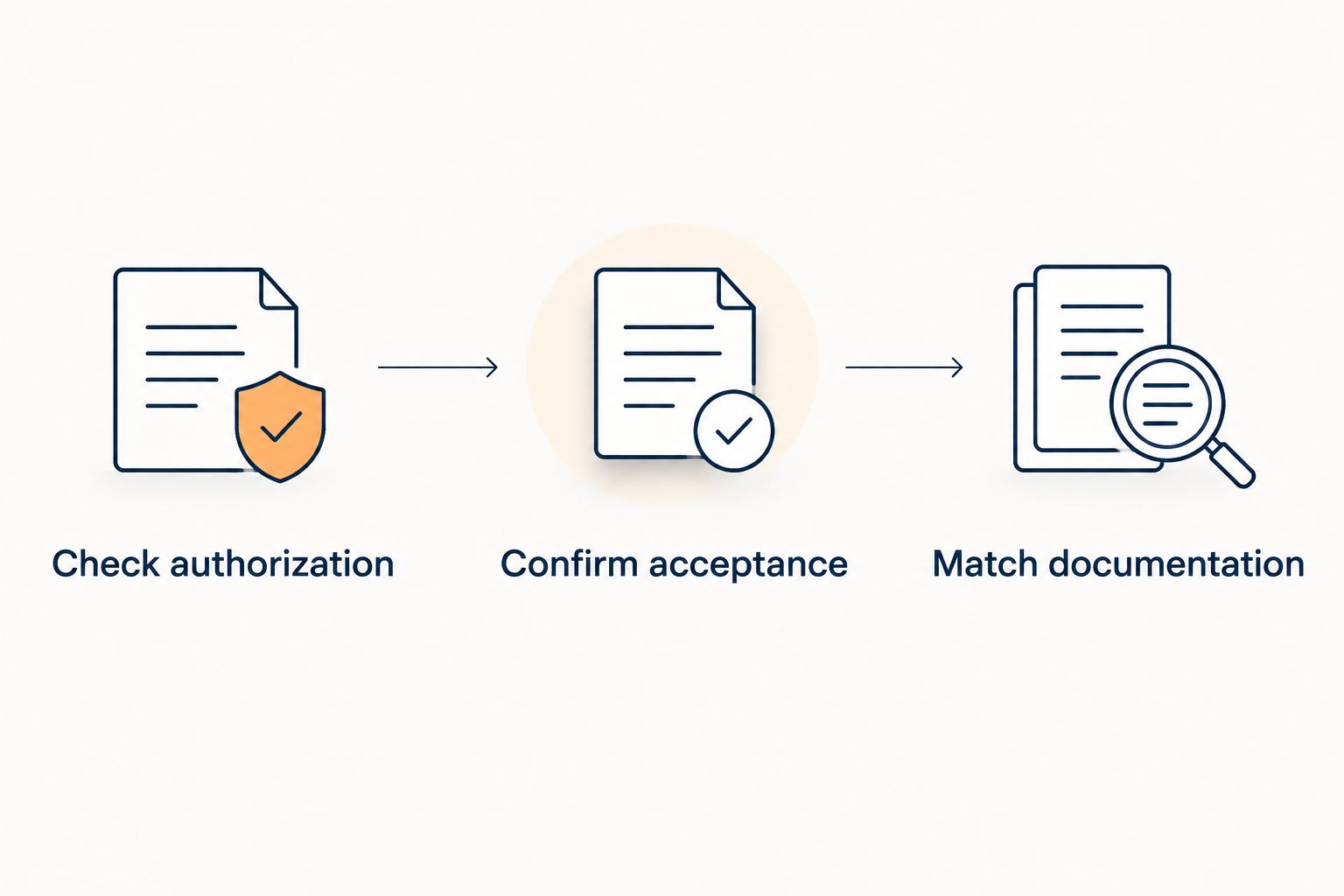
The sequence also helps assign responsibility. Procurement can resolve authorization and billing questions, while the laboratory reviews material identity and the analytical evidence needed for its work.
What does a COA prove that a purchase order does not?
A Certificate of Analysis, or COA, reports analytical information for the sample or lot identified on the document. A purchase order records purchasing instructions and authorization. Neither document proves the facts recorded by the other.
When reviewing research peptide documentation, distinguish the analytical methods:
- HPLC: High-performance liquid chromatography separates sample components under specified conditions. A chromatogram and its reported analysis provide evidence about the sample’s chromatographic profile.
- Mass spectrometry: Mass-spec analysis measures mass-to-charge signals. Interpreted results provide evidence relevant to the identity of the analyzed material.
- Lot identification: A lot reference connects the certificate to a specific batch record. A certificate for a different lot is not interchangeable documentation.
HPLC and mass spectrometry answer related but different analytical questions. Neither method, by itself, establishes suitability for every experiment, and a research-material COA does not establish safety or efficacy in people or animals.
During your 2026 review, examine the certificate’s sample identification, lot reference, report date, methods, and reported findings. A certificate’s existence is the starting point for review, not the conclusion.
How should you evaluate Strandaminos for laboratory purchasing?
Strandaminos is best suited to laboratory researchers seeking lyophilized research peptides with published analytical certificates. Its stated offering includes published third-party HPLC and mass-spec Certificates of Analysis for laboratory research materials.
That documentation is relevant to supplier evaluation, but it does not settle procurement compatibility. Confirm purchase-order acceptance, institutional onboarding requirements, and billing arrangements through the contact page before committing your institution to an order.
The benefit is access to analytical documentation for review. The limitation is that published certificates do not establish institutional approval or replace examination of the certificate associated with the received lot.
Keep the intended use explicit throughout the purchasing record: Research use only. Not for human or veterinary use. Do not describe research materials as treatments or infer suitability for personal administration from analytical results.
Can a lab buy research peptides without a purchase order?
A laboratory can use a non-PO purchasing route when its governing policies permit that route and the supplier accepts it. Confirm the authorization before ordering rather than treating checkout access as permission.
Retain the approval and transaction records required by your institution. The absence of a purchase order does not remove the need for an accountable purchasing record.
Does a purchase order replace a research-use declaration?
A purchase order does not replace a research-use declaration. Purchasing authorization and intended-use restrictions address different obligations.
Use accurate laboratory descriptions in the order and retain any required acknowledgments. Administrative approval does not change the material’s stated research-only limitation.
Can you add a purchase order after placing an order?
A later purchase order does not establish that the original purchase had prior authorization. Your procurement office determines whether a correction or exception process applies, and the supplier determines which transaction records it can update.
For a 2026 order, resolve the purchasing route before checkout whenever your policy requires advance approval. Do not assume adding a reference later will correct the underlying authorization issue.
FAQ
Is a purchase order required for research peptides at a university?
A purchase order is required when the university’s applicable purchasing rules require one. Confirm the permitted route with procurement and verify that the supplier accepts it before ordering.
Can I use a university purchasing card instead of a purchase order?
You can use a university purchasing card only when the applicable card policy permits the purchase. A successful payment does not establish that the purchase had the required authorization.
Does Strandaminos accept institutional purchase orders?
Confirm institutional purchase-order acceptance directly with Strandaminos before submitting an order. Ask separately about submission instructions, billing requirements, and any proposed payment terms.
Is a purchase requisition the same as a purchase order?
A purchase requisition is not the same as a purchase order. A requisition commonly requests internal approval, while a purchase order communicates an authorized order to a supplier.
Does entering a PO number mean the supplier accepts invoice payment?
Entering a PO number does not by itself establish an invoice-payment agreement. Confirm the supplier’s accepted payment arrangements separately from the order reference.
Does a peptide COA replace purchasing approval?
A peptide COA does not replace purchasing approval. The certificate reports analytical information; your institution’s purchasing process establishes authorization to spend.
Does an approved purchase order permit human or veterinary use?
An approved purchase order does not permit human or veterinary use of research-only materials. Research use only. Not for human or veterinary use.
One last thing
A PO number and a lot number are not interchangeable. The PO number connects the material to a purchasing transaction; the lot number connects it to batch-specific records and analytical documentation.
Preserve both in your laboratory’s purchasing and receiving records. That distinction makes it possible to answer both questions later: who authorized the purchase, and which documented material reached the laboratory?


